The USDA puts skinless chicken breast at 2.6 g of fat per 100 g, which makes it both the most expensive cut in the shop and the worst one to put inside a tamale. Two hours of steam turn that into dry threads. A skin-on thigh carries 16.6 g, and that fat renders straight into the masa wrapped around it. Twelve tamales, 390 calories each, three and a half hours start to finish.
How do you make Colombian chicken tamales? Marinate 2.6 lb of bone-in thighs for an hour and simmer them 35 minutes. Cook a sofrito for 27 minutes and mix 4 cups of masarepa with the broth and three quarters of that sofrito. Wrap with chicken, potato, carrot and peas in banana leaf and steam for two hours. Twelve tamales, 210 minutes.
What a Colombian tamale is
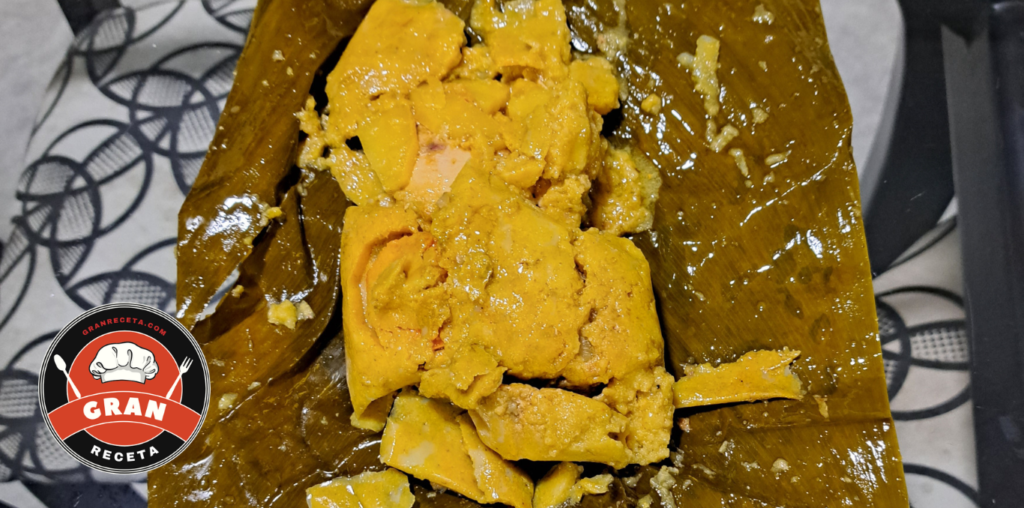
A Colombian tamale is corn masa and a savoury filling wrapped in banana leaf and steamed for about two hours. It is a relative of the Mexican tamale, but larger, wrapped in leaf rather than husk, and eaten as a whole meal rather than one of several. Breakfast, usually, with hot chocolate.
Two shopping notes for a kitchen outside Latin America. Masarepa is precooked corn flour, the same one used for arepas, sold at Latin groceries and most large supermarkets — it needs no soaking or nixtamalising. Banana leaves come frozen at Latin and Asian groceries, and thaw in 20 minutes. Foil will hold a tamale together, but it adds none of the aroma the leaf gives.
Within the family, the rice-and-pork tamal tolimense is the famous one, the tamal valluno is the enormous one, and the pork tamale is the everyday one. The chicken version is the lightest of them and also the one that most depends on technique.
The fat is the whole argument
A tamale steams for two hours, and over that time whatever fat the meat holds renders out and goes into the masa touching it. That is the mechanism. It is why the cut matters more here than in almost any other chicken recipe.
Skin-on thigh sits at 16.6 g of fat per 100 g, more even than pork shoulder at 12.4 g. Skinless breast sits at 2.6 g, and it has nothing to give. Steam it for two hours and it does not become tender, it becomes stringy.
There is no way to shorten the cooking to protect the breast, either, because the masa needs the full two hours regardless of what is inside it.
What to buy
Bone-in, skin-on thighs are the cut to ask for, and drumsticks mixed in are fine. The bone matters as much as the skin: the chicken is simmered first, and that broth becomes the liquid of the masa, so a boneless cut gives you a thinner-tasting dough.
If you can only get boneless thighs, buy them skin-on and throw a couple of wings into the simmering pot for the bone. And if you are buying a whole chicken, the back and wings go into the broth while the thighs go into the tamales.
Three quarters of the sofrito belongs in the masa
Pork broth arrives with fat and gelatin and seasons the masa on its own. Chicken broth does not, and that single fact explains most bland chicken tamales. In this recipe three quarters of the sofrito is worked into the 4 cups of masarepa and only a quarter goes into the filling.
The sofrito also needs its time: eight minutes of onion and garlic, four of bell pepper, then a quarter of an hour of tomato over medium-low. That last stretch is not optional, because it is when the tomato loses its acidity and the mixture goes from bright red to dark and thick. A five-minute sofrito leaves the masa tasting of raw tomato.
Mix with the broth warm, not hot. Masarepa absorbs liquid instantly, and boiling broth gives a pasty, heavy dough.
How long it needs in the steamer
The starch in the masa gelatinises around 185°F, but it needs the full two hours to hydrate all the way through the packet. After an hour the centre is still raw; at the 90-minute mark it has set but collapses when you open the leaf; only at two hours does it stand on the plate.
Past 150 minutes it starts to dry and the leaf turns faintly bitter, so set a timer rather than leaving it while there is still water in the pot. And keep the lid on for the first hour: each peek costs you accumulated steam and buys nothing.
Where the time goes
Sixty minutes of marinating, 35 of simmering, 27 of sofrito, 25 of wrapping and 120 of steam, with the marinade and sofrito overlapping.
Make it ahead
This is the reason Colombian households make twelve at a time. Cooked tamales freeze in their leaves for up to 3 months and reheat by steaming for 25 minutes straight from frozen — no thawing, no loss of texture. They also keep 4 days in the fridge and reheat in 15 minutes. Assembled but uncooked tamales freeze too, and go into the steamer for 2 hours 20 minutes.
Who this recipe is for
- You want a make-ahead breakfast — a dozen in the freezer, 25 minutes to the table
- You have had the pork one and want lighter — 390 calories against about 445
- You can get banana leaves — frozen ones work perfectly
- You are cooking for a crowd — the batch scales cleanly in twelves
- You keep buying chicken breast out of habit — this is the recipe that will change that
What goes wrong
Using breast. At 2.6 g of fat per 100 g it comes out of the 2-hour steam dry and stringy.
A short sofrito. Without the 15 minutes of tomato, the masa tastes of raw tomato.
All the sofrito in the filling. The masa ends up bland: three quarters belongs in the dough.
Mixing with boiling broth. Masarepa seizes and the dough turns heavy.
Lifting the lid in the first hour. You lose the steam and the masa takes longer to set.
Variations
With chickpeas. Half a cup soaked overnight, common around Bogotá.
With egg. Half a slice of hard-boiled egg per tamale, Tolima style.
With bacon. Two ounces across the batch, which adds the fat chicken does not have.
Without potato. Carrot and peas only, for a lighter tamale and about 30 calories less.
What to serve with them
One tamale per person with Colombian hot chocolate and bread is the Sunday breakfast, or aguapanela if the morning is warm. It is served in the opened leaf, with no plate underneath.
If you want the other Colombian chicken-and-corn dish, Colombian chicken rice is done in 50 minutes, and for the December version of this same wrapped-and-steamed idea there are Venezuelan hallacas.
Frequently asked questions
Can I use chicken breast? It comes out dry. If it is all you have, simmer it 20 minutes instead of 35 and add 2 oz of bacon to the masa.
Why was my masa bland? The sofrito went only into the filling. Three quarters of it belongs worked into the dough.
Can I freeze them? Yes, cooked and in their leaves, up to 3 months. Steam 25 minutes from frozen.
How much masa per tamale? About 5 oz spread out, plus a thin layer on top to close it.
Why did mine fall apart when I opened it? It needed more steam. The masa sets at an hour and a half but will not hold its shape; give it the full two hours.
Nutrition
Per tamale, calculated from each ingredient according to the USDA SR Legacy database:
- Calories: 390 kcal
- Protein: 17 g
- Carbohydrates: 42 g
- Fat: 17 g, 4 g of it saturated
- Fibre: 5 g
- Sodium: 475 mg
Half of that fat comes from the chicken skin and half from the oil in the sofrito and the masa. Pull the skin off after simmering rather than before and each one drops to roughly 340 calories, with a third less fat, and loses nothing in flavour, because by then the fat is already in the broth.
In Venezuela what we made in December were hallacas, with annatto-stained masa and a filling of three meats, and when I moved to Colombia the tamales looked like distant cousins. Then I understood that the relation is the leaf and the steam, and that each country solved the filling with whatever was nearby. Josnaisis.