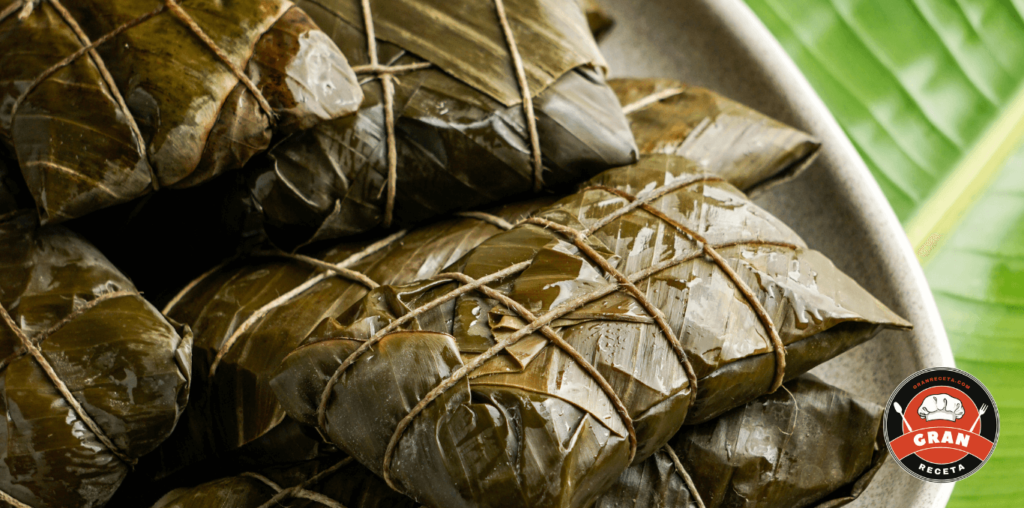
If your only reference is a Mexican tamal, the first Colombian one is a surprise: it weighs three quarters of a pound, it is wrapped in a banana leaf instead of a corn husk, it boils rather than steams, and one of them is breakfast. The tamal valluno, from the Valle del Cauca around Cali, adds a step the rest of Colombia skips. Its masa is cooked into a thick porridge before it ever meets the leaf, which is why it slices cleanly instead of spilling. 270 minutes for 15 tamales.
How do you make Colombian valluno tamales? Soak cracked corn 24 hours and marinate the meats 12. Next day, grind the corn and cook it into a porridge with the broth for 40 minutes, fold in a gigote of onion and annatto, fill each banana leaf with masa, chicken, pork, potato, carrot and peas, tie it and boil 120 minutes. 270 minutes for 15 tamales.
Colombian tamales and Mexican tamales
The word is the same and the object is not. A Colombian tamal is a full plate folded into a leaf, around 12 oz of masa, meat, potato and vegetables, and it is served one per person with a mug of hot chocolate. A Mexican tamal is about 4 oz, holds a single filling and turns up two or three at a time.
The cooking differs too. Corn husks are porous, so Mexican tamales steam above the water; banana leaves seal, so Colombian tamales boil submerged for 2 hours and come out moister. Neither is a version of the other, and a recipe written for one will not give you the other.
The masa cooked first, and what it fixes
Cracked white corn is soaked for 24 hours, ground, and then simmered in the meat broth until it thickens. The mark is easy to read: the masa holds a spoon upright and pulls away from the bottom of the pot as you stir, about 40 minutes in.
That pre-cooking changes two things. The masa goes into the leaf already made, so the 2 hours in the pot are about setting and flavor rather than cooking raw corn, and the final texture is smoother and denser than a raw-masa tamal. It is also the single best insurance against the underdone center that ruins so many homemade tamales.
The gigote, where the color and flavor come from
Gigote is the cooked base that goes into the masa: onion, scallion and garlic softened over low heat for 30 minutes, with 2 tablespoons of annatto and a splash of broth at the end. It is not a quick sauté, because the onion has to disappear completely or the masa turns stringy.
It gets folded in while the masa is still hot, off the heat. A well-gigoted masa tastes good on its own, without leaning on the meat, and that is the real test of a valluno tamal: take the filling out and the masa should still be worth eating.
What to buy outside Colombia
Banana leaves are the one thing worth a special trip. They come frozen in 1 lb folded packs in Latin and Asian markets, thaw in 20 minutes and cost little; foil will hold a tamal together but contributes none of the aroma that makes it taste like a tamal.
Cracked corn, sold as maíz trillado, is the other. If your market has none, yellow masarepa makes a workable masa with the same porridge method, using 3 cups of broth per cup of masarepa, though the texture comes out slightly finer. Everything else on the list, from annatto to pork leg, has a supermarket stand-in.
How long they boil
Two hours at a gentle boil, with the water covering them the whole time. At 60 minutes the center is still raw even with pre-cooked masa, at 90 it sets but collapses, and at 120 it holds together when you cut into it.
Top up with boiling water, never cold. And lay the leftover leaf trimmings on the bottom of the pot so the tamales never sit against hot metal, which is where scorched patches come from.
Who this recipe is for
- If you have never wrapped a tamal → build the first one open on the counter, tie it, and only then start the production line
- If you cannot find cracked corn → use yellow masarepa and the same porridge method, 3 cups of broth per cup
- If you are cooking for 30 → double everything but use two pots, because one overloaded pot takes too long to return to a boil
- If you own a pressure cooker → 45 minutes at pressure replaces the 2 hours, with a slightly wetter masa
- If you want to freeze them → they keep 3 months in the leaf and go from frozen into boiling water for 30 minutes
Make ahead, storage and reheating
Tamales are built for making ahead, which is why nobody makes a small batch. Assembled and uncooked, they hold 24 hours in the fridge. Cooked, they keep 4 days refrigerated, within the 3 to 4 day window the USDA gives cooked dishes, and 3 months frozen in their leaves.
Reheating from frozen is 30 minutes in boiling water, still tied, with no thawing. A microwave works in a pinch, 4 minutes on a plate with the leaf opened, though the masa dries at the edges. What does not work is the oven, which dries the leaf before the center warms through.
The 270 minutes of day two
Four and a half hours, of which 90 minutes is pure assembly: leaf, masa, meat, vegetables, fold, tie, repeat. Day one, which is not on that clock, is 24 hours of soaking and 12 of marinating.
This is the practical reason tamales are a group project in Colombia. Assembling 15 takes barely longer than assembling 5, the pot is the same, and the freezer takes whatever the table does not.
What goes wrong
Masa that never thickened. If it does not pull from the bottom of the pot, the tamal collapses when opened. The fix is 10 more minutes of stirring, not more boiling.
Leaves that were not passed over the flame. They crack as you fold, the tamal opens in the pot, and water gets into the masa.
Water that stops covering them. Tamales that stick out cook unevenly. Keep them submerged for the full 120 minutes.
Meat cut too small. Small cubes shred over 2 hours of boiling and disappear into the masa instead of staying as a piece you can recognize.
Variations
With hard-boiled egg. A quarter of an egg per tamal, more a home habit than a rule. It adds about 25 calories each.
No tomato in the gigote. The traditional Valle approach, because tomato turns the masa acidic if the tamales are kept several days.
Three meats. Small pieces of pork belly go in alongside, adding the fat that lean pork leg lacks.
Half-size tamales. Half the masa and filling per leaf gives 30 tamales of about 6 oz that boil in 90 minutes, easier on a long table.
What to serve with them
In Cali a tamal is Sunday breakfast, and it comes with thick Colombian hot chocolate, sometimes with a slice of cheese dropped into the mug. Half a tamal a person is plenty if there is bread and Colombian cheese arepas on the table too.
To see how the rest of the country does it, the Colombian pork tamales manage without any added lard, the Colombian tamales of Tolima use raw masa and yellow split peas and come out round, while the Colombian chicken tamales are the lighter version at around 380 calories. And for the other Valle del Cauca dish that gets cooked for a crowd, there is Colombian sancocho, the Sunday soup of hen, plantain and yuca.
Frequently asked questions
How are Colombian tamales different from Mexican ones? Banana leaf instead of corn husk, about three times the size, boiled instead of steamed, and served one per person as a meal rather than two or three as a side.
How long does the corn soak? Twenty-four hours, changing the water once. Past 48 hours it begins to ferment and the masa turns sour.
Can I use masa harina? Masa harina is nixtamalized and behaves differently. Yellow masarepa is the closer stand-in here, cooked as a porridge in the same way.
Why is my tamal raw in the middle? Usually an overcrowded pot or water that stopped covering them. Cooking the masa first lowers the risk but does not remove it.
Can they be made vegetarian? Yes, with the same gigote and masa, filling with potato, carrot, peas and a piece of firm cheese. The broth becomes vegetable broth, and the boil is the same 120 minutes.
Nutrition
Per tamal of about 12 oz (350 g), one fifteenth of the batch, calculated with the USDA database for the corn, chicken, pork and vegetables:
- Calories: 500 kcal
- Protein: 28 g
- Carbohydrates: 60 g
- Fat: 17 g, of which 5 g saturated
- Fiber: 7 g
- Sodium: 640 mg
Corn supplies most of the carbohydrate and much of the fiber: according to the USDA database, white corn grain carries 74.26 g of carbohydrate and 9.42 g of protein per 100 g, and each tamal takes roughly 2.4 oz of dry corn. The fat comes mostly from the pork ribs, the fattiest thing in the bundle, so using leg alone drops it by a few grams.
The first time I watched valluno tamales being made, what surprised me was that the masa went into the pot before it went into the leaf. In Venezuela the hallaca masa goes in raw and the water does the cooking, so this felt backwards until I opened one and tasted the difference: smoother, denser, no raw edge anywhere. Now I take my time over that porridge, because it is the step everything else rests on. Josnaisis.