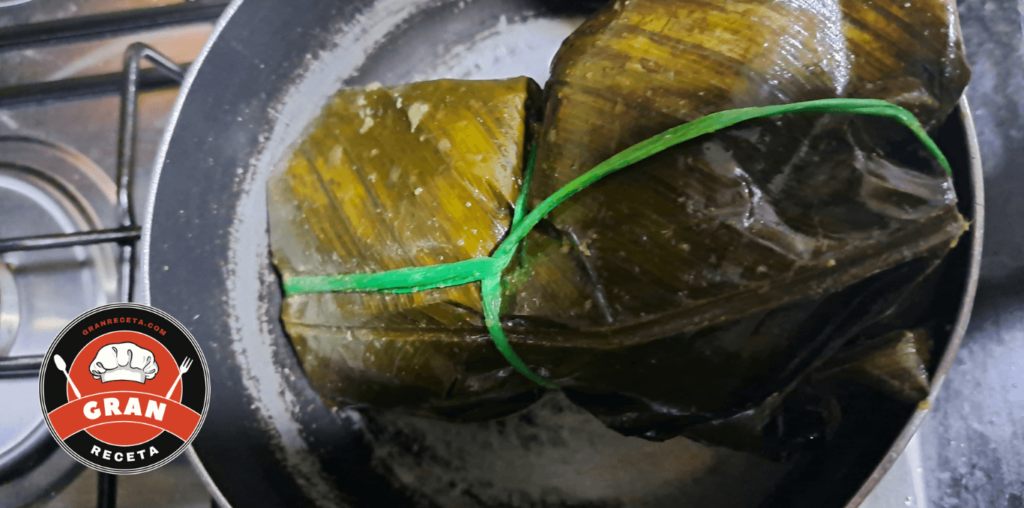
In Colombia the masa is checked with a glass of water: a small ball of it has to float. That is what separates a light pork tamale from a dense one, and what makes it possible is the fat in the broth — the leg and the ribs release enough over 45 minutes of simmering that the masa needs no lard at all. Twelve tamales at 455 calories.
How do you make Colombian pork tamales? Marinate 1.5 lb of pork leg and 1.1 lb of spare ribs for 2 hours and simmer them 45 minutes. Knead 4 cups of masarepa with 2¾ cups of that broth and two thirds of the sofrito until a ball floats in water. Wrap with potato, carrot and peas in banana leaf and steam for two hours. 12 tamales, 240 minutes.
The two cuts, and why both
Per 100 g, boneless pork leg carries 12.6 g of fat according to the USDA, and it gives the meat you cut into chunks. Spare ribs, at 23.4 g per 100 g, bring the bone that gives the broth body as well as the fat. Neither one does the whole job alone.
The textbook mistake is using tenderloin, which at 3.9 g of fat dries out beyond rescue over two hours of steaming. It is the same logic as with chicken: in a tamale, lean meat has nothing to give.
Shopping note: ask for fresh ham, pork leg or shoulder — not cured ham. Spare ribs or country-style ribs both work for the second cut, and 3.5 oz of pork belly chopped into the sofrito is what cooks add when the pork comes in lean.
The broth, fat and all
Forty-five minutes of simmering 2.6 lb of pork leaves a broth with fat floating on the surface. You do not skim it: you stir it back in, because that fat is precisely what will make the masa tender.
This is why this tamale is the only one here without added lard. The tolimense and valluno versions both use it, and the chicken tamales need oil because chicken broth is far leaner.
Use the broth warm, never boiling. Masarepa absorbs liquid instantly, and boiling broth gives a pasty dough before you can work it.
Hydration, and the float test
Per 100 g of masarepa, 130 ml of broth — near enough to ⅔ cup per cup. At half that the masa cracks as you spread it on the leaf; at a cup of broth per cup of flour it escapes at the sides as you fold; beyond that there is no tamale to wrap.
The float test is the home way of checking it, and it works for a physical reason: masa with enough fat and incorporated air is less dense than water. If the ball sinks, it is short of broth or long on flour.
It is the same test Mexican cooks use on lard-based masa, and it transfers cleanly, because the principle is density rather than the fat itself.
How it compares with the others
The four Colombian tamales share the leaf and the steam and differ in everything else. Pork and chicken are the everyday ones, built on masarepa with two hours of steaming. The tolimense and valluno are a different scale: three hours, and a masa made with rice or ground cracked corn.
On calories the pork one sits at 455 each, above the chicken version and below both of the big regional ones.
Where the four hours go
Two of them are the marinade, which asks nothing of you. Marinate overnight instead and this becomes a two-hour job on the day.
Make it ahead
Cooked tamales freeze in their leaves for 3 months and reheat by steaming 25 minutes from frozen, which is why Colombian households make twelve at a time rather than four. Assembled raw tamales also freeze, and go into the steamer for 140 minutes straight from the freezer.
Who this recipe is for
- You have never made tamales — this is the one-meat version to start with
- You want a make-ahead breakfast — a dozen in the freezer, 25 minutes to the table
- You can get banana leaves — frozen ones are perfect
- You like a moist masa — the pork fat does that work without any lard
- You are cooking lean — this is not that dish; see the nutrition section
What goes wrong
Skimming the broth. That fat is what makes the masa tender.
Kneading with boiling broth. Masarepa seizes and the dough turns heavy.
Skipping the float test. It is the only check you get before 2 hours of steaming.
Using tenderloin. It carries under a third of the leg’s fat and dries out with no way back.
Lifting the lid in the first hour. You lose the steam and the masa takes longer to set.
Variations
With chickpeas. Half a cup soaked overnight, common around Bogotá.
With egg. Half a slice of hard-boiled egg per tamale, Tolima style.
With pork belly. Three and a half ounces across the batch, which lifts the masa and adds about 40 calories each.
Without potato. Carrot and peas only, for a lighter tamale.
What to serve with them
One tamale of about 12 oz per person with Colombian hot chocolate and bread is the Sunday breakfast, or aguapanela on a warm morning. It is served in the opened leaf.
Within the family, the chicken tamales are the lighter version and the one that leans hardest on its sofrito, while the tamal valluno swaps masarepa for ground cracked corn. For the December table they sit beside Colombian buñuelos, and if the pork goes in whole rather than in chunks, that is a Colombian lechona.
Frequently asked questions
Why is there no lard? Because the leg and ribs release enough fat into the broth, and that broth hydrates the masa.
What is the float test for? To tell whether the masa has enough fat and air: if a ball floats in water, it is ready.
How much broth per flour? Roughly ⅔ cup of broth per cup of masarepa.
Can I freeze them? Yes. Cooked, three months, and 25 minutes of steam straight from frozen; raw and wrapped, closer to two and a half hours.
What if I cannot find pork leg? Boneless loin with the same ribs, or pork shoulder, which carries more fat.
Nutrition
Per tamale, calculated from each ingredient according to the USDA SR Legacy database:
- Calories: 455 kcal
- Protein: 23 g
- Carbohydrates: 42 g
- Fat: 21 g, 6 g of it saturated
- Fibre: 5 g
- Sodium: 480 mg
Nearly all the fat comes from the pork, and it is the same fat that makes the lard unnecessary. Skim the broth before kneading and the tamale drops to around 390 calories, but the masa turns noticeably drier: it is a trade, and worth knowing before you make it.
In December, at my house in Venezuela, what we made were hallacas, and the whole day revolved around the masa. When I learned to make Colombian tamales, what surprised me was that the float test was exactly the one my mother used to know when the masa was ready. Josnaisis.