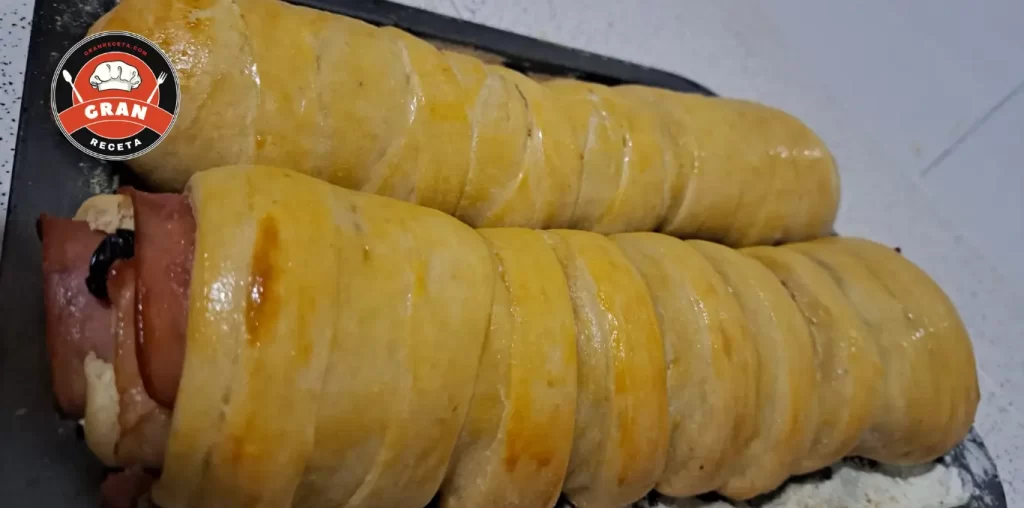

Venezuelans abroad measure December by whether they managed to make one. Pan de jamón is a rolled, enriched loaf filled with ham, bacon, raisins and green olives, sweet and salty at once, and it appears on the Christmas table beside hallacas and roast pork. It is closer to a savory cinnamon roll than to anything else in an American kitchen, it takes 215 minutes with two rises, and it fails in exactly one place: the seam. Twelve slices, 340 calories each.
How do you make pan de jamón? Knead an enriched dough of milk, butter and egg and let it rise 90 minutes. Roll it out, cover with ham, bacon, raisins and olives, roll it up tightly and seal the seam. After a 40-minute second rise, bake 35 minutes at 356 °F and brush with syrup. 215 minutes for 12 slices.
What pan de jamón is
It is one of the four fixed pieces of a Venezuelan Christmas dinner, alongside hallacas, roast pork leg and chicken salad, and it is the only one that is baked rather than boiled or roasted. Bakeries sell it from late November, and households that make their own usually bake it 1 day before the main dinner so the oven is free.
The flavor is the unusual part for anyone new to it. The base is salty, from ham and bacon, and then raisins interrupt it every few bites with something sweet, with green olives pulling in a third direction. It is served in ¾-inch slices as part of the table rather than as a sandwich or a side.
Pan de jamón, cinnamon roll, stromboli
If you have made cinnamon rolls, you already know most of the technique: an enriched dough, a rectangle, a filling, a tight roll. The differences are that this loaf is baked whole and sliced afterwards, and that the sweetness is punctuation rather than the point.
If stromboli is your reference, the shape will feel familiar and the dough will not. A lean pizza dough at 425 °F is a different animal from an egg-and-butter dough at 356 °F, and the raisins would make no sense in one and are essential in the other.
The filling ceiling
The split that works is 10 oz of ham, 5 oz of bacon, ½ cup of raisins and ⅓ cup of olives: about 21 oz spread over a 16 by 12 inch rectangle. That gives three full turns and a seam that closes without tension.
Bacon is the ingredient that causes the most trouble, because as it heats it renders fat into the dough and softens the spiral from within, so it goes in as thin strips rather than thick slices. And the ham matters too: US deli ham labeled honey or water-added carries more moisture, which turns the innermost layer of dough gummy. Ask for a firm, dry, smoked ham sliced thin.
Oven temperature and the seam
The filling goes into the oven cold and wet, so the heat has to be moderate: 356 °F for 35 minutes. Above 390 °F the crust sets before the middle is warm, the steam has nowhere to go, and it forces the seam apart along the weakest line.
Two extra safeguards. Bake it seam side down, so the weight of the loaf holds it closed, and prick the top about ten times with a toothpick to give the steam a controlled exit. With those and the right temperature, it comes out whole.
Where the calories are
Two thirds of each slice is dough: 228 of its calories, even though the loaf is named for the filling. Anyone wanting to lighten it has more room in the bacon, at 49 calories a slice, than anywhere else.
The raisins are the thing not to cut. They are 20 calories a slice and they are what makes this bread itself; without them you have a competent savory loaf and not a pan de jamón.
Who this recipe is for
- If the yeast does not foam in 10 minutes → it is dead; starting over costs less than losing the flour and the filling
- If you cannot find papelón → dark brown sugar dissolved in a splash of water, or thinned molasses, gives the same glaze
- If your oven runs hot → 340 °F for 40 minutes, with foil over the top for the last 10 if it colors too fast
- If you want to get ahead → the baked loaf freezes whole for 1 month; thaw and warm it 10 minutes at 320 °F
- If you do not eat pork → turkey ham and turkey bacon both work; the loaf loses some fat and comes out drier
Make ahead, storage and reheating
This is a bread built for December logistics. Baked, cooled and wrapped, it keeps 3 days at room temperature and 1 month in the freezer, whole or in slices with parchment between them.
Reheat a whole loaf 10 minutes at 320 °F, or slices 5 minutes in a toaster oven. By day four the crumb dries out, at which point the best use is toasting it and eating it with coffee, which is what actually happens in most households.
What goes wrong
Too much filling. Past 21 oz the roll will not close: the most common failure and the most visible.
Skipping the first rise. The crumb bakes dense and the loaf weighs like a brick.
Baking above 390 °F. The crust seals early and steam opens the seam.
Leaving the ends open. Filling escapes and burns on the tray.
Slicing it hot. The crumb compresses under the knife; give it 30 minutes.
Variations
Brown sugar in the dough. Two tablespoons of syrup worked into the dough itself, darker and sweeter, the style of some Caracas bakeries.
Without olives. Common in households that dislike them; make up the difference with an extra ¾ oz of raisins.
With cream cheese. A thin layer over the ham before rolling, which gives a moister crumb.
Mini loaves. Six individual 4-inch rolls that bake in 20 minutes and travel better.
What to serve it with
At a Venezuelan Christmas dinner it goes beside Venezuelan hallacas, roast pork and chicken salad, in ¾-inch slices, one per person, as part of the table rather than as a side. The leftovers are breakfast the next morning, 2 slices with coffee or Colombian hot chocolate.
Outside December it works as party bread with Venezuelan quesillo for dessert, or cut into squares for a tray of snacks. The dough is a close relative of the one behind homemade pizza, with a filling instead of a topping. For the other Venezuelan dish built to feed a crowd, there is Venezuelan pabellón criollo.
Frequently asked questions
Why did my loaf split open? Too much filling, an unsealed seam, or an oven above 390 °F. With 21 oz of filling at 356 °F it stays closed.
Can I freeze it? Yes, baked and whole, up to 1 month. Thaw at room temperature and warm 10 minutes at 320 °F.
Which ham should I buy? Thin-sliced smoked deli ham that is firm and dry. Honey or water-added hams release moisture into the dough.
Can I use a stand mixer? Yes, roughly ten minutes on medium instead of the twenty-five by hand. The dough still has to reach the same point: smooth, elastic and pulling away from the bowl.
How long does it keep? Three days at room temperature, well wrapped. By day four it dries, and toasting is the answer.
Nutrition
Per ¾-inch slice, a twelfth of the loaf, calculated with the USDA database for the flour, butter, ham, bacon, raisins and olives:
- Calories: 340 kcal
- Protein: 13 g
- Carbohydrates: 43 g
- Fat: 12 g, of which 5 g saturated
- Fiber: 2 g
- Sodium: 700 mg
- Sugars: 9 g
Sodium is the number that stands out, and it comes from the cured meat: according to the USDA, cured ham carries 1,203 mg per 100 g and green olives 735 mg. This is an occasion bread eaten in small amounts, one slice a person, precisely because it concentrates salt and fat into very little volume.
In my house pan de jamón was made on the 23rd of December, a day early, because my mother wanted it out of the way before the hallacas needed the oven. I kept the same schedule after moving to Colombia, and it turned out to be the fastest way to explain where I am from without discussing politics or football. The first time I took one to a Colombian house it disappeared before the pork did. Josnaisis.