
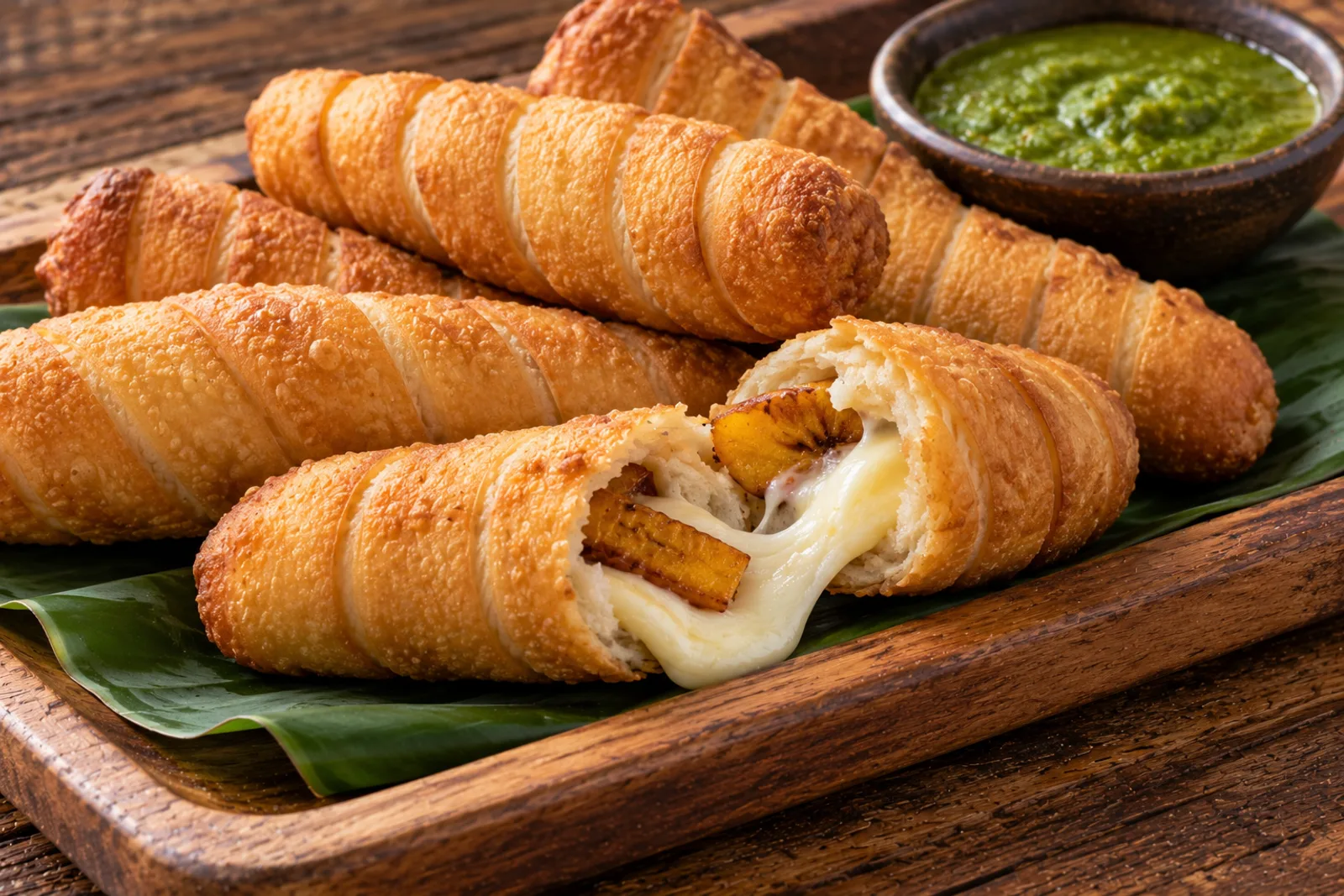

A tequeyoyo (teh-keh-YOH-yoh) is a Venezuelan tequeño, the party cheese stick, with a 3¼-inch (8 cm) finger of fried sweet plantain tucked next to the cheese before the dough goes on. Fried at 350°F (175°C) for 3 to 4 minutes, the crust blisters and cracks, the cheese turns soft but stays put, and the plantain tastes of caramel against the salt. That double filling is fatter than plain cheese, so the same dough wraps 32 instead of 40. Below: how ripe the plantain needs to be, which cheese to buy in a US or UK supermarket, how to wrap them so nothing escapes, and how to freeze a tray for a party.
What a tequeyoyo is, and how long it takes
How do you make tequeyoyos? Fry ⅜-inch (1 cm) planks of ripe plantain, let them cool, and cut them into 3¼-inch (8 cm) sticks. Pair each with a stick of firm white cheese and wrap the two in a spiral of tequeño dough rolled 1/12 inch (2 mm) thin, capping both ends. Fry 8 at a time at 350°F (175°C) for 3-4 minutes. 130 minutes for 8 servings of 4.
Tequeyoyos come from Zulia, the state around Maracaibo in western Venezuela. The name joins tequeño and yoyo, a Zulian snack of two slices of fried ripe plantain sandwiching cheese and ham, battered and fried. If you’ve had plain Venezuelan tequeños, the dough here is exactly the same; only the filling and the yield change. Zulia’s other plantain-and-cheese fritter is the mandoca, a ring of ripe plantain and corn dough.
Time. 130 minutes on the clock, about 115 of them hands-on, because the plantain gets fried first while the dough rests. Difficulty: medium. The dough is easy; the parts that need care are the plantain’s ripeness and a wrap that seals both ends.
Worth it? For a party tray of 20 or more, yes. For a snack for two, no: homemade dough only pays off in quantity.
The plantain, from black skin to a ⅜-inch stick
A plantain is a starchy cooking banana, bigger and firmer than a dessert banana, sold in the US and UK near the bananas in most large supermarkets and in Latin, Caribbean and African grocers. Don’t use bananas: they turn to mush in hot oil.
For tequeyoyos you want a plantain whose skin is more black than yellow but that still feels firm, the same point I use for Venezuelan fried sweet plantains. Between two, I take the firmer one, because it has to be cut into neat sticks after frying.
Why it goes in fried. Inside the dough the plantain gets far less heat than a slice loose in the oil, and 3-4 minutes isn’t enough to cook it raw: it comes out starchy. Fry 1 cm (⅜ in) lengthwise planks at 350°F (175°C), 2-3 minutes per side, until golden and still bendy. A plank fried dry and stiff snaps when you wrap it.
Why it goes in cold. Warm plantain steams, and the steam softens the dough from the inside before it reaches the oil. Let the planks cool on a rack for 15 minutes and blot off the surface oil.
Leftovers count. Fried plantain from dinner works, as long as it’s been in the fridge no more than 3-4 days. Cold from the fridge, it cuts into cleaner sticks.
If your plantains are yellow with no spots, buy them 4 to 6 days ahead and leave them on the counter, not in the fridge.
Which cheese to buy in the US and UK
In Venezuela it’s queso llanero, a pressed, salty white cheese. What matters is that it softens in hot oil without turning liquid, and that it’s salty enough to balance the sweet plantain.
- US. Queso para freír (frying cheese) or queso blanco in the Latin dairy case. Made to be seared without melting.
- UK. Halloumi, in nearly every supermarket. It holds perfectly; it’s salty, so cut the salt in the dough to 4 g (¾ tsp).
- Paneer, only as a last resort. It won’t melt, but it’s unsalted, so the salty-sweet contrast mostly disappears.
Skip mozzarella and cheddar. They melt, boil against the dough and burst through the weakest seam. A wet fresh cheese leaks whey, and with the moisture the plantain already brings, the dough goes soft from inside.
Ingredients and the dough
The card has every weight and cup. Three parts: the tequeño dough, 2 large ripe plantains and 10½ oz (300 g) of cheese.
| Ingredient | Amount | Swap | What changes |
|---|---|---|---|
| All-purpose / plain flour | 500 g (4 cups) | bread flour | shrinks when rolled, tougher crust |
| Cold unsalted butter | 100 g (7 tbsp) | margarine | almost no difference |
| Egg | 1 large | 30 ml (2 tbsp) more water | slightly paler, still works |
| Ripe plantain | 2 large | leftover fried plantain | saves the first frying step |
| Frying cheese | 300 g (10½ oz) | halloumi | saltier; halve the salt in the dough |
Equipment. Rolling pin, knife or pizza wheel, a deep pot, a wire rack and a clip-on thermometer. Without a thermometer, dip the tip of a wooden chopstick in the oil: a steady stream of fine bubbles means you’re near 350°F (175°C).
A 130-minute game plan
The dough’s 30-minute rest is when you fry and cool the plantain, and the final 15 minutes in the fridge is when the oil comes back up to temperature.
Make ahead. The dough keeps 24 hours in the fridge, well wrapped; give it 15 minutes on the counter before rolling. The plantain can be fried the night before and refrigerated, covered. Wrapped, uncooked tequeyoyos keep in the fridge until the next day, separated with parchment.
How to wrap tequeyoyos so they don’t open
Lay the cheese and plantain sticks side by side so the filling is a neat rectangle, about 1 × 2 cm (⅜ × ¾ in) across. If a plantain stick comes up short, butt two pieces end to end; nobody will notice inside the dough.
- Cap one end. Set the end of a ⅝-inch strip diagonally over the tip of the filling and fold it down.
- Spiral, overlapping by ¼ inch (5 mm). Don’t pull on the dough. Stretched dough shrinks in the oil and opens a crack.
- Cap the other end the same way.
- Seal dough to dough. Dough won’t stick to cheese, and it sticks even less to plantain, which carries a film of oil from frying.
When it’s right, no cheese or plantain shows anywhere, ends included.
Oil temperature in °F and °C
At 350°F (175°C) the dough seals in seconds, so the crust is set before the cheese gets runny. Fry 8 at a time; more drops the temperature too far.
- Going in: a vigorous bubble from the first second, and the tequeyoyo floats within about 30 seconds.
- Done: evenly golden with small blisters at 3-4 minutes.
- Filling peeking out: pull it straight away. The cheese is about to leak and the already-fried plantain darkens fast.
Fried, baked or air-fried, fresh or frozen
Frying gives the blistered crust. The oven and air fryer work with the same dough and a slightly different finish.
- Oven: 400°F (200°C), brushed with an extra beaten egg, 15-18 minutes, or 20-22 from frozen. Drier, bread-like crust.
- Air fryer: 375°F (190°C), brushed with oil, 8-10 minutes fresh or 12-14 frozen, turning halfway.
- With ham: many Zulian cooks wrap the cheese in a thin slice of ham before pairing it with the plantain. Saltier, and the fatter filling means the same dough makes a few fewer.
Freezing, leftovers and how many to make
Freeze them raw. Spread on a tray without touching, freeze for 2 hours until hard, then bag with the air pressed out. Food held at 0°F (−18°C) stays safe indefinitely; it’s quality that slips, so I use mine within 3 months. Fry straight from frozen at 355°F (180°C) for 5-6 minutes. Thawed, the dough goes soggy and they open.
Leftovers. Cooked tequeyoyos are safe 2 hours out of the fridge and 3 to 4 days in it at 40°F (4°C) or below. Reheat in an air fryer at 350°F (175°C) for 4-5 minutes, or the oven at 350°F (175°C) for 8, until the center reaches 165°F (74°C). The microwave makes the crust rubbery.
How many. I count 4 per person when there’s other food and 8 when they’re the main event. One batch makes 32, so 20 guests need 80 (two and a half batches) alongside other food, or 160 (five) on their own. Make the dough one 500 g (4-cup) batch at a time; that’s what kneads comfortably by hand.
What to serve them with. Hot, on a platter, with dips: guasacaca, the Venezuelan avocado sauce, cuts through the sweetness, and Venezuelan garlic sauce is the other classic. At Christmas they share the table with Venezuelan ham bread. The cheese is what makes the tray expensive; plantain and flour cost little.
Mistakes, and how to fix them
- Filling leaks → a melting cheese, an open end, or oil below 340°F (170°C).
- Dough tears before frying → the plantain was wrapped warm or oily. Cool it fully and blot it.
- Starchy plantain inside → it went in raw, or it was yellow with no spots.
- Unwinds in the oil → the strip was stretched, or the tail was pressed onto the filling.
- Greasy → oil too cool or too many at once.
- Raw dough inside → rolled thicker than 3 mm (⅛ in), or oil above 375°F (190°C).
Heat: none. Kids: the sweet plantain usually wins them over; give it 2-3 minutes, because the filling is much hotter than the crust. Allergens: wheat (gluten), egg and milk.
Frequently asked questions
What’s the difference between a tequeño and a tequeyoyo? Same dough and shape. A tequeyoyo adds a stick of fried sweet plantain, and sometimes ham, to the cheese, so each one needs about 25 % more dough.
Can I use raw plantain? No. Wrapped in dough, it won’t cook through in 3-4 minutes and stays starchy. Fry it first and let it cool.
Can I freeze tequeyoyos? Yes, raw. Freeze on a tray for 2 hours, bag them, and fry from frozen at 355°F (180°C) for 5-6 minutes.
What cheese can I use outside Venezuela? Latin queso para freír or queso blanco in the US, halloumi in the UK. Not mozzarella or cheddar.
How many does one batch make? About 32 of 3¼ inches (8 cm). The same dough makes 40 plain tequeños.
Nutrition
Per serving of 4 tequeyoyos (about 187 g / 6½ oz), worked out ingredient by ingredient from this recipe, using values for queso blanco and fried ripe plantain, and counting about 3 g of oil absorbed per piece in the final fry, which is my own estimate for frying at 350°F (175°C) and draining well:
- Calories: 636 kcal
- Protein: 16 g
- Carbohydrates: 64 g
- Fat: 35 g, of which 13 g saturated
- Fiber: 3 g
- Sugars: 10 g
- Sodium: 665 mg
About 106 kcal per serving comes from the final fry, so baked or air-fried they’re around 530 kcal. Halloumi or a saltier Latin cheese pushes the sodium up, and so does ham.
I make tequeyoyos when there’s fried plantain left from lunch, because half the work is already done. The one step I never rush is the wait: the plantain goes in cold and dry, even if the dough is ready and it costs me another quarter of an hour. With that and both ends capped, they come out as neat as any tequeño. Josnaisis.