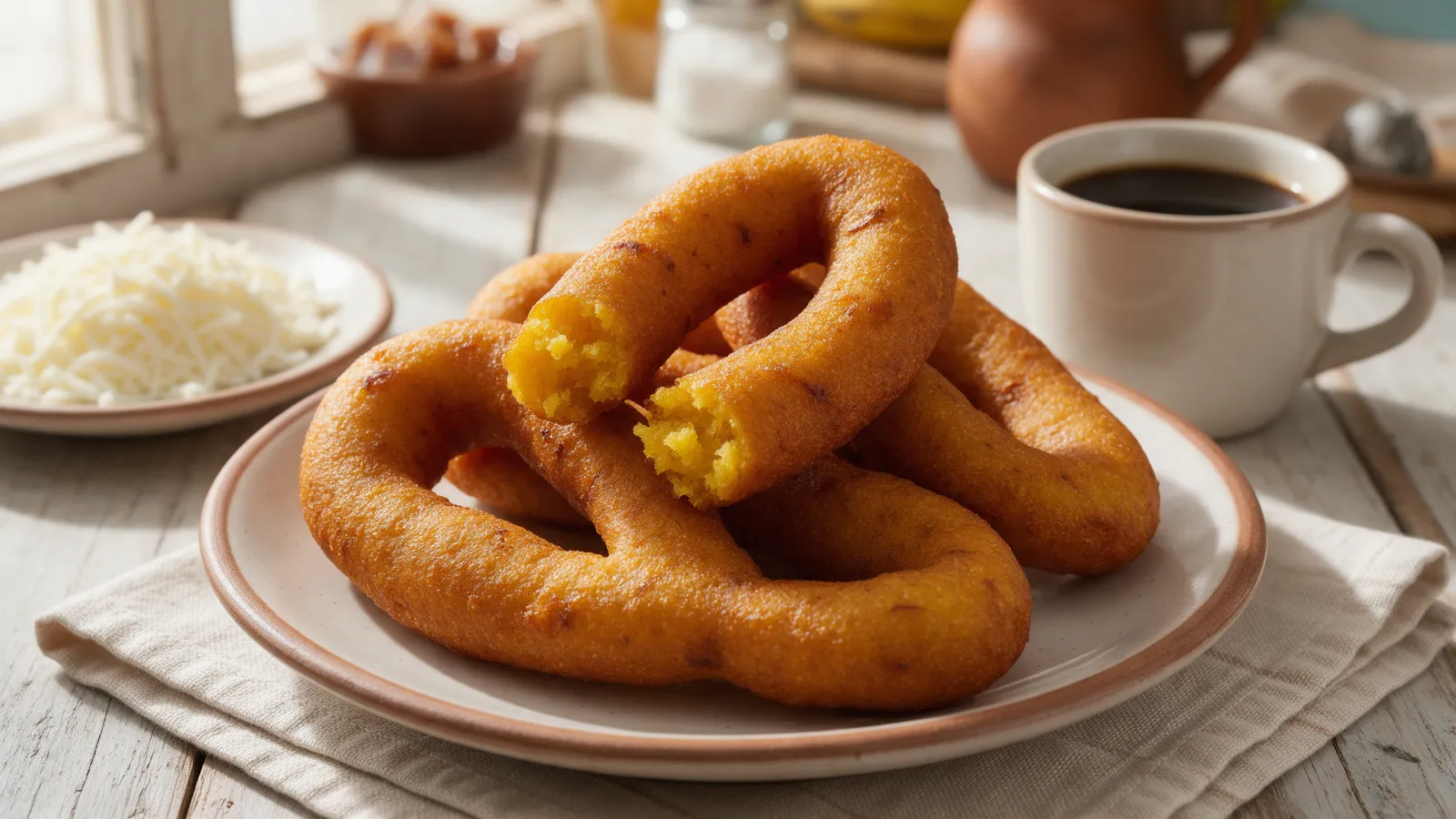

Mandocas (man-DOH-kahs) are 2-ounce rings of corn dough sweetened with very ripe plantain and papelón, studded with salty white cheese and deep-fried until the crust turns dark and crackly. They come from Zulia and Falcón in western Venezuela, where they are eaten for breakfast with butter, cheese and coffee. If you know Puerto Rican or Cuban maduros, think of the same caramel sweetness folded into an arepa dough, then fried in a ring.
What mandocas taste like and whether they are worth making
How do you make Venezuelan mandocas? Boil very ripe plantains in their skins, mash them and knead them with precooked white corn flour, grated hard white cheese and papelón dissolved in water. Roll 55 g (2 oz) ropes, close them into rings and fry at 350°F (175°C) for 5 to 6 minutes. 65 minutes for 6 servings of 3 mandocas.
They are worth it if you like sweet and salty together at breakfast. The outside is crisp and almost toffee-like from the cane sugar; the inside is dense, moist and tender, closer to a soft arepa than to a doughnut. Bits of cheese stay salty and unmelted in every bite.
Who they suit. A weekend breakfast for 6, a brunch table, or anyone who keeps a bag of frozen fritters for weekday mornings: raw mandocas freeze well and fry from frozen in 8 minutes.
Who might skip them. People avoiding deep-frying, because the air-fryer version is a different, drier thing (more on that below). And anyone shopping today: you need plantains with black skins, and green or yellow ones take 4 to 7 days to get there on the counter.
Real time. 65 minutes start to finish, about 45 of them hands-on. Plantains boil unattended for 18 minutes and the dough rests for 10.
Honest difficulty, easy. The only skill is closing the ring without cracks, and you will have it by the third one.
Shopping list, with US and UK substitutes
The amounts are in the recipe card: 400 g (14 oz) peeled plantain, 250 g (1⅔ cups) corn flour, 120 g (1 cup) cheese and 100 g (½ cup) papelón make 18 mandocas. Three of those need explaining outside Latin America.
Plantains, and how ripe. Use plantains (also called cooking bananas), never regular bananas: bananas have less starch and turn the dough gummy. In the US most supermarkets stock them; in the UK look in Caribbean and African grocers or the world-food aisle of larger supermarkets. Buy them yellow and let them blacken at room temperature. A black, slightly soft plantain gives the dough most of its sweetness and moisture. A firm yellow one makes a dry dough that cracks when you bend it into a ring, and that crack opens in the oil.
Precooked corn flour, not cornmeal. The dough needs masarepa, white precooked corn flour; Harina P.A.N. is the common brand, in Latin aisles in the US and online or in Latin shops in the UK. Cornmeal, polenta and Mexican masa harina will not hold the ring together.
Hard, salty white cheese. Venezuelans use queso de año or queso llanero. Cotija or queso seco are the closest in the US; in the UK, a well-drained feta works, or feta mixed half and half with halloumi, finely grated. Avoid mozzarella and any melting cheese: it strings, leaks fat and splits the ring.
Papelón. Unrefined cane sugar sold in hard blocks; it is the same product as Colombian panela and Mexican piloncillo.
Equipment. A heavy pot at least 20 cm (8 in) wide, a kitchen thermometer, a slotted spoon and a wire rack. A fork works instead of a potato masher if the plantain is still warm.
The plantain-to-flour ratio
I use 1.6 parts peeled plantain to 1 part flour by weight. More flour gives a firmer, less sweet fritter, close to a fried arepa; more plantain gives a softer one that slumps in the oil. Weigh the peeled plantain, because two “large” plantains can give anywhere from 330 to 450 g (12 to 16 oz).
Game plan, make-ahead and how to scale
65 minutes on the clock. Grate the cheese and make the syrup while the plantains boil, and heat the oil while you shape. The actual frying is the last quarter of an hour.
Make-ahead options.
- Up to 2 days ahead → the plantain purée, in the fridge with plastic wrap pressed onto the surface so it does not darken.
- Up to 24 hours ahead → the finished dough, wrapped, in the fridge. It firms up; knead in 1 to 2 tablespoons of water before shaping.
- Up to 2 months ahead → shaped raw mandocas in the freezer (my preferred way). Freeze them apart on a lined tray for 2 hours, then bag them. Fry straight from frozen at 330°F (165°C) for 7 to 8 minutes.
Scaling for a crowd. For 12 to 20 people, triple everything: 1.2 kg (2⅔ lb) peeled plantain, 750 g (5 cups) corn flour, 360 g (3 cups) cheese, 300 g (1½ cups packed) papelón in 360 ml (1½ cups) water. That makes 54 mandocas, or 9 batches and about 50 minutes at one pot, so shape and freeze them the day before and fry in two pots.
Shaping the ring and getting the oil right
Roll each 55 g (2 oz) piece on a clean, unfloured counter into a rope about 15 cm (6 in) long, wet the ends, overlap them by 1 cm (½ in) and press. A ring and a teardrop fry the same; both shapes are common in Zulia. Thicker ropes, around 2 cm (¾ in), stay softer inside and need an extra minute; thinner ones fry up crisp with almost no crumb.
Why 350°F (175°C). At that heat the surface seals in the first minute, so the fritter takes in little oil. In cooler oil the crust forms slowly, steam from the dough pushes out through the seam, the ring opens and soaks up fat. Much hotter and the sugar on the surface darkens before the center cooks. Six per batch is the limit in 1 liter (1 quart) of oil, because every batch of cold dough drops the temperature noticeably.
Common mistakes, kids and allergens
- They split open → dry dough, unwetted seam, or oil under 320°F (160°C).
- They are greasy → oil too cool or too many at once. Wait for 350°F (175°C) between batches.
- Dark outside, raw inside → oil above 365°F (185°C) or ropes thicker than 2 cm (¾ in).
- Sticky dough → watery plantain or too much syrup. Add flour 1 tablespoon at a time, up to 30 g (¼ cup).
- Floury and not sweet → the plantains were still yellow. Serve with extra grated papelón or a drizzle of honey.
Heat level, 0 out of 5. Nothing spicy goes in.
Kids. They love them: sweet, finger-sized and shaped like a ring. Let them roll the ropes while an adult fries, and wait 3 to 4 minutes before handing them over, because the sugary crust holds heat.
Allergens. Milk, from the cheese. No egg, no nuts, and naturally gluten-free since the flour is corn; for celiac guests, check that the bag of masarepa is labeled gluten-free.
Which version to make, air fryer, frozen or party size
- Air fryer → preheat to 400°F (200°C), brush each mandoca with ½ teaspoon of oil and cook 12 to 14 minutes, turning at 7. The result is matte and drier, closer to a griddled arepa, without the blistered crunch of frying. Pleasant, but not the same food. The air fryer is excellent for reheating fried ones.
- Short on time → fry from frozen, 7 to 8 minutes at 330°F (165°C).
- Party size → 30 g (1 oz) mini rings; the same dough makes 32 and each batch fries in 4 minutes. Serve with an iced glass of papelón con limón, the Venezuelan cane-sugar lemonade.
- Less sweet → cut the papelón to 60 g (⅓ cup packed).
- Dairy-free → leave out the cheese and add ½ teaspoon more salt. You lose the salty pockets that make them mandocas, so I would rather make something else.
How mandocas compare with other fritters
| Mandocas | Colombian buñuelos | US cornmeal hush puppies | |
|---|---|---|---|
| Base | Precooked corn flour + ripe plantain | Costeño cheese + cornstarch and tapioca starch | Cornmeal + wheat flour |
| Sweetness | Papelón and plantain | Barely sweet | Savory or lightly sweet |
| Egg | No | Yes | Yes |
| Shape | Ring or teardrop | Puffed ball | Small ball |
| Texture | Crisp crust, dense tender inside | Hollow and airy | Crumbly, cake-like |
If you want a fritter that puffs and goes hollow, make Colombian buñuelos instead.
What they cost
The US Bureau of Labor Statistics does not track plantains, masarepa or papelón, so a full US price is not possible from a verified source. What it does track shows where the money goes: at the August 2026 US city average of $5.98/lb for cheddar, used here as a floor for hard white cheese, the 120 g (1 cup) of cheese costs at least $1.58, and imported cotija or queso de año usually costs more. The papelón, priced like white sugar at $1.02/lb, is about $0.23. In Colombia, where I cook, the same 18 mandocas come to under 7,000 pesos at Bogotá wholesale prices, and the cheese is 43% of that.
Yield. 18 mandocas of about 55 g (2 oz) raw, 3 per person at breakfast.
Serving, storing and reheating
How they are served in Zulia. Hot from the oil, with butter, grated or sliced white cheese and black coffee. I also like them with natilla, a thick Venezuelan sour cream; regular sour cream is a fair stand-in. For a bigger Venezuelan breakfast spread, put them next to Colombian cheese arepas or sweet corn cachapas. If you fall for papelón, Venezuelan golfeados use it in a sticky cheese-topped roll, and the patacón maracucho is Zulia’s other street-food icon.
Fridge. The limits for cooked leftovers, according to the USDA FSIS, are no more than 2 hours at room temperature, then 3 to 4 days at 40°F (4°C) or below, in a container lined with paper towel.
Freezer. Raw is better than fried. Shaped raw mandocas keep their texture for about 2 months in my freezer. Fried ones are safe frozen and FSIS suggests 3 to 4 months for best quality, but the crust never fully comes back.
Reheating. Air fryer or oven at 350°F (180°C) for 4 to 5 minutes brings back most of the crunch; heat until steaming hot in the center, 165°F (74°C). The microwave makes them rubbery.
Mandocas FAQ
What are mandocas made of? Very ripe plantain, white precooked corn flour, papelón (unrefined cane sugar) and a hard salty white cheese, often with anise or cinnamon. They are shaped into rings and deep-fried.
Where are mandocas from? Zulia state, around Maracaibo in western Venezuela, and neighboring Falcón.
Can I use regular cornmeal? No. Use precooked corn flour (masarepa, such as Harina P.A.N.). Cornmeal and masa harina absorb water differently and the ring falls apart.
Can I use bananas instead of plantains? No. Bananas have less starch, so the dough turns sticky and the fritters spread in the oil.
What can I use instead of papelón? Panela or piloncillo are the same thing. Dark brown sugar is the best supermarket swap, at 100 g (½ cup packed). White sugar works but makes a paler, blander fritter.
Can you make mandocas in an air fryer? Yes, at 400°F (200°C) for 12 to 14 minutes, brushed with oil and turned halfway. Expect a drier, matte fritter rather than a crisp, blistered one.
Can you freeze mandocas? Yes, raw is best. Freeze them shaped on a tray, bag them, and fry from frozen at 330°F (165°C) for 7 to 8 minutes.
Are mandocas gluten-free? The ingredients are; corn flour has no gluten. Check that your masarepa is labeled gluten-free if cross-contact matters.
Nutrition per serving
Per serving of 3 mandocas (1 of 6), calculated from USDA FoodData Central (SR Legacy) using this recipe’s weights, with queso blanco and brown sugar as stand-ins for queso de año and papelón, and about 60 g (2 oz) of oil absorbed by the whole batch:
- Calories: 449 kcal (about 150 per mandoca)
- Protein: 8 g
- Carbohydrates: 71 g
- Fat: 16 g, including 4 g saturated
- Fiber: 3 g
- Sugars: 29 g, split almost evenly between plantain and papelón
- Sodium: 248 mg
The fat figure assumes hot oil; frying below 320°F (160°C) can roughly double it. Aged queso de año is usually saltier than the USDA’s queso blanco, so real sodium may run higher.
What surprised me most when I started making these at home was how long I had to leave the plantains alone. They look ruined by the time they are ready, black and soft on the fruit bowl, and that is exactly when they make a sweet, tender mandoca. These days I shape three dozen on a Sunday, freeze them, and Dylan gets hot ones on school mornings in under ten minutes. Josnaisis.