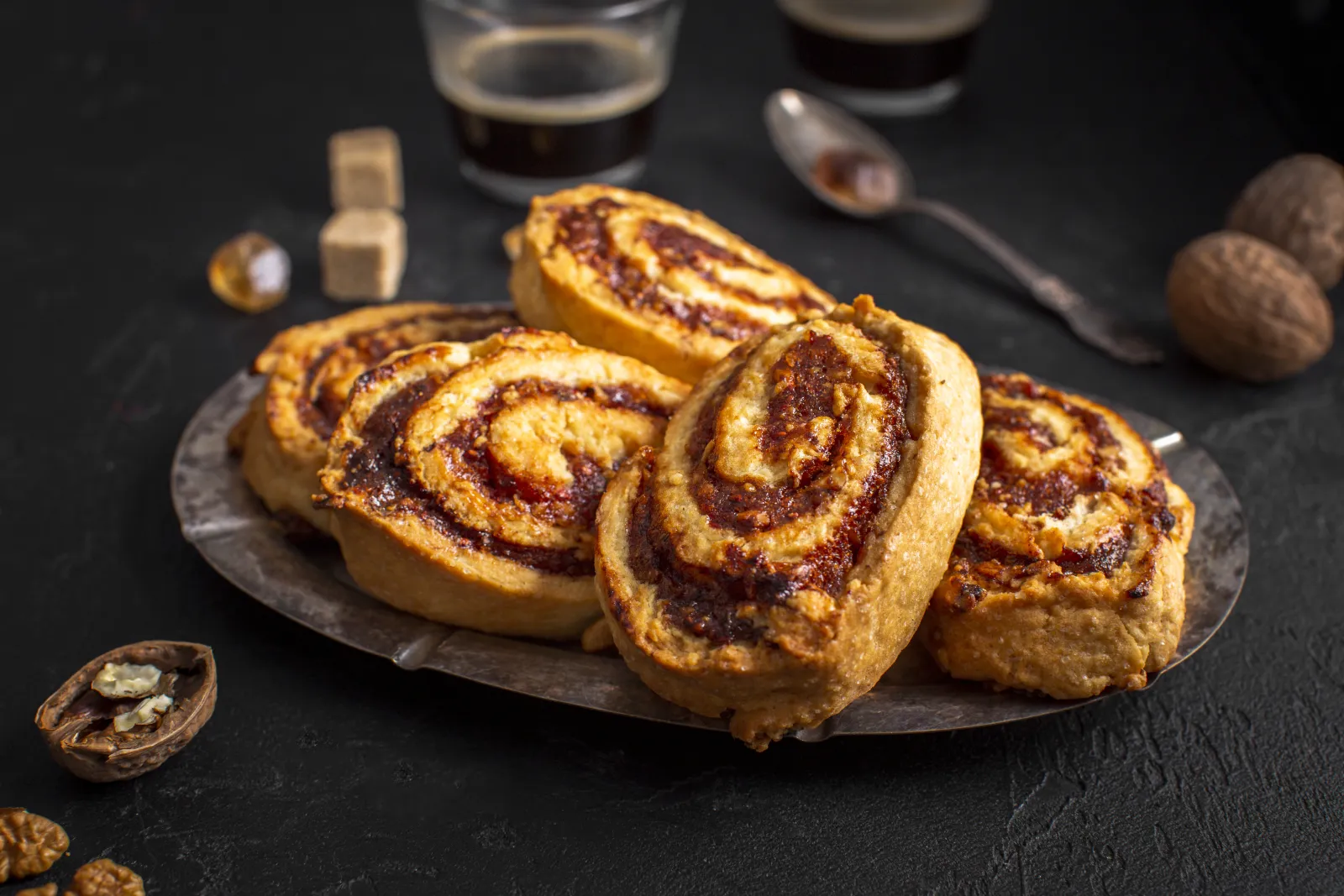

Picture a cinnamon roll with 200 g (7 oz) of salty white cheese rolled into it on purpose. A golfeado (gol-feh-AH-doh) is Venezuela’s sticky bun: an anise-scented yeast dough rolled around grated papelón, the dark unrefined cane sugar sold in blocks, and crumbly salty white cheese, then glazed with papelón syrup until the bottoms turn glossy and tacky. In Venezuela you buy them from bakeries and roadside stands and eat them with a slice of soft fresh cheese on the side. This batch makes 12 buns in a 9x13-inch (23x33 cm) pan, with an overnight route so they come out of the oven at breakfast time.
How to make golfeados, the short answer
How do you make Venezuelan golfeados? Knead 500 g (4 cups) flour with warm milk, eggs, butter, a little papelón and anise seed, and let it double for about 75 minutes. Roll it to 19x12 in (48x30 cm), cover with melted butter, grated papelón and salty white cheese, roll up, cut 12 buns, proof 45 minutes and bake at 350°F (180°C), glazing with papelón syrup at the end. Ready in 185 minutes for 12 servings.
About 45 of those 185 minutes are hands-on. The rest is the dough rising, and the syrup and grating fit inside the first rise.
Golfeado vs cinnamon roll, what actually changes
The shaping is identical, so if you’ve made cinnamon rolls you already have 80% of the skill. Four things change, and each one matters:
- The sugar is papelón (pah-peh-LOHN), not white or light brown sugar. It tastes of molasses and caramel, and it makes the syrup dark.
- The spice is whole anise seed, the licorice-scented one, not cinnamon. Whole seeds give little bursts of aroma; ground anise spreads through the dough and turns bitter.
- There’s cheese, about 200 g (7 oz) of it, inside and on top. It’s there for salt, not for melting, so it has to be a firm, salty cheese.
- The finish is a thin syrup brushed on in two stages, not a cream-cheese frosting.
The result tastes sweet first and salty second, and the anise ties them together. If you want an all-sweet bun, swap the anise for 2 tsp cinnamon and leave out the cheese, but then you’ve made a cinnamon roll with darker sugar.
Is it worth making golfeados at home, time and difficulty
Yes, if you have a weekend morning and like baking with yeast. The buns are at their best warm, in the first 2 hours, with the syrup still soft. They’re medium difficulty: the dough is lean and easy to roll, and the three places people trip up are grating the papelón fine, rolling tight and taking the syrup off the heat in time.
Good for a brunch of 6 to 12, a coffee table with friends, or anyone curious about Venezuelan baking beyond arepas. Less good for someone who dislikes licorice flavors (halve the anise) or is cutting sugar: each bun carries about 34 g.
Golfeado ingredients and US and UK substitutes
The dough is deliberately lean, 12% butter and 10% sugar on the weight of flour, compared with 16% butter in Mexican conchas. The sweetness and fat come from the filling, and a leaner dough rolls thin without tearing.
Flour. US all-purpose works. In the UK, use strong white bread flour for taller buns; plain flour gives a softer, flatter result.
Yeast. 7 g (2¼ tsp) instant yeast, mixed straight in. With active dry yeast use 9 g (1 tbsp) and always bloom it in the milk.
Papelón and what to buy instead
Papelón, panela and piloncillo are the same thing: cane juice boiled down and set in a block. The name changes by country, the result in the bun doesn’t.
- US → piloncillo cones, usually 8 oz (225 g), sit in the Latin aisle of most large supermarkets. Panela from Colombian brands is common too. Grate them on the fine side of a box grater.
- UK → panela turns up in Latin shops and online. The easiest swap is dark muscovado sugar, on every supermarket shelf, which is also unrefined and needs no grating.
- Anywhere → dark brown sugar, weight for weight. The syrup comes out lighter and less smoky, but the buns still work.
The cheese
The cheese inside a golfeado is queso blanco or queso duro, a firm, salty white cheese. What it must not do is melt into strings or leak whey into the spiral. Pat crumbly cheeses dry with paper towel before grating, and if your feta is very salty, cut it half and half with dry low-moisture mozzarella.
The soft cheese served alongside, queso de mano or queso guayanés, is a different job: fresh, mild and stretchy, the same one that goes on Venezuelan cachapas. Venezuelan grocers stock it in the US; elsewhere, a drained ball of fresh mozzarella is the closest thing.
Equipment
A stand mixer with a dough hook, a 9x13-inch (23x33 cm) pan, parchment, a box grater, a rolling pin and a kitchen scale. Weigh the papelón if you can: grated block sugar varies so much by fineness that cups are a guess. Without a mixer, knead by hand for 15 minutes.
Step-by-step, the 185-minute schedule
- Mix and knead (15 min). Dissolve 50 g papelón in the warm milk with the yeast, then knead with flour, salt, anise and eggs, adding the butter last. The dough weighs about 955 g (2 lb 2 oz).
- First rise (75 min). Doubled at 75-80°F (24-27°C). Make the syrup and grate during this time.
- Shape (20 min). Roll, fill, roll up, cut 12 buns, into the pan.
- Second rise (45 min). The buns touch and a fingertip dent springs back slowly.
- Bake (30 min). 26 minutes at 350°F (180°C), syrup, 4 minutes more.
The syrup that won’t crystallize
Two things turn papelón syrup to rock candy: stirring it while it boils, and boiling it too long. Stirring knocks sugar crystals off the sides of the pan back into the syrup, where they seed more crystals. Boiling past about 223°F (106°C), the start of the thread stage in candy making, makes a syrup that sets hard as it cools. So stir only until the sugar dissolves, then leave it at a gentle simmer for 6-8 minutes and pull it when it coats a spoon like runny honey. The teaspoon of lemon juice helps too: acid splits some of the sucrose into sugars that don’t crystallize. If it hardens anyway, 2 tbsp water over low heat brings it back.
Who this recipe is for
- First-time yeast bakers who have made a cinnamon roll and want something new with the same shaping.
- Venezuelans abroad who can’t find a bakery that makes them.
- Brunch hosts who need a pan they can shape the night before.
- Cheese-and-sweet fans, the people who put cheddar on apple pie.
Make-ahead golfeados, the overnight method and freezing
Shape the buns at night and cover the pan with plastic wrap that doesn’t touch them. They can stay in the fridge anywhere from 8 to 14 hours; the cold slows the yeast, and the proof finishes the next morning in about 60 minutes at room temperature.
Freeze baked. Cool completely, wrap each bun in plastic and bag them. Food kept at 0°F (-18°C) stays safe indefinitely according to the USDA FSIS, and only quality drops over time; I use them within 2 months. Thaw wrapped for 1 hour, then warm 6-8 minutes at 300°F (150°C) under foil so the syrup softens without burning.
Freeze unbaked. Freeze the cut buns in the pan before the second rise. Move them to the fridge the night before, then give them about 90 minutes at room temperature before baking.
Scaling. For 6, halve everything (4 g yeast), roll to 9½x12 in (24x30 cm) and bake 6 buns in an 8-inch (20 cm) square pan. For 24, make two separate batches rather than one double: 2 kg (4½ lb) of dough climbs the hook of a home mixer. The syrup can be doubled in one pan.
Mistakes that ruin golfeados
- Hot milk. Yeast dies at around 140°F (60°C). Keep the milk at 95-104°F (35-40°C), comfortably warm on your wrist.
- Coarse papelón. Chunks don’t melt in 26 minutes and stay gritty. Grate it as fine as sugar.
- Soft, wet cheese inside. It leaks whey, soaks the spiral and adds no salt.
- A loose roll. The spiral opens in the oven and the filling runs out. Roll tight and pinch the seam.
- A hot oven. The papelón on the bottom burns and tastes bitter before the center cooks. Check 350°F (180°C) with an oven thermometer.
- All the syrup at the end. It sits on the surface and stays sticky. Half goes on with 4 minutes left in the oven, which sets it and makes it shine; the rest goes on as they come out.
Allergens. Wheat, egg and dairy; no nuts. The egg is fully cooked, since the center passes 190°F (88°C) and the USDA FSIS puts egg dishes at a safe 160°F (71°C). Not spicy at all. Kids usually love them, but some balk at anise, so I use half for young ones.
Golfeado variations
- Faster → proof in a turned-off oven with the light on, around 80°F (27°C): the first rise drops to about 60 minutes and the total to about 170.
- Party size → cut the log into 24 pieces of ¾ in (2 cm), use two pans and bake 18-20 minutes. They sit well next to tequeños, Venezuela’s cheese sticks, on a party table.
- Lighter → use half the syrup to save about 24 kcal a bun, or 100 g (1 cup) cheese inside instead of 150 g to save another 13.
- With cinnamon → plenty of bakeries add 1 tsp ground cinnamon to the filling sugar.
- Cheese placement → some cooks put all the cheese inside, others all on top after the syrup. I split it 150 g inside, 50 g on top, so both parts taste salty.
No oven? I haven’t made a golfeado I liked in a skillet or an air fryer: the sugar on the bottom scorches before the spiral cooks through.
What golfeados cost to make, about $0.47 a bun
At BLS US city average prices for August 2026, a batch comes to about $5.66, or $0.47 a bun. That’s a floor: the BLS has no series for queso blanco, so the cheese is priced as cheddar, and papelón is priced as white sugar; Latin cheese and piloncillo usually cost more. Cheese is close to half the bill either way.
What to serve with golfeados, and how long they keep
Serve them warm, pulled apart from the pan, with a slice of fresh cheese and coffee with milk. In the afternoon, an iced papelón con limón, Venezuela’s raw-sugar lemonade, picks up the same flavor as the syrup; on a cold morning, a mug of Colombian aguapanela does the same warm. For a bigger Venezuelan spread, add a slice of Venezuelan ham bread or a tray of cachitos, Venezuela’s ham-filled breakfast rolls, and if you enjoy enriched doughs, the Mexican three kings bread is the festive cousin. The same papelón-and-salty-cheese pairing shows up fried in Venezuelan mandocas, sweet plantain and cheese fritters from Maracaibo.
Room temperature. I leave them out only on the day I bake them, covered with a cloth, because of the cheese. Fridge, well wrapped, up to 4 days; the crumb firms up but comes back with heat. Microwave 15-20 seconds at most, or the syrup turns hard as it cools.
Golfeados FAQ
What does golfeado taste like? Sweet and caramel-like from the papelón, salty from the white cheese, with licorice notes from the anise seed. Soft, tacky bottoms and a slightly crisp cheese top.
Can I use brown sugar instead of papelón? Yes, dark brown sugar or UK dark muscovado, weight for weight. The syrup will be a little lighter and less smoky.
What cheese is in golfeados? A firm, salty white cheese, queso blanco or queso duro. Cotija (use 20% less) and mild feta are the best US and UK substitutes. Avoid mozzarella inside.
Why did my papelón syrup harden? It was stirred while boiling or cooked past about 223°F (106°C). Rewarm it with 2 tbsp water over low heat.
Can I make golfeados the night before? Yes. Shape them in the pan, refrigerate 8-14 hours, then proof about 60 minutes and bake.
How many calories are in a golfeado? One of these buns, syrup and cheese included, weighs about 120 g and has roughly 417 kcal. A 40 g (1½ oz) slice of fresh cheese on the side adds about 120 kcal.
Can you freeze golfeados? Yes, baked for up to 2 months, or unbaked before the second rise. Reheat under foil at 300°F (150°C) for 6-8 minutes.
Golfeado nutrition per bun
Values for one bun, a twelfth of the batch with its syrup and cheese but not the side cheese, worked out ingredient by ingredient from USDA FoodData Central (SR Legacy) data, with dark brown sugar standing in for papelón:
- Calories: 417 kcal
- Protein: 10 g
- Carbohydrates: 66 g
- Fat: 13 g, including 7 g saturated
- Fiber: 1 g
- Sugars: 34 g
- Sodium: 407 mg
Papelón accounts for 32 of the 34 g of sugar, and the syrup alone for about 48 kcal a bun.
Growing up in Venezuela, golfeados were something we bought, never made. I started baking them in Colombia, using queso costeño from the market, and my first syrup set like glass on the pan because I couldn’t stop stirring it. These days I walk away from the stove while it simmers, and my son Dylan grates the cheese for the top, about half of which never makes it to the buns. A golfeado should taste a little salty, or it’s just a sweet roll. Josnaisis.