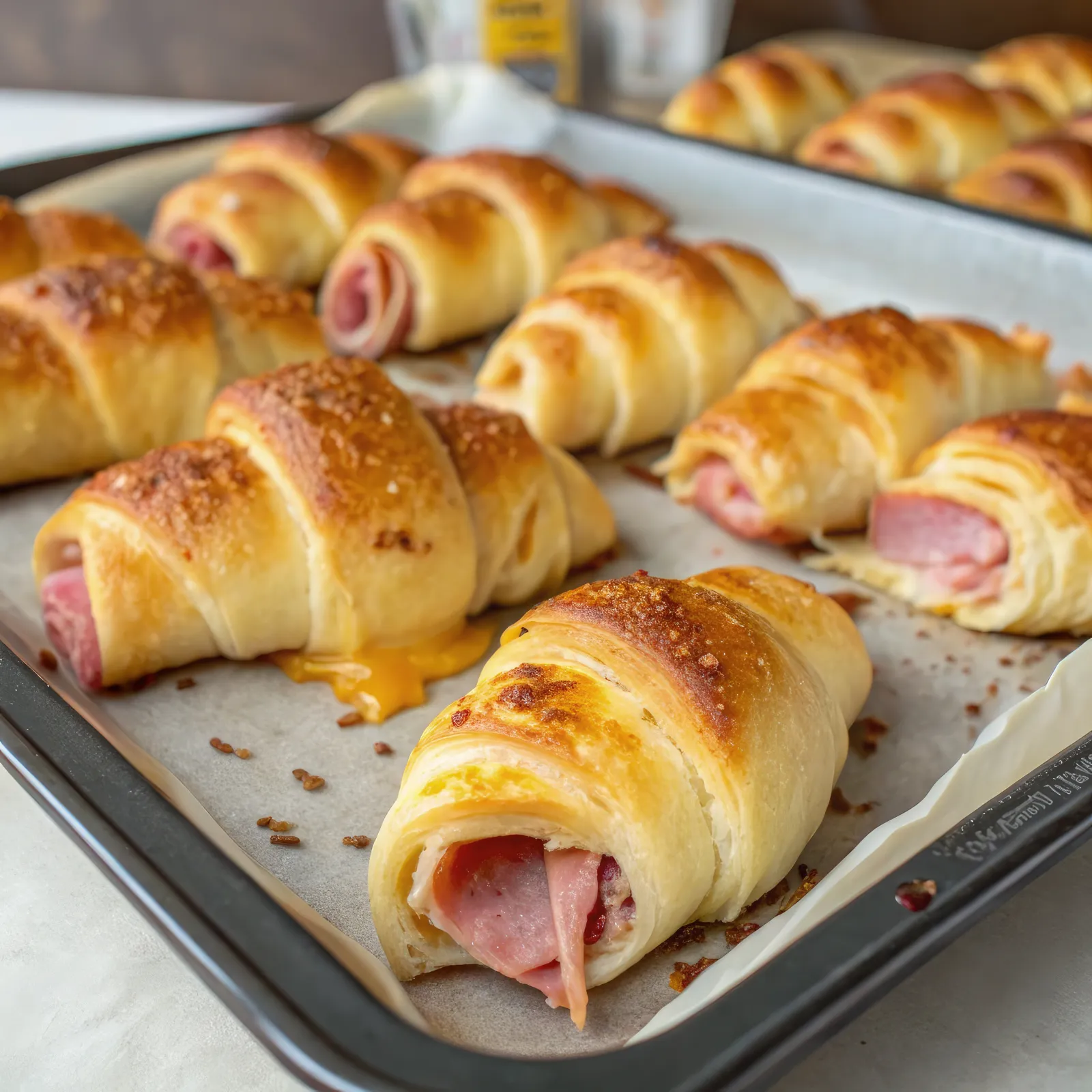

Cachitos (kah-CHEE-tohs) are the ham-filled crescent rolls of Venezuelan bakeries, the thing you eat at the counter in the morning with a small coffee. They look like croissants and they are not. The dough is a soft, slightly sweet milk bread with the butter kneaded in, so you get a tender spiral of crumb instead of shattering layers, and the shiny top comes from an egg wash with sugar. Voice of America reported that a bakery cachito costs about two dollars in Venezuela, and that Venezuelans abroad, through the group Venmundo and several bakeries, declared January 27 International Cachito Day.
What is a Venezuelan cachito, and how is it different from a croissant?
How do you make Venezuelan cachitos? Knead a sweet dough of 500 g (4 cups) flour, warm milk, egg, sugar and 80 g (5½ tbsp) butter and let it double for 75 minutes. Roll it into two 14-inch (35 cm) circles, cut each into 8 wedges, add 30 g (1 oz) of diced ham and bacon and roll toward the tip. Proof 45 minutes, brush with sweet egg wash and bake 20 minutes at 350°F (180°C). 195 minutes for 16 servings.
A cachito is a filled bread roll, not a pastry. A classic French croissant laminates around 250 g of butter into every 500 g of flour and folds it into layers over two days; a cachito uses 80 g of butter worked straight into the dough and is ready the same morning. The result is closer to a soft dinner roll or a brioche than to anything flaky, which is why it holds a moist ham filling without going greasy.
The nearest relative on this site is Venezuelan ham bread, the big Christmas loaf rolled with ham, bacon, raisins and olives. The dough is almost the same; the shape, the filling and the season are not.
Should you make cachitos at home?
Yes, if you have a free weekend morning or a stand mixer, and you want breakfast for 8 that people can eat with one hand. They suit a brunch, a birthday table or a houseguest weekend, and they freeze unbaked, which makes them a good batch project.
They are not for a weeknight whim. The clock says 195 minutes, about 70 of them hands-on. If you want flaky layers, you want a croissant; if you don’t eat pork, you’ll need the turkey or cheese filling below.
Difficulty is middling. The dough is ordinary enriched bread dough. Shaping takes practice: your first four or five rolls will look homemade, and by the sixth your hands will have it.
Ingredients, with US and UK supermarket swaps
Exact amounts are in the recipe card. In short, the dough is 500 g (4 cups) flour, 250 ml (1 cup + 1 tbsp) milk, 1 egg, 60 g sugar, 80 g butter and 7 g yeast, and the filling is 400 g (14 oz) ham plus 100 g (3½ oz) bacon. Each of the 16 rolls gets 30 g of filling wrapped in roughly twice its weight of dough.
Ham. Venezuelan bakeries use jamón de pierna, smoked cooked leg ham. In the US, buy a chunk of smoked deli ham or a ham steak and dice it yourself; pre-diced ham is often wet. In the UK, a thick slice of cooked or honey-roast ham works. Skip Parma ham and prosciutto: dry-cured ham shrivels and turns salty in the oven.
Bacon. Smoky and fatty is what you want, so thick-cut smoked bacon in the US or smoked streaky in the UK. Back bacon is leaner; the rolls come out drier.
Flour. US all-purpose has about 10% protein per USDA data, which is right for a soft roll. Bread flour makes them chewier and may want 2-4 extra teaspoons of milk. In the UK, plain flour works and strong white gives the bread-flour result.
Yeast. One 7 g packet of instant or active dry; if you bake with fresh yeast, use 21 g (¾ oz) crumbled into the milk.
Equipment. A large bowl, a rolling pin, a pizza wheel or long knife, 2 rimmed baking sheets with parchment, and a pastry brush. An instant-read thermometer helps with the milk and the doneness check. No pin? A floured wine bottle does the job.
How to plan your morning
Most people want cachitos warm at breakfast without starting at 5 a.m., and the fridge solves that. At 40°F (4°C) yeast slows to a crawl, so you can park the dough or the shaped rolls overnight.
Option 1, shape the night before (what I do). Make the dough after dinner, shape the rolls, cover the sheets loosely with plastic wrap and refrigerate 8-12 hours. In the morning, give them 60 minutes on the counter to warm up and puff, preheat for the last 20, brush and bake. Breakfast is 95 minutes away and you’ll touch the rolls for 5.
Option 2, dough the night before. Knead, cover the bowl and refrigerate 8-16 hours. Cold dough rolls out beautifully and doesn’t shrink back. Shape in the morning; the second rise stretches to 60-75 minutes because the dough starts cold.
Same-day schedule. Mix and knead (15 min) → first rise (75 min, dice the filling meanwhile) → shape (35 min) → second rise (45 min, preheat for the last 20) → egg wash and bake (25 min).
You can dice the filling on Sunday for a midweek bake: USDA FSIS gives sliced cooked ham 3 to 5 days in the fridge.
How to cut and roll cachitos so they stay closed
Cutting the wedges
Rest the two dough balls 10 minutes so the gluten relaxes; tight dough springs back when you roll it. Roll each to a 14-inch (35 cm) circle, 1/8 inch (3 mm) thick. Cut it in half, then in quarters, then each quarter in two, for 8 long triangles about 5 inches (13 cm) across the base. A ½-inch (1 cm) nick in the center of each base lets you pull the corners outward as you roll, which gives the fat middle and curved horns.
Rolling them up
- Filling, 30 g (1 oz) and no more, in a strip along the wide end, ½ inch (1 cm) in from the sides.
- Fold both base corners in over the filling like closing an envelope, so the ends are sealed before you start.
- Roll firmly toward the tip, stretching the tip with your other hand. Three and a half to four turns.
- Tip underneath. The roll’s own weight pins the tip down; tip-up rolls unwind as they rise in the oven.
- Curve into a crescent and leave 2 inches (5 cm) between rolls.
How to tell each stage is right
- Yeast: foamy within 5-10 minutes.
- Dough: a small piece stretches into a thin, translucent sheet before tearing.
- First rise: doubled, usually in 75 minutes at 75-80°F (24-27°C). A cold kitchen can take 90-120 minutes; go by size, not the timer.
- Second rise: about 1½ times bigger, and a floured fingertip dent fills back slowly. Springs back fast, wait 10-15 minutes; doesn’t spring back, bake now.
- Bake: deep golden on top and on the underside at 18-22 minutes, or 190°F (88°C) in the center.
Mistakes that ruin cachitos
- They burst open. Too much filling, a wet or warm filling, or the tip on top. Stay at 30 g (1 oz), blot the ham, keep it cold, bake tip-down.
- Dense and heavy. First rise cut short or under-kneaded dough. Wait for double and for the windowpane.
- Puffy and shapeless. Over-proofed second rise. They should grow by half in 45 minutes, not double.
- Dark bottoms, pale tops. Sheet too low, or egg wash pooling on the parchment. Use the upper and lower thirds, swap halfway, brush thinly.
- Ham leaking out the ends. The base corners weren’t folded over the filling.
Heat level: none. Kids: they love them; make some mini rolls with 40 g dough and 20 g filling, baked 15 minutes, and let them cool, because the ham stays hot. Allergens: wheat (gluten), egg and milk. Some processed hams and bacons list milk proteins, so check labels.
Which version should you make?
- Ham and cheese → 300 g (10½ oz) ham plus 100 g (3½ oz) diced low-moisture mozzarella, mild cheddar or Edam. Fresh mozzarella leaks water and opens the seam.
- No pork → 500 g (1 lb 2 oz) turkey ham, plus 20 g (1½ tbsp) butter in the filling to make up for the bacon fat.
- Vegetarian → 300 g (10½ oz) diced cheese with 100 g (3½ oz) sautéed and squeezed-dry spinach, or cheese and sweetcorn.
- A small batch for 4-6 → halve everything (use half a beaten egg, about 25 g): 8 rolls, one sheet.
- A crowd of 30 → double it: 1 kg (8 cups) flour, 800 g (1¾ lb) ham and 200 g (7 oz) bacon, 32 rolls on 4 sheets. Shape the night before and bake two sheets at a time.
- One oven rack only → bake 8 at a time in the center. Refrigerate the second sheet as soon as it’s shaped and take it out when the first goes in, so it doesn’t over-proof.
- Flaky cachitos → some Venezuelan bakeries laminate the same dough with 200-250 g butter and three folds. It’s crisper, messier and a day longer; the everyday breakfast roll is the soft one above.
What cachitos cost to make
There is no reliable official food-price source for Venezuela, so I priced the batch with US Bureau of Labor Statistics averages for August 2026. Sixteen cachitos come to $8.33, about 52 cents a roll. Ham is 57% of that; the entire dough, butter included, is $2.13. BLS tracks boneless ham, the closest series to the smoked leg ham used here, and doesn’t track yeast.
The yield is 16 rolls of roughly 90 g (3 oz) unbaked. Plan 2 per adult with coffee, or 1 next to eggs and fruit. To spend less, drop the filling to 25 g per roll or swap 100 g of ham for cheese; don’t cut the butter, which is cheap and does the most for texture.
How to serve, store, freeze and reheat cachitos
Serving. In Venezuela they’re breakfast with coffee. At home I put them out with huevos pericos, the Venezuelan scrambled eggs with tomato and scallion, or with a mug of Colombian hot chocolate. For a party spread they sit next to tequeños, the cheese sticks wrapped in a similar wheat dough, and the sweet end of a Venezuelan bakery tray is golfeados, spiral buns with raw cane sugar and cheese. If you’ve baked Mexican conchas, the dough will feel familiar.
On the counter. Ham is perishable, so the USDA FSIS 2-hour rule applies: out for breakfast, then into the fridge.
Fridge. 3-4 days in a closed container, the FSIS guideline for leftovers. The crumb firms up and comes back when reheated.
Freezer, unbaked. Shape, freeze on the sheet uncovered for 2 hours, then bag. I use them within 1 month, because after that the yeast is tired and they rise less. Thaw overnight in the fridge on a lined sheet, give them 60-90 minutes at room temperature to grow by half, then wash and bake as usual.
Freezer, baked. Cool completely, bag, and use within 1-2 months, the FSIS quality window for cooked ham.
Reheating. Oven or air fryer at 325°F (160°C), 8-10 minutes from the fridge or about 15 minutes from frozen, until the center reaches 165°F (74°C), the FSIS figure for reheated leftovers. Microwaving makes them soft and then tough; if you must, 20-30 seconds wrapped in a paper towel and eat right away.
Frequently asked questions
Is a cachito the same as a croissant? No. A croissant is laminated pastry with around 250 g of butter per 500 g of flour in thin layers; a cachito is a soft, slightly sweet bread dough with 80 g of butter kneaded in, always filled, usually with ham.
What’s the difference between cachitos and Venezuelan ham bread? Ham bread (pan de jamón) is one large Christmas loaf with ham, bacon, raisins and olives, baked 35 minutes. Cachitos are individual rolls with ham, sometimes bacon or cheese, baked 20 minutes and eaten year-round at breakfast.
Why do my cachitos open in the oven? Overfilling past 30 g (1 oz), a wet or warm filling, or a tip left on top. Cold, dry filling and tip-down rolls stay sealed.
Can I make cachitos the night before? Yes. Shape, cover and refrigerate 8-12 hours, then 60 minutes on the counter and 20 minutes at 350°F (180°C).
Can I freeze cachitos before baking? Yes, shaped and without egg wash, for up to 1 month. Move them to the fridge the evening before, then give them an hour to an hour and a half on the counter before baking.
Can I use store-bought crescent dough? You can, baked at the times on the can, and you’ll get ham crescent rolls. Canned crescent dough is flaky and buttery-salty, so the result is closer to a quick croissant than to the soft, sweet bakery cachito.
What ham should I use? Smoked cooked ham from a thick piece, diced to 1/8 inch (3-4 mm). Not prosciutto or Parma, which dry out and over-salt the roll.
Nutrition per cachito
Per roll (1 of 16, about 90 g / 3 oz unbaked), calculated ingredient by ingredient from USDA FoodData Central (SR Legacy) with the quantities above, counting half the egg wash and all the bacon fat:
- Calories: 250 kcal
- Protein: 10 g
- Carbohydrates: 30 g
- Fat: 10 g, of which 4 g saturated
- Fiber: 1 g
- Sugars: 6 g
- Sodium: 480 mg
About three quarters of the calories (184 of 250) are the dough. Sodium splits almost evenly between the salt in the dough (218 mg) and the ham and bacon (250 mg); cutting the salt to 1 teaspoon brings a roll down to about 410 mg, and you won’t miss it because the filling is already salty.
In Colombia I can buy almost every Venezuelan thing I miss except a proper bakery cachito, so I learned to bake them, and the first batches split open on the tray every single time. What fixed it was boring: less filling, ham straight from the fridge, tips tucked under. These days I shape them on Saturday night and on Sunday all I do is turn on the oven. Josnaisis.