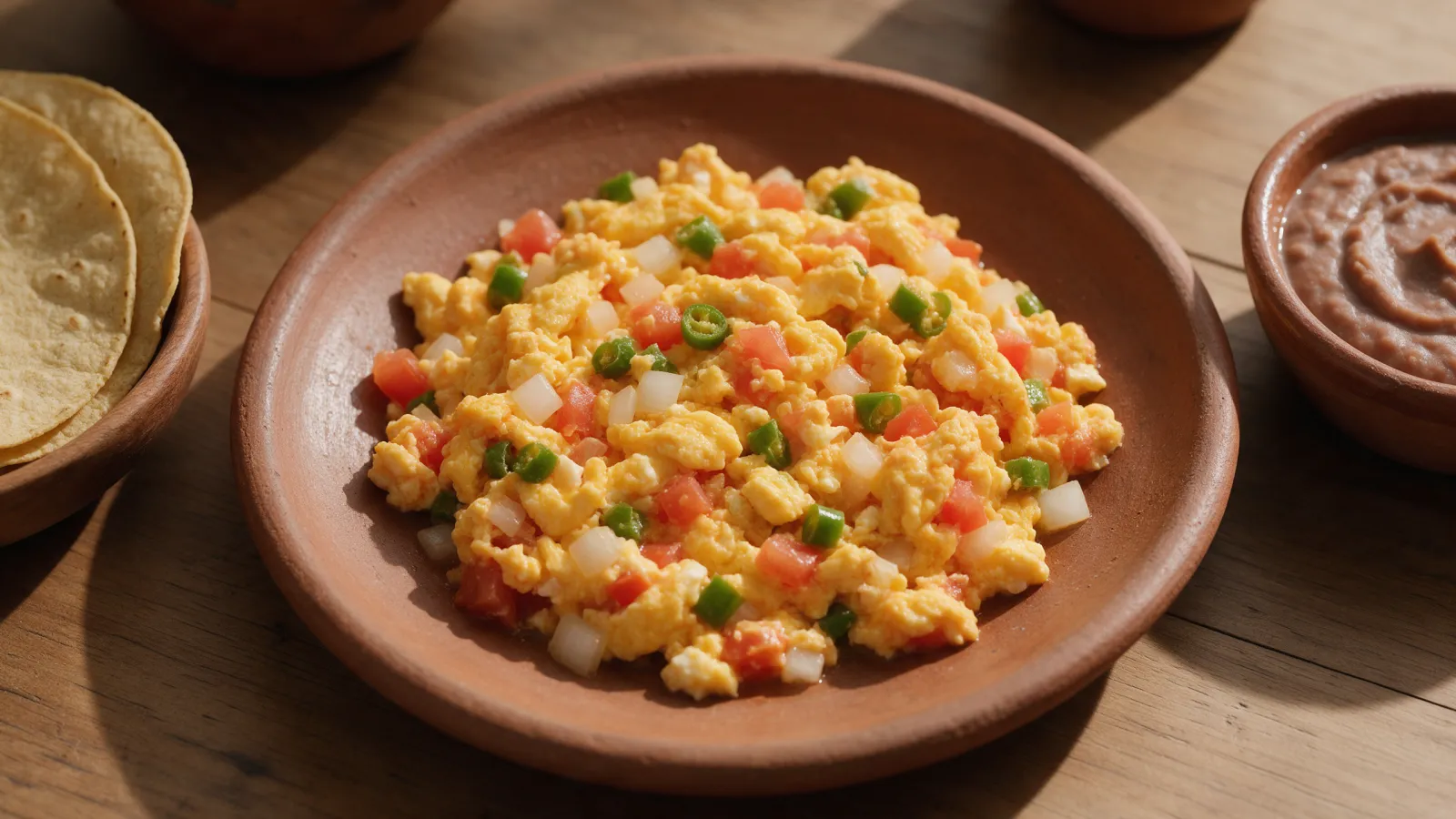

Huevos a la mexicana (WAY-vohs ah lah meh-hee-KAH-nah) are Mexico’s everyday scrambled eggs: eggs cooked into a quick sauté of diced tomato, white onion and fresh green chile, eaten with warm corn tortillas and beans. The name means “Mexican-style eggs,” and in Mexican cooking “a la mexicana” is shorthand for anything made with tomato, onion and green chile, the red, white and green of the flag. The recipe is simple. The thing that goes wrong is water: tomato releases a lot of it, and if the eggs go in too early you get pale curds sitting in a pink puddle. Four minutes of cooking the tomato first fixes that.
What are huevos a la mexicana, and are they worth making?
How do you make huevos a la mexicana? Soften 60 g (2 oz) of diced white onion in 1 tbsp of oil for 3 minutes, add 2 sliced serrano chiles for 1 minute, then cook 300 g (10½ oz) of seeded, diced tomato over medium-high heat for 4 minutes until its juice evaporates. Add 8 beaten eggs over medium-low heat and stir slowly for 2 to 3 minutes until no liquid egg remains. Ready in 20 minutes for 4 servings.
They’re worth it if you want a breakfast with more going on than plain scrambled eggs and you have 20 minutes, not 40. The tomato cooks down sweet, the onion goes soft, and the serrano adds a clean, green heat that sits behind everything rather than on top. Wrapped in a corn tortilla with a spoonful of beans, it’s a full meal for very little money.
Good for. A weekday breakfast for 2 to 4 people, breakfast tacos to eat on the way out, or a relaxed brunch if you cook the vegetable base the night before.
Not ideal for. Anyone who wants a whole egg with a runny yolk, which is a different dish, huevos rancheros with ranchero sauce. Or a buffet where the eggs will sit out for more than 30 minutes; scrambled eggs dry out and weep.
Time. 20 minutes total, 10 chopping and 10 at the stove. Difficulty, easy, as long as you don’t rush the tomato.
Ingredients, and how to keep the eggs from going watery
Everything for 4 is on the recipe card: 2 eggs per person, which is the usual portion with tortillas. If the eggs are the whole breakfast, plan on 3 each. Only three ingredients need any thought.
Tomatoes, seeded and cooked dry
Roma or plum tomatoes have more flesh and less jelly than round slicing tomatoes, which makes them the better choice. Even so, a good part of their water sits in the seeds and the jelly around them, so scoop that out: in my kitchen, 300 g (10½ oz) of whole Romas gives about 230 g (8 oz) of flesh.
Then the flesh goes into the pan over medium-high heat for 4 minutes with half the salt, which draws the water out faster. You’ll see pink juice pool in the pan first. Keep stirring until it’s gone, the cubes are soft but still holding their shape, and a spoon dragged across the bottom leaves a clean, dry line. That’s the moment for the eggs.
In winter, canned is better than fresh. Pale supermarket tomatoes in January are mostly water. A 400 g (14 oz) can of diced tomatoes, drained well in a sieve, leaves me about 250 g (9 oz) of tomato; it’s a little sweeter and needs 2 minutes less in the pan.
Serrano chiles, and how hot this is
With two serranos, seeds in, I’d call the heat medium, about 2 on a scale of 5. Most of the heat lives in the white ribs and seeds, so scraping those out takes it down a notch. Swap them for a single jalapeño and the heat drops to about 1, with a grassier flavor.
US supermarkets with a Latin section usually stock both. In the UK, serranos are hard to find: jalapeños turn up in larger supermarkets, or use half a fresh red chilli, seeded. Avoid bird’s eye chillies unless you want it much hotter than the Mexican original.
Eggs and salt
Large eggs, about 50 g (1¾ oz) each out of the shell. Beat them only until combined, around 20 seconds; whisking in lots of air makes the curds drier. Split the salt, half on the tomato and half with the eggs, ½ tsp in total.
Pan and spatula
A 26 cm (10 in) nonstick skillet is right for 8 eggs; for 4, a 20 cm (8 in) pan. A silicone spatula for pushing the curds. Well-seasoned cast iron works with a little extra oil. Stainless steel will stick.
The order of work, and quantities from 2 to 20
20 minutes, all of it hands-on. Onion, chile, tomato, eggs, in that order, each one going in only when the last has done its job.
What to look for at each stage:
- Onion, 3 minutes over medium heat — translucent and soft at the edges, no golden color.
- Chile, 1 minute — it smells green and catches slightly at the back of your nose.
- Tomato, 4 minutes over medium-high — juice released, juice gone, dry line on the pan.
- Eggs, 2 to 3 minutes over medium-low — large soft folds, no liquid egg in sight, still glossy. Off the heat now.
One pan, two heat levels
For a family where the kids don’t do chile, cook the onion and tomato without it, set a quarter of that base aside, then add the sliced chile to the rest for a minute before carrying on. In a small pan, scramble two eggs into the kids’ portion; the other six go into the grown-ups’ pan. The lazier option: drop a whole serrano, slit lengthwise, into the oil with the onion and fish it out before the eggs go in. You get the aroma and almost none of the heat.
Scaling up
| People | Eggs | Tomatoes | Onion | Serranos | Oil |
|---|---|---|---|---|---|
| 2 | 4 | 150 g (5 oz) | 30 g (1 oz) | 1 | ½ tbsp |
| 4 | 8 | 300 g (10½ oz) | 60 g (2 oz) | 2 | 1 tbsp |
| 6 | 12 | 450 g (1 lb) | 90 g (3 oz) | 3 | 1½ tbsp |
| 12 | 24 | 900 g (2 lb) | 180 g (6 oz) | 6 | 3 tbsp |
| 20 | 40 | 1.5 kg (3⅓ lb) | 300 g (10½ oz) | 10 | 5 tbsp |
Everything scales except the pan. A 26 cm (10 in) skillet takes 8 eggs at most and a 30 cm (12 in) one about 12. More than that and the layer is too thick: the bottom dries out before the top sets.
For a brunch of 12 to 20, cook the whole onion, chile and tomato base the night before, until dry. Cool it and refrigerate within 2 hours; it keeps 3 to 4 days. On the day, warm about 75 g (2½ oz) of base per 4 eggs and scramble in batches of 8, around 4 minutes each. Serve each batch as it’s done, on a warm platter.
Food safety, common mistakes and allergens
How done is done. USDA FSIS lists 160°F (71°C) as the safe temperature for egg dishes, and the FDA’s plain-language version for scrambled eggs is that they should not be runny. That matters most for young children, older adults, pregnant women and anyone with a weakened immune system, the groups the FDA singles out. Cooked through to the glossy-but-set stage, this dish meets that rule.
Raw eggs go in their carton in a fridge at 40°F (4°C) or below and are best used within 3 weeks, according to the FDA.
Mistakes I see, and the fix:
- Watery eggs → the eggs went in while the tomato was still juicy, or the seeds stayed in. Seed it, cook it dry.
- Dry, crumbly eggs → heat too high or constant stirring. Medium-low, 20 seconds untouched, slow pushes.
- A puddle forms on the plate after 5 minutes → overcooked; the proteins tighten and squeeze out water. Pull the pan while the eggs still shine.
- Tastes of fried onion → it browned. 3 minutes over medium, translucent only.
- Too hot → seeds and ribs left in. Scrape them out, switch to jalapeño, or use the whole-chile trick.
Heat level. 2 out of 5 with 2 serranos, 1 with a seeded jalapeño, close to 0 with the whole chile removed.
Kids. They usually love it with their portion set aside before the chile goes in. Soft, mild and easy to eat in a tortilla.
Allergens. Egg. No dairy and no gluten; with 100 % corn tortillas the plate is gluten-free.
Which version should you make?
- Short on time → base made the night before; 6 minutes at the stove for 4.
- For kids or anyone who avoids chile → a quarter of the base set aside, or the whole-serrano trick.
- Hotter → 3 serranos with seeds, or one dried chile de árbol crumbled into the oil before the onion. For heat with crunch, finish each plate with a teaspoon of homemade salsa macha with fried árbol chiles.
- With ham or chorizo → 100 g (3½ oz), diced and browned for 2 minutes before the onion. Halve the salt.
- Lighter → 4 whole eggs plus 6 whites and ½ tbsp of oil: about 45 kcal less per serving and a little less creamy.
- Vegan → 400 g (14 oz) crumbled firm tofu with a pinch of turmeric, 4 minutes on the base. A different dish on the same flavor foundation.
- Colombian or Venezuelan style → leave out the chile, swap the white onion for 2 green onions (scallions) and eat it with arepas; that’s essentially pericos, and the full Colombian huevos pericos with tomato and scallions recipe covers the Venezuelan version too. A split Colombian cheese arepa filled with the Mexican version is just as good.
What does it cost?
In the US, about $2.81 for 4 servings, roughly 70 cents a plate, counting only eggs and tomatoes at the BLS average prices for August: large eggs at $2.272 a dozen ($1.51 for 8) and tomatoes at $1.977 a pound ($1.30 for 10½ oz). The eggs are more than half the cost; onion and chile add pennies, though there is no BLS series to price them.
In Spain, 8 large eggs cost €2.03 at Mercadona’s price of €3.05 a dozen. In Mexico, at prices from SNIIM, the Mexican government’s market-price service, for Mexico City’s Central de Abasto, the full batch comes to about 26 pesos, and the egg is 64 % of it.
How to serve, store and reheat them
Taste and texture. Large, moist folds of egg with sweet cooked tomato, soft onion and a green heat at the back. Nothing pooling on the plate.
What to serve with them. Warm corn tortillas for making tacos at the table and Mexican refried beans on the side, about 60 g (¼ cup) per person, are the classic pairing. For something brighter, spoon over Mexican salsa verde or a little pico de gallo. And if there are stale tortillas and leftover salsa in the house, make chilaquiles verdes another morning. For something sweet after the eggs, a Mexican concha, the shell-topped sweet bun, and a cup of coffee round off the table.
Fridge. Leftover cooked egg dishes keep 3 to 4 days in the fridge, says the FDA, and shouldn’t sit out longer than 2 hours, or 1 hour above 90°F (32°C). The vegetable base on its own keeps the same, and it’s the part worth making ahead.
Freezer. I don’t freeze the finished eggs; they thaw watery and rubbery. The base without eggs freezes well in 75 g (2½ oz) portions.
Reheating. In a covered skillet over low heat with 1 tsp of water for 2 to 3 minutes, until steaming hot all the way through; USDA FSIS asks for 165°F (74°C) when reheating leftovers. In the microwave, on medium power in 30-second bursts, stirring between them. They come out firmer than fresh, which nobody notices inside a taco with salsa.
Huevos a la mexicana FAQ
What’s in huevos a la mexicana? Eggs scrambled into a sauté of diced tomato, white onion and fresh green chile, usually serrano, with salt. For 4: 8 eggs, 300 g (10½ oz) tomato, 60 g (2 oz) onion and 2 serranos.
Why are my Mexican scrambled eggs watery? The tomato. Seed it and cook it over medium-high heat for 4 minutes until the pan is dry before adding the eggs, then take them off the heat as soon as no liquid egg is left.
Are huevos a la mexicana the same as huevos rancheros? No. Here the eggs are scrambled with chopped vegetables. In huevos rancheros the eggs are fried whole, set on a corn tortilla and covered in a blended, cooked tomato sauce.
Are huevos a la mexicana spicy? Medium with 2 serranos. Use a seeded jalapeño for mild, or cook a whole chile with the onion and remove it for almost no heat.
What can I use instead of serrano chiles in the UK? A jalapeño if you can find one, or half a seeded fresh red chilli. A bird’s eye chilli is much hotter, so use only a small piece.
What do you serve with huevos a la mexicana? Warm corn tortillas and refried beans, plus salsa verde or pico de gallo if you like. Coffee alongside.
How many calories are in huevos a la mexicana? About 195 kcal per 2-egg serving without tortillas, and around 300 with two corn tortillas.
Can you make them ahead? The tomato, onion and chile base keeps 3 to 4 days in the fridge, so make it ahead and scramble the eggs to order. Fully cooked eggs reheat, but they’re firmer.
Nutrition per serving
Per serving of two eggs with their vegetables (no tortillas or beans), worked out ingredient by ingredient from the USDA FoodData Central SR Legacy database, with the tomatoes weighed whole:
- Calories: 195 kcal
- Protein: 14 g
- Carbohydrates: 5 g
- Fat: 13 g, of which 3 g saturated
- Fiber: 1 g
- Sugars: 3 g
- Sodium: 440 mg
The eggs supply 73 % of the calories and the oil 16 %. Two corn tortillas add about 105 kcal, 3 g protein, 21 g carbohydrates and 3 g fiber.
My son Dylan grew up on Venezuelan perico, the same scramble without chile, so the first time I made the Mexican version I set his share aside before the serranos went in, and that habit stuck. What took me longer to learn was patience with the tomato: four minutes, a dry pan, then the eggs. Dry pan first, eggs second. Josnaisis.