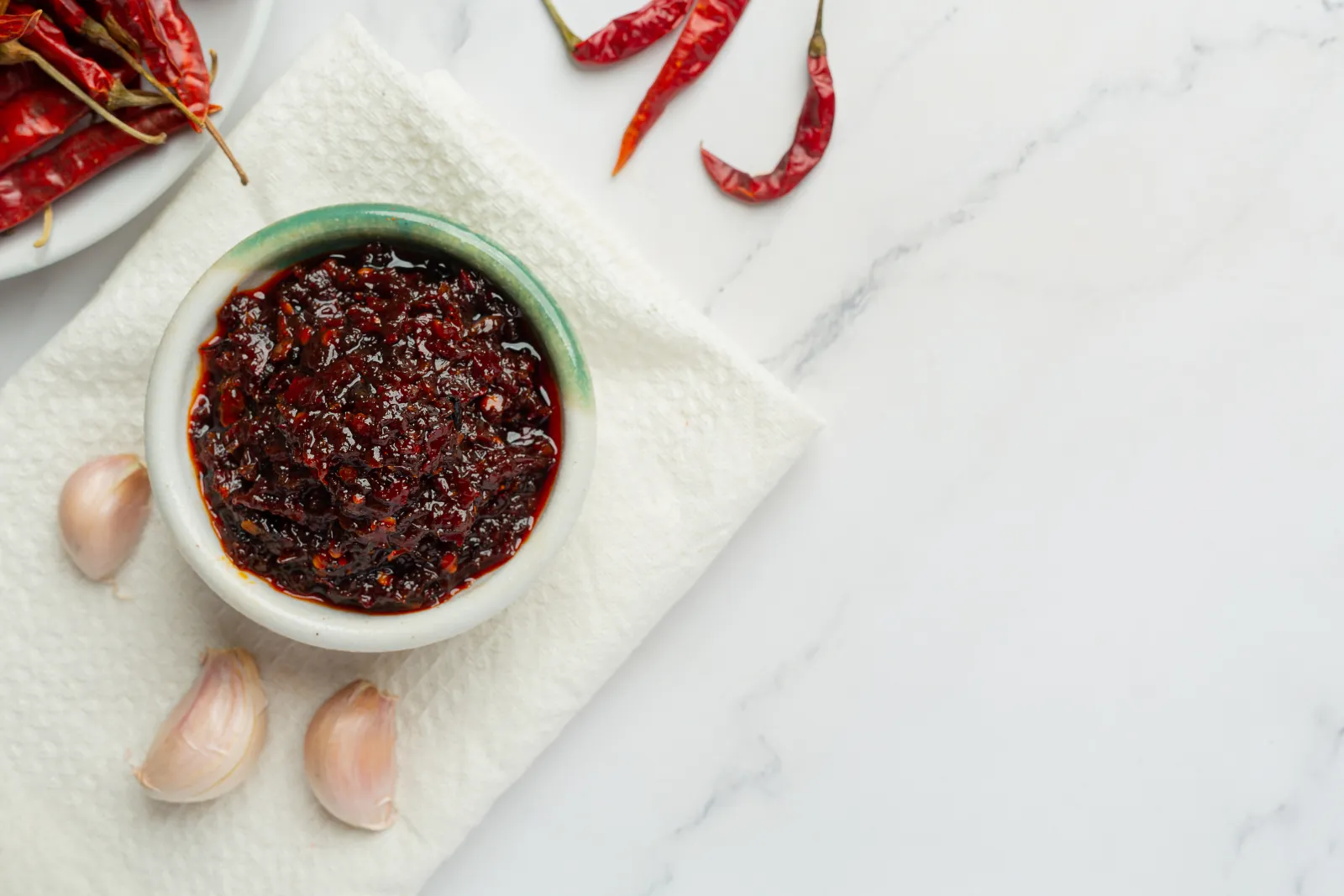

Picture the jar of Chinese chili crisp you keep in the fridge, then swap the Sichuan pepper for smoky Mexican dried chiles and the fried shallots for peanuts and sesame. That is close to salsa macha (SAHL-sah MAH-chah), a chile oil from the Mexican state of Veracruz that Mexican newspaper El Universal says is also eaten widely in Chiapas and Oaxaca. Dried chiles, garlic and nuts are fried in oil and pulsed into a coarse, crunchy relish you spoon over eggs, tacos and almost anything savory. The whole recipe hinges on one minute: the chiles must hit oil that is off the heat, at 250-265°F (120-130°C), or they scorch and turn the batch bitter.
How do you make salsa macha?
How do you make salsa macha at home? Fry raw peanuts and sliced garlic in neutral oil at 300°F (150°C) until pale gold, turn off the heat and wait until the oil falls to 250-265°F (120-130°C). Stir in árbol, guajillo and morita chiles for 30 to 60 seconds, then sesame seeds for 1 minute. Cool, pulse with salt and vinegar, and refrigerate. Ready in 40 minutes for 24 servings (1½ cups, 375 ml).
Is it worth the effort? Yes. About 25 of the 40 minutes are hands-on, and one batch fills a 1½-cup (375 ml) jar that lasts a month in the fridge. You also set the heat level yourself, which no store jar lets you do.
Who it suits. Anyone who already loves chili crisp, cooks who want a third salsa on the taco table beyond red and green, and people looking for a homemade food gift (with a “keep refrigerated” label on it).
Who it may not suit. Anyone who can’t take heat: with seeded chiles de árbol it is properly hot. Anyone with a peanut or sesame allergy, unless you use the seed-only version below. And anyone counting calories closely, because each tablespoon carries about 110 kcal, mostly from oil.
Honest difficulty, easy. The only real skill is timing the chiles. Everything else is slicing and frying.
Salsa macha vs Chinese chili crisp
They share a family resemblance and not much else. Salsa macha uses whole dried Mexican chiles, fried and then pulsed coarse, with garlic and peanuts or sesame, and no Sichuan pepper. Chinese chili crisp is usually built on chile flakes, fried shallot or onion, Sichuan peppercorns for that tingly numbness, and fermented soy beans or MSG for savoriness.
| Salsa macha | Chinese chili crisp | |
|---|---|---|
| Chiles | whole dried árbol, guajillo, morita | chile flakes |
| Crunch from | peanuts, sesame, fried garlic | fried shallot or onion, sometimes soybeans |
| Tingle | none | Sichuan peppercorn |
| Main flavor | toasted chile, nutty, smoky | savory, salty, a little sweet |
If you are using salsa macha as a chili crisp substitute, expect more chile flavor and less umami. About ½ teaspoon (2.5 ml) of soy sauce per plate closes the gap.
The chiles and other ingredients, with US and UK swaps
For 1½ cups (375 ml) you need 1 cup (240 ml) of oil, about 2 oz (55 g) of dried chiles of three kinds, 8 garlic cloves, ½ cup (70 g) of peanuts, 2 tablespoons of sesame seeds, salt and vinegar.
Why three chiles. Chile de árbol (1 oz / 30 g) is the heat: thin, bright red and clean-tasting. Guajillo (½ oz / 15 g) barely stings but gives the brick-red color and body. Morita (⅓ oz / 10 g) is a smoked, ripened jalapeño, a cousin of the chipotle, and adds smoke and a little sweetness. Plenty of cooks use árbol alone. I like the blend because I get heat, color and smoke in one jar.
| Ingredient | What it does | US swap | UK swap | What changes |
|---|---|---|---|---|
| Chile de árbol | heat | Latin aisle bags; or dried Thai chiles | dried bird’s eye chillies | Thai and bird’s eye chiles are hotter; start with ¾ oz (20 g) |
| Guajillo | color, body | dried New Mexico or California chiles | ancho, or smoked paprika (1 tsp) stirred in at the end | paprika gives color but no crunch |
| Morita | smoke | chipotle chiles, dried | 1 canned chipotle in adobo, or 1 tsp chipotle paste | adobo adds moisture; the salsa softens and keeps less well |
| Raw peanuts | crunch, nuttiness | raw Spanish or Virginia peanuts | unroasted peanuts from a wholefood shop | roasted salted ones work; add them with the chiles and drop the salt |
| Neutral oil | carries everything | canola, corn, sunflower | rapeseed or sunflower | extra-virgin olive oil tastes of olive and clouds in the fridge |
Equipment
A small 6- to 7-inch (16 to 18 cm) saucepan, so 1 cup of oil is deep enough to cover the chiles, a slotted spoon, a blender or small food processor, and a 14 oz (400 ml) glass jar with a lid. An instant-read or candy thermometer takes the guesswork out; without one, follow the visual cues below. No blender? A mortar and pestle gives a more rustic, traditional result.
Oil temperature, and how to tell each stage is right
Think of it in three heat zones: 300°F (150°C) for the slow browners (peanuts and garlic), 250-265°F (120-130°C) off the heat for the chiles, and residual heat for the sesame. None of these numbers is an official standard. They are what I measure in my kitchen and what keeps my batches from turning bitter.
- Oil at 300°F (150°C) without a thermometer → a test peanut fizzes steadily. If it spits and roars, it is too hot.
- Garlic done → straw-colored, pale gold, after 3 to 4 minutes at 300°F. If it is already brown in the pan, it will end up dark and bitter from carry-over heat.
- Oil ready for chiles → 2 to 3 minutes after you kill the heat, at around 250-265°F. A test piece of chile sizzles gently instead of curling instantly.
- Chiles done → one shade darker, red to brick, with a toasty smell, in 30 to 60 seconds at 250-265°F. Black with sharp smoke means start that stage again.
- Texture → visible ⅛-inch (2 to 3 mm) pieces suspended in the oil after 6 to 10 pulses. A smooth paste means too many pulses.
Is salsa macha safe to keep? Garlic in oil and the fridge
Homemade salsa macha belongs in the fridge, at 40°F (4°C) or below, never in the pantry. Garlic is a low-acid food, and covering it in oil creates an oxygen-free setting where Clostridium botulinum, the bacterium behind botulism, can produce its toxin, as Oregon State University (OSU) Extension explains. Extension guidance from OSU, Cornell and Michigan State limits raw or dried garlic in oil to 4 days in the fridge. For salsa macha, where the garlic is fried to golden, OSU’s own recipe gives up to 1 month refrigerated at 40°F (4°C) and up to 2 months frozen, and that is the window I follow.
Store-bought jars can sit on a shelf because they are formulated for it. After botulism outbreaks linked to garlic in oil, the FDA asked in 1989 for acidifying agents in commercial garlic-in-oil products, as the CDC’s MMWR report records. A home batch has no such safeguard, and botulism does not reliably change the smell or look of food. If a jar spent the night on the counter, throw it out.
Make ahead, freezing and gifting
Stem and seed the chiles up to a day ahead and keep them in a sealed bag. Slice the garlic just before frying. The finished salsa tastes better on day two, once the oil has taken on all the color. For gifts, use 4 oz (120 ml) jars, write the date on the lid and add “Keep refrigerated, use within 1 month.” For longer storage, freeze it in small jars or an ice-cube tray and thaw overnight in the fridge.
Scaling for a crowd
As a condiment, count 1 to 2 tablespoons (15-30 ml) per person at a taco night. One batch covers 12 people; for 20, make 1½ batches: 1½ cups (360 ml) oil, 1½ oz (45 g) árbol, ¾ oz (22 g) guajillo, ½ oz (15 g) morita, 12 garlic cloves, ¾ cup (105 g) peanuts, 3 tablespoons sesame, 1½ teaspoons salt and 1½ tablespoons vinegar. Fry the chiles in batches of about 1 oz (30 g); a big handful drops the oil temperature unevenly, and some pieces stay raw while others burn.
Mistakes that ruin salsa macha
- Chiles fried on the heat → bitter salsa. Burner off, oil down to 250-265°F (120-130°C), 30 to 60 seconds.
- Garlic pulled too late → it keeps browning after the heat is off. Take it to pale gold, no further.
- Over-blending → a smooth chile paste instead of a crunchy oil. Short pulses, 6 to 10 of them.
- Too few solids under the oil → dry, stale bits on top. Add 2 or 3 tablespoons (30-45 ml) of warm oil to cover.
- Wet spoon in the jar → water in an oil-based salsa invites mold. Always use a clean, dry spoon.
Heat level, 4 out of 5 with seeded árbol chiles; 3 out of 5 with seeded-out árbol; 2 out of 5 with ½ oz (15 g) árbol and 1 oz (30 g) guajillo. The burn arrives a few seconds after the first bite.
Allergens. Peanuts and sesame, both on the list of major food allergens in the US and the UK. It is naturally gluten-free, dairy-free and vegan. I would not put it on a young child’s plate; serve it on the side.
Which salsa macha should you make?
- Short on time → árbol, garlic and sesame only, no peanuts. About 20 minutes, and hotter.
- Nut-free → 1¾ oz (50 g) pumpkin seeds plus ¾ oz (20 g) hulled sunflower seeds, fried like the peanuts for 2 minutes. For a sesame allergy, leave out the sesame too and double the pumpkin seeds.
- Milder → ½ oz (15 g) seeded árbol and 1 oz (30 g) guajillo. Redder and sweeter.
- Smokier → ⅔ oz (20 g) each of morita and árbol.
- With almonds → ½ cup (70 g) raw almonds instead of peanuts. Softer flavor, higher cost.
- Regional takes → the Larousse Cocina dictionary, quoted by El Universal, describes it as fried serrano and morita chiles ground in a molcajete with garlic and salt, no nuts at all; some Oaxacan versions add toasted chicatana ants.
What salsa macha costs
There is no official US or UK price series for dried chiles, peanuts or cooking oil, so I won’t give you a dollar figure I can’t back up. For scale, Mexico’s consumer protection agency, Profeco, priced a similar homemade batch (1 cup of oil, about 3½ oz / 100 g of árbol chiles and a few spoonfuls of peanuts) at about 48 Mexican pesos with Mexico City prices from August 2025.
What pushes the price up. Outside Mexico, the chiles: supermarket spice-aisle jars hold a fraction of an ounce, while 4 to 8 oz bags from a Latin grocery or online cost far less per ounce. After that, the oil and the nut. Swap canola for extra-virgin olive oil and peanuts for almonds and the jar costs several times more.
Real yield. 1½ cups (375 ml), about 24 tablespoons, which in my house lasts three to four weeks, right inside the fridge window.
How to serve it
Stir the jar from the bottom, since the crunchy bits sink, and take oil and solids in the same spoon. It is a condiment, not a dip: a teaspoon or two per plate.
Spoon it over huevos rancheros or a cheesy Mexican quesadilla, drizzle it on an Oaxacan tlayuda, or finish carnitas tacos and tacos al pastor with it, where it adds a crunch that a smooth red taco salsa can’t. For guests who prefer bright and mild, put a bowl of salsa verde beside it. Beyond Mexican food, I use it on avocado toast, vegetable soups, noodles and pizza.
If the oil turns cloudy or thick in the fridge, that is normal. Leave the portion you need out for 10 minutes and it loosens. There is no need to reheat it; spoon what you need onto a plate and put the jar straight back in the fridge.
Frequently asked questions
What is salsa macha made of? Dried chiles (usually chile de árbol, often with guajillo or morita), garlic, peanuts or sesame seeds, oil and salt, sometimes a splash of vinegar. Everything is fried and pulsed coarse.
Is salsa macha the same as chili crisp? No. Salsa macha uses whole dried Mexican chiles, garlic and peanuts or sesame, with no Sichuan pepper. Chinese chili crisp uses chile flakes, fried shallots, Sichuan peppercorns and fermented soy.
Does salsa macha need to be refrigerated? Homemade, yes. Garlic in oil is a low-acid, oxygen-free mix where botulism bacteria can grow. Keep it at 40°F (4°C) or below.
How long does homemade salsa macha last? Up to 1 month in a fridge at 40°F (4°C) and up to 2 months in the freezer, the times Oregon State University Extension gives for its recipe.
Why did my salsa macha turn bitter? The chiles burned, almost always because they went into oil still on the burner or hotter than about 340°F (170°C). Fry them off the heat, at 250-265°F, for 30 to 60 seconds.
What can I use instead of chile de árbol in the UK? Dried bird’s eye chillies, starting with ¾ oz (20 g) because they run hotter. Mexican chiles are easy to order online from UK specialist shops.
Can I make salsa macha without peanuts? Yes. Use pumpkin and sunflower seeds, or just sesame and garlic. It stays just as crunchy.
How spicy is salsa macha? With seeded árbol chiles, about 4 out of 5. Seed the árbol and add more guajillo to bring it down to 2 or 3 out of 5.
Nutrition per tablespoon
Per tablespoon (15 ml, one of 24 servings), calculated from USDA SR Legacy values per 100 g for canola oil, sun-dried hot chile, dried ancho (standing in for guajillo and morita), garlic, raw peanuts, sesame seeds and salt:
- Calories: 110 kcal
- Protein: 1 g
- Carbohydrates: 2 g
- Fat: 11 g
- Saturated fat: 1 g
- Fiber: 1 g
- Sodium: 100 mg
Nearly all the sodium comes from the teaspoon of salt. Tip a little oil off the spoon and you cut calories without losing much flavor.
I grew up in Venezuela with chiles pickled in vinegar, and in Colombia my table sauce is fresh chopped ají, so frying dried chiles in oil was new to me. My first batches were bitter every time, because I added the chiles while the pan was still on the flame. Now I turn off the heat, wait, count to sixty, and the jar goes straight into the fridge with the date on the lid. Respect the minute and the chiles will reward you. Josnaisis.