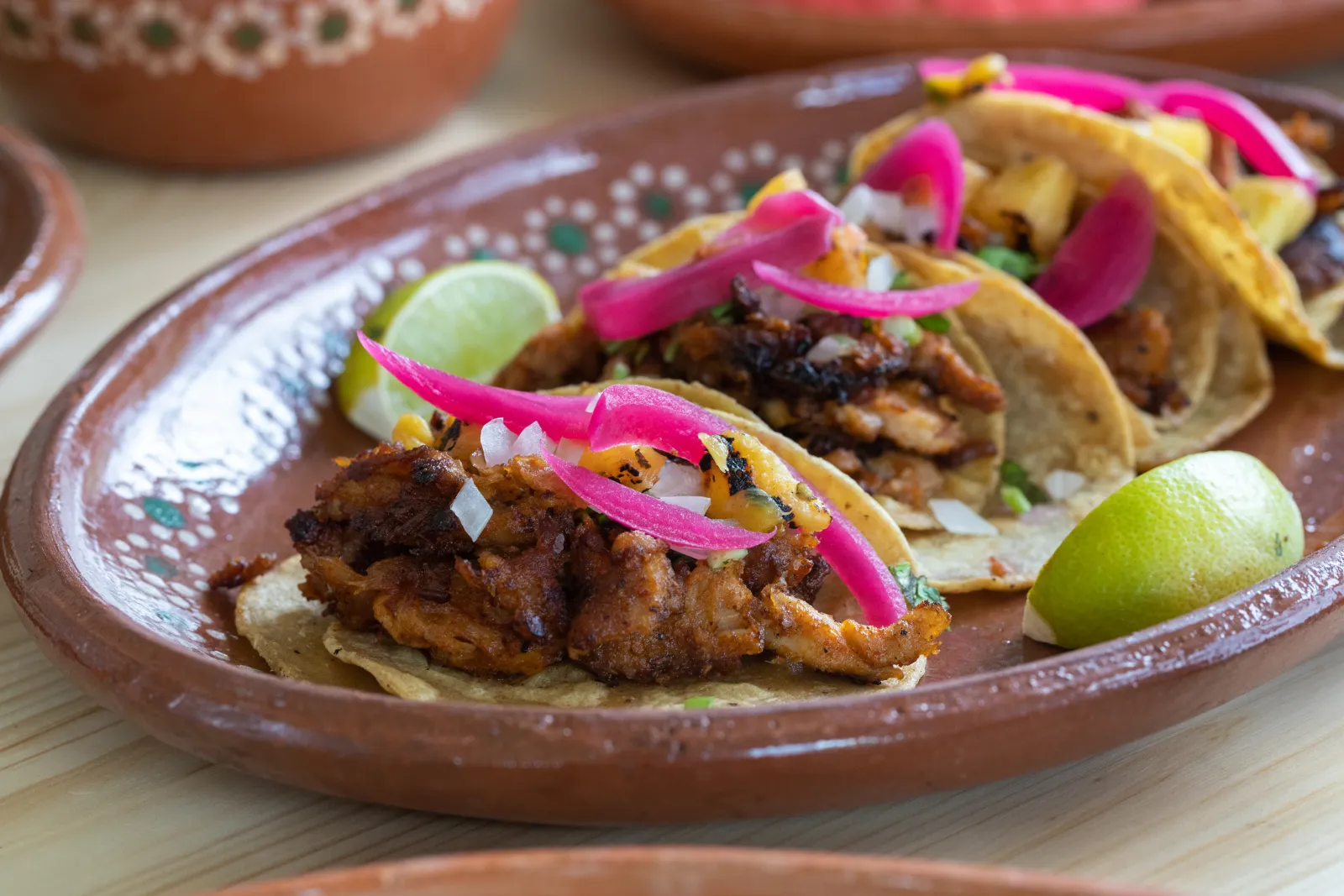

Tacos al pastor (ahl pahs-TOHR, “shepherd style”) are Mexico City’s most famous street taco: thin slices of chile-marinated pork stacked on a vertical spit called a trompo, roasted in front of a flame, shaved straight onto small corn tortillas and topped with pineapple, onion and cilantro. You almost certainly don’t own a trompo. You don’t need one. What the spit really gives you is pork that is charred and crisp at the edges and juicy in the middle, and a cast-iron skillet gets you there in 2-minute batches, after a 12-hour soak in a brick-red paste of guajillo, ancho and achiote.
Can you make tacos al pastor without a trompo?
How do you make tacos al pastor at home? Blend toasted, soaked guajillo and ancho chiles with achiote paste, pineapple juice, vinegar, garlic and spices, coat 2.2 lb (1 kg) of pork shoulder sliced ⅕ in (5 mm) thick, and refrigerate 12 hours. Next day, sear it in 4 batches in a smoking-hot cast-iron skillet, 2 minutes untouched and 1-2 more, chop, and serve in corn tortillas with seared pineapple, onion, cilantro and salsa verde. 790 minutes (70 of them hands-on) for 6 servings.
Yes, and the result is closer to the taquería than you’d expect, as long as you respect two things: thin slices and very high heat. The trompo matters most for crowds, because it cooks a lot of meat at once without anyone standing over it. For that there’s an oven version further down.
Is it worth it? For a Friday dinner or a taco party, absolutely: all the messy work happens the night before. For a same-day craving, not really. With less than 4 hours in the marinade, the outside tastes of chile and the inside tastes of plain pork.
Real time. 790 minutes on paper, but only 70 minutes of actual work: 40 the evening before, 30 on the day. The rest is the fridge doing its job.
Honest difficulty, medium. Blending a marinade is easy. Learning to keep the pan hot, and to cook in small batches when you’re tempted to dump everything in, takes one or two tries.
The dish descends from shawarma. Food historian Jeffrey Pilcher traces it to Lebanese immigrants in Puebla who sold lamb “tacos árabes” from vertical spits; Mexico City cooks switched to pork in a chile and achiote marinade and added the pineapple.
Your shopping list, with US and UK swaps
Everything in the marinade is shelf-stable except the pork, so you can buy it once and make al pastor twice. For 2.2 lb (1 kg) of meat: 4 guajillo chiles (1 oz / 28 g), 2 ancho chiles (1.2 oz / 34 g), 1.75 oz (50 g) achiote paste, ½ cup (120 ml) pineapple juice, ¼ cup (60 ml) vinegar.
- Guajillo chiles are long, smooth, brick-red dried chiles: fruity, mild, the color base.
- Ancho chiles are dried poblanos, wrinkled and nearly black: sweet, raisin-like, barely hot.
- Achiote paste is ground annatto seed with vinegar, garlic and spices, sold in small bricks. It gives al pastor its signature orange-red and an earthy, slightly bitter note.
Where to buy. In the US, achiote paste (El Yucateco and other brands, in 3.5 oz / 100 g blocks) and dried chiles sit in the Mexican aisle of most Latin grocers and Walmart. In the UK, Cool Chile Co sells achiote paste and whole guajillos; at Real Foods a 50 g bag of guajillos cost £4.29 when I checked. One block of achiote covers two batches, and dried chiles keep for months in a sealed jar.
Why canned pineapple juice goes in the marinade
Fresh pineapple contains bromelain, an enzyme that breaks down protein. Over a 12-hour soak it can turn the surface of the pork mealy. Canned and bottled juice is pasteurized, and heat deactivates the enzyme, so it adds sweetness and acidity without the mush. Save the fresh pineapple for the skillet, 2 minutes a side, and for the top of the taco.
The best cut of pork for al pastor
Pork shoulder (Boston butt) is the best choice: about 18 g of fat per 100 g raw according to USDA data, marbled through the meat, so the edges crisp and the slices stay juicy even if you overshoot by a minute. In the UK, ask the butcher for boneless shoulder or collar.
| Cut | Fat per 100 g raw (USDA) | How to cook it for al pastor |
|---|---|---|
| Shoulder, Boston butt | 18 g | ⅕ in (5 mm) slices, standard timing |
| Loin, with its fat | 12.6 g | slice thinner, about ⅙ in (4 mm), pull as soon as it browns |
| Leg, trimmed lean | 5.4 g | add 1 tbsp oil to the marinade, 1 minute a side after the first sear |
Freeze the shoulder for 30 minutes before slicing. Partly frozen pork slices cleanly; at room temperature it slides under the knife and you end up with uneven pieces that cook at different speeds.
How long to marinate al pastor
At least 4 hours, ideally 12, no longer than 48. At 4 hours the paste colors the surface; by 12 it has worked through a ⅕ in (5 mm) slice. After 48 hours the vinegar starts to soften the outside. USDA guidance allows marinated pork chops and roasts up to 5 days in the fridge, so the 48-hour limit is about texture, not safety. Marinate in the fridge, never on the counter, and don’t reuse marinade that touched raw pork unless you boil it first.
Two details that change the marinade more than any spice:
- Toast the chiles 30 seconds a side, no longer. They should smell like dried fruit. Black spots mean bitterness you can’t fix.
- Throw out the soaking water. It carries the chiles’ bitterness; blend with fresh water if you need to loosen the paste.
Three ways to cook al pastor without a spit
Cast-iron skillet, the best char for 6
Heat a 11-12 in (28-30 cm) cast-iron skillet over the highest heat for 3-4 minutes; a drop of water should vanish in a second. Sear 9 oz (250 g) per batch, single layer, 2 minutes untouched, flip, 1-2 minutes more. Then chop everything on the board and return it to the pan for 30 seconds with the pineapple: the second hit crisps the freshly cut edges. A nonstick pan can’t take this heat and won’t char the same way. Open a window; it will smoke.
Under the broiler, for 8 to 12
Lay the slices in a single layer on a rack over a sheet pan, 2.2 lb (1 kg) per pan, about 4 in (10 cm) from the broiler. 10-15 minutes, flipping halfway, until the edges darken. It chars less than the skillet but cooks a whole kilo at once. Give the chopped meat 1 minute in a hot pan before serving to sharpen the edges.
A stacked homemade trompo, for 12 to 20
Pack the marinated slices tightly into a loaf pan, or thread them onto a 10 in (25 cm) skewer planted in half an onion in a baking dish, with a pineapple round on top. Roast at 325°F (165°C) for about 2 hours, the timing of Kenji López-Alt’s loaf-pan method, until the center passes 145°F (63°C). Rest 10 minutes, shave thin slices down the sides like a taquero, and crisp them 1-2 minutes in a very hot skillet.
Who each method is for
- Cooking for 4 to 6, want the best char → skillet.
- No cast iron → broiler, then a minute in whatever pan you have.
- A party of 12 or more → the stacked trompo; it cooks hands-off while you set the table.
- Short on time → 4-hour marinade and ⅛ in (3 mm) slices. Less flavor in the center, same char.
- Chicken al pastor → 2.2 lb (1 kg) boneless thighs, same marinade, 6 hours, 3-4 minutes a batch, cooked to 165°F (74°C).
- Vegetarian → ½ in (1 cm) slabs of oyster or portobello mushrooms and cauliflower florets, 1 hour in the same marinade, very hot pan.
Make-ahead plan for a Friday taco night
Thursday evening, 40 minutes. Toast and soak the chiles, slice the pork, blend and coat, make the salsa verde. Everything goes in the fridge.
Friday, 30 minutes. Chop onion and cilantro, sear the pineapple, cook the pork in batches, warm tortillas. While the batches come off, keep the cooked pork covered in a 200°F (95°C) oven; USDA asks for hot food to stay at 140°F (60°C) or above.
Freeze ahead. Marinated raw pork freezes very well. Separate the slices with parchment, freeze flat, and thaw overnight in the fridge: al pastor in 30 minutes on any weeknight.
Tacos al pastor for a crowd of 20
I plan 3 tacos per person and 2 oz (55 g) of raw pork per taco, about 5.8 oz (165 g) per guest. If there are other dishes on the table, 2 tacos each is enough.
| Guests | Pork shoulder | Guajillo + ancho | Achiote | Tortillas | Fresh pineapple | Method |
|---|---|---|---|---|---|---|
| 6 | 2.2 lb (1 kg) | 4 + 2 | 1.75 oz (50 g) | 18 + 4 spare | 10.5 oz (300 g) | skillet, 4 batches |
| 12 | 4.4 lb (2 kg) | 8 + 4 | 3.5 oz (100 g) | 36 + 6 | 1.3 lb (600 g) | 2 skillets or broiler |
| 20 | 7.3 lb (3.3 kg) | 13 + 7 | 5.8 oz (165 g) | 60 + 10 | 1 large pineapple | stacked trompo or 2 sheet pans |
For 20, multiply the marinade by 3.3 and use two containers. In a skillet that would be 13 batches, nearly an hour at the stove; the stacked trompo cooks on its own for 2 hours and you only crisp the shaved slices at the end. Triple the salsa verde: 2 lb (900 g) tomatillos and 6 serranos.
At BLS US city average prices for August 2026, the pork category that includes shoulder and roasts was $3.74 per pound and pork chops, which is how loin is usually sold, $4.24 per pound. The pork for 6 costs $8.24, about $1.37 a person. Chiles, achiote, tortillas and pineapple aren’t tracked by the BLS, so they’re not on the chart; the achiote and chiles are the pricey part only the first time.
Mistakes that ruin homemade al pastor
- Gray, boiled pork → crowded pan or low heat. 9 oz (250 g) batches, maximum heat.
- Bitter marinade → burnt chiles or the soaking water went into the blender.
- Mealy surface → fresh pineapple in a long marinade. Use canned juice.
- Dry, tough slices → loin or leg cut too thick or cooked too long. Thinner slices, out as soon as they brown.
- Marinade burns before the pork cooks → too much paste clinging to each slice. Let the excess drip off before it hits the pan.
- Bland inside → under 4 hours of marinating, or slices over ½ in (1 cm) thick.
Spice level, kids and allergens
Spice, 1 out of 5. Ancho is around 1,000 Scoville units and guajillo around 5,000 on Food.com’s chart, both mild. The heat lives in the salsa: serranos run 7,000-25,000, chile de árbol about 25,000. Keep salsa on the side and everyone is happy; for the hot one, a taqueria red salsa with charred tomatoes and chiles de árbol lets each person decide how much.
Kids usually love it: the pork is sweet, tangy and barely hot. Chop it smaller for them and make sure no whole clove survived the blender.
Allergens. No gluten, dairy, egg, nuts or fish, provided the tortillas are 100% corn. Some achiote pastes contain flour, so check the label if you’re cooking for someone with celiac disease.
How to serve and store al pastor
Serving. Small corn tortillas warmed on a dry pan 30 seconds a side, about 2 oz (55 g) of pork, a few cubes of pineapple, onion and cilantro, with salsa and lime on the table. Refried or black beans are the natural side; Venezuelan black beans cooked thick work well. To drink, a cold Colombian soursop juice or a condensed milk lemonade. For a bigger Mexican spread, pozole rojo shares the guajillo and ancho base, and mole poblano takes the ancho somewhere far more complex. On a grilling night, Colombian beef skewers use the same marinate-overnight, high-heat logic, and Venezuelan pernil is marinated pork done low and slow in the oven.
Fridge. Per USDA FSIS, cooked pork shouldn’t sit out longer than 2 hours and keeps 3-4 days at 40°F (4°C) or below.
Freezer. Cooked al pastor keeps 2-6 months, but raw marinated pork is the better thing to freeze (see the make-ahead section).
Reheating. In a very hot skillet for 1-2 minutes, to 165°F (74°C): the edges crisp up again. The microwave heats it but softens it.
Frequently asked questions
What is al pastor meat made of? Pork, marinated in dried chiles, achiote, pineapple juice and vinegar. Taquerías mostly use shoulder; at home, shoulder sliced ⅕ in (5 mm) thick is the best cut.
What does “al pastor” mean? “Shepherd style” in Spanish. The name is usually tied to the spit-roasted lamb of the Lebanese version that came before the pork one.
Can I make al pastor in the oven? Yes. Under the broiler, 10-15 minutes per sheet pan, flipping halfway; or stacked in a loaf pan at 325°F (165°C) for about 2 hours, then shaved and seared.
What can I use instead of achiote paste? 1 tbsp sweet paprika plus an extra tablespoon of vinegar matches the color but not the earthy flavor. Order the real paste online if you can; a 3.5 oz (100 g) block makes two batches.
Is al pastor spicy? Barely. The chiles in the marinade are mild; the heat comes from the salsa you add.
What is the difference between al pastor and carnitas? Al pastor is marinated in a red chile and achiote paste and charred quickly; carnitas is unmarinated pork slowly cooked in its own fat until tender, then crisped.
How long can al pastor marinate? 4 hours minimum, 12 ideally, 48 at most for texture. Always in the fridge.
Nutrition per serving
Per serving of 3 tacos, calculated ingredient by ingredient with USDA FoodData Central (SR Legacy) and the quantities above, without subtracting the fat left in the pan. Achiote paste isn’t in that database and is left out, as are the salsa and lime:
- Calories: 673 kcal
- Protein: 35 g
- Carbohydrates: 50 g
- Fat: 38 g, of which 11 g saturated
- Fiber: 8 g
- Sodium: 732 mg
That’s roughly 224 kcal a taco. Most of the fat comes from the shoulder, and some of it stays in the skillet, so the real number is a little lower. Loin brings fat down by about 9 g per serving.
I learned this dish as an outsider, and the instinct I had to unlearn was the Venezuelan one: in my family, marinated pork means a pernil that spends hours in a low oven. Al pastor wants the opposite, minutes instead of hours and a pan hot enough to smoke. Once that clicked, the leftover marinade in my freezer became the quickest dinner I own. Josnaisis.