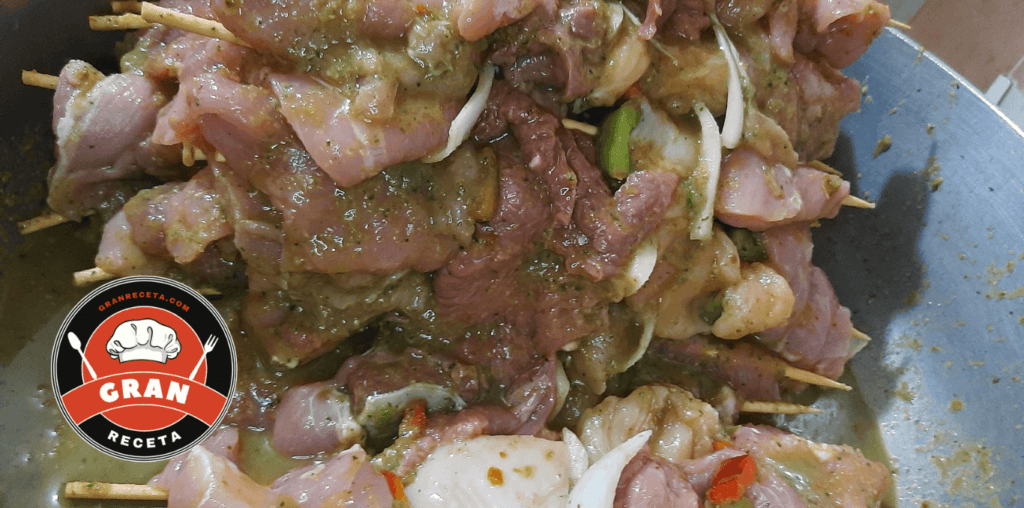
Three hours of marinade reach about 4 mm into a piece of beef, and no further. The only thing that reaches the centre of a 1½-inch cube is salt, so the beer and garlic season the surface — which happens to be where the crust forms. Understanding that changes two decisions: how big to cut the cubes and how long it is worth marinating. Four servings at 465 calories.
How do you make Colombian beef skewers? Cut 1.8 lb of sirloin cap into 1½-inch cubes and marinate them 3 hours in beer with garlic, cumin and salt. Thread them loosely and grill 8 minutes over medium coals, 2 a face, to 145°F inside. Rest 3 minutes. 240 minutes for 4 servings.
Which cut survives a skewer
A cube of beef spends 8 minutes over fire. Nothing gets tenderised in that time, so the cut has to arrive tender — which rules out collagen cuts like shank, however cheap, since they want two hours in a pot.
Top sirloin cap — sold as picanha at Latin and Brazilian butchers, or as sirloin cap elsewhere — is the best balance: 12.7 g of fat per 100 g according to the USDA, enough that the cube does not dry on the coals, with a short grain that cuts easily. Plain top sirloin works with slightly less fat. Tenderloin stays tender but dries fast and costs considerably more.
Flank, excellent in other dishes, is tough in cubes: its grain is long, and in a 1½-inch cube it runs in every direction at once.
How far a marinade actually goes
Marinades move by diffusion, and diffusion through something as dense as muscle is slow: a few millimetres in three hours. What does cross the meat is salt, because the sodium ion is far smaller than the flavour molecules in garlic or cumin.
Two practical consequences follow. First, marinating for 12 hours does not season the centre: it only softens the surface further and, with acid in the mix, turns it mealy. Three hours is the sweet spot.
Second, the cube size. At 1½ inches every bite carries a reasonable share of marinated surface; at 2½ inches the middle tastes of beef and salt and nothing else.
The beer contributes sugars that help browning and some malt flavour, but it does not tenderise — the idea that it “opens the fibres” does not hold up. What tenderises is the cut and not overshooting the temperature.
The point, and the 3-minute rest
The USDA gives 145°F with a 3-minute rest as the safe point for whole cuts of beef, and there the cube is pink and juicy. At 160°F it turns grey and begins to dry; at 176°F it is tough.
A 1½-inch cube gets to 145°F in about 8 minutes over medium coals, turned four times. The coals are right when your hand lasts exactly 4 seconds 6 inches above them: 8 seconds means not enough fire, under 2 means the surface will burn before the centre warms.
The rest is not decorative. It counts inside the USDA’s safe point, and it is when the juice redistributes from the centre outward.
Where the four hours go
Fifteen minutes of cutting, 3 hours in the fridge, 30 to temper and skewer, 8 on the coals and 3 resting. Nearly all of the clock is waiting, and the hands-on part fits in half an hour.
Make it ahead
Marinated skewers freeze well raw, already threaded and separated with paper, for up to 2 months. Thaw them in the fridge before grilling, never straight from the freezer: an ice-cold cube hits 145°F on the outside long before the middle gets there. Cut and marinate in the morning and the evening is eight minutes of work.
What goes wrong
Cubes larger than 2 inches. The centre is raw when the surface has already dried.
Pressing the cubes together. The touching faces steam instead of browning.
Marinating 12 hours. It does not season the centre and oversoftens the surface.
Grilling cold meat. The middle lags and the outside dries out.
Skipping the rest. The juice stays in the centre and runs out at the first cut.
Variations
With chorizo. Alternating beef cubes with slices of Colombian chorizo on the same skewer.
Mixed. Beef and chicken on separate skewers, since chicken wants 165°F and 10 minutes.
With pineapple. One cube of pineapple every two of beef, the Medellín stall version.
In a pan. No skewer at all, seared 6 minutes in a hot cast iron pan.
What to serve with them
Street stalls serve them with boiled baby potatoes, homemade ají and lime, often with an arepa alongside. Two skewers per person comes to about 465 calories.
For a full grill, Colombian chorizo is simmered first and seared beside them, and Colombian patacones handle the side. If you would rather braise than grill, Colombian shredded beef uses the collagen cuts that fail here, and on a bigger table Colombian sancocho is usually what follows.
Frequently asked questions
Which cut is best? Top sirloin cap, sold as picanha. Top sirloin works; tenderloin dries fast and costs more.
How long should I marinate? Three hours. Longer does not season the centre, because the marinade only travels a few millimetres.
Does beer tenderise the beef? No. It adds flavour and sugars that help browning; tenderness comes from the cut and the temperature.
When is it done? At 145°F in the centre with a 3-minute rest, per the USDA.
Can I freeze them? Yes, raw and threaded, up to 2 months. Thaw in the fridge before grilling.
Nutrition
Per serving of 2 skewers, about 7 oz of beef, calculated from each ingredient according to the USDA SR Legacy database:
- Calories: 465 kcal
- Protein: 41 g
- Carbohydrates: 4 g
- Fat: 30 g, 10 g of it saturated
- Fibre: 1 g
- Sodium: 715 mg
This is one of the highest-protein servings on the site: 41 g, about what a bowl of sancocho carries, in 7 oz of beef. Some of the marinade fat stays on the coals, so a well-drained grill lands a little below the figure. Made with plain top sirloin, a serving comes down to around 420 calories.
The best skewers I have eaten came from a corner stall, grilled over half an oil drum and served with boiled potatoes on the same foam plate. What the man did right was not the marinade: it was never crowding the grill and turning them four times. Josnaisis.