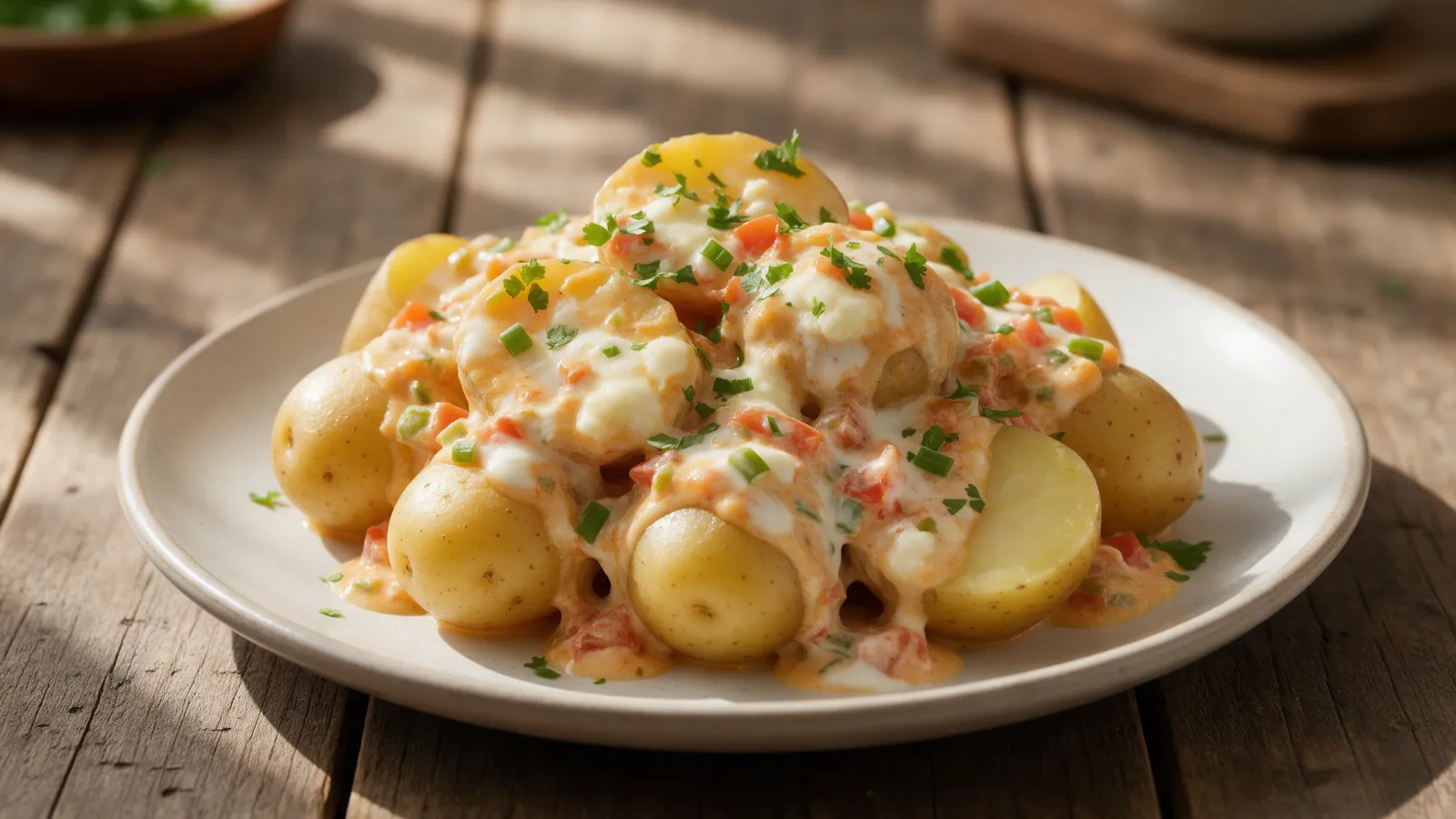

Papas chorreadas (PAH-pahs choh-reh-AH-dahs) translates loosely as “drizzled potatoes”: small boiled potatoes, split open, with a hot sauce of tomato, scallion, heavy cream and melted cheese poured over until it runs down the sides. It comes from the Andean highlands around Bogotá, in the Colombian departments of Cundinamarca and Boyacá, where it sits next to the meat at Sunday lunch. If you know scalloped potatoes or a cheesy gratin, this is the stovetop cousin with tomato in it, and it takes 40 minutes.
Are papas chorreadas worth making as a side?
How do you make papas chorreadas? Boil small whole potatoes in cold salted water for 15-22 minutes from the boil. Meanwhile, soften scallions in butter, add grated tomato and cook it down 10-12 minutes until no liquid runs, then stir in heavy cream over the lowest heat. Off the boil, melt in shredded Monterey Jack or mozzarella in three batches and pour over the split potatoes. 40 minutes for 6 servings.
Yes, if you want a potato side that’s richer than mashed and quicker than a gratin. The tomato gives it acidity and sweetness, the cream rounds it off and the cheese binds the sauce so it clings to the potato.
Good for. A steak or roast chicken dinner for 6, a cookout where you want something other than potato salad, or a meatless supper with a green salad. As a main it feeds 4.
Maybe not for. Anyone avoiding dairy or watching saturated fat (13 g a serving, nearly all of it from the cream and cheese). It’s also best eaten within 15 minutes of making: on a buffet it stiffens as it cools.
Time. 40 minutes, about 25 of them hands-on. The potatoes boil on their own while you make the sauce.
Difficulty, easy. The only thing that goes wrong is the sauce splitting, and that comes down to order and heat, both covered below.
What you need, and the US and UK swaps
Full amounts are in the recipe card: 1.2 kg (2.6 lb) of small potatoes, 500 g (1.1 lb) of tomatoes, 200 ml (about ¾ cup) of cream and 150 g (5.3 oz) of cheese for 6 sides.
The cheese decides whether the sauce is smooth
In Colombia the usual choice is queso doble crema, a stretchy pasta filata cheese that melts much like mozzarella. Abroad you want the same behaviour: a young, rennet-set cheese with enough moisture to flow. Monterey Jack gives the smoothest sauce with no strings; low-moisture mozzarella (the block or bagged shredded kind, not the balls in brine) melts and stretches a little. Queso Oaxaca from a Latin grocery is the closest to the Colombian original.
The one to avoid is queso fresco, along with feta and paneer. They’re acid- or heat-set, and the curd softens in the sauce without ever melting, so you get white crumbs in pink cream.
Which potatoes to buy
In Bogotá the classic is papa criolla, a small Andean potato with yellow, buttery flesh and skin so thin you eat it. Many Latin supermarkets in the US sell it frozen in bags; in my kitchen it goes straight from the freezer into the water and is done in 10-12 minutes from the boil. Otherwise:
| What you can find | Where | Cooking time from the boil | What changes |
|---|---|---|---|
| Frozen papa criolla | Latin grocery stores (US), Latin online shops (UK) | 10-12 min | nothing, it’s the real thing |
| Baby gold, baby Yukon | US supermarkets | about 18 min | firmer, less buttery |
| Charlotte, baby new potatoes | UK supermarkets | about 18 min | waxy and firm, holds its shape well |
| Small red potatoes | US and UK | 20-22 min | white flesh, a little less sweet |
| Russet, Maris Piper | US, UK | 20 min halved | floury, falls apart if you overcook |
Cream, and whether milk works
Reach for US heavy cream (around 36 % fat) or UK whipping or double cream; anything under 30 % is asking for trouble. The fat shields the milk protein from the tomato’s acid. Light cream and milk curdle far more easily.
If milk is all you have, use 250 ml (1 cup) whole milk with 1 tsp (3 g) cornstarch (cornflour in the UK) whisked in cold before it goes in the pan. The starch keeps it from splitting. You lose some richness and about 85 kcal per serving.
Scallions stand in for Colombian cebolla larga, a long green onion with a thicker white stem; in the UK they’re spring onions. Any ripe tomato works; grate it on a box grater and the skin stays behind in your hand.
How to time it, and how to tell each stage is right
40 minutes on the clock. Potatoes and sauce run in parallel; one after the other they take 55.
Make-ahead plan. Cook the tomato and scallion base a day or up to 3-4 days ahead and refrigerate it; on the day, warm it 3 minutes, add the cream and cheese and you have sauce in 10 minutes. The potatoes can be boiled the day before too and rewarmed whole in simmering salted water for 3-4 minutes. Don’t make the finished cream and cheese sauce ahead.
Checkpoints.
| Stage | What you should see |
|---|---|
| Potatoes, 15-22 min | a knife slides in without pushing; skins still intact |
| Scallions, 5 min | soft and translucent, no brown edges |
| Tomato, 10-12 min | fat glistens at the edges; a spoon leaves a channel that stays open for 2 seconds |
| Cream, 2-3 min | small bubbles at the edge only |
| Cheese, 3 batches | each handful vanishes in 30-40 seconds of stirring |
Why the order keeps the sauce from splitting
Three rules. Dry tomato first: the liquid a tomato releases is acidic water, and cream poured into it clumps. Cream over the lowest heat, and cream with real fat. Cheese off the boil, in batches: overheated cheese tightens up, squeezes out its fat and turns into rubbery strings floating in oil. I switch the burner off before the first handful and only turn it back on, at its lowest, if the sauce cools too much.
Mistakes to avoid, plus spice, kids and allergens
- White specks and thin whey → the cream split. Pull the pan off the heat, add 2 tbsp cold cream and whisk hard for 1 minute; it usually comes back. If not, blitz it 10 seconds with a stick blender.
- Stringy cheese in a pool of grease → the cheese boiled. There’s no full fix; next time, heat off and three batches.
- Thin, watery sauce → the tomato wasn’t cooked down, or you used fresh mozzarella in brine. Reduce the base 3 more minutes before the cheese goes in.
- Crumbs that never melt → queso fresco or feta. It’s the cheese, not you.
- Burst, waterlogged potatoes → overcooked, or they went into boiling water. Start cold and check from minute 15.
- Too salty → mozzarella and Jack bring their own salt. Taste after the cheese has melted, not before.
Heat, 0 out of 5. Nothing in it is spicy. Colombians put ají picante, a fresh scallion and cilantro hot sauce, on the table for anyone who wants it.
Kids. It’s potatoes and melted cheese; most children are in. If yours pick out onion, blend the tomato base for 10 seconds before the cream.
Allergens. Dairy (cream, cheese, butter). No gluten, egg, nuts or fish. If you thicken the milk version, use cornstarch, and check any bouillon cube you add to the potato water, since some contain wheat.
Versions, from weeknight to a crowd of 20
- Weeknight shortcut → frozen papa criolla and a tomato base made at the weekend: 20 minutes.
- For 12 → double everything and use a 32 cm (12½ in) skillet or two pans; the tomato needs 15-18 minutes to cook down instead of 10-12. Keep potatoes covered in their pot and the sauce over the lowest heat or a water bath, and pour at the table.
- For 18-20 → triple it, make the tomato base the day before and finish the cream and cheese in two pans. Allow 200 g (7 oz) of potato a person alongside meat, 300 g (10½ oz) as a main.
- Lighter → 250 ml (1 cup) whole milk with 1 tsp cornstarch instead of cream, and 100 g (3½ oz) cheese: about 280 kcal and 10 g fat a serving.
- Vegetarian → it already is, unless you boil the potatoes in chicken stock.
- Oven-finished → split potatoes in a baking dish, sauce over, 50 g (1¾ oz) more cheese on top, 8-10 minutes at 400°F (200°C) until spotted brown.
- Rustic Boyacá style → crumbled queso campesino, a fresh farmer’s cheese that softens into little curds rather than melting, and the onion in bigger pieces.
What it costs to make for 6
At US average retail prices for August 2026 from the Bureau of Labor Statistics, the potatoes, tomatoes, cheese and butter come to $6.87, about $1.15 a serving. That’s before the cream, scallions, garlic and cilantro, which BLS doesn’t track.
The cheese series BLS publishes is cheddar, so I use it as the price of the Jack or mozzarella; and the potato series is plain white potatoes, which are cheaper than baby golds or Charlotte, so treat the potato bar as a floor. In Bogotá the same dish costs about 2,386 Colombian pesos a serving at wholesale, and the papa criolla alone is 59 % of it.
Yield. 6 side servings of about 330 g (11½ oz), or 4 mains with salad. Roughly 1 cup (240 ml) of sauce per 400 g (14 oz) of potato.
How it tastes, what to serve it with, and storage
Taste and texture. Hot, tender potato under a glossy pink sauce that tastes of cooked-down tomato and sweet scallion, softened by cream, with cheese that pulls into short strings when you lift the spoon.
What to serve it with. In Colombia it goes beside the lunch meat: Colombian sobrebarriga, braised flank steak, grilled beef or Colombian beef skewers. It shares its potatoes and its region with the Andean tuber stew from Boyacá, and the sauce is a creamy relative of the hogao on Colombian patacones. If you have papa criolla left over, it’s also the yellow potato in Colombian ajiaco. Leftover sauce is good the next morning spooned over Boyacá-style arepas.
Fridge. According to USDA FSIS guidance for cooked leftovers: no more than 2 hours at room temperature, then 3 to 4 days at 40°F (4°C) or below. Store sauce and potatoes separately if you can.
Freezer. FSIS gives 3-4 months for frozen leftovers, but I don’t freeze this: boiled potatoes turn watery and grainy, and the cheese sauce separates on thawing. The cooked tomato and scallion base freezes well on its own for up to 3 months.
Reheating. Warm the sauce over the lowest heat with 2 tbsp milk or cream per cup, stirring, to 165°F (74°C), never boiling. Rewarm potatoes covered in the microwave for 1-2 minutes or 3 minutes in simmering water. Sauced leftovers microwave best at medium power in 1-minute bursts, stirring between.
Papas chorreadas FAQ
What cheese is best for papas chorreadas outside Colombia? Monterey Jack for the smoothest sauce, or low-moisture mozzarella. Queso Oaxaca is closest to the Colombian queso doble crema. Avoid queso fresco and feta; they don’t melt.
Why did my cheese sauce split or go grainy? The tomato still had liquid when the cream went in, the cream was too lean, or the cheese boiled. Cook the tomato dry, use 30 %+ cream, and melt the cheese off the heat.
What’s a substitute for papa criolla? Frozen papa criolla from a Latin grocery is the real thing. Otherwise baby gold or small Yukon Gold in the US, Charlotte or baby new potatoes in the UK, skins on.
Can I make it with milk instead of cream? Yes: 250 ml (1 cup) whole milk with 1 tsp cornstarch whisked in cold, over low heat. Lighter, and it holds together.
How many people does 1 kg (2.2 lb) of potatoes feed? 5 people as a side at 200 g (7 oz) each, or 3 to 4 as a main.
Can I make papas chorreadas ahead? The tomato base, yes, for up to four days in the fridge. The potatoes, a day. Add the cream and cheese 10 minutes before serving.
Is it the same as Costa Rican or other “papas chorreadas”? No. Elsewhere in Latin America “chorreada” names other dishes, such as Costa Rica’s sweet corn pancake, the chorreada. This is the Colombian potato side.
Nutrition per serving
Per side serving (about 330 g / 11½ oz, one sixth of the recipe), worked out ingredient by ingredient from the USDA SR Legacy database with this recipe’s amounts. USDA has no entry for papa criolla, so the potatoes are calculated as red potatoes with skin. Sodium counts the ½ tsp in the sauce plus what the potatoes take up from salted water, about 2.4 mg per gram according to USDA’s boiled-with-salt entry.
- Calories: 390 kcal
- Protein: 12 g
- Carbohydrates: 39 g
- Fat: 22 g, of which 13 g saturated
- Fiber: 5 g
- Sugars: 6 g
- Sodium: 860 mg
About 140 of the 390 kcal come from the potatoes and 190 from cream and cheese. Boil the potatoes in unsalted water and sodium drops to about 390 mg.
I grew up in Venezuela, where potatoes went into salads and soups and nobody poured cream over them, so this was a Colombian discovery for me. My first batch split because I added the cream while the tomato was still weeping. Now I wait until the pan goes quiet. Josnaisis.