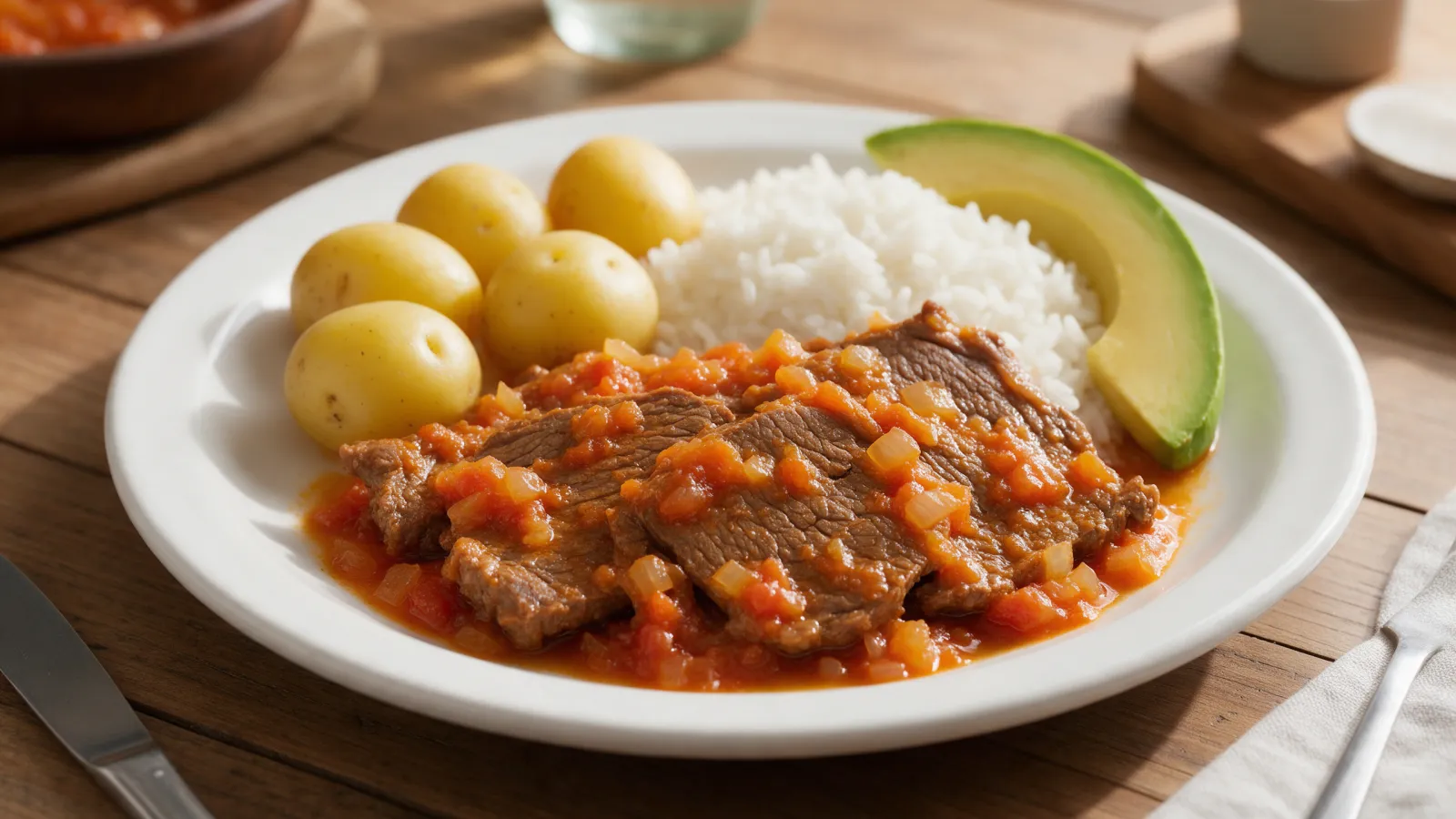

Sobrebarriga (soh-breh-bah-REE-gah) means “over the belly,” and that is where the cut comes from: the flat, long-grained muscle under the ribs that US butchers sell as flank steak. In Colombia nobody grills it pink. It goes into a pot whole for two and a half hours until a fork slides through, then gets sliced and finished one of two ways, simmered in a tomato and cumin Creole sauce or baked under a breadcrumb crust. Both versions start from the same pot, so you choose at the end.
What Colombian sobrebarriga is, and whether it’s worth 3 hours
How do you make Colombian sobrebarriga? Simmer a whole 1.5 kg (3.3 lb) flank steak for 150 minutes over low heat with onion, scallions, garlic, bay and thyme until a fork slides in with no resistance. Slice it across the grain and either simmer it 15 minutes in a Creole tomato sauce made with 2 cups of the broth, or top it with breadcrumbs and bake 20 minutes at 400°F (200°C). Ready in 190 minutes for 6 servings.
It’s worth it if you’re feeding four or more, or want lunches for half the week. Flank is one of the cheaper steaks at a US supermarket, and of the 190 minutes only about 45 need you. What you get is beef that cuts with the side of a fork yet still comes out in neat slices, sitting in a sauce it has soaked up.
Good for. A Sunday lunch, a make-ahead dinner for guests, meal prep for 3 days.
Not for. A weeknight without a pressure cooker, or anyone who likes steak medium-rare. Sobrebarriga is always cooked through, and cut too early it’s tough.
Time. 190 minutes total, about 45 hands-on on the stovetop. In a pressure cooker or Instant Pot, about 110 minutes.
Difficulty, medium. Nothing technical. Two places it goes wrong: pulling the beef before the fork test passes, and slicing with the grain.
Which beef to buy in the US or UK
Buy flank steak. It’s the same muscle, a little leaner than the Colombian cut, which usually comes with a layer of fat on one side. US supermarkets sell flank in pieces of 700 g to 1 kg (1½-2¼ lb), so for 6 people you’ll need two. In the UK, ask a butcher for flank, often labeled bavette. Latin butcher shops in the US sometimes stock it as sobrebarriga.
One naming trap: in Colombia the word is also used for skirt steak, a different cut from the plate. Skirt works if that’s what you find, but it’s thinner and fattier, gets tender sooner and tends to shred.
Ingredient swaps for a US or UK supermarket
| Colombian ingredient | What to buy | What changes |
|---|---|---|
| Sobrebarriga | Flank steak, or bavette in the UK | Leaner; keep any fat on |
| Tomate chonto | Plum or vine tomatoes | Nothing you’d notice |
| Cebolla larga | Scallions or spring onions | Nothing you’d notice |
| Pimentón | Red bell pepper | Same thing |
| Color (achiote) | Ground annatto, or sweet paprika | Paprika gives the color, less earthy |
| Cerveza (optional) | Any pale lager, 330 ml (12 oz) | Slight bitterness against the sweet tomato |
Ground annatto is in the Latin aisle of most US supermarkets, sometimes as “achiote molido,” and online in the UK.
Equipment
An 8-quart (8-liter) pot with a lid, a long knife and a deep skillet for the sauce. If your pot is smaller, cut the flank in two pieces along the grain, never across it, before cooking. A pressure cooker or Instant Pot is optional.
Stovetop or pressure cooker
Pressure cooker method. Same beef and aromatics with 1.5 liters (6 cups) of water, never above the two-thirds line. Cook 45 minutes at high pressure, then let the pressure drop naturally for 10 minutes. If the fork still resists, lock the lid and go 10 more. In an Instant Pot, use the Pressure Cook setting on High for the same times.
I use the stovetop when I’m going to bake it, because I can stop at the exact moment the slices still hold together.
The plan, and how to tell each stage is right
The beef simmers for 150 minutes without needing you. The sauce gets made inside that window, in the last 30 minutes.
Cues to watch for.
- The simmer. Small bubbles at the edge only. A rolling boil firms up the outside and clouds the broth.
- Doneness. A fork goes into the thickest part and comes out without lifting the meat; the edge splits into strands under the back of a spoon.
- The sauce. No tomato pieces left with any shape, and oil shining at the edge of the skillet, after about 10 minutes.
- The slices. The grain shows as dots or short lines on each cut face, not as long threads running along the slice.
Slicing across the grain
Look at the cooked flank: the fibers run lengthwise, like wood grain. Cut at a right angle to them, in slices 1.5 cm (½ in) thick. Each bite then has short fibers that separate as you chew. Sliced with the grain, the same beef eats like leather.
Make it the day before
This is how I always do it for guests. Cook the beef, let it cool in its broth for 30 minutes, then refrigerate it submerged. Overnight the fat sets on top and lifts off in one sheet, and cold beef slices cleaner than hot.
Before you cook, mistakes, spice, kids and allergens
- Tough beef. It needed more time. Flank goes through a stage around 90 minutes where it’s cooked but still firm; keep going until the fork test passes.
- Dry and stringy. It boiled hard or overcooked. Low heat, and start testing at 130 minutes.
- Chewy slices. Cut with the grain. Shred what’s left in the pot and use it like Colombian shredded beef.
- Watery sauce. Too much broth. Two cups, reduced 5 minutes before the beef goes in.
- Soggy crust on the baked version. The slices went in wet. Drain and pat them dry before the breadcrumbs.
Spice level, 0 out of 5. Cumin, not chili. For heat, put Colombian ají picante on the table.
Kids. Usually a hit; the sauce is mild and a little sweet. Slice their portions thin and trim off the fat.
Allergens. The stewed version has no gluten, dairy, egg or nuts. The baked version adds gluten from the breadcrumbs and dairy from the butter. Beer in the broth adds gluten.
Which version to make
- Simmered in Creole sauce (en salsa criolla). The everyday version, and the best one for reheating. 15 minutes in the sauce.
- Baked with breadcrumbs (al horno). Drain the slices, brush with 2 tbsp of the sauce, top with 60 g (1 cup) breadcrumbs and 30 g (2 tbsp) butter, and bake 20 minutes at 400°F (200°C) until golden. Adds about 75 kcal a serving. Eat it the day it’s made.
- Short on time. Pressure cooker, 45 minutes plus 10 release, sauce made meanwhile.
- With beer. Swap 330 ml (12 oz) of the water for a pale lager.
- One-pot with potatoes and cassava. Add 500 g (1.1 lb) russet potatoes and 500 g (1.1 lb) frozen cassava (yuca) to the sauce with 1 liter (4 cups) broth, simmer 25 minutes, then add the beef. No rice needed.
- For 10 people. 2.5 kg (5.5 lb) of flank in two pieces in a 10-quart pot; the time doesn’t change, since thickness is the same. For 20, 5 kg (11 lb) in two pots, and bake it in trays.
What it costs
At US city average prices from the Bureau of Labor Statistics for August 2026, the beef and tomatoes come to about $44.55, or $7.43 a serving. The BLS doesn’t publish a flank steak average, so the beef is priced at its all-uncooked-beef-steaks average of $12.81 a pound.
Yield. 1.5 kg (3.3 lb) of raw flank cooks down to about 1 kg (2.2 lb): 6 portions of about 165 g (6 oz). With rice and potatoes on the side, it stretches to 8 smaller plates.
What drives the cost. The beef, at 95 % of the total. In Colombia it’s the same story: at Bogotá wholesale prices the meat is 91 % of the dish.
How it’s served, and how to store and reheat it
Flavor and texture. Deep, brothy beef that breaks under a fork into slices that keep their shape, with a sweet-savory tomato sauce. The baked version trades the sauce for a crisp, buttery crust over a soft middle.
How Colombians serve it. One portion per plate with sauce spooned over. The baked version is tied to Bogotá, where it comes with papas chorreadas, potatoes in a cheesy tomato and scallion sauce, and Colombian white rice. Colombian patacones, fried green plantain, are the other classic side. If you like whole-cut braises, Colombian posta negra is the dark, panela-glazed cousin from Cartagena, and a small cup of Colombian ajiaco makes a proper Bogotá Sunday lunch.
Fridge. USDA FSIS guidance for cooked meat is 3 to 4 days at 40°F (4°C) or below, refrigerated within 2 hours of cooking. Store it in sauce or broth, in shallow containers.
Freezer. 2 to 6 months (FSIS), in portions covered with sauce or broth. The stewed version freezes well; for the baked one, freeze the beef plain and add the crumbs when you bake it.
Reheating. Covered, over low heat, with 2-3 tbsp of broth or water per portion, until it reaches 165°F (74°C) in the center, about 10 minutes. The baked version goes back in a 350°F (180°C) oven for about 12 minutes so the crust stays crisp.
FAQ
What cut of beef is sobrebarriga? Flank steak. In Colombia the name sometimes covers skirt steak as well, but the classic dish uses the flank.
How long does sobrebarriga take to get tender? About 150 minutes of gentle simmering for a piece 2-3 cm (¾-1¼ in) thick, or 45 minutes at high pressure plus a 10-minute natural release.
Can I make sobrebarriga in an Instant Pot? Yes. 45 minutes on High pressure with 6 cups of water, 10 minutes natural release, then the sauce on Sauté.
Can I use skirt steak instead of flank? Yes, for the stewed version. It’s tender in about 90 minutes but shreds more easily, so it’s a weaker choice for the baked one.
Is sobrebarriga the same as ropa vieja? No. Both can start with flank, but sobrebarriga is served in slices, while ropa vieja and Colombian shredded beef are pulled into strands.
Can I make it ahead? Yes, and it’s better that way. Cook the beef a day early, chill it in its broth, and on the day make the sauce and simmer the slices for 15 minutes.
How much flank steak do I need for a crowd? About 250 g (9 oz) raw per person: 2.5 kg (5.5 lb) for 10, 5 kg (11 lb) for 20.
Nutrition per serving
Per portion of about 165 g (6 oz) cooked beef with sauce, no sides, calculated from USDA FoodData Central (SR Legacy) using the quantities above and counting all 2 tsp of salt:
- Calories: 470 kcal
- Protein: 55 g
- Carbohydrates: 9 g
- Fat: 23 g, of which 8 g saturated
- Fiber: 3 g
- Sugar: 5 g
- Sodium: 920 mg
The baked version adds about 75 kcal and 5 g fat per serving. Trimming the fat cap on the plate brings the real numbers down.
Growing up in Venezuela, flank was only ever shredded for pabellón. The first time I was served it in thick slices under a golden crust, in Bogotá, I assumed the oven was doing the work. It isn’t. It’s the long, quiet simmer and the knife going across the grain. Josnaisis.