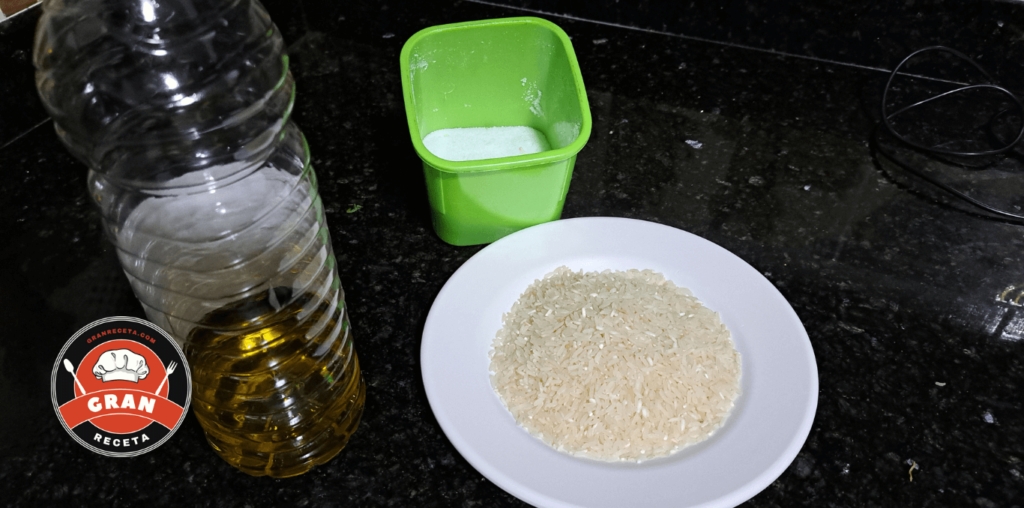
Colombian cooks give the dry grains 2 minutes in the pan before any water touches them. The dry grains go into oil with a whole scallion and get stirred until they turn glassy, which coats each one in fat and slows the water down. That step, plus putting the lid on at one exact moment, is the difference between fluffy rice and a sticky block. Four servings at 210 calories, and half an hour from cupboard to table.
How do you make Colombian white rice? Soften a scallion in 1 tbsp of oil, toast 1 cup of rice for 2 minutes, add 2 cups of water and salt, and cook uncovered about 9 minutes until the surface water is gone. Cover, drop to the lowest heat for a dozen minutes, rest three and fluff with a fork. 4 servings, 25 minutes.
Which rice, and how much water
Long grain is the one that comes out fluffy, and it is chemistry rather than skill: it holds more amylose, the starch fraction that does not break down in the pot, so the grains stay separate. Short grain holds more amylopectin, softens and clings, which is exactly right for risotto or rice pudding and wrong here.
Jasmine and basmati both work if that is what is in the cupboard, with a little less water — about 1¾ cups per cup of rice — because they are drier grains to begin with. What will not work is short grain, no matter how you cook it.
Measured by volume the ratio is two parts water to one of rice, and scaling up does not change it: 3 cups of rice want 6 of water. What has to change is the pot, wide enough that the rice sits about an inch deep. Any deeper and the bottom overcooks before the top sets.
What the water ratio does
At 1½ cups per cup of rice the grain stays chalky in the middle, because there is not enough water for the starch to hydrate. At 2½ it goes soft and sticky, and at 3 it collapses into porridge.
Measure both with the same cup rather than eyeballing it. Undercooked rice can still be rescued with ¼ cup of hot water and 5 more minutes covered; overcooked rice cannot be rescued at all.
The three moments that decide it
Toasting, minute 2. The grains are stirred in the oil until they look glassy. The film of fat slows the water’s entry and holds the surface starch in place. Skip it and the rice is fine but noticeably stodgier.
Covering, minute 15. Not a clock time but a sight: the water is gone from the surface and the bubbling has stopped, while the rice still looks glossy. Cover early and the leftover water gets absorbed into already-soft grains; cover late and the bottom scorches.
Resting, 3 minutes. Off the heat, lid on. The grains at the bottom hold more moisture than the ones on top, and those 3 minutes even it out. Fluff immediately and you get a wet layer and a dry one.
When it goes wrong
Almost every rice failure traces back to one of two moments — the lid going on at the wrong time, or fluffing before it has rested — and only one of them can be fixed after the fact.
Worth knowing: a rice cooker does the last two stages for you but not the first. Toast the rice in a pan with the scallion, then tip it into the cooker with the same 1:2 ratio and let it run. You keep the flavour and lose the timing problem entirely.
Where the 25 minutes go
Six minutes of actual work at the start, nine uncovered, a dozen covered and three resting. Only those first six ask you to stand at the pot; after that you check the surface once, around minute 15.
Make it ahead
Cooked rice keeps three days covered in the fridge and reheats over low heat under a lid with a splash of water. Day-old rice is also the correct rice for frying — the grains have dried and will not clump — which is exactly why Colombian calentado is made with yesterday’s rice and yesterday’s beans.
What goes wrong
Stirring after the boil. Every pass breaks grains and releases the starch that glues them.
Covering too early. Standing water gets absorbed and the rice turns gummy.
Peeking under the lid. You lose the steam that is cooking the top layer.
A pot that is too small. Rice 2 inches deep overcooks at the bottom before the top sets.
Fluffing straight off the heat. Without the 3-minute rest, the moisture never evens out.
Variations
With garlic. One whole clove softened with the scallion and pulled out at the end.
With coconut. Swap 1 cup of the water for coconut milk, on the way to Colombian coconut rice.
With cilantro. Two tablespoons chopped in as you fluff, the Caribbean habit.
With carrot. Two ounces grated in with the toasting, for a faint orange colour.
What to serve it with
This is the default side of Colombian cooking. It goes beside Colombian sancocho and Colombian ajiaco, under Colombian shredded beef, and on the plate of a bandeja paisa next to the beans.
A serving is about 5 oz cooked, four heaped spoonfuls. And when the rice is meant to be the dish rather than the side, Colombian arroz atollado cooks it in broth with meat until it turns creamy.
Frequently asked questions
Should I rinse the rice? Colombian cooks do not. The surface starch is handled by toasting, and rinsing washes off some of the added vitamins in enriched rice.
Why does mine stick to the bottom? The heat stayed too high after covering, or the pot is thin. Covered, it goes to the lowest setting.
How do I know when to cover it? When the water has gone from the surface and the bubbling stops, around minute 15, with the rice still glossy.
Can I use brown rice? Yes, with 2½ cups of water and about 45 minutes total, though it will not be as fluffy.
How much does 1 cup of rice make? Four side servings, about 21 oz cooked.
Nutrition
Per serving — one of four — calculated ingredient by ingredient according to the USDA and its SR Legacy database:
- Calories: 210 kcal
- Protein: 4 g
- Carbohydrates: 40 g
- Fat: 4 g, 1 g of it saturated
- Fibre: 1 g
- Sodium: 590 mg
All of the sodium comes from the teaspoon of salt; use half a teaspoon and it drops to around 300 mg with the rice still properly seasoned. The fat is the tablespoon of oil from the toasting, about 29 calories a serving, and it is the only thing separating this from plain boiled rice.
When I arrived from Venezuela I made rice with no scallion and no toasting, the way I learned it at my mother’s house, and next to the rice served here it tasted like hospital food. What I was missing was two minutes in the pan before the water. Josnaisis.