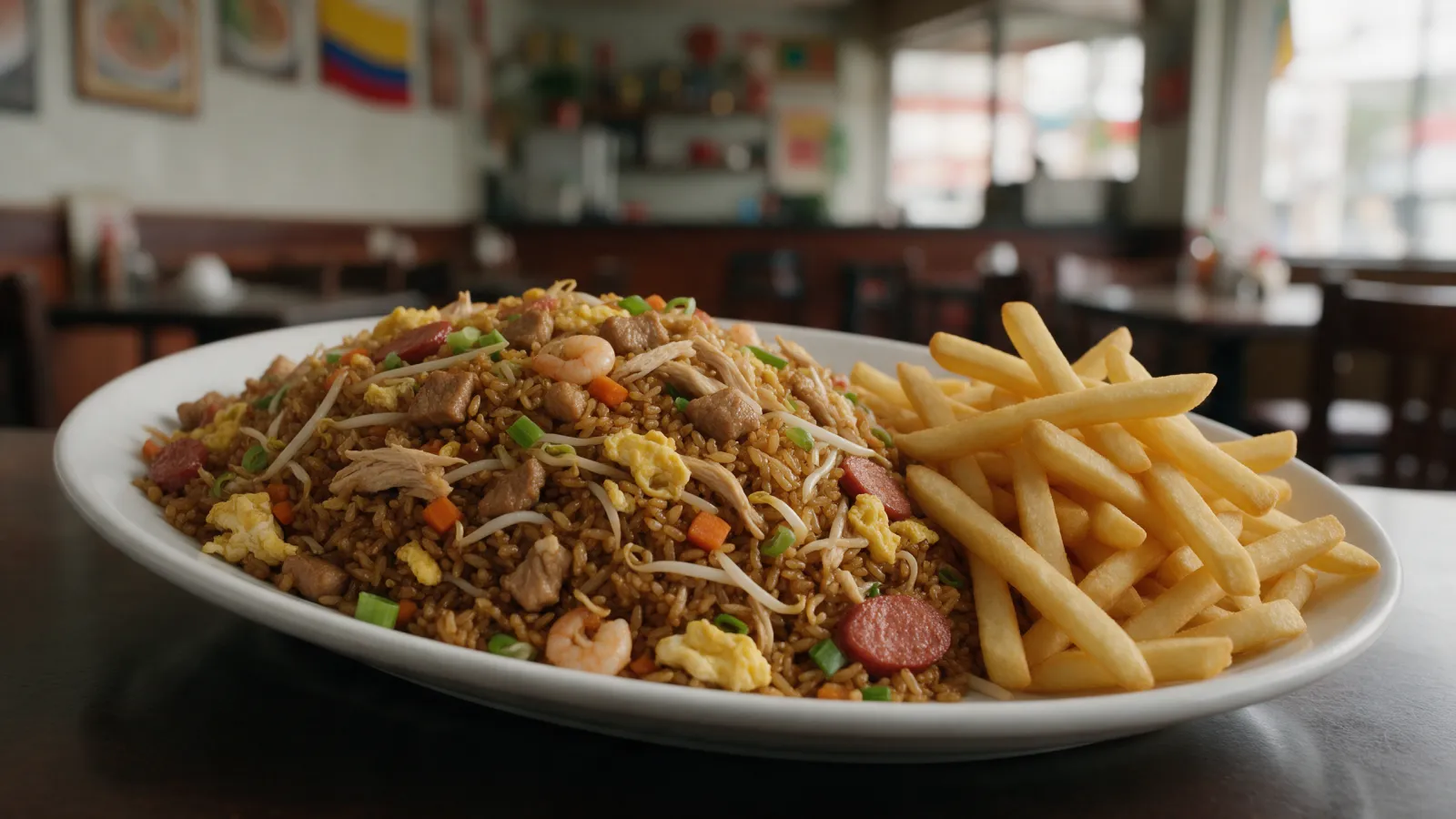

Order arroz chino at a neighborhood Chinese restaurant anywhere in Colombia and you get a heaping plate of dark brown fried rice studded with pork, chicken, shrimp, sliced hot dogs and ham, crunchy bean sprouts on top and a pile of French fries on the side. It is Colombia’s own takeout dish, and it is not the fried rice you know from a US or UK takeaway: it is darker, saltier, sweeter at the back thanks to Worcestershire-style sauce, and far more loaded. This is the home version for 6, cooked in a regular skillet.
What is Colombian fried rice, and is it worth making?
How do you make Colombian fried rice? Cook the rice the day before and chill it. On the day, stir-fry an egg omelet, pork, chicken, shrimp and hot dogs with ham one at a time over high heat; fry the cold rice in two batches with garlic, scallions and carrot; then toss everything with soy sauce, Worcestershire, dark soy and bean sprouts. Serve with fries. 55 minutes for 6 servings.
It is a Colombian stir-fried rice built on Chinese technique and Colombian taste. Food writing in Colombia, from El Tiempo to El Colombiano, describes it as a local adaptation of wok-fried rice, with more meats and a dark sauce; when a Chinese content creator tried a plate in Bogotá, El Tiempo quoted the verdict as “we don’t have this kind of rice in China.” That’s the point: it is its own dish.
Worth it if you like takeout fried rice with more going on, you are feeding 6 or more, or you have rice left from yesterday. One plate covers lunch for a hungry adult.
Skip it if you have no cooked rice and no 2 hours to chill a fresh batch, or you are watching sodium: one plate carries about 1,140 mg before the fries.
Real time. 55 minutes on the day, about 50 of them at the stove, plus 25 minutes the night before to cook the rice. Slice everything the night before as well and the day-of work drops to 35 minutes.
Honest difficulty, medium. Nothing here is hard, but the stove never rests. What goes wrong is fresh rice, a crowded pan and sauce poured into the middle.
What you need, with US and UK swaps
For 6 plates: 370 g (2 cups) raw long-grain rice, 1 kg (2.2 lb) of mixed meat and shrimp, 3 eggs, 200 g (7 oz) bean sprouts and 80 ml (⅓ cup) of sauces. The Colombian names below map to things you can buy at a regular supermarket.
Rice, and why yesterday’s is better
Use plain long-grain white rice, the everyday kind (see my Colombian white rice for the stovetop method, 2 cups water to 1 cup rice), and skip the salt: the soy sauce brings plenty. Fresh rice has a wet surface that steams and glues the grains together. J. Kenji López-Alt tested stored rice for the San Francisco Chronicle: rice sealed tightly in the fridge did worst, loosely covered rice was awkward to fry for the first 6 hours and ideal by 12. So I cook it the night before, spread it on a sheet pan and keep it under a towel.
No leftover rice? America’s Test Kitchen cooks it 2 hours ahead, spreads it on a rimmed baking sheet to cool and chills it for 30 minutes. It fries well, just a touch softer.
The sauces, and where the dark color comes from
Regular soy sauce seasons and turns the rice medium brown; pouring more only makes it saltier. Worcestershire, which Colombians call salsa negra or salsa inglesa, adds the sweet-sour back note. The deep takeout color comes from dark soy sauce, a thick soy sold mainly for coloring, at Asian grocers in the US and UK and online; 1 tsp per 1 kg (2.2 lb) of rice is enough. Across the recipes I compared, total sauce ranged from about 40 ml to 120 ml per kilo of cooked rice; I use 80 ml (⅓ cup) per kilo: ¼ cup soy, 1 tbsp Worcestershire, 1 tsp dark soy.
Equipment, and why you don’t need a wok
A heavy 12-inch (30 cm) skillet, cast iron, carbon steel or nonstick, a wide spatula, a sheet pan for the rice and a big bowl to park the cooked meat. ATK fries 4 to 4½ cups of cooked rice in a 12-inch skillet; I stop at about 1 lb (500 g) per batch because a home burner recovers heat slowly. With a 10-inch (25 cm) pan, cook three batches instead of two.
The game plan, and how to tell each stage is right
The night before. Cook and chill the rice. Dice the carrot, slice the scallions, mince the garlic and cut each meat into its own covered container. The omelet keeps too, sliced. With that done, the day-of cooking is 35 minutes.
The order for the meat. Slowest to fastest, one at a time, each out to the bowl before the next: pork (4 min), chicken (4-5 min), shrimp (2 min raw) and hot dogs with ham (2 min, just to brown). Cooking them together drops the pan temperature and they stew in their juices instead of browning.
How to tell it’s going right.
- Pan ready → the oil barely smokes and a grain of rice sizzles on contact.
- Meat → browns within a minute. If liquid pools, the pan was too full.
- Rice → after 4-5 minutes it crackles, grains jump apart and a few turn golden.
- Sauce → hisses and smells of caramel as it hits the edge; within 2 minutes the pan is dry.
- Bean sprouts → still snap when you bite one.
High heat on a home stove
Restaurants have bigger burners; at home you compensate by cooking less at once. Preheat the empty skillet on high until the oil just smokes, the way López-Alt does, and fry no more than 1 lb (500 g) of rice per batch: spread it, let it sit 1 minute to toast, toss, repeat. Pour the sauce around the edge of the pan, the hottest part, so it reduces on the metal before it reaches the rice. Poured in the middle, it soaks in and makes the rice soggy.
Before you cook, rice safety, spice, kids and allergens
Leftover rice is the one real risk. Cooked rice is the classic home for Bacillus cereus, whose spores survive cooking; if the rice sits warm for hours, they make a toxin that reheating does not destroy. Food Standards Scotland says to chill cooked rice within 1 hour and eat it within 24 hours; the USDA FSIS allows 2 hours out of the fridge (1 hour above 90°F / 32°C) and 3 to 4 days refrigerated. For fried-rice rice, I follow the stricter rule: in the fridge within the hour, in the pan the next day.
Common mistakes.
- Sticky, clumpy rice → fresh rice or a tightly sealed container. Use day-old rice and break it up by hand first.
- Pale rice → sauce poured in the middle, or no dark soy. Pour it around the edge on maximum heat.
- Too salty → more soy sauce was added for color. Stir in plain unsalted rice; next time, use dark soy for color.
- Grey, stewed meat → all of it went in at once. One at a time, into the bowl.
- Limp sprouts → added too early. Last minute only.
Spice level, 0 out of 5. It isn’t hot. In Colombia, ají picante goes on the table for whoever wants it.
Kids. Usually a favorite, thanks to the hot dogs and fries. Serve them a smaller plate and keep extra soy sauce off the table: an adult plate is over 1,100 mg sodium.
Allergens. Soy and wheat (regular soy sauce is brewed with wheat; use tamari labeled gluten-free for celiacs), egg, shellfish (shrimp), and sesame if you use the oil. Lea & Perrins Worcestershire contains anchovies. Check hot dog and ham labels for gluten, milk or soy.
Which version should you make?
- Short on time → chicken and hot dogs only, about 35 minutes at the stove.
- No wok → this recipe, as written, in a 12-inch (30 cm) skillet.
- For a party of 20 → multiply by 3⅓: 1.25 kg (6¾ cups) raw rice, 1 kg (2.2 lb) chicken, 850 g (1.9 lb) pork, 650 g (1.4 lb) shrimp, 10 hot dogs, 350 g (12 oz) ham, 10 eggs, 650 g (1.4 lb) bean sprouts, 200 ml (¾ cup plus 1 tbsp) soy, 50 ml (3 tbsp) Worcestershire and 1 tbsp dark soy. Cook the rice and prep the night before. On the day it’s seven batches in a 12-inch skillet, about 2 hours; hold finished batches covered with foil in a low oven at 140°F (60°C) or above, checked with a thermometer.
- For 4 → two thirds of everything; 250 g (1⅓ cups) raw rice fits in one batch.
- Holiday leftovers → swap the pork and ham for 350 g (12 oz) of leftover roast pork, like Venezuelan pernil, or holiday ham. It’s already cooked: 2 minutes to brown.
- Lighter → no hot dogs or ham, and low-sodium soy sauce: about 530 kcal and 560 mg sodium per plate, roughly half.
- Vegetarian → 400 g (14 oz) extra-firm tofu, cubed and browned like the chicken, plus 200 g (7 oz) mushrooms.
How it compares to takeout fried rice and Peruvian chaufa
Cantonese or Yangzhou fried rice is pale and gentle, with egg, shrimp, Chinese ham and peas. Peruvian chaufa, from the Chinese-Peruvian chifa kitchens, is built on scallions, garlic, ginger and soy sauce; Gastón Acurio’s home version uses 8 tablespoons of soy and sesame oil. The Colombian plate is the darkest and the most loaded of the three, and the only one that comes with fries.
Within Colombian rice dishes, it’s the only one fried from cooked rice: arroz con pollo cooks the rice raw in chicken stock, arroz atollado is soupy, and coastal shrimp rice simmers in a stock made from the shells.
What it costs to make
With US average prices from the BLS for August 2026, chicken breast at $4.17/lb, pork chops at $4.24/lb (the closest pork series), ham at $5.38/lb, long-grain rice at $1.11/lb and eggs at $2.27 a dozen, those five come to about $7.80 for 6 plates. The BLS doesn’t track shrimp, hot dogs, bean sprouts or sauces, so add those at your store’s price. Shrimp is usually the single most expensive item, so leaving it out is the easiest saving. Homemade fries from 2 lb (900 g) of potatoes add about $1.95 at the BLS white-potato price of $0.98/lb.
In Colombia, with wholesale Bogotá prices from the DANE’s SIPSA bulletin for 12-18 September 2026, the items it tracks add up to 20,660 pesos, about 3,443 per plate, and shrimp, chicken and pork are 83% of that.
What to expect, how to serve it and how to store it
Flavor and texture. Separate grains with toasted spots, salty with a sweet-sour finish, and something different in every forkful: browned pork, shrimp, hot dog, egg and the crunch of the sprouts. The color should be an even dark brown with no white streaks.
How to serve it. Piled on a platter or in wide bowls with fries on the side, soy sauce and hot sauce on the table. A cold coconut lemonade is the Colombian drink to go with it.
Fridge. Into shallow containers and the fridge within 1 hour. FSIS gives 3 to 4 days; Food Standards Scotland, stricter about rice, 24 hours. I eat it the next day. Fries don’t store well: they go soft.
Freezer. Freezes well in flat bags for up to 3 months. The sprouts soften when thawed, so if you plan to freeze, keep them out.
Reheating. In a hot skillet with 1 tsp oil, 4 to 5 minutes, tossing, until it reaches 165°F (74°C) in the center; in the microwave, covered with 1 tbsp water, in 1-minute bursts, stirring between. Reheat once only. Leftovers with beans make a good Colombian calentado the next morning.
Frequently asked questions
Why is Colombian fried rice so dark? Dark soy sauce and Worcestershire, reduced on the hot edge of the pan over very hot rice. More regular soy sauce doesn’t get you there; it only adds salt. One teaspoon of dark soy per 2.2 lb (1 kg) of rice does it.
Can I use freshly cooked rice? Yes, if you spread it hot on a sheet pan to let the steam escape and chill it for 30 minutes. Without that step, it clumps.
What are raíces chinas? Mung bean sprouts, the regular bean sprouts sold in the produce section in the US and as beansprouts in the UK. They go in for the last minute only.
Why does it come with French fries? That’s how Colombian neighborhood Chinese restaurants serve it, and how Colombian recipe writers, El Espectador among them, suggest serving it at home.
What order do the meats go in? Slowest to fastest, one at a time: pork, chicken, shrimp, then hot dogs and ham. Each comes out before the next, and they all go back in with the rice at the end.
How much should I make per person for a party? About 60 g (⅓ cup) raw rice and 165 g (6 oz) of meat per person as a main. For 20, 1.25 kg (6¾ cups) raw rice and about 3.3 kg (7.3 lb) of meat.
How long does it keep in the fridge? Up to 24 hours by Food Standards Scotland, 3 to 4 days by USDA FSIS, provided it went into the fridge within an hour. Reheat it once, to 165°F (74°C).
Is it gluten-free? Not as written: regular soy sauce contains wheat, and hot dogs and ham may too. With gluten-free tamari, a gluten-free Worcestershire and checked labels on the meats, it can be.
Nutrition
Per plate (about 400 g / 14 oz, without fries), calculated ingredient by ingredient from USDA FoodData Central (SR Legacy) with the quantities in this recipe, no salt in the rice and all the oil counted:
- Calories: 630 kcal
- Protein: 42 g
- Carbohydrates: 58 g
- Fat: 25 g, of which 5 g saturated
- Fiber: 3 g
- Sugars: 4 g
- Sodium: 1,140 mg
Soy sauce supplies half the sodium and the hot dogs and ham about a third. A 100 g (3.5 oz) serving of oven-baked frozen fries adds 158 kcal, 5 g fat and 324 mg sodium.
I’m Venezuelan and live in Colombia, and arroz chino was one of the first things I learned to order for delivery here. Getting it right at home came down to two habits: rice cooked the night before, and never more than half of it in the pan at once. Everything else is just keeping the stove hot. Josnaisis.