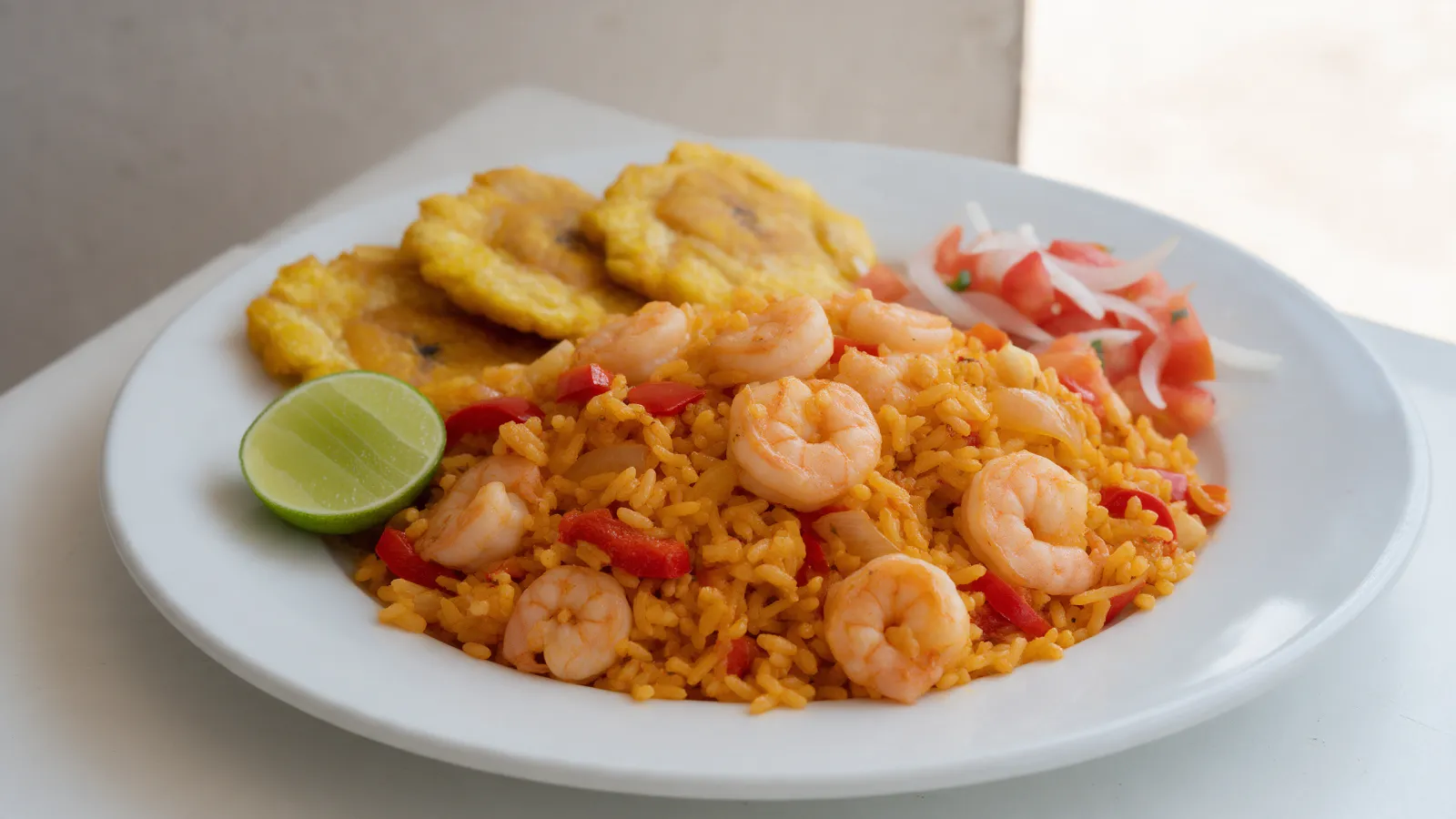

Roughly 44 % of a whole shrimp’s weight is head and shell. In Colombian shrimp rice, arroz con camarones (ah-ROHS kohn kah-mah-ROH-nes), that 44 % becomes the cooking liquid: fried for 3 minutes, simmered for 20, strained, and poured over the rice at 2 cups of stock to every cup of grain. The result is a loose, orange, one-pot rice from Colombia’s coasts that tastes of shrimp in every spoonful, with the shrimp themselves added so late they stay juicy.
What Colombian shrimp rice is, and whether it’s worth the 85 minutes
How do you make Colombian shrimp rice? Peel the shrimp and turn the heads and shells into a 20-minute stock. Sear the shrimp for 2 minutes and set aside, build a sofrito of onion, bell pepper and tomato in the same oil, toast the rice, and cook it in the stock at a 2:1 ratio. The shrimp go back on top for the last 4 minutes and rest 5. Ready in 85 minutes for 6 servings.
It is a dish of both Colombian coasts. On the Caribbean side it is usually made like this, with bell pepper, a tomato-and-onion sofrito called hogao and the shrimp stock; on the Pacific side coconut milk and annatto are more common. Think of it as a cousin of paella that ends up fluffy rather than creamy, or of jambalaya without the sausage and the heat.
Worth it if you can get raw shrimp with heads, or at least shell-on, and you want one pot that feeds 6 as a full meal. Skip it if you need dinner in 30 minutes (the quick version below takes about 55) or anyone at the table is allergic to shellfish, since the stock is shrimp too. Of the 85 minutes, about 40 are hands-on, and nothing is technically hard. The two things that go wrong are measurable: the amount of stock and the minutes the shrimp spend in the pot.
Ingredients, and what to buy in a US or UK supermarket
You need 1.25 kg (2¾ lb) of head-on shrimp, 500 g (2½ cups) of long-grain rice and 1.2 liters (5 cups) of stock for 6. Most of the list is ordinary; four items are worth a note.
| Colombian ingredient | What it is | US swap | UK swap |
|---|---|---|---|
| Camarón con cabeza | Raw shrimp with heads | Head-on shrimp at Asian or Latin markets; otherwise 820 g (1.8 lb) headless shell-on | Raw king prawns, head-on, at a fishmonger or frozen |
| Pimentón | Bell pepper | Red and green bell pepper | Red and green pepper |
| Cebolla larga | Long green onion | Scallions | Spring onions |
| Achiote or color | Ground annatto seed, mainly for color | Annatto powder in the Latin aisle | 1 tsp sweet paprika plus a pinch of turmeric |
| Arroz de grano largo | Long-grain white rice | Any long-grain white rice | Long-grain or basmati rice |
Why the shrimp size on the bag matters. In a study published in Foods comparing five species, edible meat was 56 % of the whole weight of whiteleg shrimp (Litopenaeus vannamei), the most widely farmed. That is why 1.25 kg (2¾ lb) head-on gives about 700 g (1.5 lb) of peeled meat, roughly 115 g (4 oz) per person. Headless shell-on shrimp lose much less: about 86 % is meat in a study on the same species, so 820 g (1.8 lb) gets you there.
Rice. Long-grain stays separate at a 2:1 ratio by volume. Short-grain releases starch and turns the dish risotto-like; parboiled (converted) rice needs extra liquid and comes out drier.
Annatto. It adds color more than flavor, which is why the paprika and turmeric swap works almost unnoticed.
Which shrimp to buy, head-on, frozen or precooked
Head-on raw shrimp win, because the stock comes free with them. Frozen raw shell-on shrimp are the practical choice in most US and UK supermarkets and still give a decent shell stock; add a fish or shrimp bouillon cube if it tastes thin. Precooked shrimp are the last resort.
Thaw it safely. The FDA recommends thawing seafood overnight in the fridge, or in a sealed bag submerged in cold water. The USDA FSIS adds that the water should be changed every 30 minutes and that a 1 lb (450 g) package thaws in an hour or less. Never on the counter. Raw fresh shrimp keep 1-2 days in the fridge according to the FDA storage chart, so buy them the day before at most.
The game plan, and what to make ahead
Peel first, start the stock, and do all the chopping while it simmers: that is what keeps the dish at 85 minutes instead of two hours.
Make-ahead. The day before, peel the shrimp (store the meat covered and unseasoned in the fridge) and make the stock. On the day, you’re at about 45 minutes to the table. The sofrito can be made ahead too, but it saves only 10 minutes.
Cues that each stage is on track.
- Stock → heads go from grey to deep red within 3 minutes; the strained stock is orange and measures 5 cups (1.2 liters).
- Sofrito → a spoon drawn through it leaves a trail that doesn’t flood. Extra liquid here ends up as soggy rice.
- Uncovered rice → after 12 minutes there’s no liquid on top and steam craters dot the surface. Cover now.
- Shrimp → a loose C, opaque and pearly, 145°F (63°C) in the center. A tight O means overcooked.
How to keep the shrimp from turning rubbery
The rice needs 22 minutes plus a rest; medium raw shrimp need a few. Put them in together and the shrimp sit near 212°F (100°C) for 25 minutes, contract and go tough. The fix is two short encounters with heat: a 1-minute-per-side sear at the start, which flavors the oil the sofrito cooks in, and 4 minutes on top of the rice at the end, lid on, lowest heat, then a 5-minute rest off the heat. Gentle steam finishes them.
Why fry the heads first. Three minutes over high heat toasts the shells and releases the orange fat inside the heads; press them with the spoon as they fry. Boiled without that step, the stock is paler and flatter. Twenty minutes of simmering is plenty. In my kitchen, shells simmered past 30 minutes give the rice a bitter, shell-like edge. If you only have shells and no heads, blitz them with the stock in a blender and strain: thicker, more intense, worth the extra 2 minutes.
Scaling it for 4, 12 or 20
The ratio never changes: 2 cups of stock per cup of rice and about 115 g (4 oz) of peeled shrimp per person. What changes is the pot. Keep the rice no deeper than 3-4 cm (1½ in), or the bottom overcooks before the top is done.
| Servings | Head-on shrimp | Rice | Stock | Pot |
|---|---|---|---|---|
| 4 | 850 g (1.9 lb) | 330 g (1⅔ cups) | 800 ml (3⅓ cups) | 24 cm (9-10 in) |
| 6 | 1.25 kg (2¾ lb) | 500 g (2½ cups) | 1.2 liters (5 cups) | 28-30 cm (11-12 in) |
| 12 | 2.5 kg (5½ lb) | 1 kg (5 cups) | 2.4 liters (10 cups) | 36-40 cm (14-16 in) or two pots |
| 20 | 4.2 kg (9¼ lb) | 1.65 kg (8¼ cups) | 4 liters (16½ cups) | two large pots |
For a crowd, peel and make the stock the day before: peeling 4 kg (9 lb) of shrimp takes well over an hour. In my big pot the uncovered stage runs 2-3 minutes longer, so trust the craters, not the timer. The shrimp must fit in a single layer on top of the rice; that is why two pots beat one for 20.
Mistakes that ruin shrimp rice
- Rubbery shrimp → they cooked with the rice from the start, or rested uncovered over a live flame. They go in at minute 73, lid on, and rest off the heat.
- Soggy rice → a wet sofrito or stock poured by eye. Cook the sofrito dry and measure 5 cups exactly. Already soggy? Uncover on the lowest heat for 5 minutes.
- Hard grains on top → steam escaped. Add ½ cup (120 ml) of hot stock, put a clean tea towel under the lid and give it 5 minutes.
- Bitter stock → shells scorched in the pan or simmered over 30 minutes.
- Bland rice → unsalted stock. Taste it before it goes into the pot; it should be as salty as a good soup.
- Gritty bites → the vein was left in. A shallow cut along the back removes it in seconds.
Versions, coconut, beer, quick and for a party
- Quick, about 55 minutes → precooked shrimp and 5 cups (1.2 liters) of fish or vegetable stock. The shrimp go in for the last 2 minutes just to heat. You lose the shell stock, and it shows.
- Pacific-style with coconut → replace 400 ml (1⅔ cups) of stock with one 400 ml (13.5 fl oz) can of coconut milk. Moister and slightly sweet; adds about 131 kcal and 14 g of fat per plate, almost all saturated (USDA).
- With beer → when I want a toastier background I swap 330 ml (11 fl oz) of the stock for a light lager. The USDA nutrient retention table puts alcohol left after 30 minutes of cooking at about 35 %; with a 4 % beer that is under 1 ml of alcohol per plate. Leave it out for kids or anyone avoiding alcohol, and note that beer contains gluten.
- Wetter, “ensopado” style → 6 cups of stock instead of 5 for a rice that is almost soupy.
- Lighter → 2 tbsp oil instead of 3 and 400 g (2 cups) rice: about 420 kcal per plate, same amount of shrimp.
Not to be confused with Colombian coconut rice, a side dish with no protein that is also the usual partner for Colombian fish in coconut sauce, or Colombian mullet rice, which uses salted fish soaked for hours. For a spicy, saucy shrimp dish without rice in the pot, camarones a la diabla is the Mexican one.
What it costs to make for 6
About $18.54 in a US supermarket, or $3.09 a plate, before peppers, herbs and limes. Shrimp alone is 83 % of that, so the bag you choose is the budget.
The shrimp line uses the average advertised US supermarket shrimp price reported by Expana for the second quarter of 2026, $8.53 per pound, which doesn’t specify size or form; rice and tomatoes use BLS August 2026 averages ($1.111 and $1.977 per pound). In Colombia the same pot costs about 29,973 pesos at Bogotá wholesale prices from the DANE SIPSA bulletin of 12-18 September 2026, with shrimp again 83 %. I don’t have a verified UK price to give.
How to serve it, store it and reheat it
On the Caribbean coast it comes in a deep plate with fried green plantains, a tomato and onion salad dressed with lime, and sometimes avocado. Colombian patacones are the plantain side, and a Colombian coconut lemonade is the cold drink. The same rice technique, with chicken instead of shrimp, is Colombian chicken rice; for a soupier seafood dinner, try the Colombian seafood stew.
Fridge. The FDA gives 3-4 days for cooked seafood at 40°F (4°C) or below, and no more than 2 hours at room temperature; the USDA FSIS says the same for cooked rice. Spread leftovers in shallow containers so they cool fast.
Freezer. The FDA’s quality guideline for cooked fish is 4-6 months. In my experience shrimp that have been frozen and reheated turn firmer, so I keep frozen portions for a month at most.
Reheating. Add 2 tbsp of water per plate, cover, and warm on low heat or in the microwave in 1-minute bursts until it reaches 165°F (74°C) in the center, the FSIS guideline for leftovers. If you can, lift the shrimp out and add them for the last minute.
FAQ
What is arroz con camarones? Spanish for rice with shrimp. The Colombian coastal version is a one-pot rice cooked in stock made from the shrimp heads and shells, with bell pepper, onion, tomato and annatto.
How much liquid for shrimp rice? 2 cups of stock per cup of long-grain rice: 5 cups (1.2 liters) for 2½ cups (500 g). A can of coconut milk replaces the same volume of stock.
When do you add shrimp to rice so they don’t get rubbery? For the last 4 minutes, on top of the rice with the lid on, then a 5-minute rest off the heat. They’re done at 145°F (63°C).
Can I use frozen shrimp? Yes. Thaw them overnight in the fridge or in a sealed bag in cold water changed every 30 minutes, and make the stock with the shells.
Can I use precooked shrimp? Yes, with bought fish or vegetable stock, adding the shrimp for the last 2 minutes only to heat them.
What do you serve with Colombian shrimp rice? Tostones (patacones), a tomato and onion salad with lime, and avocado. Hot sauce on the side, since the dish itself isn’t spicy.
Is it gluten-free? The base recipe is, if your stock cube is. The beer version is not.
Nutrition per serving
Per serving (one sixth of the pot, without plantains), calculated ingredient by ingredient from USDA SR Legacy data with the quantities above, 700 g (1.5 lb) peeled raw shrimp and the 2 tsp of salt:
- Calories: 501 kcal
- Protein: 31 g
- Carbohydrates: 75 g
- Fat: 8 g, of which 1 g saturated
- Fiber: 3 g
- Sugars: 4 g
- Sodium: 927 mg
The rice supplies 1,825 of the pot’s 3,007 kcal and the shrimp 595. Salt accounts for about 775 mg of the sodium per plate; with 1½ tsp it drops to about 733 mg.
I grew up in Venezuela buying shrimp already peeled, so the first time I bought them whole in Colombia I nearly threw the heads away out of habit. Now the stock is the part I’d never skip, and I make it the night before while I clean the kitchen. The shrimp are what people see; the shells are what they taste. Josnaisis.