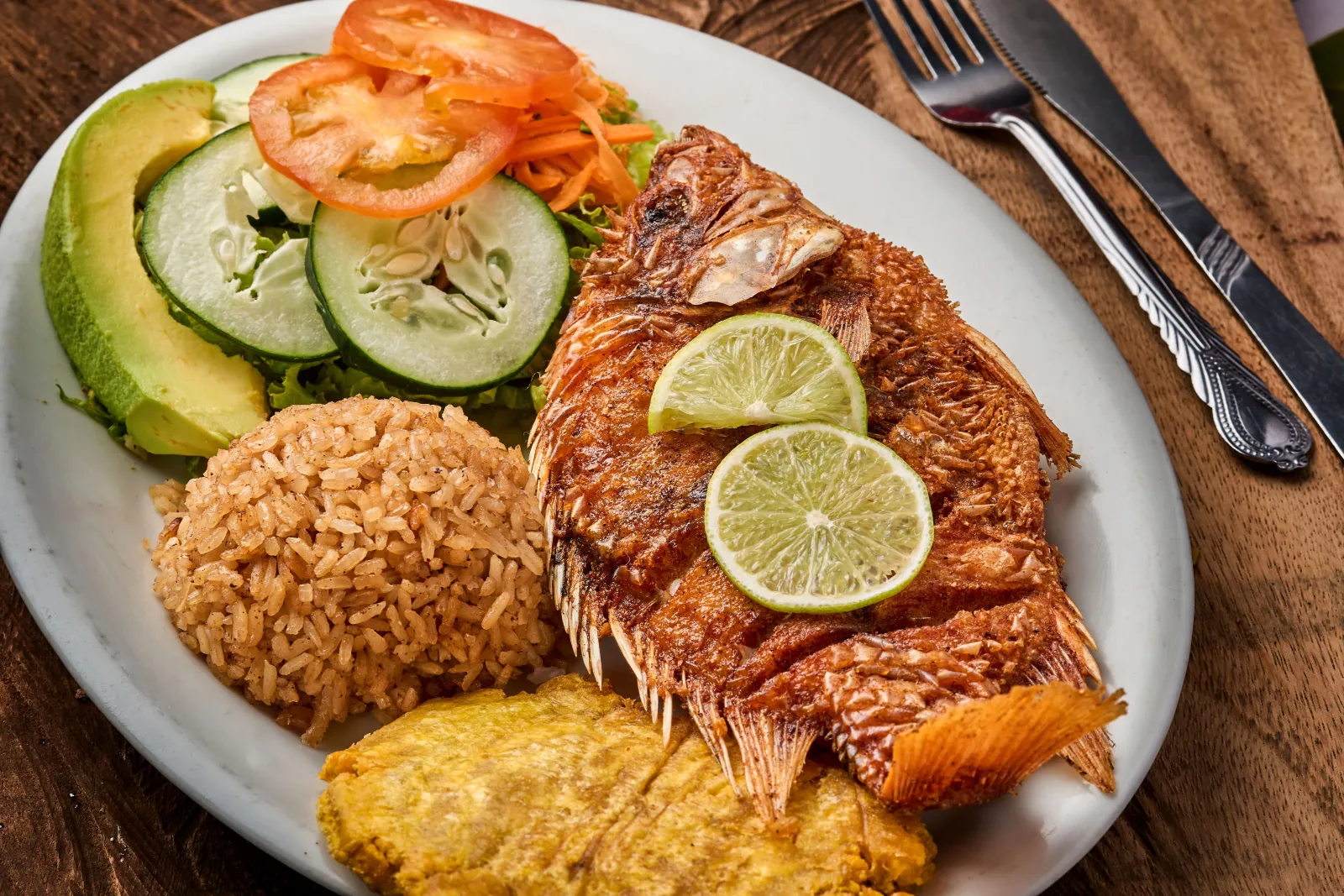

A 1 lb whole tilapia, scored three times on each side, rubbed with garlic, lime and salt and fried for 12 minutes until the tail eats like a potato chip: that is what Colombians call mojarra frita (moh-HAH-rah FREE-tah). Along Colombia’s Caribbean coast it comes to the table head and all, with fried green plantains, coconut rice and a tomato salad; inland it is what you order at roadside restaurants by the river, and what many families cook during Holy Week. If you have never fried a whole fish at home, this is the one to start with: the fish is cheap, the seasoning is three ingredients, and the only real skill is leaving it alone in the pan.
What is Colombian fried mojarra, and is mojarra just tilapia?
How do you make Colombian fried mojarra? Score a cleaned 1 lb (450 g) whole tilapia three or four times per side, rub it with crushed garlic, salt and lime juice for 15 minutes, pat it dry, dust it with flour and fry it in ¾ inch (2 cm) of oil at 355°F (180°C) for 6 minutes per side without moving it, until it reads 145°F (63°C) by the backbone. 90 minutes for 4 servings.
Yes, in practice it is tilapia. The red mojarra sold in Colombian markets is red tilapia, which Colombia’s national statistics office, DANE, describes in its market bulletins as a hybrid of several Oreochromis species native to Africa and Israel. That is good news if you live in the US or the UK, because whole tilapia, often frozen, is easy to find in Asian and Latin grocery stores. You are cooking the same fish.
Is it worth making at home? If you have a deep skillet and an hour at the stove, yes. A whole fish stays far juicier than a fillet, because the bone and skin protect the flesh, and the crust runs from head to tail. It is less suited to a weeknight for a crowd: one 12-inch (30 cm) skillet fries one fish at a time, 12 minutes each. Difficulty is medium. Nothing is technically hard, but hot oil asks for attention.
Ingredients, and what to buy in a US or UK supermarket
The card above has exact amounts: four 1 lb (450 g) fish, 8 garlic cloves, 2 limes, 2 tsp salt, ½ cup flour and 1 quart (1 liter) of oil for 4 people. One fish per adult is the standard Colombian portion. A 1 lb fish gives you about 6 oz (180 g) of meat on the plate, since a tilapia fillet is only 27 to 40 percent of the whole fish according to processing studies.
| You can’t find | Use | What changes |
|---|---|---|
| Red tilapia (mojarra roja) | Regular whole tilapia, fresh or frozen | Nothing but the skin color |
| Any tilapia | Red snapper, whole | Firmer, sweeter flesh; add 1-2 min a side |
| Any tilapia (UK) | Sea bream (dorade), whole | Very close; small ones need only 4-5 min a side |
| Any tilapia | Branzino (European sea bass) | Slimmer, so 5-6 min a side for 1 lb |
| Colombian limón Tahití | Ordinary limes (Persian limes) | Same fruit; lemons work but taste sweeter |
| Wheat flour | Cornstarch / cornflour | Thinner, glassier crust, gluten-free |
Fresh or frozen fish
The FDA gives four signs of a fresh whole fish: clear, shiny eyes, red gills, firm flesh that springs back, and a mild smell, never sour or ammonia-like. Cook fresh fish within 2 days. Frozen is perfectly fine for this recipe. Thaw it overnight in the fridge on a plate, or sealed in a bag in cold water if you’re short on time, never on the counter. Thawed fish releases more water, so dry it with extra care.
Flour or no flour
Flour gives an even golden crust, helps the skin let go of the pan and cuts down on splatter, because it soaks up the last of the surface moisture. Without flour the skin still crisps if it is properly dry, but it spits more and sticks more easily. I always flour it. Cornstarch makes a thinner, more brittle shell and keeps the dish gluten-free.
Equipment
A 12-inch (30 cm) deep skillet, two wide spatulas for turning, a wire rack and ideally an instant-read thermometer. Fish of 1¼ to 1⅔ lb (550-750 g) average about 12 inches (31 cm) long in tilapia processing studies, so they need a bigger pan or a wok.
How long to fry a whole fish, by weight
Fry at 355°F (180°C) when the fish goes in. The temperature drops as soon as it hits the oil; turn the heat up until the bubbling is brisk and even again, without smoke. Above 375°F (190°C) the flour darkens before the middle is cooked.
With about ¾ inch (2 cm) of oil, the fish sits half-submerged and gets turned once. The times below fall inside the 5 to 8 minutes per side that the recipes I compared give for a single whole fish:
| Fish weight | Per side | Total |
|---|---|---|
| 9-12 oz (250-350 g), kid’s portion | 4-5 min | 8-10 min |
| 14-18 oz (400-500 g), one adult | 6-7 min | 12-14 min |
| 1¼-1⅔ lb (550-750 g), to share | 7-8 min | 14-16 min, plus 5 min in a 400°F (200°C) oven if needed |
How to score a whole fish
Three or four diagonal cuts per side, about 1¼ inches (3 cm) apart, down to the backbone without cutting through it. On a 1 lb fish that is roughly ⅜ inch (1 cm) deep at the thickest point. Scoring lets the heat into the thick back, takes the garlic and lime into the flesh, and keeps the fish flat in the pan.
Dry it twice, or the oil will spit
Hot oil spits when water hits it, because the water turns to steam instantly and throws the oil out. So the fish gets dried twice: after rinsing, inside and out and in the cuts, and again just before the flour, since the lime juice leaves the skin wet. Brush off any garlic stuck to the skin too; at 355°F it burns long before the fish is done.
How to tell a whole fish is done
- Thermometer → 145°F (63°C) in the thickest part next to the backbone, not touching bone. That is the FDA’s safe minimum for fish.
- Fork in the deepest cut → the flesh lifts cleanly off the bone and has lost its translucency.
- Dorsal fin → tug it with tongs; if it slides out, the fish is cooked.
A golden skin tells you nothing about the center. On a larger fish, the outside can look perfect at 10 minutes while the back is still raw.
A make-ahead plan for four
With one skillet, frying four fish is half of the 90 minutes. The 15-minute rest in the marinade is when you start the rice or peel the plantains, and each fish goes to the table as it comes out instead of waiting for the last one.
The day before: make the coconut rice and the salad (undressed). That morning: clean and score the fish, and keep them in the fridge on paper towels, unsalted. 15 to 30 minutes before frying: the garlic and lime rub, never longer.
Skillet, air fryer or a big batch?
- Short on time → two skillets at once, or a 14-inch (36 cm) wok that takes two fish. Frying four drops from 60 to about 35 minutes.
- Air fryer → 400°F (200°C), fish dried, floured and brushed with 1 tbsp oil: 10 minutes on the first side, 8 to 10 on the second for a 14-16 oz (400-450 g) fish, until 145°F (63°C). It crisps, but the skin is drier and has none of the blistering. One fish per 6-quart basket, lying flat.
- For 12 people → twelve 12-14 oz (350-400 g) fish, two skillets and an oven at 200°F (90°C) with a rack: each finished fish waits there up to 20 minutes so everyone eats together. Change the oil halfway if it darkens.
- Lighter → halve the salt (¼ tsp per fish) and sodium falls from 1,260 to about 680 mg per plate. The air fryer cuts the absorbed oil from about 1 tbsp (12 g) to the brushing.
- No flour → just as crisp if bone-dry; expect more splatter.
- No frying at all → a bigger fish split open, painted with guajillo paste and cooked over coals in a hinged basket is Mexico’s pescado zarandeado, grilled butterflied snapper.
Hot oil safety
The U.S. Fire Administration estimated 170,000 home cooking fires in the US in 2021, and in the ones that spread beyond the pan, the leading factor was unattended cooking (37 percent). With a quart of hot oil on the stove:
- Stay in the kitchen. If you see smoke, turn the burner off.
- Keep a lid or a sheet pan within reach. If the oil catches fire, cover the pan and turn off the heat. Never use water, which turns a pan fire into a fireball.
- Lower the fish in tail first, away from you, and turn it with two spatulas rather than tongs that can drop it.
Mistakes that ruin fried mojarra
- It sticks → the fish was wet, the oil wasn’t hot enough, or you moved it too soon. Hands off for the first 6 minutes.
- The oil spits everywhere → it wasn’t dried twice.
- Dark outside, raw by the bone → oil above 375°F (190°C), or a fish over 1¼ lb (550 g) in too little oil. Lower the heat and finish 5 minutes in a 400°F (200°C) oven.
- Greasy and soft → oil too cool, or two fish crowded into a 12-inch pan.
- Bitter → gills left in, or garlic burned on the skin.
- White, firm surface before frying → the lime marinade went past 30 minutes.
Spice level, 0 out of 5. Nothing in the fish is hot; Colombian ají goes on the side. Kids like the crunch; the issue is bones. Give them a small 9-10 oz (250-300 g) fish, opened up: lift the top fillet, pull the whole backbone out from the tail and check with your fingers. Allergens: fish, and gluten from the flour unless you use cornstarch. No dairy, eggs or nuts.
What it costs
In Colombia, with wholesale prices from the DANE SIPSA bulletin for 12 to 18 September 2026, four fish with their oil, limes, garlic and flour cost 30,756 pesos at Barranquilla’s Barranquillita market, about 7,689 per plate; the fish is 66 percent of that and the quart of oil 30 percent. In the US, the Bureau of Labor Statistics doesn’t track tilapia or whole fish, so I won’t guess at a number: check the per-pound price at your fish counter and multiply by 4 lb, which is nearly the whole bill. The rest is small change. At August 2026 BLS averages, the ½ cup of flour costs about $0.07, and the BLS tracks lemons (not limes) at $2.11 per pound.
The oil is the second biggest cost. Strain it through a fine sieve once cool and it is good for another round of fish (not for doughnuts, it keeps the smell).
What to serve with it
On the coast, the plate is the fish, lime wedges, Colombian patacones or Caribbean tostones, Colombian coconut rice and a tomato and onion salad dressed with the juice of 1 lime. To drink, a Colombian coconut lemonade. If you’d rather have your river fish in a pot, the Colombian river fish stew known as viudo is the slow version.
How to eat it. Lift the top fillet along the cuts with a fork, pull out the backbone in one piece from the tail, then eat the bottom fillet. The fried tail and fins are edible and the best part for many people; the cheeks hold good meat too.
Storage and reheating
- Fridge → USDA FSIS guidance for leftovers: no more than 2 hours at room temperature and 3 to 4 days in the fridge, covered. Take the meat off the bone first.
- Freezer → don’t freeze it fried; the skin turns soggy and never comes back. Freeze the raw, cleaned fish well wrapped and fry it on the day.
- Reheat → never in the microwave. Use a 400°F (200°C) oven on a rack for 8 to 10 minutes, or an air fryer at 355°F (180°C) for 4 to 5 minutes, to 165°F (74°C) in the center, the FSIS figure for reheating leftovers.
Frequently asked questions
Is mojarra the same as tilapia? The red mojarra sold in Colombia is red tilapia, an Oreochromis hybrid according to DANE. Outside Colombia, buy whole tilapia.
How long do you fry a whole tilapia? For a 14-18 oz (400-500 g) fish, 6 to 7 minutes per side at 355°F (180°C), 12 to 14 minutes in all. Check for 145°F (63°C) next to the backbone.
What temperature should the oil be for frying whole fish? 350 to 355°F (177 to 180°C) when the fish goes in, and never above 375°F (190°C).
Do you flour fish before frying? For this dish, lightly. Flour gives an even crust and less splatter; cornstarch works for gluten-free.
How do I stop the oil from splattering? Dry the fish twice, inside, outside and in the cuts, and lower it in tail first, away from you.
Can you make mojarra frita in an air fryer? Yes: 400°F (200°C), about 10 minutes plus 8 to 10 after turning for a 1 lb fish, brushed with 1 tbsp oil. Crisp, though drier than fried.
Can you eat the tail and the skin? Yes. Fried properly, the tail and fins crunch like chips, and the skin is the point of the dish.
How many fish per person? One 14-18 oz (400-500 g) fish per adult, one 9-10 oz (250-300 g) per child.
Nutrition
Per serving (one 1 lb / 450 g fish, about 6 oz / 180 g edible meat), without sides, calculated from USDA FoodData Central (SR Legacy) using the amounts in this recipe, counting about 8 g of flour that sticks and roughly 12 g (1 tbsp) of oil absorbed per fish:
- Calories: 320 kcal
- Protein: 37 g
- Carbohydrates: 9 g
- Fat: 15 g, of which 3 g saturated
- Sodium: 1,260 mg
Most of the fat is frying oil: the fish itself brings 3 g and the oil about 12 g. Almost all the sodium is the salt in the rub, 1,163 of the 1,260 mg.
In Venezuela we call this simply pescado frito, and at the beach it comes with tostones; my first mojarra in Colombia arrived with coconut rice, and I’ve never gone back. The hardest lesson was patience: six minutes of leaving the fish alone while the oil crackles, until the skin lets go by itself. Josnaisis.