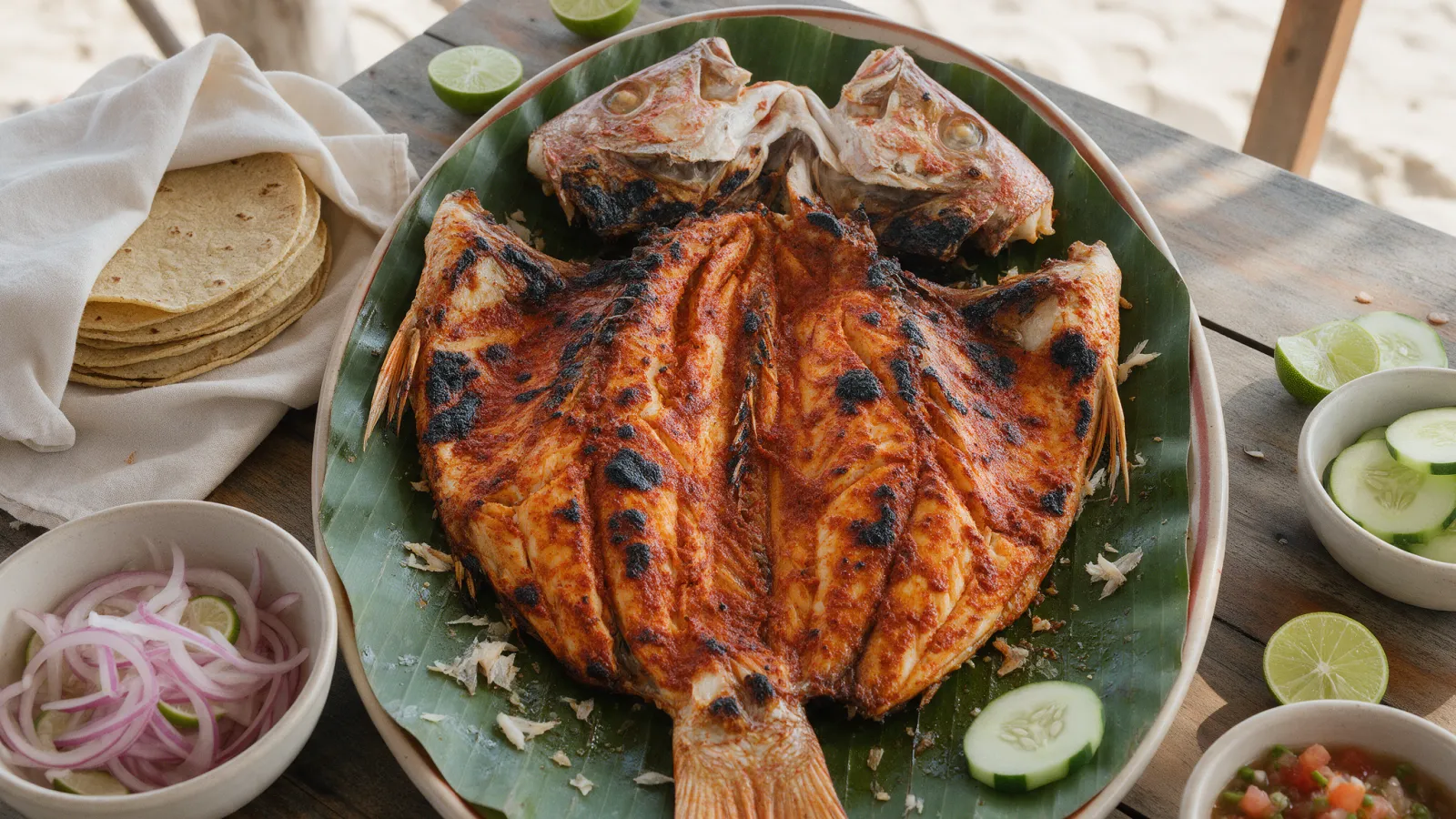

Pescado zarandeado (pes-KAH-doh sah-rahn-deh-AH-doh) is how Mexico’s Pacific coast grills a whole fish. The fish is split open flat like a book, painted on the cut side with a brick-red paste of dried chiles, and cooked over coals inside a zaranda, a hinged double grate that lets you flip the whole thing in one move. If you’ve ever lost half a fish to the grill bars, that basket is the answer, and it’s where this recipe spends most of its attention: how to buy and butterfly the fish, how hot the fire should be, and how to turn it without tearing the skin.
What is pescado zarandeado, and should you make it?
How do you make pescado zarandeado? Butterfly a 4 lb (1.8 kg) red snapper, salt it and spread the cut side with a blended paste of guajillo chiles, garlic, lime, soy sauce, Worcestershire and mayonnaise. Chill 30 minutes, then grill it in an oiled fish basket over medium-high coals, turning every 3 to 5 minutes, for 20 to 25 minutes until it reads 145°F (63°C) by the backbone. Finish with butter. Ready in 90 minutes for 4 servings.
Make it if you have a grill, or if you’re happy with an oven version that’s tasty but not smoky. It’s a sharing dish: the fish goes in the middle of the table and everyone pulls off flakes to fold into warm tortillas with red onion, cucumber and lime. Rick Bayless writes that most researchers place the original marinade on Mexcaltitán, a small island in the state of Nayarit, made with soy, garlic, lime, salt, pepper and achiote, and that today’s versions often lean on mayonnaise and hot sauce instead.
Good for. A summer cookout, a casual dinner for 4 to 8, or Lent Fridays. One 4 lb (1.8 kg) fish is the whole main course for four.
Not ideal for. Anyone who hates picking out bones: the backbone lifts out in one piece once the fish is cooked, but a few fine pin bones stay in the flesh. And it’s not a 30-minute weeknight meal.
Time, honestly. 90 minutes start to finish, about 65 of them hands-on, including soaking the chiles and waiting for the coals. The fish itself is on the grill for 25.
Difficulty, medium. The marinade is easy. The skill is in fire control and the flip: coals too hot burn the glaze before the center is cooked, and a cold basket glues the skin down.
What you need, and how to shop for it in the US or UK
You need one whole fish of about 4 lb (1.8 kg) for 4 people, roughly 1 lb (450 g) of whole fish per person. A whole snapper yields around 42 to 45 percent skin-on fillet, according to Reluctant Gourmet’s fish yield chart, which leaves about 7 oz (200 g) of fish per plate.
Which fish to buy
Red snapper is the classic: firm, with a tough skin that survives the basket. In Mexico the same family is sold as huachinango or pargo, and snook (robalo) is the other common choice. If your fish counter doesn’t have snapper, buy two or three smaller fish rather than hunting for one big one: they fit the basket better and cook in about the same time.
How to butterfly the fish, or what to ask for
The easy way: ask the fish counter to scale, gut and butterfly it through the back, leaving the backbone attached to one side. “Butterflied for the grill” or “split open like a book” both work.
To do it yourself you need a long, sharp knife:
- Scale and gut the fish, rinse and pat dry.
- Stand it on its belly and find the dorsal fin; the backbone runs right underneath.
- Cut along one side of the backbone, from behind the head to the tail, keeping the blade against the bone.
- Keep easing the flesh off the ribs down to the belly without cutting through the skin, so the two halves stay joined underneath.
- Open it flat. Split the head down the middle so it lies flat, or cut it off if the fish won’t fit the basket.
Don’t remove the backbone before grilling. It shields the thickest flesh from the heat and pulls out in one piece once the fish is done.
US and UK shopping and swaps
| You need | In the US | In the UK | What changes |
|---|---|---|---|
| Guajillo chiles | Hispanic aisle of most supermarkets, or online | Online Mexican grocers | Swap 2 ancho chiles for a sweeter, darker paste, or 1 tbsp sweet paprika plus a pinch of cayenne for color only |
| Whole red snapper | Fish markets, Gulf Coast stores, Asian and Latin grocers | Frozen at Caribbean and Asian grocers | Branzino, sea bass or sea bream are the best stand-ins |
| Mexican oregano | Hispanic aisle | Online | Regular dried oregano is fine, a little more minty |
| Mayonnaise | Any jar | Any jar | 3 tbsp oil instead gives a thinner glaze that burns faster |
| Soy sauce | Any | Any | Gluten-free tamari for coeliacs |
| Achiote paste, optional | Hispanic aisle | Online | Adds color more than heat |
The grill basket, and what to use without one
A hinged fish basket is a double wire grate with a handle, sold at hardware stores and in grilling sections. For a 4 lb (1.8 kg) fish you want one about 20 x 12 inches (50 x 30 cm). Without one:
- Two oven racks the same size, wired together at the corners.
- Heavy foil, well oiled, laid on the grill as in Mama Maggie’s Kitchen’s version. You don’t flip it; close the lid instead. You lose the charred crust on the cut side.
- The oven, where nothing needs turning.
How to plan it, from soaking chiles to the last flip
The trick to the schedule is that the fish’s 30 minutes in the fridge and the coals’ 30 minutes to burn down happen at the same time.
How to tell each stage is going right.
- Toasted chiles → pliable and fragrant after 20 to 30 seconds a side. If they crack when bent or smoke, they’ve gone too far.
- Marinade → thick, brick-colored, stays put on a spoon.
- Coals ready → covered in white ash, no flames, and your hand lasts 4 to 5 seconds at 4 inches (10 cm).
- First flip → after 3 to 4 minutes the marinade has lost its shine and the basket lifts away cleanly.
- Done → 145°F (63°C) by the backbone, or opaque flesh that separates into flakes. The glaze is dark red with charred edges.
What you can do ahead
- Up to a week before → the chile paste without the mayonnaise. Milk Street says its chile paste keeps up to a week refrigerated; I keep mine in a jar and stir in the mayo on grilling day.
- The day before → buy the fish and have it butterflied. The FDA advises cooking fresh fish within 2 days, kept at 40°F (4°C) or below.
- On the day → coat, chill 30 minutes, grill. Past about 2 hours the lime in the marinade starts turning the surface white and chalky.
Charcoal, gas grill or oven, heat and timing
For a 4 lb (1.8 kg) butterflied fish, about 1¼ inches (3 cm) at its thickest, plan on 20 to 25 minutes over medium-high coals, which matches the 20-to-30-minute range Mexican newspaper Excélsior gives, and check with a thermometer. Published times swing wildly, anywhere from a quarter of an hour to well over 40 minutes, because fire strength and fish size vary so much.
- Charcoal or wood → the method in this recipe and the only one that smokes the glaze. Excélsior uses the hand test at 10 cm for 4 to 5 seconds; Adán Medrano gives the same test with mesquite at 4 inches.
- Gas grill → medium-high, 400 to 450°F (200 to 230°C) with the lid down, basket straight on the grate, 20 to 25 minutes with 2 or 3 flips. The closed lid cooks the top so you turn it less.
- Oven → 400°F (200°C), skin side down on a rack over a sheet pan, 20 to 25 minutes, then 3 to 4 minutes under the broiler (grill, in the UK) to char the glaze. No flipping, no breakage, no smoke.
- Air fryer → fillets only. Spanish site Directo al Paladar cooks them 8 minutes at 400°F (200°C).
Turning it without sticking or breaking
- Dry fish → moisture on the skin steams against the metal and welds it on. Pat it dry right before it goes in.
- Hot, oiled basket → 2 minutes over the fire, then oil it with a brush or folded paper towel, as Rick Bayless does. Oiling cold metal doesn’t work.
- Marinade on the flesh only → on the skin it burns and sticks.
- Clamp it snug → if the fish slides around inside, it tears when you flip. Adjust the basket to the thickness of the back.
- Wait for it → the skin lets go by itself once it has crisped, usually within the first 4 minutes. If it resists, give it another minute.
Feeding 8, 12 or 20
Rule of thumb: 1 lb (450 g) of whole fish per person and one batch of marinade per 4 lb (1.8 kg) fish. Several 4 lb fish beat one giant one, since they fit a normal basket and cook in the same time.
| People | Fish | Marinade | Baskets or rounds |
|---|---|---|---|
| 4 | 1 × 4 lb (1.8 kg) | 1 batch | 1 round, 25 min |
| 8 | 2 × 4 lb | 2 batches | 2 baskets at once |
| 12 | 3 × 4 lb | 3 batches | 2 rounds, 50 min |
| 20 | 5 × 4 lb | 5 batches | 3 rounds, 75 min |
Hold finished fish loosely tented with foil in a 200°F (95°C) oven; the USDA says hot food that has to wait should stay at 140°F (60°C) or above. Top up the charcoal between rounds, because one load of coals lasts about two fish.
Before you start, mistakes, safety, heat level and allergens
The safe temperature. The FDA’s safe minimum for fin fish is 145°F (63°C), or flesh that’s opaque and separates easily with a fork. On a butterflied fish, probe the thickest part right beside the backbone, which is the last spot to cook.
Common mistakes.
- Stuck to the basket → cold or unoiled metal, or wet fish. Heat, oil, dry.
- Black glaze, raw middle → coals too hot. Raise the grate or spread the coals and give the skin side longer.
- Dry fish → it went past 145°F, usually at the thin belly edge. The slashes in the thick back even things out.
- Broke on the flip → the fish was loose in the basket, or it was a delicate fish like tilapia. Clamp it snug and choose snapper, bass or bream.
- Tastes of raw lime → marinated too long. Thirty minutes is enough; Excélsior asks for at least 30.
- Too salty → soy and Worcestershire bring plenty of salt. Stick to the teaspoon in the recipe.
Heat level, 1 out of 5. Guajillo is a flavor chile more than a hot one. With the chile de árbol it’s about a 3, and the hot sauce on the table covers everyone else.
Kids. Usually a hit, because the glaze tastes more of soy and lime than chile. Give them flakes from the thick back, checked for pin bones, in a tortilla with cucumber.
Allergens. Fish; egg, from the mayonnaise; soy and wheat, from the soy sauce; milk, from the butter. Classic Worcestershire contains anchovies. For a gluten-free meal, use tamari and a gluten-free Worcestershire.
Which version to make
- Short on time → skin-on snapper or bass fillets about 1 inch (2.5 cm) thick, same marinade, 8 to 10 minutes in a basket or a very hot cast-iron pan, like Rick Bayless’s zarandeado fillets. About 40 minutes total.
- No grill → the oven at 400°F (200°C), 20 to 25 minutes, plus the broiler. Tasty, just not smoky.
- No basket → two oven racks wired together, or oiled foil with the lid closed.
- For a party → several 4 lb fish in rounds, with the first ones held in a low oven. The scaling table above has the numbers.
- Lighter → skip the mayonnaise and butter and use just chile, lime and soy, closer to the old marinade Bayless describes. That saves about 169 calories per serving; lower the coals a little, as the thinner glaze burns faster.
- Vegetarian → there’s no traditional version. The same paste works on eggplants halved lengthwise or portobello mushrooms, 10 to 12 minutes over the coals.
How it compares with other fish dishes here. A whole fish in tomato, olive and caper sauce, no grill needed, is fish Veracruz style. Whole fish with crisp skin from a frying pan is Colombian fried mojarra. For battered fish in tortillas, Baja fish tacos, and for raw fish cured in lime, Mexican fish ceviche. Zarandeado is the one that needs a fire.
What pescado zarandeado costs in the US
The fish is almost the whole bill. Texas grocery chain H-E-B listed whole red snapper at about $13.97 a pound, so a 4 lb (1.8 kg) fish comes to roughly $55.43.
Add 6 limes at the USDA’s retail average of 50 cents each, a red onion, garlic and butter at USDA and Bureau of Labor Statistics prices, and dinner for 4 runs about $59.59, or $14.90 a plate, before tortillas, cucumber and the pantry sauces, which have no official price series. Two or three branzino or a striped bass usually cost less per pound than red snapper, and that’s the swap that saves money.
Yield. 4 plates of about 7 oz (200 g) cooked fish each, with 3 tortillas apiece. With Mexican red rice and beans on the side, it stretches to 5.
What to expect, how to serve it and how to store leftovers
Taste and texture. Blistered, smoky skin; white, juicy flesh in big flakes; a dark red glaze that’s salty and tangy with the sweetness of dried chile underneath. The belly edge cooks a little further and the flesh by the bone stays most tender.
How it’s served. Whole, on a board or platter, so everyone pulls off pieces with a fork and builds their own tacos with corn tortillas, red onion, cucumber, lime and hot sauce. A bowl of pico de gallo belongs on the table, and a pitcher of tamarind agua fresca is a good cold drink alongside.
Fridge. The USDA’s limit is 2 hours at room temperature; after that, leftovers keep 3 to 4 days at 40°F (4°C) or below. Flake the flesh off the bones first and store it covered.
Freezer. FoodSafety.gov gives cooked fish 4 to 6 months for best quality, though the skin loses its crunch. I freeze it flaked, ready for tacos.
Reheating. In a 300°F (150°C) oven, covered with foil with a spoonful of water or butter, about 10 minutes, to 165°F (74°C), the USDA’s target for leftovers. The microwave dries it out and makes it rubbery. Cold, in a taco with lime and onion, it’s just as good.
Pescado zarandeado FAQ
What kind of fish is used for pescado zarandeado? Whole red snapper is the classic, along with snook in Mexico. Outside Mexico, branzino, sea bass, striped bass or sea bream all work. Tilapia breaks easily.
Where is pescado zarandeado from? Mexico’s Pacific coast, especially the states of Nayarit and Sinaloa. Rick Bayless notes that most researchers place the original marinade on the island of Mexcaltitán, in Nayarit.
What does zarandeado mean? It refers to the zaranda, the hinged double grate that holds the fish flat over the coals and lets you flip it in one piece.
How long does it take to grill a whole butterflied fish? A 4 lb (1.8 kg) fish takes 20 to 25 minutes over medium-high coals, turned every 3 to 5 minutes, until 145°F (63°C) by the backbone.
Can I make pescado zarandeado in the oven? Yes. Roast it skin side down at 400°F (200°C) for 20 to 25 minutes, then broil 3 to 4 minutes to char the glaze.
Can I use fillets instead of a whole fish? Yes. Skin-on fillets about 1 inch (2.5 cm) thick take 8 to 10 minutes in a basket or a hot cast-iron pan.
How do I keep fish from sticking to the grill? Dry the skin well, preheat the empty basket and oil it just before the fish goes in. Then leave it alone until the skin releases by itself.
Is pescado zarandeado spicy? Not much. Guajillo is mild, more about color and a raisin-like flavor than heat. Add a chile de árbol to the paste or hot sauce at the table for more.
How much fish do I need per person? About 1 lb (450 g) of whole fish per person, so a 4 lb (1.8 kg) fish feeds 4.
Nutrition per serving
Per serving (about 7 oz / 200 g of fish with its glaze, without tortillas or sides), calculated ingredient by ingredient from USDA FoodData Central (SR Legacy) using this recipe’s amounts, counting all of the marinade and a 45 percent flesh yield:
- Calories: 410
- Protein: 43 g
- Carbohydrates: 9 g
- Fat: 22 g, including 8 g saturated
- Fiber: 2 g
- Sugars: 4 g
- Sodium: 1,367 mg
Snapper itself is very lean; nearly all the fat is from the mayonnaise and butter, about 169 calories a serving, and those are the first things to drop for a lighter plate. Of the 1,367 mg of sodium, roughly three quarters comes from the teaspoon of salt and the soy sauce together, so low-sodium soy makes a real dent. Some marinade stays on the basket, so treat these numbers as a ceiling. Three corn tortillas add about 157 calories.
In Colombia, where I live, a whole fish on the table usually means fried mojarra, so the first time I set down a grilled, chile-red snapper, everyone sat waiting for the patacones. They ended up building tacos instead and asking for the paste. What I keep relearning with this dish is that it’s won at the fire, not in the blender: medium coals and a hot, oiled basket beat a blazing grill every time. Josnaisis.