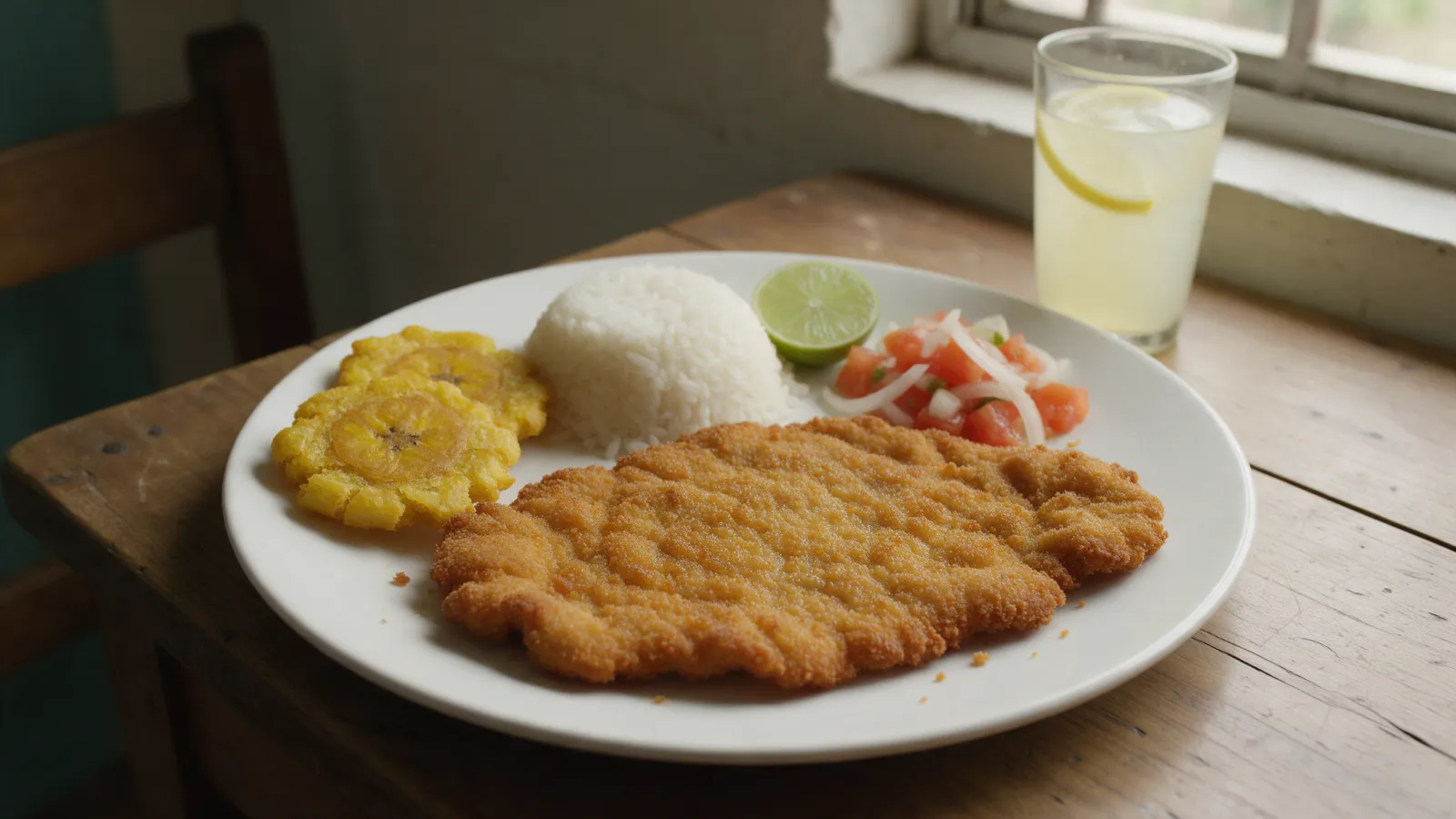

Order lunch in Cali, Colombia, and the chuleta comes out as a golden pork cutlet the size of the plate, next to white rice, a couple of fried green plantains and a wedge of lime. Chuleta valluna (choo-LEH-tah vah-YOO-nah) means “cutlet from the Valle del Cauca,” the region around Cali, and despite the word chuleta there’s no bone: it’s a boneless steak of pork leg or loin, pounded thin, marinated in lime, cumin and garlic, then breaded and fried. If you’ve made schnitzel or chicken cutlets, you already know half of it. The other half is the marinade and a crust that’s meant to cling to the meat.
What is chuleta valluna, and is it worth making at home?
How do you make chuleta valluna? Pound 1 cm (⅜ inch) pork steaks to 5 mm (3/16 inch) and marinate them 30 minutes with garlic, cumin, lime, salt and pepper. Pat dry, coat in flour, egg and fine breadcrumbs, and fry in ⅜ inch (1 cm) of oil at 350°F (175°C) for 2½ to 3 minutes per side, until the center hits 145°F (63°C). 80 minutes for 4 servings.
Yes, if you want a weeknight-friendly cutlet with more personality than a plain breaded chop. Everything comes from a regular supermarket except, maybe, the green plantains for the side.
What it tastes like. Salty, crunchy crust; juicy pork underneath with an earthy note from cumin and a sour edge from lime, which you double down on with a squeeze at the table. Colombian news site RTVC describes the Valle version as a pork steak that is marinated before breading, and the magazine Semana lists the seasoning as lime, cumin, pepper and salt.
Who it’s for. Anyone feeding 4 to 6 on a weekend, or a cook who likes a plate that’s a full meal: meat, rice, plantain, salad.
Who should skip it. If you don’t want to shallow-fry at home, the air fryer version below works, but it’s paler and drier. It isn’t a 15-minute dinner either, because of the marinade.
Effort. Medium. Pounding and breading are easy. Oil temperature is where it goes wrong, and a cheap probe thermometer fixes that.
Chuleta valluna vs schnitzel vs milanesa
- Wiener Schnitzel → veal, and in Austria the name legally requires it, according to Wikipedia. About 4 mm thick, fried in lard or clarified butter at 320-340°F (160-170°C), with crumbs left unpressed so the crust puffs away from the meat.
- Argentine milanesa → mostly beef, especially round (nalga), cut just under 1 cm, often with garlic and parsley in the egg. Served with fries.
- Chuleta valluna → pork, marinated in lime and cumin, crumbs pressed on so the crust stays attached, served with rice and plantains.
If you want a puffy, wavy schnitzel crust, this isn’t the recipe. A Cali chuleta has a flat, tight crust.
Shopping list and the swaps that actually work
For 4: 1¾ lb (800 g) boneless pork, 2 eggs, ½ cup (70 g) flour, a heaping cup (120 g) of fine breadcrumbs and 2½ cups (600 ml) of oil, plus garlic, cumin, oregano, lime, salt and pepper. Exact amounts are in the recipe card.
The pork. Colombian recipes use both cuts: the newspaper El Espectador uses the center of the leg, My Colombian Recipes uses loin. I prefer leg. It has more flavor and forgives an extra half minute in the pan, while loin is leaner (3 g of fat per 100 g against 5 g for lean leg, per USDA data) and dries out faster.
- In the US → boneless pork loin chops are the easy buy, or packaged “pork cutlets.” Fresh leg is sold as fresh ham, usually as a roast; ask the butcher to slice it.
- In the UK → pork leg escalopes, which retailers such as Riverford and Northfield Farm cut from the leg and slice thin. They may need only a few taps with the mallet.
- Avoid shoulder (Boston butt) for this. The seams of fat and connective tissue tear when you pound it.
Breadcrumbs. Fine, dry, plain, with a sandy texture. America’s Test Kitchen found that panko fried up hard and crunchy on breaded cutlets, and that’s what you get here too: a spikier crust than the smooth one you’d be served in Cali. Seasoned Italian-style crumbs add a lot of salt; if you use them, drop the ¼ tsp salt in the flour.
Lime. Colombia’s limón Tahití is the same Persian lime sold in US and UK supermarkets. Lemon works in a pinch, with a slightly different sourness.
Oil. Any neutral oil with a high smoke point. Skip extra-virgin olive oil: its flavor fights the cumin, and 2½ cups of it is an expensive way to fry.
How thin to pound pork for chuleta valluna
5 mm, or 3/16 inch, half the starting thickness. Thinner, and the meat dries out before the crust is golden. Thicker, and the crumbs burn before the center reaches 145°F (63°C).
A 7 oz (200 g) steak at that thickness covers roughly 8 by 7½ inches (20 x 19 cm). If it doesn’t fit your skillet, cut it in two.
How to pound without tearing. Plastic wrap or an open freezer bag on both sides, the flat face of the mallet (the toothed face shreds the surface and lets oil into the meat), and strokes that start in the center and push outward. A small tear is fine: the egg and crumbs seal it.
Oil temperature and safe pork, the numbers that matter
The oil goes in at 350°F (175°C) and shouldn’t drop below 320°F (160°C). The pork is done at 145°F (63°C) in the center with a 3-minute rest.
Where those numbers come from. ThermoWorks, in its pork schnitzel recipe, adds the meat at 350°F (177°C) and holds the oil near 325°F (163°C) during the cook. The 145°F with a 3-minute rest is the USDA FSIS minimum for whole cuts of pork, set in 2011; FSIS notes the meat may still look slightly pink and be safe, and that color isn’t a reliable test. Ground pork, which this recipe doesn’t use, goes to 160°F (71°C).
Checking a thin cutlet. Slide the probe in from the side, into the thickest part. Without a thermometer, cut into that spot: the meat should be white with a faint blush and the juice clear.
Why the breading falls off, and other mistakes
- Wet meat → marinade left on the surface turns to steam and pushes the crust off. Pat dry before the flour.
- Too much flour → the egg sticks to loose flour, not to the meat, and the whole crust slides off in one piece. Shake until it’s barely visible.
- No rest → 10 minutes in the fridge lets the crumbs hydrate and set. In the comments on the ThermoWorks recipe, a reader suggests 30 minutes and the author agrees it helps.
- Cool oil → below 320°F (160°C) the crumbs absorb oil instead of sealing.
- Too much flipping → every turn loosens the crust. Once, with tongs at the edge.
- Burnt outside, raw inside → oil above 375°F (190°C) or meat thicker than 7 mm (¼ inch). Lower the heat, pound thinner.
- Soggy underside → resting on paper towels. Use a rack.
Spice level, 0 out of 5. For heat, serve Colombian ají picante on the side.
Kids. Usually a hit, since it’s breaded meat with no sauce. Cut it into strips and trim the crisp edges for small children.
Allergens. Gluten (flour and breadcrumbs) and egg. No dairy or nuts. For gluten-free, use rice flour and gluten-free crumbs; the crust is more brittle.
Game plan, make-ahead and cooking for a crowd
80 minutes on the clock, about 40 hands-on. The marinade and the coating’s rest are dead time: use them for the rice and the plantains.
| What | How far ahead | How to store |
|---|---|---|
| Pounded, seasoned pork | Up to 24 hours | Covered, fridge, marinade without lime |
| Breaded raw cutlets | Same day, or frozen | Single layer on a tray, then a freezer bag |
| Rice | 1 day | Covered, fridge; reheat with a splash of water |
| Patacones | Same day | Fry before the pork, in the same oil, and keep warm in a 195°F (90°C) oven |
| Fried cutlets | Up to 20 minutes | On a rack in a 195°F (90°C) oven |
Why the lime waits. My Colombian Recipes marinates its cutlets overnight with garlic, onion and cumin and no acid. I don’t leave lime on the pork for more than 4 hours; the surface turns pale and the crust grips worse.
Scaling up. An 11-inch (28 cm) skillet fits 2 cutlets per batch, about 6 minutes each.
| Servings | Pork | Eggs | Flour | Breadcrumbs | Batches, one skillet |
|---|---|---|---|---|---|
| 4 | 1¾ lb (800 g) | 2 | ½ cup (70 g) | 1 cup (120 g) | 2, 12 min |
| 6 | 2⅔ lb (1.2 kg) | 3 | ¾ cup (100 g) | 1½ cups (180 g) | 3, 18 min |
| 10 | 4½ lb (2 kg) | 5 | 1⅓ cups (175 g) | 2½ cups (300 g) | 5, 30 min |
| 20 | 8¾ lb (4 kg) | 10 | 2¾ cups (350 g) | 5 cups (600 g) | 10, or 5 with 2 skillets |
For 10 or more, season the night before, bread in an assembly line of three trays and run two skillets. Burnt crumbs darken and embitter later batches, so plan on fresh oil after the fourth batch.
Air fryer, less oil, and other versions
- Air fryer → heat it to 400°F (200°C), spray the breaded cutlets on both sides, cook in a single layer 5 minutes, flip, spray again and give them 3 to 5 more minutes, until 145°F (63°C). Those are the times in Crumb Top Baking’s air fryer pork schnitzel. The crust is paler, drier and less rich; by my estimate each cutlet takes up about 7 g (½ tbsp) less oil, roughly 60 kcal.
- Less oil → 2 tbsp per batch over medium heat, 3 minutes per side, wiping the pan between batches, as My Colombian Recipes does. Fine for 2 people; the edges come out patchy.
- Lighter → loin plus the air fryer brings it from 470 to about 380 kcal.
- Chicken or beef → butterflied chicken breast or a thin beef steak, pounded to 5 mm and treated the same way. Chicken has to reach 165°F (74°C).
- Freezer-to-pan → breaded raw cutlets go straight from the freezer into oil at 330°F (165°C), about 4 minutes per side. That’s my method, and I always check for 145°F (63°C).
What it costs in the US
With the Bureau of Labor Statistics US city averages for August 2026, boneless pork chops at $4.532/lb make the 1¾ lb (800 g) of pork $7.99. Two eggs at $2.272 a dozen are 38 cents, 11 oz (320 g) of rice at $1.111/lb is 78 cents and the flour 8 cents. Four limes at 50 cents each, the price in USDA AMS retail ads for 9 October 2026, add $2.
That’s $11.23 for what is tracked, about $2.81 a plate, with pork at 71% of it. The BLS doesn’t track breadcrumbs, frying oil or plantains, and has no fresh pork leg series, which is why the loin chop price stands in. In Colombia, with wholesale prices in Cali for the same week, the pork was 62% of the full plate. At Colombian restaurants in Miami, the Cali newspaper El País found it on menus for $14 to $18, so the homemade plate costs a fraction of that.
How it’s served in Cali, and how to store it
On the plate. Semana says it comes mainly with rice and patacones; RTVC adds potatoes or salad. Make Colombian white rice, a few Colombian patacones, a tomato and onion salad and lime wedges. El Espectador suggests a glass of Colombian lulada, the chunky lulo drink from Cali. For a bigger Valle-style lunch, start with Colombian empanadas or aborrajados, stuffed sweet plantains. If you like your fried pork with a different crunch, try Colombian chicharrón, the pork belly that also tops a bandeja paisa.
Fridge. USDA FSIS gives cooked meat leftovers 3 to 4 days at 40°F (4°C) or below, and no more than 2 hours at room temperature. Store the cutlets in a single layer so the crust doesn’t steam.
Freezer. Fried, 2 to 3 months (FSIS, cooked meat). Raw breaded cutlets keep 4 to 6 months, the FSIS window for raw pork chops.
Reheating. Oven or air fryer at 350°F (180°C), 6 to 8 minutes on a rack, until 165°F (74°C) in the center, the FSIS reheating temperature. The microwave turns the crust soft for good.
Chuleta valluna FAQ
What is chuleta valluna? A Colombian breaded pork cutlet from Cali and the Valle del Cauca: boneless leg or loin pounded to about 5 mm (3/16 inch), marinated in lime, cumin and garlic, coated in flour, egg and breadcrumbs and fried. It’s served with rice and fried green plantains.
What cut of pork is best for chuleta valluna? Boneless leg (fresh ham, or leg escalopes in the UK) or boneless loin. Leg has more flavor and stays juicier; loin is leaner and dries out faster.
How thin should pork cutlets be? About 5 mm, or 3/16 inch. Start with ⅜ inch (1 cm) steaks and pound them to half.
Why does the breading fall off my pork cutlets? Wet meat, too much flour or oil below 320°F (160°C). Pat dry, shake off the flour, rest the breaded cutlets 10 minutes and fry at 350°F (175°C).
What temperature should pork cutlets be cooked to? 145°F (63°C) in the center, then a 3-minute rest, per USDA FSIS. It may look slightly pink and still be safe.
Can you make chuleta valluna in an air fryer? Yes: 400°F (200°C), sprayed with oil, 5 minutes, flip, then 3 to 5 more. It’s paler and drier than fried.
Is chuleta valluna the same as schnitzel? Close relatives. Schnitzel is traditionally veal with a puffy, loose crust; chuleta valluna is pork, marinated in lime and cumin, with a crust pressed tight to the meat.
Nutrition per cutlet
Per cutlet (about 5 oz / 140 g fried, without sides), calculated from USDA FoodData Central (SR Legacy): 800 g of raw lean pork leg, the coating that actually sticks (25 g flour, 60 g egg, 70 g breadcrumbs), 35 g of absorbed oil and the 8 g of salt. The absorbed oil is estimated from USDA’s breaded, pan-fried veal, which picks up about 18 g of fat per pound of raw meat.
- Calories: 470 kcal
- Protein: 46 g
- Carbohydrates: 19 g
- Fat: 22 g, of which saturated 5 g
- Fiber: 1 g
- Sugars: 1 g
- Sodium: 1,040 mg
Loin saves about 25 kcal and 4 g of fat per cutlet compared with leg. Most of the sodium is the salt: halve the salt in the marinade and it drops to about 750 mg.
In Venezuela, where I grew up, any breaded cutlet was a milanesa, and it came with fried sweet plantains. In Cali I learned to marinate it in lime first, and to stop blaming the breadcrumbs: every crust I lost was cold oil. Now the thermometer comes out before the pork does. Josnaisis.