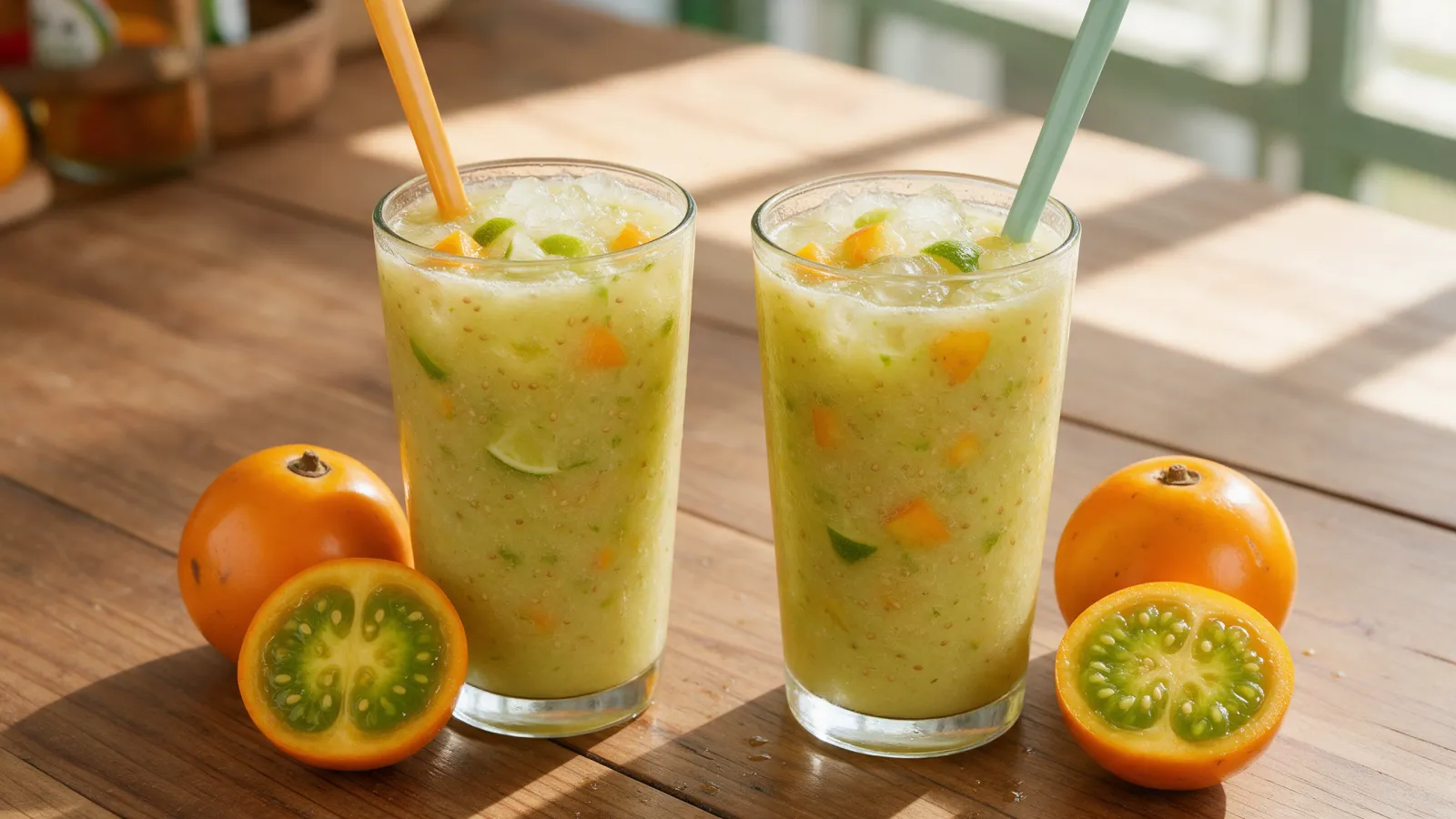

In Cali, Colombia, lulada never goes near a blender. Where most fruit drinks are blended smooth and strained, here the lulo is diced by hand, crushed with sugar in the pitcher, topped up with lime and ice water, and served with a spoon. You drink the juice and then eat the chunks. This version gives exact amounts per glass and for a party pitcher, tells you what to buy when fresh lulo is nowhere to be found, and shows how much sugar the fruit you have actually needs.
Is lulada worth making, and what is it?
How do you make Colombian lulada? Peel 6 ripe lulos, dice them into ¼ in (0.5 cm) cubes and mash them in a pitcher with 60-80 g (5-6 tbsp) of sugar until they release their juice, without blending, so the seeds stay whole. Stir in 60 ml (¼ cup) lime juice and 500 ml (2 cups) very cold water and pour over ice, unstrained. Ready in 15 minutes for 4 servings.
Lulada (loo-LAH-dah) is the signature cold drink of Cali and the Valle del Cauca, in southwestern Colombia: lulo, lime, water, sugar and ice, with the fruit chopped and mashed instead of blended. Lulo (Solanum quitoense) is called naranjilla, “little orange”, in Ecuador and on most US labels. It’s a tomato relative about the size of a tangerine, roughly 115 g (4 oz), with an orange, fuzzy skin and a green, jelly-like flesh full of small flat seeds. Botanist Julia Morton, in Fruits of Warm Climates, compares the flavor to pineapple and lemon. That’s close: sharp, fragrant and green.
Worth it? If you can get lulo or its frozen pulp, yes. It takes 15 minutes, needs no blender, and tastes like nothing else in a US or UK kitchen. Each glass carries 100 g (3.5 oz) of fruit, nearly half again what goes into a glass of Colombian lulo juice, so it drinks like a thin fruit cup.
Not for you if you dislike sour drinks or bits in your glass. And if frozen pulp is all you can find, you’ll get a thick, smooth drink without the chunks.
Effort. Easy. 15 minutes, 13 of them hands-on; the only skill is peeling six small fruits without losing their juice.
Lulada vs lulo juice vs the blender shortcut
Some recipes blend the lulo for up to a minute and strain it, then drop a few diced pieces into the glass. That’s lulo juice with garnish.
The seeds are the reason. Blades crack them in seconds, and cracked lulo seeds leave a bitter, mouth-drying edge. A muddler presses the flesh off them and leaves them whole; you swallow them without noticing, the way you do with kiwi seeds.
What you need, and how to find lulo in the US and UK
Exact amounts are in the recipe card. The ratio I scale from is per 11 oz (330 ml) glass: 100 g (3.5 oz) pulp, which is 1½ lulos, 20 g (1½ tbsp) sugar, 15 ml (1 tbsp) lime juice, 125 ml (½ cup) water and 75 g (½ cup) ice.
Choosing lulo, fresh, frozen or canned
- US. Goya sells Naranjilla Fruit Pulp in 14 oz (396 g) frozen packs at Latin grocers and at chains such as ShopRite and PriceRite. Latin markets also stock frozen whole lulos and canned lulo in syrup. Fresh lulo is rare; when you do see it, it’s usually in Colombian or Ecuadorian groceries.
- UK. Look for “pulpa de lulo” or “pulpa de naranjilla” in the freezers of Latin American shops in London and other big cities, or from online frozen-food shops that ship Latin products.
- Ripe fresh lulo is deep orange, gives slightly under your thumb and loses its fuzz when rubbed. A study from the National University of Colombia at Palmira, published in Acta Agronómica, measured riper lulos at 9.04 °Brix against 6.58 for less ripe ones, with acidity falling from 3.78 to 3.21 g of citric acid per 100 g. Riper fruit needs less sugar.
Using frozen pulp. Thaw the pack for 10 minutes, stir in the sugar with a spoon (there’s nothing to mash) and carry on. If you have even two or three fresh or frozen whole lulos, dice them into the pulp to bring back some chunks. Canned lulo is already sweet: drain it, rinse it, and use half the sugar.
Is there a substitute for lulo? Not really. Passion fruit with extra lime makes a good tart, seedy drink, but it tastes of passion fruit. I’d rather use frozen naranjilla pulp than fake it.
Sugar, and what it does to the calories
Lime matters too. Colombian limón is the small green Persian or Tahiti lime, the same one sold as “lime” in the US and UK. Lemon works at a pinch; it’s a little softer and less aromatic.
Equipment, and what to use instead
A paring knife, a cutting board with a juice groove, a wide 1.5 liter (6 cup) pitcher and something to mash with. A cocktail muddler is ideal; a potato masher is faster for big batches; a wooden spoon handle or a fork will do. No blender, no strainer.
How to plan it, and how to tell it’s going right
The order. Rub, peel and dice all the fruit first. Then sugar and mash, rest, and only then lime and water. Ice goes in the glasses at the last minute.
Signs you’re on track.
- Peeling → the skin comes off in thin strips and you can see a firm green ring of flesh underneath. Peel too thick and you lose the most flavorful part.
- Mashing → after 2 minutes the bottom of the pitcher is full of green juice and the chunks are about chickpea size. If you hear seeds crunching, ease off.
- After resting → the sugar is dissolved and doesn’t feel gritty.
- In the glass → cloudy green, thick, with chunks sinking and seeds visible against the glass.
Make-ahead and party amounts
The night before, or that morning, peel, dice and mash the fruit with the sugar and lime, cover it and refrigerate. In my kitchen that base keeps well for 24 hours. Add water and ice when you serve.
| Glasses, 11 oz (330 ml) | Lulos | Sugar | Lime juice | Cold water | Ice |
|---|---|---|---|---|---|
| 4 | 6, 650 g (1.4 lb) | 80 g (6 tbsp) | 60 ml (¼ cup) | 500 ml (2 cups) | 300 g (2 cups) |
| 6 | 9, 1 kg (2.2 lb) | 120 g (⅔ cup) | 90 ml (6 tbsp) | 750 ml (3 cups) | 450 g (3 cups) |
| 12 | 18, 2 kg (4.4 lb) | 240 g (1¼ cups) | 180 ml (¾ cup) | 1.5 liters (6 cups) | 900 g (6 cups) |
| 20 | 30, 3.25 kg (7.2 lb) | 400 g (2 cups) | 300 ml (1¼ cups) | 2.5 liters (10½ cups) | 1.5 kg (10 cups) |
With frozen pulp, count one 14 oz (396 g) pack for every 4 glasses: 5 packs for 20. Peeling 30 lulos takes me about 40 minutes, which is why I always do the base a day ahead. For 20, mash in an 8 liter (8 quart) pot with a potato masher, and keep the ice in the glasses: ice in a big pitcher waters it down within the hour.
Before you make it, mistakes, kids and allergens
- Bitter → it was blended, or mashed so hard the seeds cracked. Press, don’t grind.
- Thin and watery → the water went in before the sugar, or the lulo was underripe. Sugar and mashing first; 500 ml (2 cups) water for 400 g (14 oz) pulp, no more.
- Too sour → underripe fruit or too much lime. Take the sugar up to 100 g (½ cup) before cutting the lime.
- Fuzz in the glass → the lulos weren’t rubbed before peeling.
- Turns dull and brownish → it sat for hours with the water in. Store the base undiluted.
- Hard chunks → no rest. The 2 minutes with sugar softens the fruit.
Heat level, 0 out of 5. Sour, never spicy.
Kids? Most like it with the full 100 g (½ cup) of sugar or with condensed milk, and younger ones enjoy eating the chunks with a spoon.
Allergens. The basic recipe contains none of the major allergens; the condensed-milk version contains dairy. Lulo belongs to the nightshade genus Solanum, like tomato and eggplant, so anyone allergic to that family should check first. Morton notes that the fuzz on the skin can irritate sensitive skin; wear kitchen gloves to rub the fruit if it bothers you.
Which version should you make?
- Short on time → frozen pulp, 5 minutes start to finish.
- No muddler → a potato masher or wooden spoon; the result is the same.
- For a crowd → make the base the day before and dilute it in the pitcher as guests arrive.
- Lighter → 40 g (3 tbsp) sugar for 67 kcal a glass. Tarter, and plenty of people prefer it that way.
- With condensed milk → smear 1 tablespoon (20 g) of sweetened condensed milk around the inside of each glass before pouring, and cut the pitcher sugar to 40 g (3 tbsp). Creamier and sweeter, 132 kcal a glass. Spanish Wikipedia lists it as a recent, non-traditional variation. The same idea drives Colombian condensed milk lemonade.
- For adults → English Wikipedia notes lulada is sometimes served with a shot of aguardiente, Colombia’s anise spirit; Spanish Wikipedia treats liquor as a non-traditional addition. I’d add 30 ml (1 oz) to the glass, not the pitcher, so the pitcher works for everyone.
What lulada costs
In the US, Goya’s 14 oz (396 g) naranjilla pulp was listed at $2.99 to $4.29 on PriceRite and ShopRite’s online stores. Sugar at the BLS August 2026 average of $1.024 a pound adds 18 cents for 80 g. The BLS doesn’t track limes; at its lemon average of $2.114 a pound, two pieces of citrus come to about $1.06. A 4-glass pitcher comes to $4.23 to $5.53, roughly $1.06 to $1.38 a glass, and the pulp is about three quarters of that.
In Cali the fruit is cheap: the DANE’s SIPSA wholesale bulletin for September 12-18, 2026 had lulo at 4,888 pesos a kilo at Cavasa, Cali’s main wholesale market, so the whole pitcher costs about 3,850 pesos, lulo included, sugar and limes too.
Yield. 4 tall glasses of about 11 oz (330 ml) with ice, or 6 smaller 7½ oz (220 ml) glasses alongside snacks.
What to expect, how to serve it and how long it keeps
Taste and texture. Tart and fresh, with lulo’s pineapple-and-lemon aroma and sweetness you set yourself. Thick, cloudy green, with soft chunks and seeds you swallow without biting.
How it’s served. Ice cold, in a tall glass with a spoon. In Cali it sits next to fried street food: Colombian empanadas from Cali or aborrajados, cheese-stuffed sweet plantains need something sour beside them, and so does a Sunday pot of Colombian chicken and rice or a chuleta valluna, Cali’s breaded pork cutlet. On a fruit table, it goes with cholado, Cali’s shaved ice with fruit or a pitcher of Colombian salpicón.
Out of the fridge. Lulada is cut fruit, and according to USDA FSIS cut fruit is perishable: 2 hours at room temperature at most, 1 hour above 90°F (32°C). At a summer party, put the pitcher out in rounds.
Fridge. Once diluted, I drink it the same day: it won’t spoil in a few hours at 40°F (4°C) or below, but melting ice thins it and the color and aroma fade. The undiluted base keeps 24 hours.
Freezer. Freeze the mashed base, with its sugar and lime, in flat bags, one per pitcher. FSIS says food held at 0°F (−18°C) stays safe indefinitely; for quality I use it within 3 months. Thaw in the fridge and add cold water. Don’t freeze finished lulada with ice; it separates.
Lulada FAQ
What does lulada taste like? Sour and fragrant, somewhere between pineapple and lime, sweetened to taste. The texture is thick, with chunks of fruit you eat with a spoon.
Is lulo the same as naranjilla? Yes. Both names refer to Solanum quitoense: lulo in Colombia, naranjilla in Ecuador and on most US frozen-pulp labels.
Do you blend lulada? No. Blending cracks the seeds and makes it bitter, and once it’s strained it’s lulo juice. Lulada is mashed by hand.
Do you eat the seeds? Yes, whole. They’re small and flat enough to swallow whole; the problem only comes when they’re crushed.
How much frozen pulp for lulada? One 14 oz (396 g) pack for 4 glasses. You’ll lose the chunks; dice a few whole lulos into it if you have them.
Can I use lemon instead of lime? Yes, in the same amount. It’s slightly less sharp and less aromatic than lime.
Is lulada alcoholic? Not traditionally. Some people add a shot of aguardiente; put it in the glass, not the pitcher.
How long does lulada last? 2 hours out of the fridge, 1 hour above 90°F (32°C). The undiluted base lasts 24 hours refrigerated.
Nutrition
Per 11 oz (330 ml) glass, a quarter of the recipe with 80 g (6 tbsp) of sugar, calculated from USDA SR Legacy data for frozen unsweetened naranjilla (lulo) pulp, raw lime juice and granulated sugar:
- Calories: 106 kcal
- Protein: 1 g
- Carbohydrates: 27 g
- Fat: 0 g
- Fiber: 1 g
- Sugars: 24 g, 20 g of them added
- Sodium: 5 mg
Lulo pulp has only 25 kcal per 100 g (3.5 oz), so three quarters of each glass’s calories are the sugar: unsweetened, it’s 29 kcal. Nothing is strained, so the fruit’s fiber stays in the glass. The condensed-milk version comes to about 132 kcal.
Lulo was a stranger to me in Venezuela. The first lulada I made at home I blended out of habit, and it came out bitter and thin. These days the blender stays in the cupboard, and the only thing I measure with care is the sugar, because no two bags of lulo ripen the same. Josnaisis.