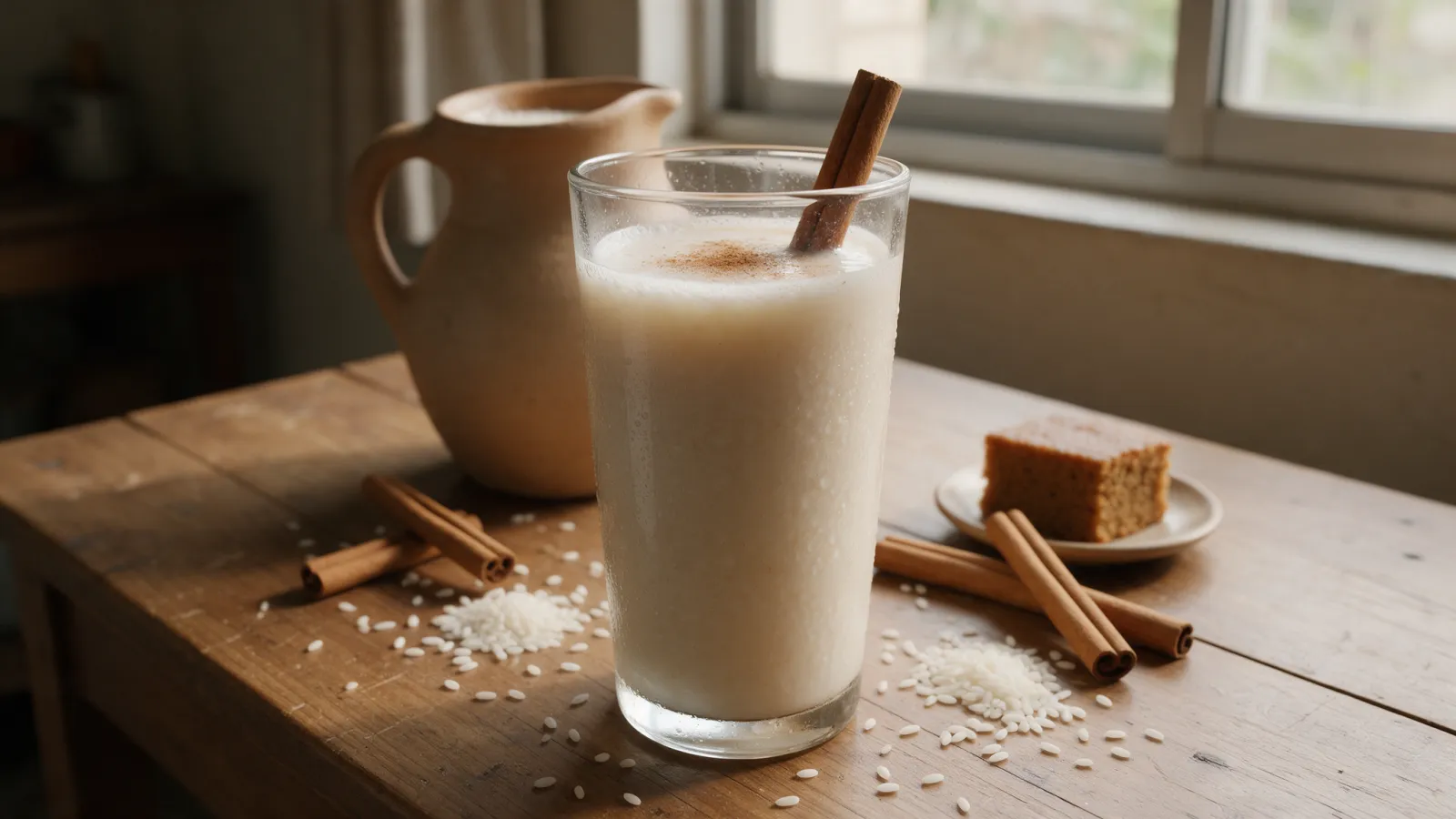

If you have ever had Mexican horchata, you are halfway to Colombian masato (mah-SAH-toh). Both are cold, sweet rice drinks spiced with cinnamon. The difference is that in the Colombian highlands around Bogotá, Boyacá and the Santanderes, the rice is cooked until it bursts, blended thick, and then left on the counter for a day or two with yeast until it turns tangy and slightly fizzy. That fermentation is the whole character of the drink, and it is also why a laboratory study from Colombia’s University of Pamplona found 1.5% alcohol in a commercial bottle.
What is Colombian masato, and is it worth making?
How do you make Colombian masato? Simmer 250 g (1⅓ cups) of rice in 1 litre (4¼ cups) of water with cinnamon and cloves until it bursts, blend with 1.5 litres (6⅓ cups) of cold water, and sweeten with 300 g (1½ cups) of sugar. Below 86°F (30°C), stir in ½ teaspoon of instant yeast, ferment 24 hours at 72-79°F (22-26°C) and chill 4 hours. Ready in 1740 minutes for 10 servings, with about 50 minutes of hands-on work.
Masato is a thick, cold fermented drink made from cooked rice, water, sugar or unrefined cane sugar, cinnamon and cloves. In Colombia it is sold in bakeries, drunk with cheese breads and set out at Christmas next to buñuelos. The name also covers a completely different Amazonian drink made from cassava, which is where most English-language confusion starts.
Worth it if you like tangy drinks such as kombucha or kefir and want something cheap that mostly makes itself. One batch is 10 glasses for about 50 minutes of work.
Skip it, or make the unfermented version, if it’s for kids, someone pregnant or anyone avoiding alcohol. And it isn’t a same-day drink: fermented, it takes about 29 hours start to finish.
Masato vs horchata, kumis and Amazonian masato
Mexican horchata soaks raw rice and blends it, with no cooking and no fermentation, so it stays thin and sweet. Colombian kumis is cow’s milk thickened by lactic bacteria, with no yeast and no alcohol. Amazonian masato starts from boiled cassava that women chew and spit back into the mash. Researchers working in the Peruvian Amazon, writing in EcoHealth, describe saliva as the main source of its microbes, with a ferment of anywhere from one to three days. Venezuela’s rice chicha looks similar but is cooked rice blended with milk and drunk fresh.
Ingredients, the ratio, and US and UK swaps
Per litre (quart) of water, use 100 g (½ cup) of rice and 120 g (⅔ cup) of sugar, so the water outweighs the rice tenfold and the sugar slightly outweighs the rice. I checked that against three sources. The University of Pamplona formula uses 10% rice and tests sugar between 10% and 20%; the Infobae recipe uses 1 cup of rice to 8 cups of water, close to 1:10; My Colombian Recipes uses ⅔ cup to 6 cups, about 1:11. That middle ground pours easily but still leaves a coating on the glass.
| Ingredient | In Colombia | US swap | UK swap | What changes |
|---|---|---|---|---|
| Rice, 250 g (1⅓ cups) | Cheapest white or broken rice | Any long-grain white rice | Long-grain or pudding rice | Pudding rice gives a slightly thicker drink |
| Sweetener, 300 g (1½ cups) | White sugar or panela | Granulated sugar, or piloncillo from the Mexican aisle | Granulated sugar, or jaggery or dark muscovado | Panela-type sugars make it tan and molasses-y |
| Starter, ½ tsp (1.5 g) | Baker’s yeast or a glass of old masato | Instant yeast | Fast-action dried yeast | None, if the dose stays small |
| Spices | Cinnamon stick, whole cloves | Cassia or Ceylon sticks | Cinnamon sticks | Cassia smells stronger |
Don’t rinse the rice. You want every bit of starch in the pot, because that’s what thickens the drink. Don’t blend the cloves, either: blended, they turn it bitter.
Equipment. A heavy 3-quart (3-litre) pot, a blender, a fine sieve and a 3-4 quart (3-4 litre) glass jar. Glass or food-grade plastic only, never metal: masato turns acidic and picks up a metallic taste. An instant-read thermometer helps; without one, 86°F (30°C) feels barely warm on your wrist.
The temperatures that decide everything
Five numbers. 212°F (100°C) to simmer the rice soft. Below 86°F (30°C) before the yeast goes in, or it dies. 72-79°F (22-26°C) on the counter for about 24 hours. 40°F (4°C) in the fridge, which slows fermentation but doesn’t stop it. And 185°F (85°C) for 5 minutes if you want to stop it completely, the treatment the Pamplona researchers used.
A warm summer kitchen is already in range. In a cold house, the jar goes into the switched-off oven or a cupboard near a radiator, and you allow up to 48 hours.
Step by step, on a 30-hour plan
Start after dinner. The pot simmers for half an hour, you blend and sweeten, and the jar sits overnight and through the next day. By the following evening it’s cold and ready.
Why the blending water has to be cold
Cooked rice is one of the foods UK health advice singles out: according to the NHS, it should be cooled within 1 hour, because Bacillus cereus spores survive cooking and multiply at room temperature. Masato then spends a day at room temperature on purpose, so the safe sequence matters. Blending the hot rice with fridge-cold water brings it under 86°F (30°C) in minutes, the yeast goes in straight away, and the drink starts acidifying before anything else gets a foothold. The Pamplona study recommends a pH below 4 for exactly that reason; their masato went from pH 5.44 to 3.68 in 12 hours.
How to tell it’s ready.
- At 6-8 hours → fine bubbles at the edge and a faint bread smell. No bubbles at all by 12 hours means dead yeast or a cold room.
- At 24 hours, ready → a thin foam, bubbles you can hear with your ear to the jar, a bread-and-fruit smell, and a taste that starts sweet and finishes tangy with a slight prickle.
- At 48 hours → noticeably sour and fizzier. Some people like it that way.
- Past 72 hours → heading toward rice vinegar.
Who this recipe is for
- If you’ve never fermented anything → this is a forgiving first project: the yeast does the work and 24 hours is the only timing that matters.
- If you’re feeding kids → skip the yeast, chill and serve the same day.
- If you want it stronger → leave it 48 hours, but keep tasting.
How much alcohol does masato have?
There is no reliable way to know at home without measuring. The best data comes from Lida Maldonado and Luz Caballero at the University of Pamplona, who measured 1.5% alcohol by volume in a commercial masato from that town. Unpasteurized, the same masato kept fermenting in the fridge and reached 2.3% after 12 days, with enough gas to swell its container. Heated to 185°F (85°C) for 5 minutes, it stayed at 1.5%. They also note that Colombia has no specific standard for masato and evaluated it under the country’s rules for alcoholic beverages. So I treat fermented masato as a drink with alcohol, less than beer but not zero.
Food safety, and when to throw it out
A University of Antioquia study of masato from three small producers found, alongside the fermenting microbes, others above the limits allowed for consumption. At home, scalded equipment, fast cooling and a proper dose of yeast deal with that. Then look before you drink.
Throw out the whole batch if you see:
- Mold of any color on the surface or the rim. Don’t skim it.
- A pink, orange or black film, or masato that pulls into strings on a spoon.
- A rotten, cheesy or nail-polish smell, rather than bread and fruit.
- No bubbles at 48 hours together with an off smell.
- More than 3 days out of the fridge.
Mistakes that ruin masato
- Yeast added to warm rice. Above about 86°F (30°C) it struggles, and nothing ferments. Cool first.
- Rice not cooked enough. Whole grains give a thin, gritty drink. They need to burst.
- Tight lids. Masato makes gas even at 40°F (4°C). Caps go on loosely, and you open bottles once a day.
- Blended cloves. Bitter and harsh. Remove them with the cinnamon.
- Tasting too early. At 6 hours it tastes of raw yeast. Give it the full 24.
Variations, scaling and making ahead
- Unfermented (kids, no alcohol) → skip the yeast and chill 4 hours. Sweet, like a pourable rice pudding without the milk. Keeps 3-4 days, the USDA window for cooked leftovers.
- Panela or piloncillo → same weight as the sugar; tan, with molasses notes.
- Lighter → 150 g (¾ cup) sugar for about 149 calories a glass instead of 207. A little more sour.
- Thicker → 300 g (1½ cups) rice instead of 250 g.
- No yeast at all → the old way, fermenting from whatever is around, takes 2-3 days and comes out different every time. I prefer the yeast.
Scaling. Keep 100 g (½ cup) rice and 120 g (⅔ cup) sugar per litre (quart) of water. For 2 quarts (2 L, 8 glasses): 200 g (1 cup) rice, 240 g (1¼ cups) sugar, ½ teaspoon yeast. For 1 gallon (4 L, 16 glasses): 400 g (2 cups) rice, 480 g (2⅓ cups) sugar, ¾ teaspoon yeast, in two jars. For a Saturday party of 30, double the gallon, cook Thursday night and refrigerate Friday night.
What it costs
At US city-average prices from the Bureau of Labor Statistics for August 2026 (white rice $1.111/lb, sugar $1.024/lb), the rice and sugar for a full batch come to $1.29, about 13 cents a glass. Sugar is just over half of that. Cinnamon, cloves and yeast have no BLS price series, so they are left out. In Colombia, the same batch costs about 1,851 pesos at Bogotá wholesale prices.
What to serve with it
In Bogotá, masato comes with cheese breads, and one batch of 10 glasses covers an afternoon table for 10. My favorite is warm Colombian almojábanas, soft cheese-and-corn rolls; pandeyuca, the cassava cheese bread, works too. For something sweeter on the side, Colombian corn envueltos steamed in husks are a good match for the tang. If the evening is cold and you want a hot drink with the same breads, make aguapanela.
How to store masato
Keep it at 40°F (4°C) or below in clean bottles with loose caps. Fermented, I drink it within 4-5 days; Infobae gives 3-5, and the Pamplona data shows it keeps getting more sour and a little stronger every day. Heat-stopped at 185°F (85°C), it stays the same for about a week (it was stable for 12 days in the study). Unfermented, 3-4 days. I don’t freeze it, and it’s never reheated: masato is a cold drink. If it has settled hard, shake it or give it 10 seconds in the blender.
Masato FAQ
Does Colombian masato have alcohol? Fermented, yes. A University of Pamplona study found 1.5% ABV in a store-bought masato, which crept up to 2.3% when it sat unpasteurized in the fridge for 12 days. The unfermented version has none.
How long do you ferment masato? About 24 hours at 72-79°F (22-26°C) with ½ teaspoon of instant yeast, up to 48 in a cool kitchen. Without yeast, 2-3 days.
Is masato the same as horchata? No. Horchata is soaked raw rice, blended and strained, never fermented. Masato is cooked rice, blended thick and fermented.
Is masato the drink made with chewed cassava? That’s the Amazonian masato of Peru and the Colombian Amazon. Rice masato from the Colombian highlands is a different drink with the same name.
Can kids drink masato? The unfermented version, yes. The fermented one has alcohol, so no.
Is masato gluten-free and dairy-free? Yes, unless a recipe thickens it with wheat flour, as some do.
Why does my masato taste like vinegar? It fermented too long or too warm. If there’s no mold or rotten smell, a little extra sugar rescues it; next time, chill it at 18-20 hours.
Nutrition per glass
Per glass of about 250 ml (1 cup), one-tenth of a batch made with 250 g rice and 300 g sugar (cinnamon and cloves removed), calculated ingredient by ingredient from USDA SR Legacy data:
- Calories: 207 kcal
- Protein: 2 g
- Carbohydrates: 50 g
- Fat: 0 g
- Sugars: 30 g, all added
- Sodium: 2 mg
The figures don’t subtract the sugar the yeast eats or add the calories from alcohol. Halving the sugar brings a glass down to about 149 calories.
I grew up in Venezuela drinking rice chicha the same day it was made, so the first masato I tried in a Bogotá bakery tasted to me like chicha that someone had forgotten on the counter. Now I make both. Dylan gets his glass from the jar before the yeast goes in, and the rest sits on my counter until it starts to hum. Josnaisis.