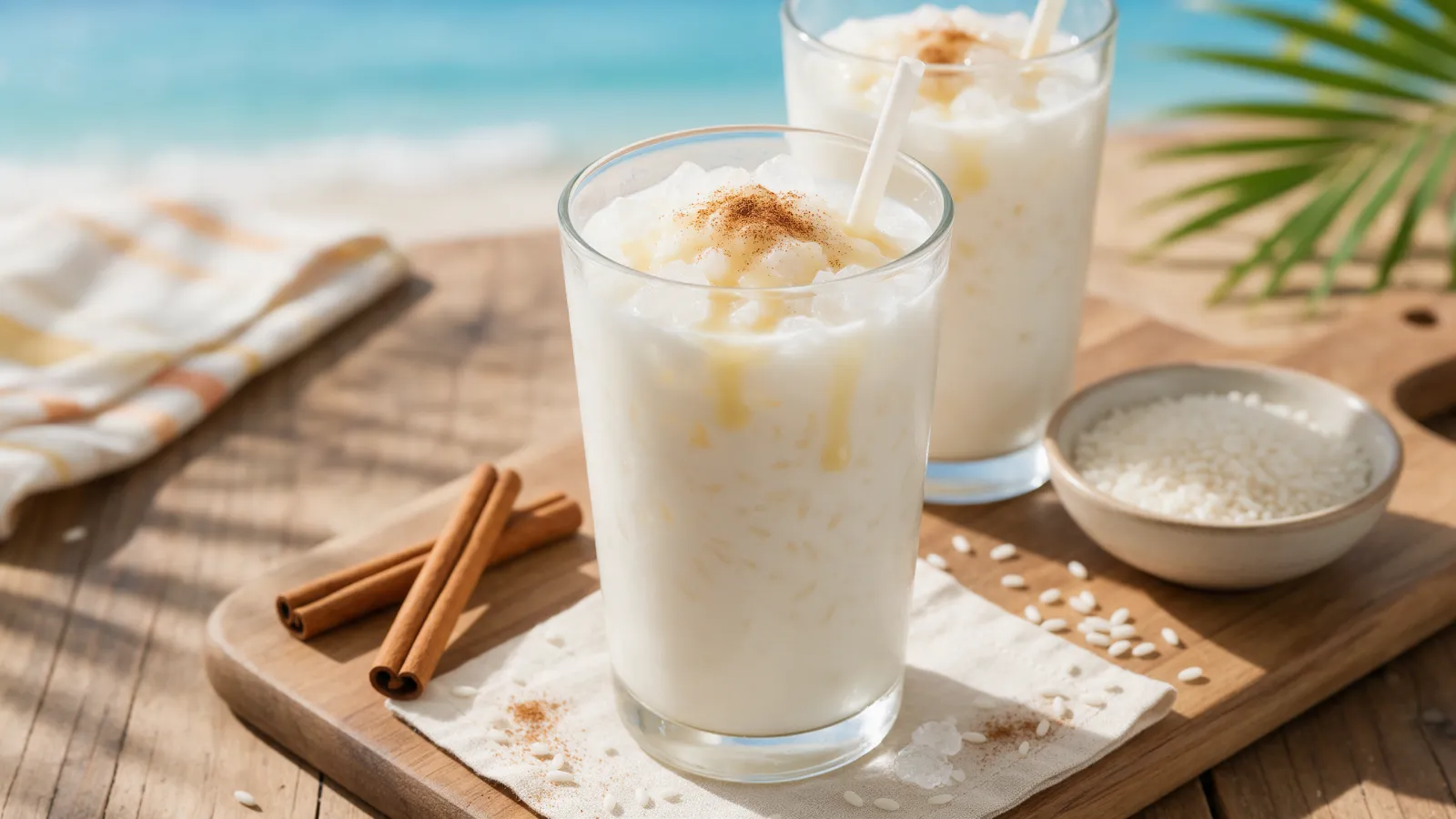

One cup of rice, one can of condensed milk and a liter of milk make 10 glasses of Venezuelan chicha (CHEE-chah), a drink that tastes like a rice pudding milkshake. The rice is cooked until it falls apart, blended with milk, sweetened condensed milk, cinnamon and vanilla, then poured over crushed ice. In Venezuela it is sold from street carts by vendors called chicheros, served thick with a dusting of cinnamon on top. It contains no alcohol and no corn, which is the first thing to know if you have heard of the fermented corn chicha of Colombia and the Andes. The one step that decides whether it drinks silky or sandy is blending the rice while it is still warm.
What is Venezuelan chicha, and is it worth making?
How do you make Venezuelan chicha? Simmer 200 g (1 cup) of rice in 1.2 liters (5 cups) of water with a cinnamon stick for 40 minutes, until the grains break down. Let it cool until just warm, blend it in two batches with 1 liter (4¼ cups) of whole milk and a 14 oz (397 g) can of condensed milk, add vanilla and strain. Serve cold over crushed ice. Ready in 120 minutes for 10 servings.
Yes, if you want a cheap, filling cold drink for a crowd. Rice and milk for a 10-glass batch cost about $1.61 at US average prices, and the result tastes of cinnamon and real rice rather than the powdered mixes sold in Latin groceries. At 264 kcal a glass it is closer to a snack than to a soda, which is how it is drunk in Venezuela: mid-afternoon, with something salty.
It is not for you if you avoid dairy (there is an oat milk version further down), if you want something light in sugar, or if you need a drink in ten minutes. The rice needs 40 minutes on the stove, though only about 20 minutes of the full 2 hours is hands-on work. Difficulty is easy: the only real risk is undercooked or cold rice, and you can see both before you blend.
How it differs from horchata, Colombian chicha and rice pudding
Mexican horchata is the nearest relative in the glass, but it is made from raw rice soaked for 8 to 12 hours in water and drinks thin and refreshing; my Mexican horchata recipe walks through it. Chicha uses cooked rice and milk and comes out thick. Colombian and Andean chicha is a different drink altogether, fermented from corn and mildly alcoholic: Colombia’s Law 34 of 1948 caps commercial fermented corn and cereal drinks at 4% alcohol by volume. And if you want the same rice, milk and cinnamon to eat with a spoon, that is Colombian rice pudding.
What you need, with US and UK swaps
The recipe card has exact amounts. The short version is 200 g (1 cup) of rice, 1.2 liters (5 cups) of water, 1 liter (4¼ cups) of whole milk and one 14 oz (397 g) can of sweetened condensed milk for about 2.1 liters (2¼ quarts) of chicha, 10 glasses of 210 ml (7 fl oz) before ice.
The rice. Medium or short grain breaks down fastest: Calrose in the US, pudding rice in the UK. Broken rice, sold cheaply in Asian and Latin grocers, is what street vendors favor and works beautifully. Regular long-grain rice is fine with 10 extra minutes of simmering. Skip parboiled or “converted” rice; it is processed to stay firm and leaves grit however long you blend.
The milks. Sweetened condensed milk is the thick, sugary one sold in 14 oz cans in the US and 397 g tins in the UK (Carnation or store brands). Do not grab evaporated milk by mistake: it has no sugar. Whole milk gives the classic body; 2% or semi-skimmed works but drinks thinner.
The cinnamon. A stick simmered with the rice gives a rounder flavor than ground cinnamon stirred in later, which can turn the drink muddy. Either Ceylon or cassia sticks work; with cassia, use half a stick, as it is stronger.
How sweet should it be?
Condensed milk supplies almost all the sugar. A full 14 oz (397 g) can holds about 216 g of sugar according to USDA data, so I add it in two parts and taste.
Without condensed milk, sweeten with about 150 g (¾ cup) of sugar; the drink comes out lighter in flavor and body.
Equipment
A heavy 3-quart (3-liter) pot, a countertop blender and a fine-mesh sieve. With a weaker blender, use three batches instead of two and give each one 3 minutes. An immersion blender in a tall jug works in small batches at 4 minutes each, strained twice. No fine sieve? A clean cotton cloth or a nut milk bag does the same job.
How to plan it, and how to tell each stage is right
Two hours on the clock, about 20 minutes of work. Almost all of it is waiting, and the order matters more than the effort.
Make it the day before. The finished, strained chicha keeps well in a covered pitcher and is thicker and colder the next day, which is how it comes from the cart. What does not work is cooking the rice ahead and blending it cold the next morning.
Signs you are on track:
- At 20 minutes → grains are swollen and opaque but still whole, with plenty of liquid left.
- At 40 minutes → grains crush against the pot with no resistance and some have burst open. It looks like loose porridge.
- Ready to blend → warm enough that you can rest a hand on the pot, around 20 minutes off the heat.
- Blended → a drop rubbed between your fingers feels smooth. If it scratches, blend another minute.
- Strained → 2 to 3 tablespoons of paste left in the sieve. Half a sieve full means the rice was undercooked.
Why chicha turns gritty, and how to stop it
Grit is bits of rice grain the blade chipped instead of pureeing, and it has three causes. Undercooked rice: if the grain still has a firm center, more blending will not fix it; more simmering will. Cold rice: as cooked starch cools it reorganizes and firms up, a process called retrogradation, the same reason leftover rice is hard straight from the fridge. Warm rice purees in 2 minutes. An overfilled blender: with the jar full to the top, the mix spins without touching the blade, so blend half the rice at a time. Straining is optional for many Venezuelan cooks; I always do it, because those last few tablespoons are exactly what you feel on your tongue.
Scaling chicha for a party, 5, 10 or 20 glasses
This is a drink for a crowd, and the math is simple: everything doubles except the simmering time. Make the 20-glass batch the day before and store it in two pitchers.
I count one glass per guest when there are other drinks and two when chicha is the only one. Buy crushed ice too, about 2 kg (4½ lb) per 10 glasses: cubes do not mix into a drink this thick. In the US, 20 glasses use two 14 oz cans of condensed milk.
Before you start, mistakes, kids and allergens
The critical point is time out of the fridge. This is a milk drink, and the USDA Food Safety and Inspection Service puts the danger zone between 40°F and 140°F (4°C and 60°C), with no more than 2 hours at room temperature, or 1 hour above 90°F (32°C). Blending with cold milk brings the temperature down; after straining, straight into the fridge.
- Gritty → undercooked or cold rice. Simmer the full 40 minutes and blend warm.
- Thin and watery → too much milk, or rice left in the sieve. Stick to 1 liter (4¼ cups) of milk per 200 g (1 cup) of rice.
- Thick as paste the next day → normal; it thickens as it chills. Stir in a splash of cold milk.
- Tastes scorched → the rice caught on the bottom in the last 10 minutes. Keep the heat low and stir more often near the end; if it catches, move it to a clean pot without scraping.
- Too sweet → the whole can went in at once. Thin it with 200 to 300 ml (about 1 cup) of cold milk.
- Sour smell or curdled look → it sat out too long or is too old. Throw it out.
Kids love it; it is usually the first pitcher to empty at a children’s party. For them I use half a can, which drops each glass to 16 g of sugar. It is not spicy at all. The main allergen is milk, from both milks. It contains no gluten, egg or nuts, but check the label of vanilla extract and any instant mix if you are cooking for someone with celiac disease.
Which version should you make?
- Street-cart style → the recipe as written, over crushed ice with ground cinnamon and a thin drizzle of condensed milk on top.
- Quicker → cook the rice in a pressure cooker or Instant Pot with the water and cinnamon for 15 minutes at high pressure and let the pressure release naturally; it comes out fully broken down and saves about 25 minutes of stove time.
- Less sweet → half a can of condensed milk and 200 ml (¾ cup) more milk.
- Lactose-free → lactose-free milk and lactose-free condensed milk; the texture does not change, because the rice gives the body.
- Dairy-free → oat milk instead of milk, sweetened with 150 g (¾ cup) of sugar or a can of oat or coconut condensed milk. Creamy, a little less rich.
- Richer → replace 250 ml (1 cup) of the milk with evaporated milk.
What chicha costs to make
At US average prices from the Bureau of Labor Statistics for August 2026, the rice ($1.111 per pound) and the liter of whole milk ($4.229 per gallon) come to $1.61 for 10 glasses. The BLS does not track sweetened condensed milk, the priciest ingredient, so treat that as the floor and add the cost of one can. The condensed milk is always what makes this drink expensive; the rice barely registers. For a 20-glass batch, store-brand cans or a larger tub bring the cost down most.
What to expect, how to serve it, and how to store it
Taste and texture. Sweet, with cinnamon up front, a mellow rice flavor underneath and vanilla at the end. Thick and smooth like a shake; the crushed ice thins it as you drink. A wide straw helps.
What to serve with it. Something salty and fried is the Venezuelan habit: Venezuelan tequeños, cheese sticks wrapped in dough, or Colombian cheese arepas. For something sweet alongside, golfeados, the sticky cinnamon and cheese buns, or a slice of Venezuelan quesillo. If you want a dairy-free drink on the same table, papelón con limón is tart and cuts through it. The Colombian cold oat drink is built on the same idea, cooked grain, milk and cinnamon served ice-cold.
Fridge. 3 to 4 days at 40°F (4°C) or below, the USDA FSIS guideline for leftovers. I finish it within 2 days, because the cinnamon fades by day three. Keep it covered; milk picks up fridge smells.
Freezer. Freeze it in ice cube trays for up to 1 month and use the cubes in place of ice, which is my favorite way to keep it. Thawed as a drink it separates, but 20 seconds in the blender brings it back.
Reheating. Don’t. Chicha is a cold drink.
Frequently asked questions
Is Venezuelan chicha alcoholic? No. Venezuelan rice chicha is never fermented. The alcoholic chicha is the fermented corn drink of Colombia and the Andes.
What is the difference between chicha and horchata? Chicha uses cooked rice blended with milk and condensed milk and drinks thick. Mexican horchata uses raw rice soaked 8 to 12 hours in water and drinks thin.
Why is my chicha gritty? The rice was undercooked or blended cold. Simmer it 40 minutes until it falls apart, blend it while warm in two batches, then strain.
What rice is best for chicha? Medium or short grain, or broken rice. Long-grain works with 10 more minutes of simmering; parboiled rice does not break down.
How long does chicha last in the fridge? 3 to 4 days at 40°F (4°C) or below, covered, per USDA FSIS, as long as it never spent more than 2 hours at room temperature.
Can I make chicha without condensed milk? Yes, sweeten it with about 150 g (¾ cup) of sugar. It is lighter and a little thinner.
How much chicha do I need for 20 people? A double batch: 400 g (2 cups) rice, 2.4 liters (10 cups) water, 2 liters (8½ cups) milk and two 14 oz cans of condensed milk.
Nutrition per glass
Per glass of about 210 ml (7 fl oz) without ice, one tenth of the batch made with the full can, calculated from USDA FoodData Central (SR Legacy) with this recipe’s amounts and assuming all the rice ends up in the glass:
- Calories: 264 kcal
- Protein: 8 g
- Carbohydrates: 43 g
- Sugars: 27 g (about 5 g is lactose from the milk)
- Fat: 7 g, of which 4 g saturated
- Sodium: 134 mg
The condensed milk accounts for 127 of the 264 kcal. With half a can, a glass drops to about 200 kcal and 16 g of sugar.
Growing up in Venezuela, chicha was something you bought, never something you made: a plastic cup from the cart, packed with crushed ice, after school. The first batch I made in my own kitchen, in Colombia, I blended with yesterday’s cold rice and it came out like wet sand. Warm rice fixed it, and I have never looked back. Josnaisis.