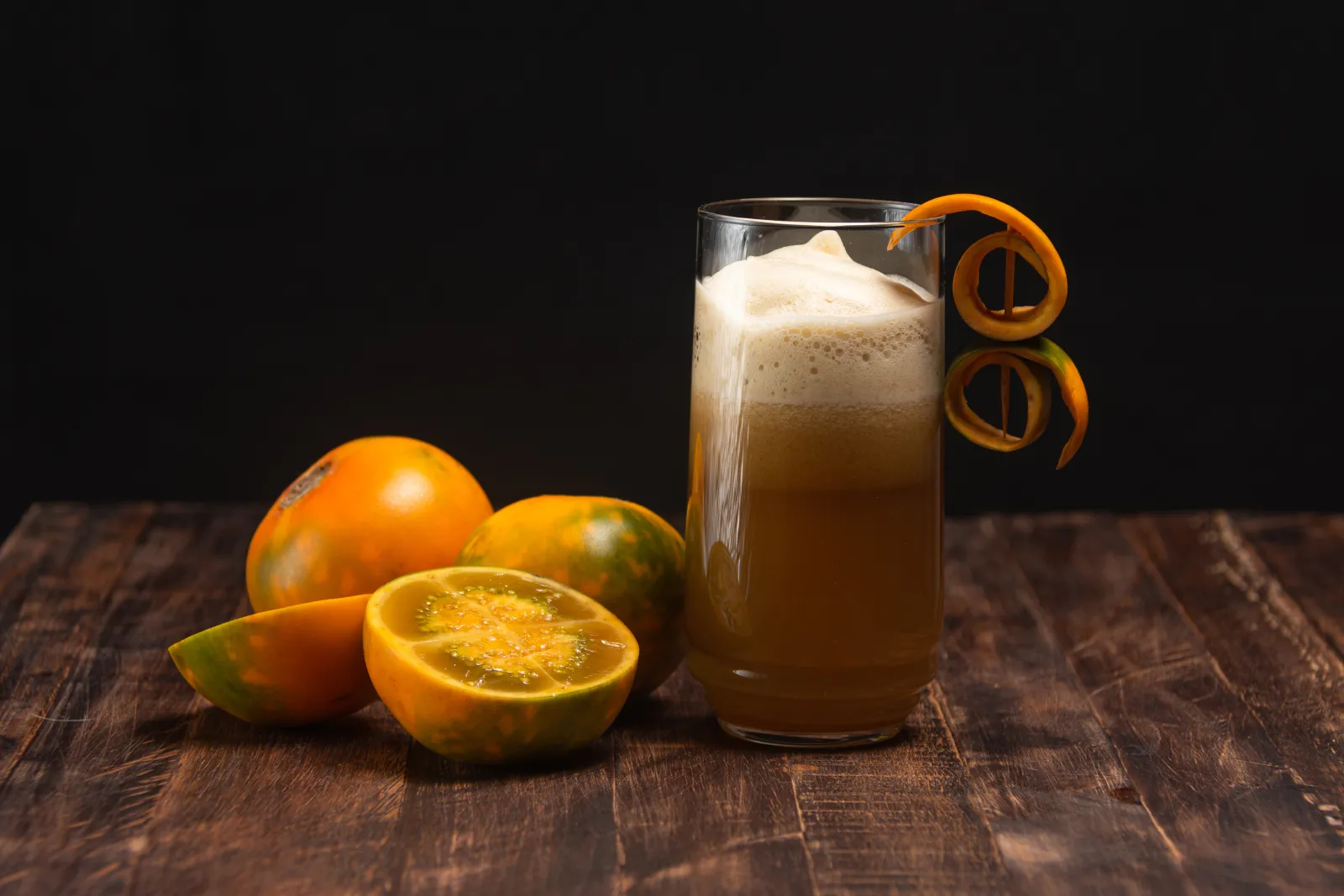

Lulo (LOO-loh) tastes like someone crossed a lime with a green pineapple and added a hint of rhubarb, and in Colombia it’s the juice you’re most likely to be offered with a weekday lunch. The fruit is the size of a small orange, fuzzy on the outside and green and seedy inside. Outside South America you’ll mostly meet it as frozen pulp, often labeled naranjilla, its name in Ecuador. This recipe gives you one fixed ratio that works with fresh fruit or a bag from the freezer aisle, the blender habit that keeps it from turning bitter, and a milk version that doesn’t curdle.
What is lulo, and is lulo juice worth making?
How do you make Colombian lulo juice? Rub the fuzz off ripe lulos, halve them and scoop out the pulp. Pulse the pulp with a third of the water 3 or 4 times, just enough to free the seeds without grinding them, then strain and stir in the rest of the cold water and the sugar. For 1 liter (about 1 quart), use 4 lulos, 750 ml (3 cups) water and 60 g (⅓ cup) sugar. Ready in 10 minutes for 4 servings.
Lulo is Solanum quitoense, a plant of the northern Andes in the same genus as tomatoes and eggplants. Colombians call it lulo; Ecuadorians call it naranjilla, “little orange,” after the color of the ripe fruit, as botanist Julia Morton records in Fruits of Warm Climates, published online by Purdue University. Same fruit, two names, so a bag of naranjilla pulp is exactly what you want.
Each fruit weighs about 115 g (4 oz) and is a little under two-thirds pulp, 62 to 64 % according to a National University of Colombia study published in Acta Agronómica. The pulp is green, very juicy and sharply sour.
Worth it? Yes, if you like tart drinks. It’s 10 minutes of work, it goes with almost any lunch, and nothing in a US or UK supermarket tastes like it. Skip it if sour drinks aren’t your thing: even sweetened, lulo is more acidic than lemonade made the usual way.
Finding lulo in the US and UK, fresh or frozen
Fresh lulos are rare and pricey outside South America. Frozen pulp is what most Colombians abroad use, and for juice it works.
| What you find | Where | What changes in the glass |
|---|---|---|
| Fresh lulo | Latin produce markets, occasionally | nothing, this is the reference |
| Goya Naranjilla Fruit Pulp, 14 oz (396 g) | frozen aisle of US Latin and mainstream grocers; ingredients are pulp and ascorbic acid | slightly duller color, flatter aroma, same acidity |
| El Sembrador frozen lulo pulp, 14 oz | US grocers including Target | same as above |
| Generic “pulpa de lulo” or “pulpa de naranjilla” | Latin grocers and online frozen-food shops in the UK | same as above; check the label for added sugar |
There is no real substitute fruit. Passion fruit with a squeeze of lime gets you a tart tropical juice, but not lulo’s green, tomato-adjacent edge.
With frozen pulp, use the same weight: 280 g (10 oz) per liter, about three-quarters of a 14 oz bag. Let it sit 10 minutes out of the freezer and blend it half-frozen. If your pulp is seedless, you can blend for 20 seconds straight with no risk of bitterness.
Step by step, and the pulse trick
10 minutes, all of them hands-on: 2 minutes rubbing and rinsing, 3 scooping, 1 blending, 2 straining, 2 sweetening and pouring.
Getting the fuzz off
Ripe lulos are covered in short brown hairs. Morton notes that on a ripe fruit they rub off easily, while on an unripe one they cling so tightly that packers use brushes, so the fuzz doubles as a ripeness test. A damp kitchen towel under the tap does the job in a minute. She also warns that the hairs can irritate very sensitive skin; if yours itches, wear kitchen gloves.
You don’t need to peel. Halve the fruit and scoop it with a teaspoon, scraping the green ring just under the skin, which in my kitchen carries most of the color and the flavor.
Pulse, don’t blend
Lulo seeds are flat, hard and about 3 mm (⅛ in) across, and there are a lot of them. Three or four pulses of 1 to 2 seconds separate flesh from seed. Run the blender for 30 seconds and the seeds break, and the juice turns bitter, astringent and gray-green with a stubborn foam. That’s my own hard-won observation, not something I read; Morton’s home method simply says to blend the pulp “briefly” and strain.
Blend the pulp with just 250 ml (1 cup) of the water. Less liquid means the pulp separates from the seeds faster and strains more easily.
Strain and press
Pour through a fine-mesh sieve and press with the back of a spoon for about a minute. Whole seeds should be all that’s left. If you see seed fragments, use one pulse fewer next time.
Who this recipe is for
- If you’ve never tasted lulo → start with the water version and 60 g (⅓ cup) sugar, then adjust.
- If you only have frozen pulp → same 280 g (10 oz) per liter; no fuzz, no scooping, 5 minutes total.
- If you’re cooking for kids → the milk version, which softens the sourness.
- If you’re feeding a crowd → make the strained base the night before (see the party section).
Water or milk, and why milk can curdle
Lulo with milk (jugo de lulo en leche) is as common in Colombia as the water version, and creamier. It can also split, and the numbers explain why. In the Acta Agronómica study, ripe lulo pulp came in below pH 3, at 2.89 to 2.94. Fresh milk sits around pH 6.6, and casein, its main protein, clumps and curdles once the pH drops to 4.6, as McMaster University’s chemistry lab manual on extracting casein from milk sets out.
So the milk version needs a different order:
- Pulse the pulp with 100 ml (scant ½ cup) water and the 60 g (⅓ cup) sugar, then strain.
- Stir that base into 750 ml (3 cups) whole milk straight from the fridge, at 40°F (4°C) or colder, or give it a single 5-second pulse.
- Serve immediately.
Cold milk is slower to curdle, one part pulp to nearly three parts milk keeps the mix well away from the threshold for a while, and with the sugar already dissolved you don’t need to keep blending once the milk is in. Made this way, mine has never split in the first 15 minutes; left on the table for half an hour, I’ve seen fine curds settle. If that happens it’s still safe to drink if it hasn’t been out more than 2 hours; a 5-second blend smooths it out.
In my experience skim milk curdles more readily than whole. Almond or oat milk doesn’t curdle the same way and makes a lighter drink.
At 192 kcal per glass with whole milk, against 76 with water, the milk version is closer to a smoothie than a lunch drink.
Lulada, the chunky version from Cali
Lulada is the lulo drink of Cali and the Valle del Cauca, and the difference is that the fruit is chopped by hand, not blended, and nothing is strained. For 2 glasses: peel 2 ripe lulos with a knife and dice them into 1 cm (⅜ in) cubes, seeds and all. Put them in a pitcher with the juice of 2 limes, 60 ml (¼ cup), and 40 g (3 tbsp) sugar, and crush lightly with a wooden spoon for a minute. Stir in 1 cup of crushed ice and 200 ml (generous ¾ cup) of very cold water, and serve with a spoon. It works out at 103 kcal per glass. Some cooks add a spoonful of sweetened condensed milk to the bottom of the glass.
Making it for a party, scaling and make-ahead
The ratio stays fixed at 280 g (10 oz) pulp, 750 ml (3 cups) water and 60 g (⅓ cup) sugar per liter, so scaling is just multiplication. I plan on a glass and a half per guest on a hot afternoon, which puts 20 people at about 7.5 liters (2 gallons).
Make ahead. The night before, pulse and strain all the pulp with 1 liter (1 quart) of water per 2.1 kg (4⅔ lb), sweeten it, and refrigerate. At the party, top up a pitcher at a time with cold water and ice. The milk version doesn’t make ahead: mix it a liter at a time as you pour.
What it costs in the US
At the listed $3.69 for a 14 oz (396 g) bag of Goya naranjilla pulp, the 280 g (10 oz) for a liter costs about $2.61. Sugar at the BLS August 2026 average of $1.024 a pound adds 14 cents, so a liter of lulo juice with water comes to about $2.75, or 69 cents a glass. Whole milk at $4.229 a gallon adds 84 cents.
In Colombia the fruit is cheap: the DANE’s SIPSA wholesale bulletin for 12 to 18 September 2026 put lulo at 5,050 pesos a kilo in Bogotá’s Corabastos market, and 3,744 in Pasto, in the southern Andes.
Mistakes that ruin lulo juice
- Bitter juice → the seeds got ground. Pulse 3 or 4 times; never run the blender continuously with seeded pulp.
- Thin, flavorless juice → too little pulp or green fruit. Stick to 280 g (10 oz) per liter and buy deep-orange lulos.
- Mouth-puckering sourness → add 15 g (1 tbsp) more sugar before you add more water.
- Curdled milk version → warm milk, too much pulp, or time on the counter. Cold milk, pre-sweetened pulp, serve at once.
- Fuzz in the glass → the fruit wasn’t rubbed down. A damp towel under the tap, before cutting.
Storing lulo, pulp and juice
Whole fruit. A half-ripe lulo keeps about 8 days at room temperature, per Morton. Once fully orange it softens and ferments fast, so I refrigerate it and use it within 2 to 3 days.
Juice with water. In a covered pitcher at 40°F (4°C) or below, I give it up to 24 hours. It doesn’t spoil that fast, but the aroma fades and the green dulls, so I make it for the day.
Juice with milk. Drink it fresh. If any is left, refrigerate it right away: the USDA Food Safety and Inspection Service’s limit for perishable food outside the fridge is 2 hours, and milk counts.
Freezer. Freeze pulp or strained base in flat 280 g (10 oz) bags, one per liter. At 0°F (−18°C) frozen food stays safe indefinitely according to the FSIS; for quality I use mine within 3 months. Don’t freeze the finished juice: it separates when it thaws.
What to serve with lulo juice
Plan on one 250 to 350 ml (8 to 12 oz) glass per person at lunch. Its sharpness is made for fried and rich food, like the snacks of the Valle del Cauca: aborrajados, cheese-stuffed sweet plantains and crispy Colombian corn empanadas. At home it’s my Sunday drink with Colombian chicken rice. For a juice table with contrast, pair it with creamy, low-acid Colombian soursop juice or Colombian coconut lemonade. On cold evenings, swap it for a mug of aguapanela, the cane sugar drink. On a hot afternoon, Colombian cholado, shaved ice piled with fruit and syrups, is the Valle del Cauca’s spoonable answer to a juice, and Colombian salpicon, diced fruit in watermelon juice, is the one you drink through a straw.
Lulo juice FAQ
What does lulo taste like? Sour and green, somewhere between lime and unripe pineapple. Morton compares the pulp to pineapple and lemon.
Is lulo the same as naranjilla? Yes. Both names refer to Solanum quitoense: lulo in Colombia, naranjilla in Ecuador.
Can you eat lulo seeds? Yes, whole, as in lulada. What you want to avoid is grinding them in the blender, which makes the juice bitter.
Where can I buy lulo? Mostly as frozen pulp: Goya’s naranjilla pulp and El Sembrador lulo pulp, both 14 oz (396 g), in the US; generic lulo or naranjilla pulp at Latin grocers in the UK.
How much frozen pulp do I need per liter? 280 g (10 oz), about three-quarters of a 14 oz bag.
Why did my lulo juice with milk curdle? Milk protein sets at pH 4.6, and lulo pulp sits far below that, around 2.9. Use milk at 40°F (4°C), sweeten the pulp first, and serve immediately.
How long does lulo juice last? Up to 24 hours refrigerated for the water version; the milk version should be drunk fresh.
Lulo juice nutrition
Per 250 ml (1 cup) glass of the water version, a quarter of the recipe, calculated from USDA SR Legacy data for frozen naranjilla (lulo) pulp and granulated sugar:
- Calories: 76 kcal
- Protein: 0 g
- Carbohydrates: 19 g
- Fat: 0 g
- Fiber: 1 g, a little less after straining
- Sugars: 18 g, 15 g of them added
- Sodium: 3 mg
Lulo pulp alone has just 25 kcal per 100 g (3.5 oz), so nearly all the calories come from the sugar; unsweetened, a glass is 18 kcal. Made with whole milk, a glass carries 27 g of sugars, 6 g each of protein and fat, and about 192 kcal. Vitamin C varies a lot from fruit to fruit: Morton cites 31 to 84 mg per 100 g (3.5 oz) of fresh lulo.
I first made lulo juice the way I made soursop juice back in Venezuela, blender on high and walk away, and poured the whole bitter batch down the sink. Now I count the pulses out loud, and my son Dylan counts with me. Josnaisis.