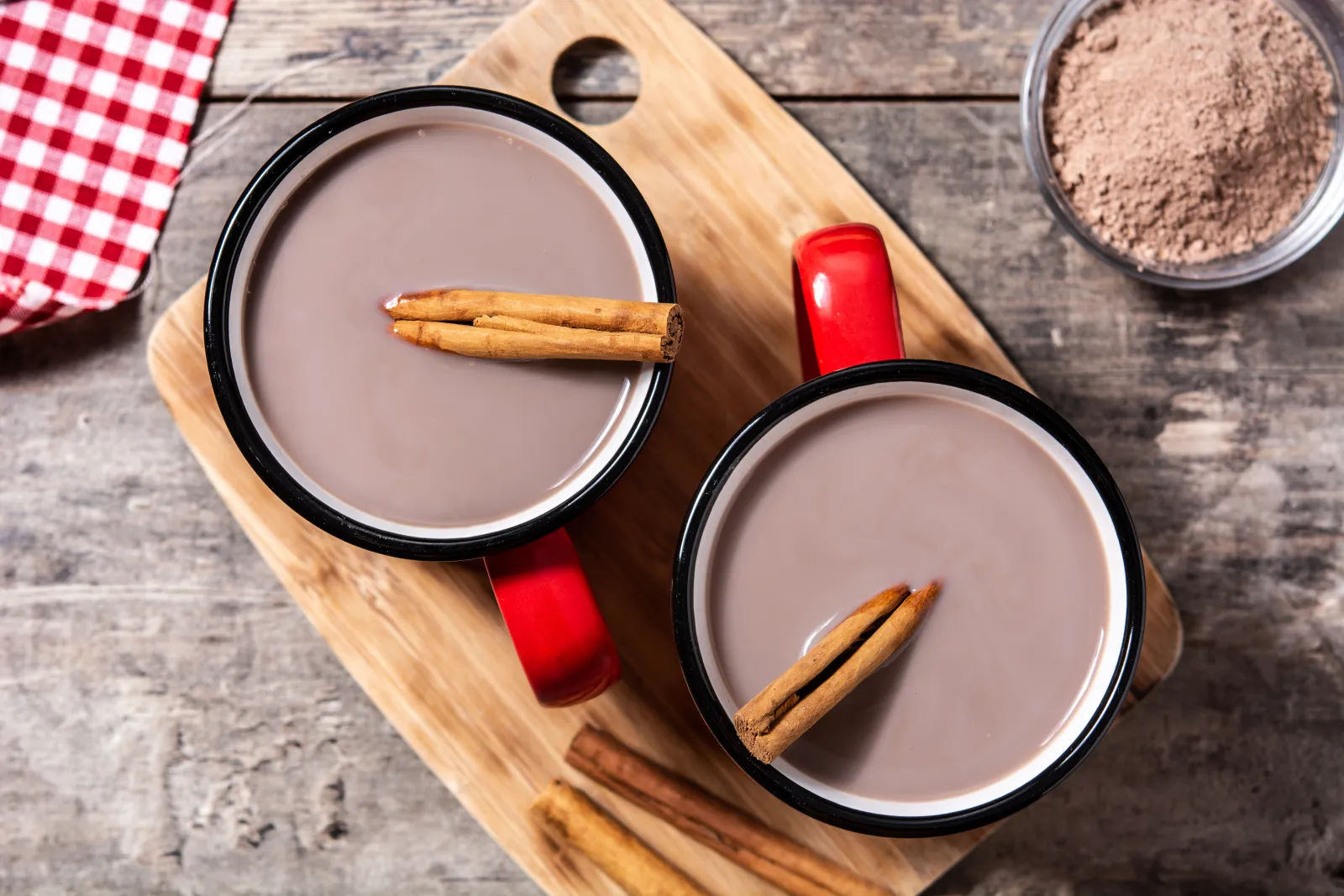

Cook 60 g of corn masa in a liter of milk and water until it coats a spoon, sweeten it, and you have atole, the hot Mexican drink made from the same dough as a tortilla. In Mexico it’s what people drink with tamales, especially through the December posadas and on the Day of the Dead. This version is the plain one, sweetened with piloncillo and scented with cinnamon and vanilla, and every other flavor, chocolate included, starts from it.
What is atole, and is it worth making at home?
How do you make atole? Whisk 90 g (3/4 cup) of masa harina into cold water and strain it. Melt piloncillo with a cinnamon stick in more water, add milk, and when it steams, pour in the masa while whisking. Simmer gently for 15 minutes until it coats a spoon, then add vanilla. Ready in 35 minutes for 6 servings.
Yes, if you like a drink with body. Atole (ah-TOH-leh) sits somewhere between a thin pudding and a milky tea: you drink it from a mug, but it’s thick enough to coat the spoon. The masa gives it a toasted corn flavor you won’t get from milk and cinnamon alone. It’s also cheap, at about 31 cents a cup at US prices for a party batch.
When it shines. Alongside tamales, at a Christmas Eve table, on a cold morning, or anywhere you need one pot to serve 20 people.
When to skip it. If you want a light drink. A 250 ml (1 cup) mug runs 183 kcal.
Time and effort. 35 minutes, 22 of them hands-on. Difficulty is easy, and lumps are the only thing that goes wrong.
Chocolate atole has its own name, champurrado. If that’s what you’re after, my Mexican champurrado with masa and piloncillo uses the same method plus a tablet of Mexican chocolate.
Ingredients, with US and UK swaps
Six cups (1.5 liters) need 90 g (3/4 cup) of masa harina, 100 g (3.5 oz) of piloncillo, 600 ml (2 1/2 cups) of milk and 900 ml (3 3/4 cups) of water. The thickener is the decision that changes the drink.
Masa harina, fresh masa or cornstarch
Masa harina is dried, ground nixtamalized corn, the flour used for tortillas. Maseca is the common brand in the US, in the Latin aisle of most supermarkets. In the UK, look for it at Mexican grocers, most of which sell online. The rate here is 60 g per liter (about 1/2 cup per quart), and it’s the one I use for plain atole because it actually tastes of corn.
Fresh masa from a tortilleria has the strongest flavor. Use 2.5 times the weight of masa harina, because it’s 60 % water: 225 g (8 oz) for this recipe, with 135 ml less water in the bowl. Ask for plain tortilla masa. Tamale masa is already mixed with lard and salt.
Cornstarch makes a smoother, pudding-like atole with no corn flavor at all, and it needs only 5 to 8 minutes of simmering. It’s pure starch, so it thickens with less: 35 g per liter, which is 52 g (6 1/2 tbsp) for this batch. I use it for the fruit flavors. In the UK, cornstarch is sold as cornflour; don’t confuse it with American cornmeal or corn flour, which won’t thicken the same way.
Two things that don’t work: cornmeal or polenta (gritty, and they don’t dissolve) and precooked arepa flour like Harina P.A.N., the one for Colombian cheese arepas. It thickens, but the corn isn’t nixtamalized, so the atole tastes like arepas.
Piloncillo and the brown sugar swap
Piloncillo is unrefined cane sugar pressed into a cone, sold in 8 oz (227 g) cones at Latin markets. Colombian panela and Venezuelan papelón are the same product in another shape and swap 1:1 by weight. In a regular US store, use dark brown sugar, 100 g (1/2 packed cup); in the UK, dark muscovado is closer still. The drink gets a little less molasses depth, nothing more.
Equipment
A heavy 3-liter (3-quart) pot, a whisk, a fine sieve and a wooden spoon. No sieve? A clean tea towel works. No whisk? Blend the masa and cold water for 10 seconds instead.
Mistakes that ruin atole
The 2 minutes when the masa hits the hot milk decide the texture. These are the problems I see, and their fixes:
- Lumps. The masa went in undissolved or all at once. Strain the atole or blend it for 10 seconds.
- Raw, floury taste. It wasn’t simmered long enough. It looks thick at minute 5 but needs the full 15.
- Scorched bottom. Heat too high, or too little stirring. If it catches, don’t scrape: pour the atole into a clean pot and leave the burnt layer behind.
- Too thin. Whisk 15 g (2 tbsp) more masa harina into 50 ml (3 tbsp) of cold water and stream it in.
- Gluey. Add hot milk, 50 ml (3 tbsp) at a time.
- Curdled fruit atole. Fruit acid splits hot milk. See the strawberry and guava notes below.
Spice level, 0 out of 5. Kids usually love it; just let a mug cool for 2 or 3 minutes, because the thickness holds heat. Allergens: milk. Corn is naturally gluten-free, but check the masa harina label for cross-contact if you cook for someone with celiac disease.
How to plan it, from one pot to a party batch
How to tell each stage is right:
- Masa mixture is smooth and milky, with nothing gritty when you run a finger along the bottom of the bowl.
- Syrup has no lumps of piloncillo after 10 minutes.
- Milk steams, with tiny bubbles at the edge.
- Simmer shows slow bubbles, never a spitting boil.
- Done means it coats the spoon and the raw taste is gone, usually between minute 12 and 15 of simmering.
Scaling for 12 or 20 people
| Ingredient | 6 cups (1.5 L) | 12 cups (3 L) | 20 cups (5 L) |
|---|---|---|---|
| Masa harina | 90 g (3/4 cup) | 180 g (1 1/2 cups) | 300 g (2 1/2 cups) |
| Cold water for the masa | 400 ml (1 2/3 cups) | 800 ml (3 1/3 cups) | 1.33 L (5 1/2 cups) |
| Water for the syrup | 500 ml (2 cups) | 1 L (4 1/4 cups) | 1.67 L (7 cups) |
| Piloncillo or dark brown sugar | 100 g (3.5 oz) | 200 g (7 oz) | 330 g (11.6 oz) |
| Whole milk | 600 ml (2 1/2 cups) | 1.2 L (5 cups) | 2 L (1/2 gallon) |
| Cinnamon sticks | 1 | 2 | 3 |
| Vanilla extract | 1 tsp | 2 tsp | 1 tbsp |
The 20-cup batch needs an 8-liter (8-quart) pot. In my kitchen that volume takes about 15 minutes longer to steam and 5 minutes longer to simmer, so allow an hour from cold.
Make-ahead plan
- The day before. Make the syrup (water, piloncillo, cinnamon), cool it and refrigerate it covered.
- An hour before guests arrive. Whisk and strain the masa, reheat the syrup, add the milk, then the masa.
- During the party. Hold it covered over the lowest heat, at 140°F (60°C) or above, stirring the bottom every 10 minutes.
Which version to make, cornstarch, fruit and rice
- Short on time → the cornstarch version, about 25 minutes in total.
- Dairy-free → swap the milk for water, the traditional way in many homes, or oat milk. With water it drops to about 120 kcal a cup.
- For a crowd → masa harina, the 20-cup column and syrup made the day before.
- Chocolate → that’s champurrado.
Strawberry atole. Make the base with cornstarch and skip the vanilla. Blend 300 g (10 oz) of strawberries with 100 ml (scant 1/2 cup) of the milk and strain. Once the atole coats the spoon, lower the heat to minimum, stir in the purée and heat for 3 minutes without letting it boil hard. That’s how I keep it from splitting.
Guava atole. Simmer 4 guavas, about 300 g (10 oz), in the syrup water with the piloncillo and cinnamon for 10 minutes, then blend and strain out the seeds. Before the milk goes in, add 1/8 tsp of baking soda; it neutralizes part of the fruit’s acidity, and it’s the step guava atole recipes insist on so the milk doesn’t curdle. Thicken with 52 g (6 1/2 tbsp) of cornstarch. Frozen guava pulp from Latin freezers works if you can’t find fresh fruit.
Rice atole. Soak 80 g (scant 1/2 cup) of long-grain rice for at least 2 hours, blend it with the cold water, strain, and use that instead of the masa, plus 25 g (3 tbsp) of cornstarch for body. It lands somewhere between hot horchata and rice pudding.
What it costs
At the BLS August 2026 US average for whole milk ($4.229 a gallon) and October list prices (Maseca at $3.98 for 4 lb and Great Value vanilla at $5.72 for 2 fl oz at Walmart.com, piloncillo at $1.28 per 8 oz cone at H-E-B), 6 cups cost $1.91, or 32 cents a cup, before the cinnamon.
The cornstarch version costs a few cents more, not less: 52 g of Argo cornstarch at $2.44 per 16 oz box is about $0.28, against $0.20 of masa harina.
Serving, storing and reheating
How it’s served. Hot, in a mug, with savory tamales: Mexican green chicken tamales are the classic pairing. For something sweet, it goes with pan de muerto in early November or a slice of Mexican three kings bread on January 6. Coffee drinkers at the same table can have café de olla, which shares the cinnamon and piloncillo. For a savory breakfast without tamales, atole also goes well with Mexican molletes, bean and cheese toast.
Keeping it hot. Hot food, according to USDA FSIS, should be held at 140°F (60°C) or above, and leftovers go in the fridge within 2 hours.
Fridge. 3 to 4 days at 40°F (4°C) or below, covered. It sets like pudding as it cools; that’s the starch, not spoilage.
Freezer. I don’t freeze it. Thawed atole weeps water and turns grainy.
Reheating. Over medium-low heat with 50 ml (3 tbsp) of milk or water per cup, whisking until smooth again, to 165°F (74°C), the FSIS reheating temperature for leftovers. In the microwave, 1-minute bursts with a whisk in between. Fruit versions are best reheated gently on the stove.
Frequently asked questions
What does atole taste like? Like warm, sweet corn with cinnamon and vanilla, with the texture of a thin custard. The piloncillo adds a molasses note.
Is atole the same as champurrado? Champurrado is atole with Mexican chocolate added. Same masa, same method.
Can I make atole with cornstarch instead of masa? Yes. Use 35 g per liter, about 4 tbsp per quart. It’s smoother and faster, but it won’t taste of corn.
How much masa harina per quart? About 60 g per liter, a generous 1/2 cup per quart, for an atole that coats a spoon.
Why is my atole lumpy? The masa went into hot liquid undissolved. Always whisk it into cold water first and strain it.
Why did my strawberry atole curdle? The fruit acid split the hot milk. Add the purée at the end over low heat, and for guava use a pinch of baking soda before the milk.
Can I use cornmeal or polenta? No. They stay gritty. Use masa harina, fresh masa or cornstarch.
How much atole do I need for 20 people? 5 liters (about 5 quarts): 300 g of masa harina, 2 liters of milk, 3 liters of water and 330 g of piloncillo.
How long does atole keep? 3 to 4 days in the fridge. Thin it with milk as you reheat.
Nutrition
Per 250 ml (1 cup) serving made with whole milk, calculated ingredient by ingredient from USDA FoodData Central (SR Legacy), with dark brown sugar standing in for piloncillo:
- Calories: 183 kcal
- Protein: 5 g
- Carbohydrates: 33 g
- Fat: 4 g (2 g saturated)
- Fiber: 1 g
- Sugars: 22 g
- Sodium: 82 mg
About 16 g of the sugar comes from the piloncillo and 5 g from the milk. Made with water, a cup is about 120 kcal; the cornstarch version is about 161 kcal.
I learned champurrado first and plain atole second, which is backwards. Now the plain one is what I make most, on cold mornings for my son Dylan, with Colombian panela standing in for piloncillo and a bag of masa harina that lives in my pantry all year. Good atole is mostly patience with a spoon. Josnaisis.