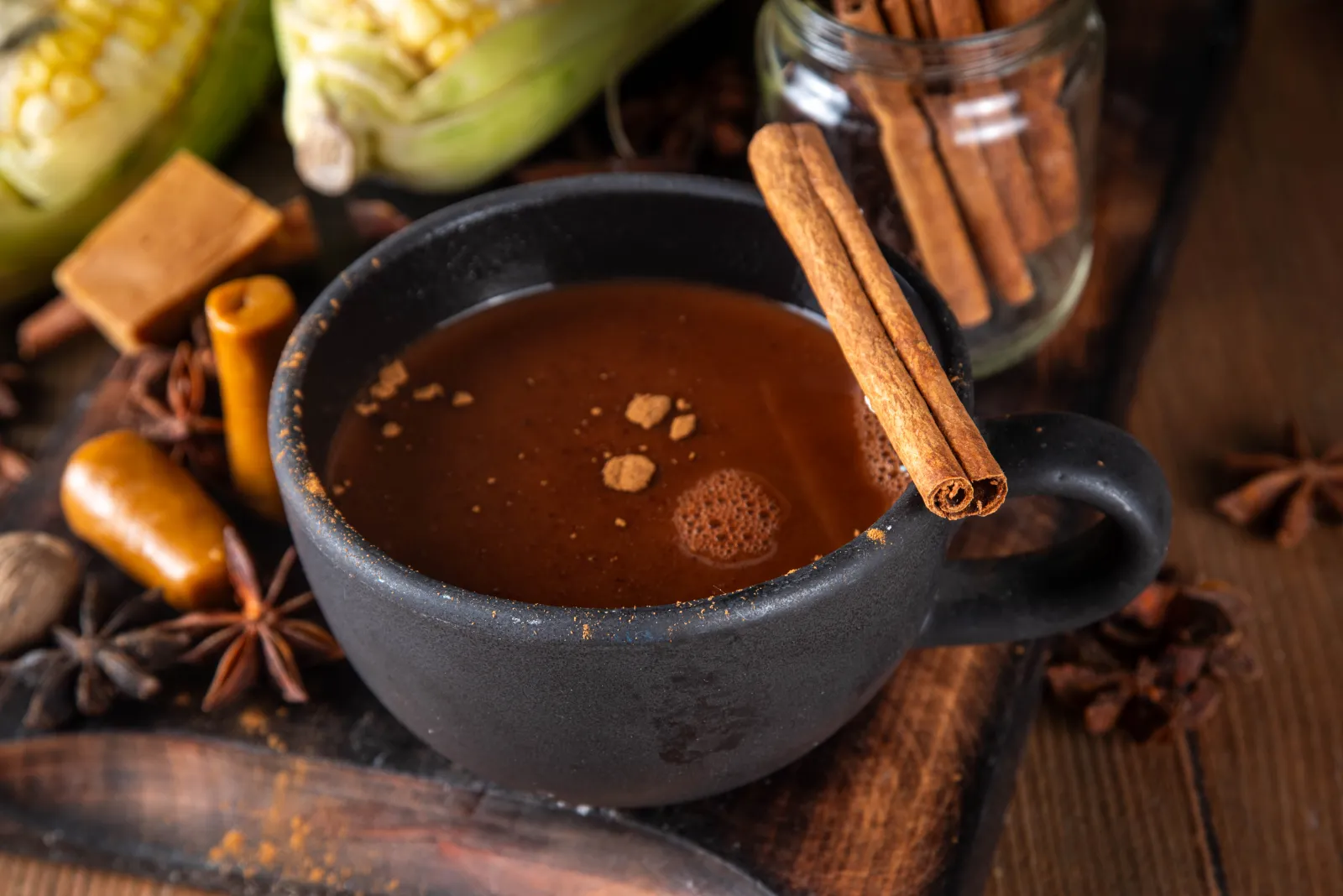

Champurrado (chahm-poo-RAH-doh) is what happens when Mexican hot chocolate meets the same corn dough used for tortillas. A modest 7 oz (200 g) of masa turns 6 mugs of chocolate milk into something silky enough to coat a spoon, with a toasted-corn background that cocoa alone can’t give you. In Mexico it belongs to the atole family, hot drinks thickened with nixtamalized corn, and it shows up at the December posadas and on the Day of the Dead, nearly always next to a plate of tamales. If you have ever been handed a cup at a Mexican Christmas party and wondered why it was so thick, this is why.
What is champurrado, and how is it different from hot chocolate?
How do you make champurrado? Dissolve 7 oz (200 g) of fresh masa, or ⅔ cup (80 g) of masa harina, in cold water and strain it. Melt piloncillo with a cinnamon stick in water, stir in Mexican chocolate, then add milk. Whisk the masa in a thin stream and simmer 12 to 13 minutes until it coats a spoon. 35 minutes for 6 servings.
The short version: masa is the difference. Mexican hot chocolate is tablet chocolate whipped into milk. Atole is masa cooked in water or milk with cinnamon, vanilla or fruit (my plain Mexican atole with masa harina is the base recipe). Champurrado is both at once. And it’s a different drink again from the Colombian hot chocolate I make at home, which has no corn, is frothed with a wooden molinillo, and gets a cube of cheese dropped into the cup.
Is it worth making? Yes, especially for a crowd. It costs about $0.37 a mug at US prices, it’s made in one pot, and it scales to 20 mugs without any extra technique. Who it isn’t for: anyone after a light drink, since a 1-cup (250 ml) mug with whole milk carries 254 kcal and 33 g of sugar.
Time and difficulty. 35 minutes, about 25 of them stirring. It’s easy, with one thing to get right: lumps, which you avoid by dissolving the masa in cold water first.
The three ingredients that matter, and US and UK swaps
Masa harina vs fresh masa, the exact conversion
Fresh masa is the dough tortillerías make from corn cooked with lime (calcium hydroxide), the process called nixtamalization. Masa harina is that dough dried and ground; Maseca is the brand you’ll see most. The Maseca bag says 2 cups of flour to 1½ cups of water, which works out to roughly 240 g of flour and 355 ml of water for about 1.3 lb (600 g) of dough. So for this recipe, ⅔ cup (80 g) of masa harina plus ½ cup (120 ml) of water replaces 7 oz (200 g) of fresh masa. Fresh masa tastes more of corn; masa harina gives a smoother drink and keeps for months in the pantry.
What doesn’t work: cornmeal, polenta, cornstarch or UK cornflour. King Arthur Baking says plainly that cornmeal and corn flour are not substitutes for masa harina, and the reason is the lime: without nixtamalization you get a thick chocolate drink with no tortilla flavor. Also skip the “masa preparada” for tamales sold at Latin grocers in the US, which already has lard and salt in it. Ask for plain masa for tortillas.
Mexican chocolate, and what to use if you can’t find it
Mexican table chocolate (Abuelita, Ibarra) comes in tablets of about 3.2 oz (90 g), already sweetened and spiced with cinnamon. USDA figures put it at 69 % sugar, so one tablet brings roughly 2.2 oz (62 g) of sugar with it. That’s why the recipe only needs 3.5 oz of piloncillo.
| If you have | Use | What changes |
|---|---|---|
| Taza or another stone-ground Mexican disc | same weight | grainier, more cacao |
| 70% dark chocolate | 1.4 oz (40 g) + 1.8 oz (50 g) extra sugar + a pinch of ground cinnamon | more bitter, more chocolate body |
| Unsweetened cocoa powder | 0.7 oz (20 g) + 2.3 oz (65 g) extra sugar | thinner and less rounded; cocoa is defatted |
| Colombian sweet table chocolate | same weight | very close; keep the cinnamon stick |
Read the label on whichever tablet you buy: many commercial brands contain soy lecithin, and some use vegetable fat alongside the cocoa butter.
Piloncillo, and the brown sugar swap
Piloncillo is unrefined cane sugar pressed into cones, sold in Latin aisles in the US. It tastes of molasses and caramel. Swap it by weight for dark brown sugar (about ½ cup packed for 3.5 oz) in the US, or dark muscovado in the UK; the result is close, a touch less deep. Colombian panela and Venezuelan papelón are the same kind of product as piloncillo and swap one for one. White sugar works but tastes flat.
Where to shop
- US → Maseca and Abuelita or Ibarra sit in the Hispanic aisle of most large supermarkets and at Walmart; piloncillo is at Latin grocers. Fresh masa comes from a tortillería.
- UK → masa harina, Mexican chocolate and piloncillo are sold by Mexican specialist grocers online. Search for “masa harina” by name; a bag labelled cornflour or polenta is not it.
Equipment
A heavy 3-quart (3-liter) saucepan, a fine sieve, a balloon whisk and a wooden spoon. A wooden molinillo is the traditional whisk; a balloon whisk does the same job. For 20 mugs you need an 8-quart (8-liter) pot.
Mistakes that ruin champurrado
The one moment that decides everything is the first 2 minutes after the masa goes in.
- Lumps → the masa went in undissolved or all at once. Dissolve it cold, strain, pour in a thin stream while whisking. Rescue: sieve the pot or blend 10 seconds.
- Scorched bottom → heat too high, or the spoon stopped moving. Keep it at a gentle simmer and scrape every 30 seconds. If it catches, pour into a clean pot without scraping and leave the burnt layer behind.
- Too thin → not enough simmering. Give it 5 more minutes; still thin, whisk 0.7 oz (20 g) masa harina into ¼ cup (60 ml) cold water and stream it in.
- Gluey → too much masa or over-reduced. Whisk in hot milk, 3 tablespoons at a time, until it coats the spoon without clinging.
- Too sweet → the tablet is already sweet. Start with 2.5 oz (70 g) of piloncillo and taste.
- Tastes like an arepa → someone used precooked arepa flour (Harina P.A.N.), which isn’t nixtamalized.
Kids, spice and allergens. Heat level 0 of 5; cinnamon only. Children usually love it, but a thick drink holds heat longer than milk, so give little ones 2 or 3 minutes before handing over the mug. Allergens: milk (unless you make it with water), often soy from the chocolate, and possible gluten traces in packaged masa harina or tablets, so check labels for anyone with celiac disease.
Planning a posada or Christmas Eve batch
Make the piloncillo syrup the day before, and on the day the whole 20-mug batch takes under an hour.
Two days ahead. Buy masa harina, chocolate and piloncillo; they keep for months. If you’re using fresh masa, buy it the day before and keep it wrapped in the fridge.
The day before. Simmer 7 cups (1.7 liters) of water with 11.6 oz (330 g) of piloncillo and 3 cinnamon sticks for 10 minutes. Cool, cover and refrigerate. Chop 10.6 oz (300 g) of chocolate.
On the day, an hour before guests arrive. Reheat the syrup, melt the chocolate, add 2.5 quarts (2.5 liters) of milk, and once it steams, stream in the dissolved masa. In my kitchen, 5 quarts of liquid takes about 15 minutes longer to steam than the 6-mug batch, and the final simmer about 5 minutes longer.
| 6 mugs (1.5 qt) | 12 mugs (3 qt) | 20 mugs (5 qt) | |
|---|---|---|---|
| Masa harina + extra water | ⅔ cup (80 g) + ½ cup | 1⅓ cups (160 g) + 1 cup | 2¼ cups (270 g) + 1⅔ cups |
| or fresh masa | 7 oz (200 g) | 14 oz (400 g) | 1.5 lb (670 g) |
| Cold water for the masa | 1 cup | 2 cups | 3½ cups |
| Water for the syrup | 2 cups | 4 cups | 7 cups |
| Piloncillo or dark brown sugar | 3.5 oz (100 g) | 7 oz (200 g) | 11.6 oz (330 g) |
| Mexican chocolate | 1 tablet (90 g) | 2 tablets (180 g) | 3⅓ tablets (300 g) |
| Whole milk | 3 cups | 6 cups | 10½ cups (2.5 L) |
Keeping it hot all night
The USDA Food Safety and Inspection Service says hot food stays safe at 140°F (60°C) or above, and leftovers go into the fridge within 2 hours of coming off the heat.
- Slow cooker on warm → my choice for a party. Pour the champurrado in hot from the stove; FSIS advises against reheating in a slow cooker. Stir every 10 minutes and check with a thermometer that it stays above 140°F.
- The pot on the lowest flame, covered, scraping the bottom every 10 minutes. Traditional, and needs the most attention.
- A thermos preheated with boiling water for 5 minutes, if you’re taking it to someone else’s party.
What it costs
At the US city-average prices the Bureau of Labor Statistics reported for August 2026, whole milk was $4.229 a gallon and sugar $1.024 a pound. Walmart.com listed a 19 oz box of Abuelita (6 tablets) at $5.82 and a 4 lb bag of Maseca at $3.98 when I checked in October. That puts 6 mugs at $2.21 and 20 mugs at $7.37, about $0.37 a mug either way. The chocolate is the biggest line, around 44 % of the cost, ahead of the milk; the masa that makes it champurrado costs less than 60 cents for 20 mugs. The BLS doesn’t track piloncillo, so I’ve priced it as sugar; expect to pay a little more at a Latin grocer.
Serving, storing and reheating
Taste and texture. Thick and smooth, chocolate and cinnamon first, molasses from the piloncillo behind, and a toasted corn finish. It doesn’t foam like whipped hot chocolate, though a quick turn with a molinillo before serving gives a thin froth.
What to serve it with. Tamales are the classic pairing, and Colombian chicken tamales do the job well. For a savory breakfast, it is good next to a plate of chilaquiles verdes with fried eggs. On a mixed Latin Christmas table it sits happily next to Colombian buñuelos, a slab of natilla, or Venezuelan hallacas. For anyone who wants something hot without chocolate, aguapanela is the one to offer. On the Day of the Dead, the bread for dunking is pan de muerto with orange blossom, rolled in sugar while still warm.
Fridge. 3 to 4 days at 40°F (4°C) or below, covered, per USDA FSIS guidance on leftovers. Cold, it sets almost like a pudding.
Freezer. I don’t freeze it. Thawed, it splits and turns grainy.
Reheating. Over medium-low heat with 3 tablespoons (50 ml) of milk or water per mug, whisking until it’s pourable again, to 165°F (74°C). In the microwave, 1-minute bursts with a whisk in between.
Champurrado variations
- Dairy-free or vegan → replace the milk with water, as many Mexican families do, or oat milk; with water it drops to about 176 kcal a mug. Check the tablet for milk solids.
- Less sweet → 1.75 oz (50 g) of piloncillo instead of 3.5 oz: about 32 kcal and 8 g of sugar less per mug.
- Spoon-thick → up to 85 g of masa harina per liter (about ⅔ cup per quart), the ratio in Vallarta Supermarkets’ recipe. Closer to a pudding.
- Deeper flavor → stone-ground chocolate de metate instead of a commercial tablet, or a star anise pod with the cinnamon.
Frequently asked questions
What is the difference between champurrado and atole? Champurrado is a chocolate atole. Both are thickened with corn masa; plain atole is flavored with cinnamon, vanilla or fruit, and champurrado adds Mexican chocolate and piloncillo.
Is champurrado the same as Mexican hot chocolate? No. Mexican hot chocolate has no masa, so it’s thin and frothy. Champurrado is thick enough to coat a spoon.
Can I make champurrado with masa harina? Yes. Use ⅔ cup (80 g) of masa harina with ½ cup (120 ml) of extra water for every 7 oz (200 g) of fresh masa. It comes out a little smoother.
Can I use cornmeal or cornstarch instead of masa? They thicken, but they aren’t nixtamalized, so you lose the corn-tortilla flavor that makes it champurrado.
What can I use instead of piloncillo? Dark brown sugar in the US or dark muscovado in the UK, same weight. Panela works too.
How do I keep champurrado warm for a party? In a preheated slow cooker on warm, at 140°F (60°C) or above, stirring every 10 minutes. Heat it on the stove first.
How long does champurrado keep? 3 to 4 days in the fridge. It thickens a lot when cold; reheat with 3 tablespoons of milk per mug.
Nutrition
Per 1-cup (250 ml) mug with whole milk, calculated ingredient by ingredient from USDA FoodData Central (SR Legacy) using the quantities above. Masa is counted as its dry equivalent (80 g masa harina), piloncillo as brown sugar, and the tablet as Mexican baking chocolate:
- Calories: 254 kcal
- Protein: 6 g
- Carbohydrates: 44 g
- Fat: 7 g, of which 4 g saturated
- Fiber: 1 g
- Sugars: 33 g
- Sodium: 94 mg
About half the sugar comes from the piloncillo, a third from the chocolate tablet and the rest from the milk. Made with water, a mug is around 176 kcal and 27 g of sugar.
I’m Venezuelan and I live in Colombia, so champurrado came into my kitchen late and by way of a mistake: my first pot was made with arepa flour because that’s what my pantry always has, and it tasted like breakfast with chocolate in it. Now a bag of masa harina waits on the shelf every December. Josnaisis.