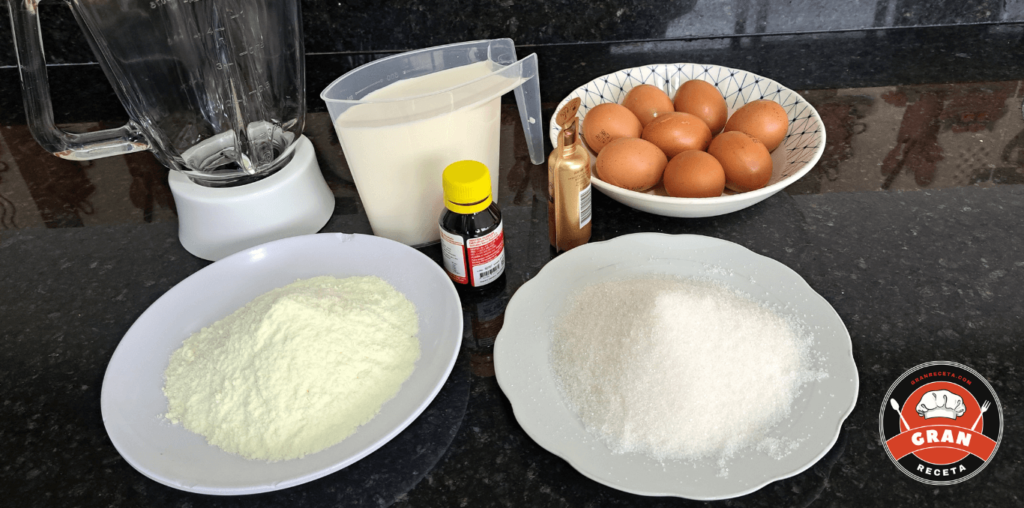
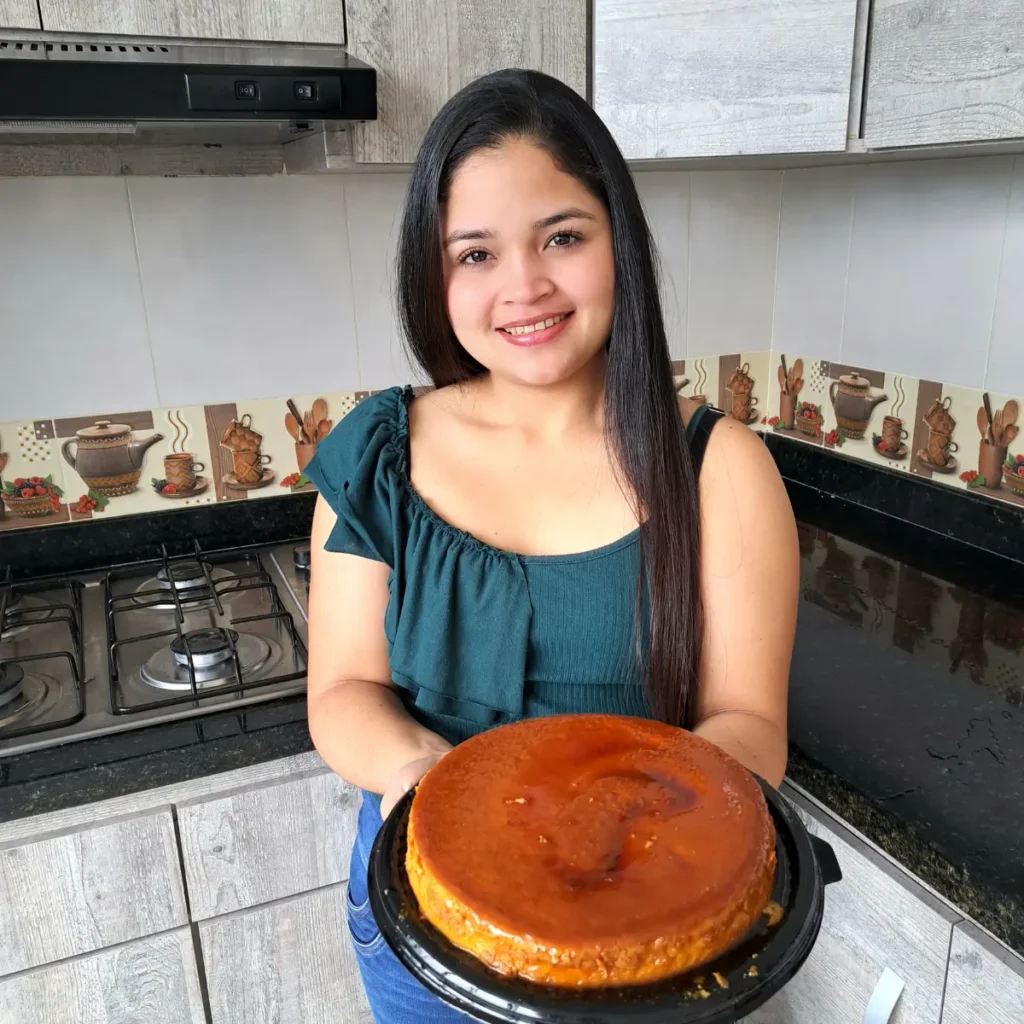
If you’ve only had flan, quesillo will look wrong at first: it’s full of tiny holes, and in Venezuela that’s exactly how it’s supposed to be. Quesillo is the caramel custard Venezuelans make for every birthday, and it differs from flan in one ingredient: it’s made with 5 whole eggs instead of yolks. Egg whites are 88 % water per USDA, and as they set in the oven they trap bubbles that leave those fine holes through the custard. The rest is a 14-oz can of sweetened condensed milk, the same can filled with whole milk, vanilla, a splash of rum and 80 minutes covered in a water bath at 340 °F. Twenty minutes of work, about 6 hours of waiting, and 10 servings of around 250 calories.
How do you make Venezuelan quesillo? Make a caramel with ¾ cup of sugar in the pan, blend 5 whole eggs with a can of sweetened condensed milk, a can of whole milk, vanilla and rum for 1 minute, strain it over the cold caramel, and bake covered in a water bath at 340 °F (170 °C) for 80 minutes. Cool in the bath half an hour, then refrigerate 4 hours before unmolding. About 380 minutes for 10 servings.
What quesillo is, and why the holes are the point
Quesillo means “little cheese” in Spanish, and the name is about the look: a slice is pocked with small holes like a cheese. It’s the Venezuelan branch of the caramel custard family, baked in a covered pan called a quesillera, chilled, and flipped so the caramel runs down the sides. Per the Venezuelan food magazine El Estímulo, the historical dictionary of Venezuelan Spanish records references to the dessert from 1929 on, and several of them describe precisely that porous texture. A quesillo without holes gets called a flan in Venezuela, and it isn’t a compliment.
The holes have a physical cause. Per USDA, egg white carries 10.9 g of protein and only 0.2 g of fat per 100 g, with nearly everything else water; the yolk carries 26.5 g of fat per 100 g. A yolk-only flan is a dense, fatty mixture that sets as one smooth block. Quesillo, with the whites in, is a wetter mixture, and, as El Estímulo puts it, once it passes the boiling point in the oven, bubbles form and the egg sets around them. Those fixed bubbles are the holes. That’s why their size is a matter of oven temperature, not luck.
The can you must not confuse, and the rest of the shopping
Sweetened condensed milk, one 14-oz can. It’s the sugar, the creaminess and half the protein of the dessert: per USDA, 321 kcal, 54 g of sugar and 7.9 g of protein per 100 g. Evaporated milk sits next to it on the shelf in a nearly identical can and has no sugar; with it you get a pale custard that never tastes like quesillo. Per El Estímulo, the first condensed-milk quesillo in print is in Graciela Schael Martínez’s La cocina de Casilda, Caracas, 1953, which calls it “quesillo de leche condensada”; the dessert is older than the can, but the quesillo everyone makes today is the can’s.
Whole milk, one can-measure. Measuring the milk in the empty condensed-milk can is how every Venezuelan kitchen does it: about 1⅔ cups, the same ratio every time. Skim milk gives a firmer, less creamy set.
5 large whole eggs. Five per can is the count that sets creamy and survives unmolding; with 4 it’s a spoon custard and with 8 it tastes like sweet omelet. Room temperature, because cold eggs drop the mixture’s temperature and set unevenly.
Sugar for the caramel, ¾ cup. The only bitterness in the dessert, and it balances 38 g of sugar per serving. Pale caramel makes the quesillo cloying; black caramel makes it bitter. Dark amber, like strong tea, is the target, and you get there by swirling the pan, never stirring.
Vanilla and dark rum. A teaspoon and a tablespoon. The rum is aroma, not booze; at 340 °F for 80 minutes the alcohol cooks off. Skip it for kids and double the vanilla.
The pan. A quesillera is an 8-9 inch round pan with a lid. Any solid round pan sealed with foil works, and a bundt pan is a common US substitute. Not a springform or loose-bottom pan: the water bath gets in.
Oven temperature, from smooth to the classic holes
This is the decision that defines the quesillo, and recipes contradict each other because each one picks a different result without saying so. At 300 °F for two and a half hours the custard never boils, sets slowly and comes out nearly smooth; that’s the version for anyone who wants it to pass for flan. At 340 °F for 80 minutes, this recipe, the water bath simmers gently, the edges of the custard cross the boiling point, and you get fine, even holes top to bottom. At 365 °F in 60 minutes the holes are big and the edge sets firmer than the center. Above 390 °F a crust forms and the custard curdles, weeping liquid and turning grainy.
The lid is part of the temperature. Covered, steam circulates inside and the surface sets at the same pace as the center; uncovered, the top dries into a skin before the middle is done. And the bath starts with hot water so the first 20 minutes aren’t spent heating it.
How long it takes, 20 minutes of work and an afternoon of waiting
Your hands are busy for about 20 of the 380 minutes: the caramel, then blending, straining and setting up the bath. The 80 minutes in the oven ask nothing, not even a peek. The half hour cooling in the bath lets the set finish on residual heat without a temperature shock, and the 4 hours in the fridge do two jobs that have nothing to do with cold: the custard firms enough to survive the flip, and the caramel, which hardened in the pan, dissolves in the custard’s moisture and turns back into sauce. Unmold at 2 hours and the custard cracks while the caramel stays glued to the bottom.
That’s why quesillo is a day-ahead dessert in my house. It keeps 5 days covered in the fridge and tastes better on day two.
Step by step
The caramel, swirled, never stirred
Put the sugar in the pan directly over medium heat. For the first few minutes nothing happens and you don’t touch it. When the edges start to color, swirl the pan in gentle circles until every grain is melted and the color is dark amber, about 8 minutes total. Tilt to coat the bottom and an inch up the sides, and let it cool until hard and glassy. If your pan can’t go on the stove, make the caramel in a skillet and pour it in at once; it hardens in seconds.
The custard, 1 minute in the blender and a strainer
Oven to 340 °F, kettle on for the bath. Into the blender go the 5 eggs, the can of condensed milk, the can of milk, the vanilla and the rum. Exactly 1 minute on medium: enough to combine, because every extra minute whips in air that turns into large, ragged holes instead of the fine ones. Pour through a fine strainer over the cold caramel; it catches the egg’s chalaza and the big surface bubbles.
The oven, covered and in a water bath
Cover the pan with its lid or with foil crimped tight around the rim, and set it in a deep roasting pan. Pour hot water halfway up the custard pan and slide it all into the oven. Eighty minutes, no opening. The test is the jiggle: nudge the pan and the center should move as one, like gelatin; if it ripples like liquid, 10 more minutes and test again. Out of the oven, it stays in the bath for 30 minutes.
Who this recipe is for
- If it’s your first time → bake at 340 °F and use a double layer of foil if the pan has no lid; the beginner’s mistake is uncovering at 40 minutes to look
- If you want it smooth, flan-style → 300 °F for 2½ hours, with the custard strained twice
- If you have no oven → a covered water bath on the stovetop, water at a gentle simmer, a little over an hour; the bottom sets before the center, so start the jiggle test around the 50-minute mark and put a folded towel under the pan
- If you can’t find sweetened condensed milk → there’s no substitute that gives the same result; milk and a cup of sugar make a flan, not a quesillo
- If you’re cooking for 20 → two pans, not one big one; a 12-inch pan needs over 2 hours and the edge overcooks before the center sets
What goes wrong, and how to see it coming
Buying evaporated milk. Same shelf, same-looking can, not the same product: no sugar. The quesillo comes out pale, unsweet and with a boiled-egg texture. The label says “sweetened condensed milk”.
Blending for 3 minutes. The extra air doesn’t leave in the oven; it sets as big, uneven holes, and the custard rises and then sinks as it cools. One minute, then strain.
Baking uncovered. The surface dries, skins over and then cracks. The lid or sealed foil is part of the recipe, not an accessory.
Unmolding at 2 hours. The custard has no body yet and the caramel is still hard on the bottom: the quesillo cracks and the caramel stays in the pan. Four hours in the fridge, minimum.
Burning the caramel. Dark amber to black takes about ten seconds, and burnt caramel makes the whole pan bitter with no fix. If it goes too far, throw it out and start over with ¾ cup of sugar; it’s cheaper than the rest of the can.
Variations you’ll find in Venezuela
Coconut quesillo. The can of milk becomes a can of full-fat coconut milk, plus ½ cup of shredded coconut in the blender. Richer and with fewer holes, because the coconut fat thickens the mixture.
Chocolate quesillo. Three tablespoons of unsweetened cocoa dissolved in the milk before blending. It has history: per the Caracas daily Últimas Noticias, of the 234 recipes in Schael Martínez’s La cocina de Casilda only two use chocolate, the quesillo and the cake, in a country where cacao was almost only drunk.
Pumpkin or plantain quesillo. A cup of cooked pumpkin purée or mashed ripe plantain in the blender with the rest. Sets firmer and needs 10 more minutes in the oven.
Panela caramel. In the Andes the caramel is made with grated panela (piloncillo) instead of white sugar; darker, with molasses notes, and it needs 2 tablespoons of water so it melts without scorching.
What to serve it with
On its own, cold, with its caramel, in slices of about 4½ oz. On a Venezuelan Christmas table it follows the hallacas and the ham bread, and in Colombia I set it next to Colombian natilla so everyone picks their December dessert. For the smooth, yolk-based cousin, Colombian flan is the version without holes, and if you want something lighter on the same table, a cold Colombian rice pudding does the job. At Christmas it shares the tray with Colombian buñuelos, and after a big pot of sancocho it’s the dessert that doesn’t need a fork.
Make ahead, storage and transport
Covered in the fridge it keeps 5 days; from day three it compacts a little but the flavor holds. Egg custards fall under the foods the USDA says to refrigerate within 2 hours, and this one has milk in it too, so it never sits out through a party. Take it out 15 minutes before serving so the caramel runs. Don’t freeze it: thawed, it weeps and turns grainy. If it’s traveling, carry it in its pan, unmolded only at the destination, and use 6 eggs instead of 5 for a firmer set that survives the car.
Questions people ask
Why does quesillo have holes and flan doesn’t? The whites. Quesillo uses whole eggs, and egg white is 88 % water per USDA; once the custard passes the boiling point in the oven, bubbles form and the egg sets around them. Flan uses yolks only, which are fat rather than water, and sets smooth. The hotter the oven, the bigger the holes.
How many eggs per can of condensed milk? Five large eggs, about 9 oz, per 14-oz can plus a can of milk. Six gives a firmer set that travels better; four won’t survive unmolding.
Can I make it without an oven? Yes, in a covered water bath on the stovetop: water at a gentle simmer, pan covered, a little over an hour, with the jiggle test starting around minute 50. The bottom sets before the center, so a folded towel or a rack under the pan helps.
Why did my caramel turn white and grainy? It crystallized because it was stirred with a spoon or because dry sugar fell into the melted caramel. Move the sugar by tilting the pan, never with a spoon, and let it melt on its own.
Can I use a bundt pan? Yes, and it’s the most common US substitute for a quesillera. Coat the caramel evenly into the fluting, seal the top with foil, and unmold onto a plate wider than the pan; the tube helps it bake evenly.
Is quesillo the same as flan? No. They share the caramel and the water bath, but quesillo uses whole eggs and sweetened condensed milk and has holes; flan uses yolks, milk and sugar and is smooth. In Venezuela one is quesillo and the other is flan; elsewhere both get called flan.
Nutrition
Per serving, one tenth of the pan (about 4½ oz / 130 g), calculated from the USDA database for the eggs, condensed milk, whole milk, caramel sugar and rum: about 250 kcal, 39 g carbohydrate, 7 g fat of which 4 g saturated, 8 g protein, 0 g fiber, 38 g sugar from the condensed milk and caramel, and 105 mg sodium.
The condensed milk supplies about half the calories and 22 of the 38 g of sugar; the caramel adds most of the rest. It’s a small-portion dessert by design: 4½ oz is plenty, which is why an 8-inch pan serves 10.
Quesillo is the dessert of my Venezuelan childhood the way arequipe is for Colombians: at every birthday, every Christmas, every family visit. What still surprises me when I make it in Colombia is the reaction to the holes. Here people see a flaw and ask what went wrong; in Venezuela, if it has no holes, someone will say that’s a flan. The quesillo with holes is the right quesillo. Josnaisis.