
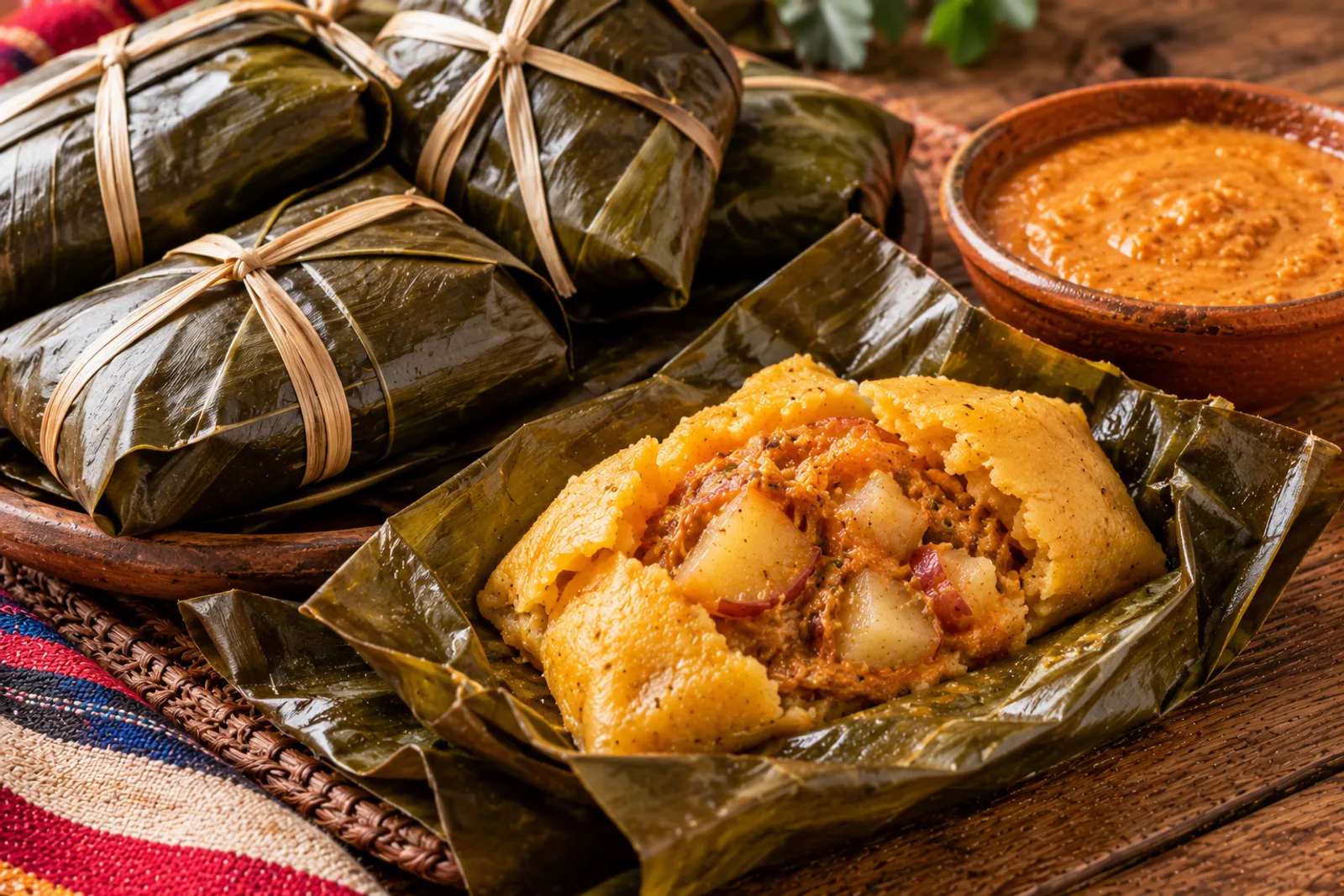

Tamales de pipián (tah-MAH-les deh pee-pee-AHN) are the small banana-leaf tamales of Popayán, a colonial city in southwest Colombia. Each one is about 4 inches (10 cm) long: a thin layer of yellow corn masa tinted with annatto, wrapped around pipián, a thick stew of mashed potato, tomato-and-onion hogao and toasted ground peanuts. The usual extra is a small piece of pork and a wedge of hard-boiled egg, and they come with peanut ají, a mild peanut and chile sauce. They take 45 minutes of steaming, much less than other Colombian tamales, because nothing inside is raw.
What pipian tamales are, and how long they take
How do you make Colombian pipian tamales? Cook 14 oz (400 g) of sliced potatoes in an annatto hogao until they collapse, stir in 5¼ oz (150 g) of toasted ground peanuts and cook the filling dry. Once it’s cold, spoon it with a piece of pork onto discs of precooked corn masa, wrap in flame-softened banana leaves, tie and steam for 45 minutes. 160 minutes for 12 tamales.
Total time 2 hours 40 minutes, about 1 hour of it hands-on. Medium difficulty: the cooking is simple, and the wrapping takes a few tries to get neat.
Colombian pipián has nothing to do with Mexican pipián, the pumpkin-seed sauce that belongs with mole verde with pumpkin seeds. In Popayán the word means this potato and peanut stew, the same one that fills Colombian peanut empanadas.
If you know Colombian tamales as the big Sunday ones, these are a different idea. The tamal tolimense and the tamal valluno start from cracked corn soaked for one to three days, carry several meats and boil for two hours or more. Pipian tamales are small, almost vegetarian, and fit into a morning.
Ingredients, with US and UK swaps
| Ingredient | Metric | US | What to buy outside Colombia |
|---|---|---|---|
| Raw unsalted peanuts | 200 g | 7 oz | Any supermarket; UK health-food aisle |
| Potatoes | 400 g | 14 oz | Yukon Gold; in the UK, Desiree |
| Yellow precooked corn flour | 300 g | 10½ oz (2¼ cups) | Masarepa (P.A.N. or Goya) in the Latin aisle or online |
| Lard or oil | 40 g | 3 tbsp | Lard is traditional; oil works and keeps it vegetarian |
| Ground annatto | 2 tsp | 2 tsp | Latin aisle as achiote; not Yucatán achiote paste |
| Banana leaves | 24 pieces | 24 pieces | Frozen, in Latin and Asian grocers |
| Green onions | 110 g | 4 oz | Spring onions in the UK |
Potatoes. In Popayán the filling is made with papa colorada, a red-skinned local potato that collapses into a firm mash. Outside Colombia, Yukon Gold (Desiree in the UK) is the closest: it mashes smooth and holds its shape when you cook it dry. Red potatoes work but come out wetter and need 2 or 3 minutes longer in the pot. Frozen Colombian papa criolla from Latin grocers is sweeter, yellower and breaks down faster. Avoid russets: mashed with peanuts they turn gluey.
Peanuts. Buy them raw and toast them yourself; that toasted flavour is the whole point of the dish. If you only have salted roasted peanuts, rinse and dry them and cut the filling salt to ¼ tsp. Unsweetened peanut butter is a last resort, added a spoonful at a time to taste, and it makes the filling pasty.
Masa. Use masarepa, the precooked flour for arepas. Mexican masa harina will set the tamale too, but it tastes of tortilla, not of Colombian corn. Fresh masa from cooked ground corn is also used in Popayán; the done-test below is the same, though it usually takes longer.
No banana leaves? Fold each tamale in baking parchment, then in foil. Same cooking time, but you lose the green, slightly tea-like aroma the leaf gives the masa.
Equipment. An 8 to 10 quart (8 to 10 litre) pot with a lid and a steaming rack, or a bed of spare leaf scraps; a skillet; a blender for the ají; a wooden spoon for the filling.
Allergens and heat. Peanuts are in both the filling and the sauce, and there’s no swap that keeps the dish. Gluten-free if your corn flour and stock are. The tamale itself isn’t spicy; all the heat is in the ají, so children can have it on the side.
Make the filling the day before
The filling is the one step that decides the tamale, and it is better cold and a day old: the peanut and hogao flavours blend overnight, and cold filling is firm enough to wrap.
- Toast the peanuts. 8 minutes in a dry skillet over medium heat, until golden and fragrant. Raw peanuts taste green and beany. Grind to coarse sand. Past that point the oil comes out and the filling turns sticky.
- Make the hogao. Annatto in the oil for 30 seconds, then green onion and garlic for 5 minutes, then tomato and cumin for 5 more, until the pan stops looking wet.
- Cook the potatoes in it. Slices go in with 1 cup (240 ml) water, covered, over low heat for 20 minutes. Stir every 5 minutes, pressing with the spoon, and add a splash of water if they catch. They’re ready when a slice collapses under the spoon.
- Dry it out. Add the peanuts loosened in ¼ cup (60 ml) water and stir without stopping for 5 minutes. It’s right when a spoon dragged across the pot shows the bottom for a moment and the filling moves as one mass. A soft, purée-like filling makes a tamale that falls apart on the plate.
Spread it on a tray to cool, then cover and refrigerate. It keeps 3 to 4 days.
Making the masa and wrapping the tamales
Masa. Hot stock with the melted lard, annatto and salt, poured over the corn flour and kneaded for 3 minutes, then covered for 5. Flatten a piece between your fingers: the edge should stay smooth. If it cracks, add stock a tablespoon at a time, up to ¼ cup (60 ml). If it sticks to your hands, oil them; don’t add flour. Shape 12 balls of about 2¼ oz (65 g), roughly the size of a large egg.
Leaves. Wipe each piece and pass it over a gas flame for 15 seconds a side. It turns from bright to dark green and becomes pliable; unheated, it splits along the ribs when folded. On an electric stove, dip the pieces in boiling water for 1 minute.
Wrapping. Cross two leaf pieces, shiny side up, with a few drops of oil. Press a ball of masa into a 4¾ in (12 cm) disc, add 2 heaped tablespoons of filling, a piece of the browned pork and an egg wedge. Lift the edges of the bottom leaf so the masa folds over the filling and closes around it. Fold the long sides of the leaf over, tuck the short ends under, wrap the second leaf the opposite way and tie in a cross. Firm, not tight: the masa swells a little.
Steaming, and how to tell they’re done
Put 1¼ in (3 cm) of water and a rack in the pot and bring it to a boil. Lay the tamales flat, two layers at most, cover and cook for 45 minutes over medium heat, topping up with hot water every 15 minutes. The water must stay below the tamales; if it seeps in, the masa turns watery and grey.
Rest them 5 minutes and open one. Done means the masa is firm, gives like a soft arepa when you press it, and peels cleanly away from the leaf. If it sticks or the centre looks wet, give them another 10 minutes.
The pork was browned for 7 minutes before wrapping and spends 45 more minutes in steam, so it cooks through comfortably; pork is safe from 145°F (63°C) with a short rest.
If something goes wrong
- The tamale falls apart when opened. The filling was too wet or still warm. Cook it until it leaves the bottom of the pot, and chill it.
- The masa cracks as you fold. Too dry. Add a tablespoon of stock and knead for a minute.
- The masa is soggy or grey. Water got in: loose tie, or the water level was above the rack.
- The masa sticks to the leaf. Undercooked, or the leaf wasn’t oiled. Ten more minutes.
- The filling tastes flat. The peanuts weren’t toasted enough. They should be golden and smell roasted.
Variations and scaling
- Vegetarian. Leave out the pork, keep or skip the egg, and use oil instead of lard. About 265 calories per tamale, and the version that shows off the filling best.
- Chicken. 10½ oz (300 g) boneless thighs in 12 pieces, browned like the pork.
- Quicker filling. Boil whole potatoes for 20 minutes, peel them hot, crush with a fork and mix with the hogao and peanuts. Easier to watch, and the flavour barely changes.
- For 24. Double everything, make the filling the day before and steam in two pots or two batches. The wrapping is what can’t be rushed, so make it a two-person job: one spreads masa, the other folds and ties.
Serving, storing and reheating
Open them on the plate in their leaf, with peanut ají spooned over. One makes a mid-morning snack with a mug of Colombian hot chocolate; two make lunch, with a bowl of Colombian ají picante for anyone who wants real heat.
- Fridge. Cooked, in their leaves, in a covered container within 2 hours of cooking: 3 to 4 days.
- Freezer. Cooked, cooled and still wrapped, in a freezer bag: 3 months.
- Reheat. Steam on the rack, 15 minutes from the fridge or 25 minutes from frozen (no need to thaw), until the centre reaches 165°F (74°C) and steams when opened. In the microwave, one at a time, in its leaf under a damp paper towel: 2 minutes at medium power, turn it over, then 1 minute more. The masa comes out a little drier than steamed.
Pipian tamale questions
Where are they from? Popayán, the capital of Cauca department in southwest Colombia, like the peanut empanadas. Next door, in the Valle del Cauca, the house tamale is the much larger valluno.
Can I freeze them uncooked? You can, but precooked masa weeps as it thaws and comes out softer. I freeze them cooked, and they reheat as they were on day one.
Can I make the peanut ají ahead? Yes, it keeps 2 days covered in the fridge. It thickens as it chills; loosen it with a spoonful of water.
What does pipian taste like? Like a creamy, mild potato mash with a strong toasted-peanut flavour and a little cumin. Annatto gives the colour, not heat.
Nutrition per tamale
Per tamale (the batch makes 12), with pork, egg and its share of the peanut ají, calculated ingredient by ingredient from the amounts above:
- Calories: 325
- Protein: 13 g
- Carbohydrates: 30 g
- Fat: 18 g, of which 4 g saturated
- Fiber: 4 g
- Sugars: 3 g
- Sodium: 475 mg
Peanuts and corn flour each bring a little under a third of the calories. Without pork and egg, each tamale drops to about 265.
I always make the filling a day ahead and make twice what I need, because half of it ends up as empanadas at the weekend. The part that took me longest was the tying. I grew up with Venezuelan hallacas, which are big and tied slowly, and these are so small that the trick is not to pull the leaf tight until the masa has already closed around the filling. Josnaisis.