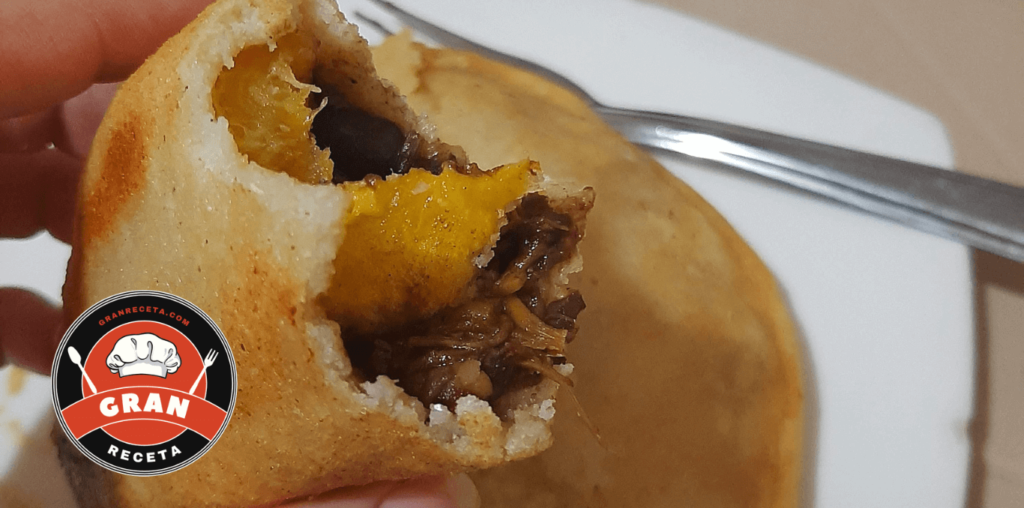
What separates these from every other Colombian empanada is one ingredient: peanut. The filling is mashed yellow potato with hogao and ground toasted peanuts, and that peanut — 49 g of fat per 100 g according to the USDA — is what makes a filling of potato and tomato taste creamy. They come from Popayán, in the Cauca, and they are tiny. Twenty of them, 140 calories each, 75 minutes.
How do you make empanadas de pipián? Toast and grind the peanuts, boil 14 oz of yellow potatoes and mix them with hogao and the peanuts. Knead a corn dough with warm water and annatto oil, shape 20 empanadas around the cold filling and fry them 4 minutes at 355°F. Serve with peanut ají. 75 minutes for 20 empanadas.
How they differ from other empanadas
A pipián empanada weighs about an ounce — a third of an antioqueña. You eat them in two or three bites, which is why in Popayán they are ordered by the dozen rather than by the unit.
The dough is cracked corn stained with annatto, like much of Colombia, but the filling is like nothing else: potato, hogao and peanut, with no meat at all. They are vegetarian without trying to be, which is unusual in this cuisine.
And they come with their own sauce. Peanut ají — ground peanuts, chilli, cilantro and a little of the potato water — is not interchangeable with other sauces: it is made from the same ingredient as the filling.
The peanut, and what to do without it
The peanuts go in raw and are toasted at home for 8 minutes in a dry pan. Toasting develops the flavour compounds and makes them grind better; raw peanuts straight into the filling taste green and beany, which is what they are.
The grind matters as much as the toast. Stop at coarse sand. Taken further, the oil comes out, the mixture turns to paste and the filling goes from creamy to sticky.
Salted roasted peanuts from a supermarket work: rinse them, dry them, grind them and cut the salt in the filling. Unsweetened peanut butter is a last resort — creamy, but it buries the hogao.
The filling goes in cold
Fresh pipián is above 140°F and still steaming, and both of those soften the dough from the inside. An empanada built with warm filling almost always bursts in the oil, and no amount of careful sealing prevents it.
Cooled, the potato starch retrogrades slightly and the filling turns firm, almost mouldable. It can be made the day before and kept covered in the fridge, which also improves it, since the peanut and the hogao settle together.
Mash the potato with a fork, never in a processor. Beating breaks and stretches the starch granules, and the filling turns gluey — the same fault as an over-beaten mashed potato.
Four minutes in the oil
At 355°F a one-ounce empanada is golden in 4 minutes. At 300°F the dough soaks up oil and softens; at 390°F it cracks and opens before the inside is even warm, which matters little here since the filling is already cooked.
Fry no more than five or six at a time. Each cold batch drops the oil temperature, and a crowded pot poaches them instead of frying them.
Drain them upright on a rack. Flat on paper, the underside softens in its own steam, which on something this small shows up immediately.
Where the 75 minutes go
Peanuts, potatoes and hogao all run at the same time, so the real sequence is 45 minutes of preparation and cooling, 20 of shaping and 10 of frying.
Make it ahead
The filling is better made the day before and it makes the shaping far easier. Shaped raw empanadas freeze well spread on a tray and then bagged, and go into the oil straight from frozen with one extra minute. Fried ones do not keep: at this size they lose their crunch within the hour.
Who this recipe is for
- You want a vegetarian empanada — this is the classic Colombian one, no substitutions needed
- You are cooking for a crowd — 20 small ones disappear faster than 10 large
- You have peanuts and potatoes — the rest is a tomato sofrito
- You have never had peanut ají — that alone is worth the recipe
- You are avoiding nuts — this is not the recipe for you; the peanut is the dish
What goes wrong
Filling them warm. The dough softens from the inside and they burst.
Grinding the peanuts to paste. The oil comes out and the filling turns sticky.
Processing the potato. The starch stretches and the filling turns gluey.
Overfilling. With more than a teaspoon the edge will not seal.
Frying more than six at once. The oil drops below 355°F and they poach.
Variations
With egg. Half a slice of hard-boiled egg inside, as some Popayán households do.
With beef. Three ounces of shredded beef mixed into the pipián, for anyone who wants them meaty.
Baked. At 400°F for 15 minutes, brushed with oil: less fat, a drier dough.
Hotter ají. Add one chopped hot chilli to the peanut sauce.
What to serve them with
Peanut ají, always, and three at a time as a snack, which comes to about 420 calories. With Colombian hot chocolate or cold aguapanela they make a full Cauca afternoon.
On a fried platter they sit beside Colombian stuffed plantains and Colombian carimañolas. For the other great Colombian empanada, Colombian empanadas carry beef and potato and weigh twice as much, and before a Colombian sancocho these play the part of the fried opener.
Frequently asked questions
What is pipián? The filling: mashed yellow potato with hogao and ground toasted peanut. It gives the dish its name.
Why do mine burst in the oil? Almost always a warm filling, or too much of it.
Can I freeze them? Yes, shaped and raw on a tray for up to 2 months. Fry from frozen with 1 extra minute.
Do they contain meat? No. Traditional pipián is vegetarian; beef is a variation.
How hot is peanut ají? Barely. It is creamy rather than spicy, and its job is to echo the peanut in the filling.
Nutrition
Per empanada of about 1 oz, calculated from each ingredient according to the USDA SR Legacy database:
- Calories: 140 kcal
- Protein: 4 g
- Carbohydrates: 15 g
- Fat: 8 g, 1 g of it saturated
- Fibre: 2 g
- Sodium: 105 mg
Roughly half the fat comes from the peanuts and half from the frying oil. Baked, each one lands near 105 calories with 4 g of fat, though the dough turns dry rather than crisp.
The first time I ate these in Popayán I ordered six, expecting the empanadas I knew, and finished them in two minutes because they are minuscule. What stayed with me was the peanut ají, which struck me as the strangest and most logical sauce I had tried. Josnaisis.