
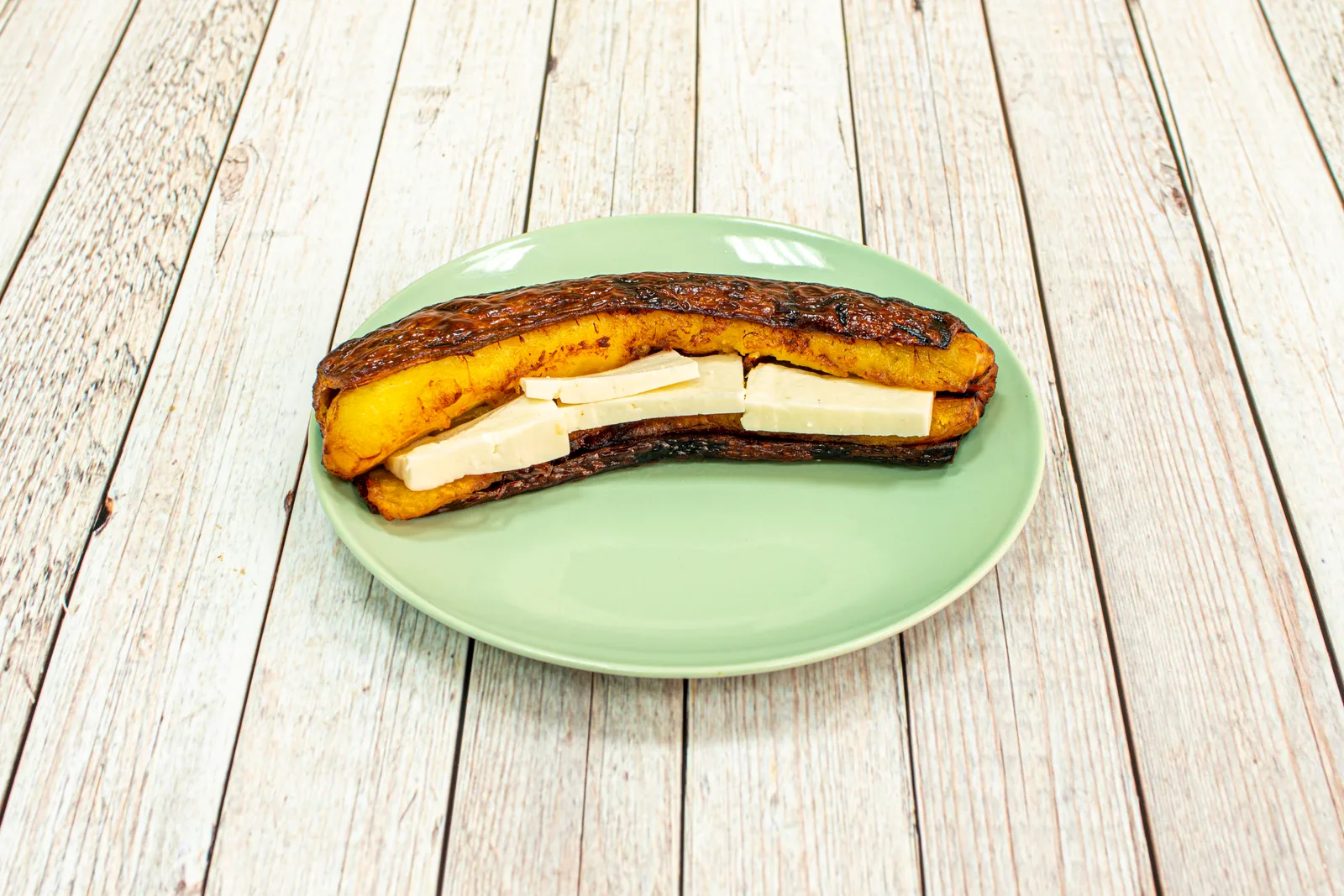

The peel decides this recipe before the oven reaches 400°F (200°C): for baked sweet plantains with cheese you want plantains that are yellow with lots of black patches, or nearly black, and still firm when you squeeze them. Those roast whole for 45 minutes until the outside turns sticky and dark gold, then get split like a canoe and filled with salty white cheese and a strip of guava paste. Below are the recipe for 4, air fryer, skillet and grill methods, what to buy in a US or UK supermarket, and how to get ahead the day before.
What baked sweet plantains with cheese are
How do you make baked sweet plantains with cheese? Peel 4 very ripe plantains, brush them with 1 tablespoon of melted butter and bake them whole at 400°F (200°C) for 30 minutes, then turn and bake 15 more. Split each one lengthwise without cutting through the ends, fill with 1.4 oz (40 g) cheese and a strip of guava paste, and bake 5 to 7 minutes. 65 minutes for 4 servings.
A plantain looks like a big banana but it’s a cooking fruit: starchy and potato-like when green, sweet and soft once the peel turns black. In Colombia and Venezuela a ripe one is roasted whole and stuffed with cheese (plátano asado con queso). Colombians often add guava paste, a combination called queso y bocadillo; Venezuelans tend to use a soft, mild fresh cheese or grate a hard salty one on top. It’s served as a side to rice, beans and meat, or eaten on its own as a snack.
It isn’t the same as Venezuelan fried sweet plantains, or tajadas, which are sliced and fried, or aborrajados, which are stuffed, dipped in a flour-and-egg batter and fried. Puerto Rican pastelón layers plantain with ground beef, and Colombian candied plantains simmer in a panela syrup. If you want a sliceable bake of plantain, cheese and egg, that’s the Venezuelan plantain cake.
Time. 65 minutes, only about 12 of them hands-on. Difficulty, easy. The one judgment call is picking the plantain.
Which plantains to buy and how ripe they should be
You need plantains, not bananas. In the US they’re in the produce section of most supermarkets and in every Latin grocery; in the UK, in large supermarkets and in African, Caribbean and Latin grocers. A dessert banana falls apart in a 45-minute bake and tastes like dessert, without the firm flesh that holds the cheese.
Stores usually sell them green or barely yellow. Leave them at room temperature, out of the fridge, in a paper bag until they’re covered in black: depending on where they started, that takes several days to a week. There’s no shortcut. A green plantain baked with sugar on top is still starchy and dry. If yours is already black and squishy, bake it in its peel (see below) and spoon the cheese over the top instead of stuffing it.
Ingredients and which cheese to use
The recipe allows one plantain per person and 1.4 oz (40 g) of cheese per plantain. As a side to a big plate of meat, half a plantain each is plenty.
Cheese in the US and UK
The classic pairing is sweet plantain against salty cheese. What changes from one cheese to another is whether it melts or just softens:
- Colombian costeño cheese. Salty and firm: it softens and sweats in the oven but doesn’t string. Some Latin groceries in the US stock it.
- Venezuelan queso de mano or queso telita. Soft, mild, milky fresh cheeses that melt well. Hard salty queso blanco duro is grated over the top instead, because it doesn’t melt.
- Queso blanco or queso fresco (US Latin brands). Softens without melting and is milder than costeño.
- Low-moisture mozzarella (the block, not the fresh balls). Melts and strings, with little salt. Fresh mozzarella leaks water: pat it dry first.
- My go-to outside Colombia: half mozzarella, half feta. The mozzarella gives the stretch, the feta the salt. In the UK, where Latin cheeses are hard to find, this is the closest match.
- Halloumi or Latin frying cheese browns but won’t melt; it stays a firm stick inside the plantain. Fine if you like that, but it’s a different texture.
Guava paste and what to use instead
Guava paste is a firm, sliceable block of cooked guava and sugar; in Colombia it’s called bocadillo. In the US it’s sold in bars or tins in the Hispanic aisle. In the UK, look in Latin or Caribbean grocers or online. Quince paste (membrillo), sold near the cheese in many supermarkets, melts the same way but is tarter and has none of the guava aroma.
Cut thin strips, about ¼ inch (½ cm): a thick slab won’t melt in 5 minutes and stays firm in the middle.
Equipment. A baking sheet, parchment paper, tongs and a small sharp knife.
How to make baked sweet plantains with cheese
Peeling without breaking it
Cut off the ends and run the knife lightly along one ridge of the peel, just through the skin. On a ripe plantain the peel comes away easily with your fingers. If the plantain tears while you peel it, it was too soft: bake it anyway and put the cheese on top.
The first bake, 45 minutes
30 minutes at 400°F (200°C) on one side, untouched, then 15 minutes on the other. The side touching the sheet browns most, which is why you turn it. It’s ready to stuff when:
- Both sides have golden to mahogany patches and the sugar looks sticky on the parchment.
- A toothpick slides into the center with no resistance, like a baked potato.
- Pressed with tongs, it gives but doesn’t flatten.
If the toothpick still meets resistance, give it 5 more minutes. If it’s darkening a lot before it softens, cover it loosely with foil and carry on.
Splitting and stuffing
Split it only once it’s baked: a raw plantain slit lengthwise splays open in the oven and the cheese ends up on the sheet. Cut along the top without going through the bottom, and leave about ¾ inch (2 cm) uncut at each end so you get a canoe that holds the filling. Cheese goes in first, guava paste on top, then 5 to 7 minutes back in the oven. With costeño or queso blanco don’t wait for it to melt: it’s done when it softens and sweats and the guava paste turns glossy.
Air fryer, skillet or grill
- Air fryer. Peeled and brushed with the butter, at 370°F (185°C) for 8 minutes per side. Split, stuff and give it 3 to 4 minutes more at the same temperature. Two large plantains fit in a medium basket per batch, which makes this the fastest way for one or two people.
- Skillet. An 11-inch (28 cm) skillet with a lid, 1 tablespoon butter and 1 tablespoon oil, over medium-low heat. Brown the whole plantains with the lid on, turning every 4 to 5 minutes, until golden on all sides and a toothpick goes in easily: about 15 to 20 minutes. Split, stuff, cover and leave 3 to 5 minutes over low heat to soften the cheese. This gives the most caramel, but stay close: the sugar burns fast if the heat creeps up.
- Grill. Peeled and brushed with butter, over medium-high heat, about 4 minutes per side, until it has toasted grill marks. If it’s thick and still firm inside, move it to the cooler side of the grill and close the lid for a few minutes. Stuff it and tent with foil to soften the cheese.
- In the peel, in the oven or on embers. Wash the plantain, cut off the ends and slit the peel lengthwise. It takes noticeably longer than a peeled one: start checking at 35 minutes at 400°F (200°C). It’s ready when the peel is black and split, oozing syrup, and the flesh gives when pressed. It won’t brown; it comes out moist and very soft and is eaten with a spoon straight from the peel, cheese on top. It’s the best use for a plantain that’s already black and squishy.
Common problems and how to avoid them
- Dry and starchy. The plantain was green or plain yellow. More oven time won’t fix it; next time wait for lots of black on the peel.
- It tears when you split it. It was black and soft, or it was split before baking. Leave ¾ inch uncut at each end and cut only once it’s cooked.
- Burnt outside, hard inside. Oven too hot or a very thick plantain. Cover with foil halfway through and let it finish.
- The cheese runs out and burns on the sheet. Too much cheese, or the slit goes right through. 1.4 oz (40 g) fills the canoe without spilling.
- The guava paste stays hard. The strips were too thick. Slice them thin or squash them with a fork.
- Too salty. Some costeño cheese is very salty. Taste a piece first; if it is, mix it with mozzarella or soak it in cold water for 30 minutes.
Allergens and kids. Contains milk (cheese and butter). No gluten, egg or nuts, and no heat. Most kids like it; for small ones, let the guava paste cool a couple of minutes longer.
Versions and quantities for a crowd
- For a party. Every plantain bakes at once on one or two sheets: the time is the same for 4 or 20, you just need more sheets. With two sheets, swap their shelves when you turn the plantains.
- Sweeter. Sprinkle 1 teaspoon of sugar or grated panela per plantain over the butter before baking, or a pinch of cinnamon. Watch them closely for the last 10 minutes: sugar burns before the plantain does.
- With bacon. Wrap each stuffed plantain in a slice of bacon and bake 10 minutes instead of 5 to 7, until the bacon is crisp.
- Lighter. Use 0.9 oz (25 g) cheese per plantain and brush with oil instead of butter. The plantain itself is still most of the calories.
The cheese is what drives the cost: plantains are cheap, and 1.4 oz (40 g) of cheese per plantain is all you need.
What to serve them with, and storing
Serving. In Colombia they go next to rice and meat, such as Colombian posta negra; in Venezuela, next to Venezuelan black beans with rice and shredded beef. On their own with milky coffee they’re an afternoon snack.
Make ahead. Bake the plantains without filling, cool them and refrigerate them covered. The next day, split, stuff and bake 10 to 12 minutes at 350°F (180°C), until hot and the cheese is soft.
Fridge. Once stuffed, put them in an airtight container within 2 hours and they keep 3 to 4 days.
Freezer. I don’t freeze them: the plantain weeps water as it thaws and the cheese turns rubbery.
Reheating. In the oven at 350°F (180°C) for 8 to 10 minutes, or in the air fryer at 340°F (170°C) for 4 to 5 minutes, until hot all the way through. The microwave heats them but softens the crust and makes the cheese rubbery.
Frequently asked questions
Can I use bananas instead of plantains? Not for this. Bananas have less starch and more water: in a 45-minute bake they collapse into something closer to dessert, without the caramelized crust or the firm flesh that holds the cheese.
Do I need to boil the plantains first? No. Some cooks boil them and then just melt the cheese on top to save time, but they come out pale and watery. Baked straight from raw, the plantain’s sugar concentrates and browns.
Do they need salt? Not with costeño, feta or queso blanco: the cheese brings the salt. With mozzarella alone, a pinch of salt over the butter before baking helps.
Can I use dulce de leche instead of guava paste? Yes, a teaspoon per plantain once it comes out of the oven, not before, because in the oven it burns and runs. It’s sweeter and less tangy than guava.
Nutrition
Per serving (one plantain of about 9 oz / 250 g peeled with 1.4 oz / 40 g cheese, without guava paste), worked out ingredient by ingredient from the recipe quantities:
- Calories: 456 kcal
- Protein: 11 g
- Carbohydrates: 81 g
- Fat: 14 g, of which 7 g saturated
- Fiber: 4 g
- Sugars: 45 g
- Sodium: 316 mg
The plantain brings about 305 kcal and nearly all the sugar, its own; the cheese about 124 kcal and most of the sodium. Saltier cheese such as costeño or feta pushes the sodium up. Guava paste is almost pure sugar: a thin 0.9 oz (25 g) strip is enough.
I stuff mine with whatever is saltiest in the fridge, because a properly ripe plantain already brings all the sweetness. When I buy plantains for the week, I set aside the ones that go black first and bake them on Sunday: they’re the ones that taste best this way. Josnaisis.