
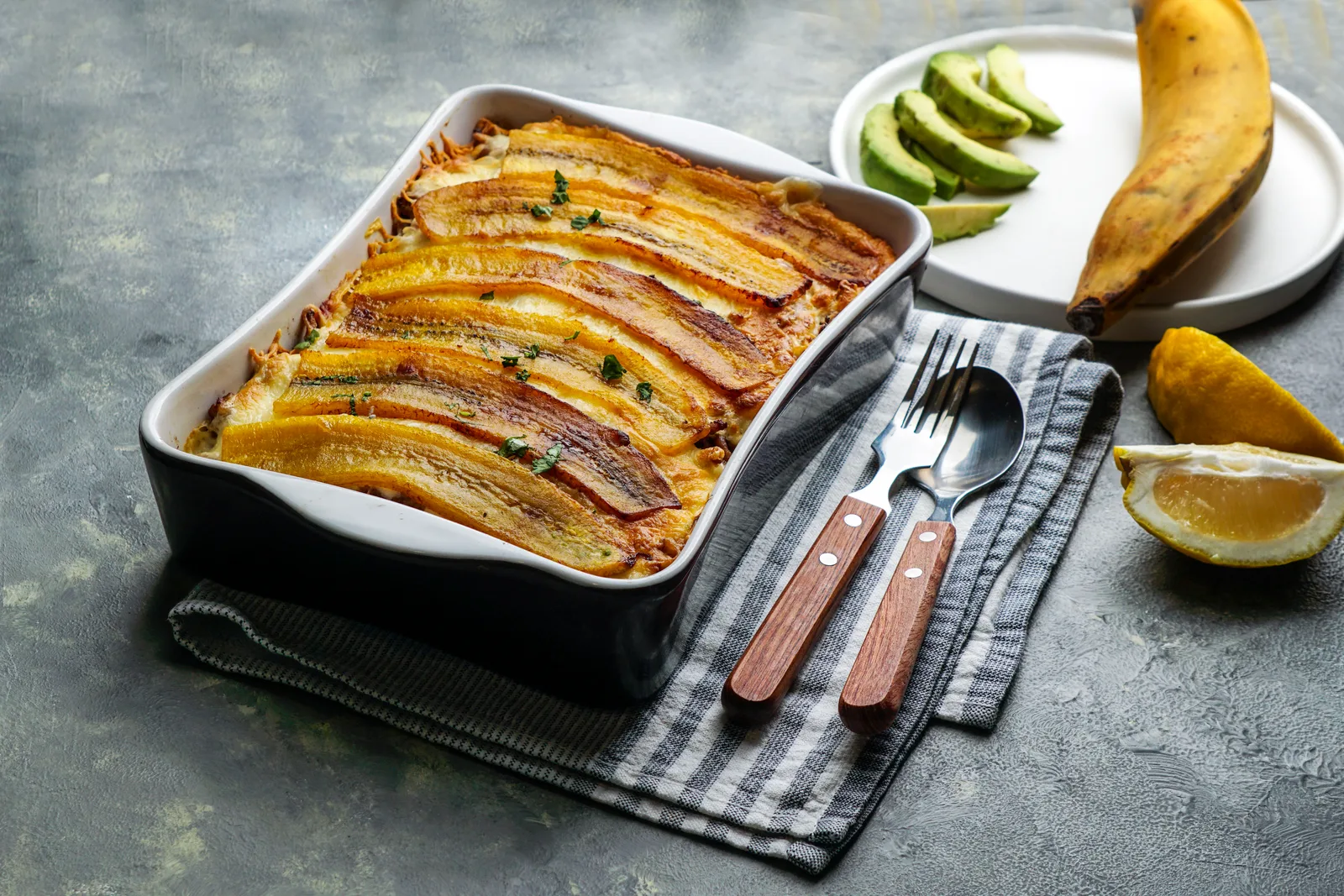

Pastelón (pahs-teh-LOHN) is the Puerto Rican answer to lasagna: long strips of fried sweet plantain take the place of the pasta, with a sofrito-seasoned ground beef filling and melted cheese in between and beaten egg holding it together. The plantain has to be ripe, with the skin nearly black, because the dish depends on its sweetness against the salty beef and olives. This version fills a 9x13 in (23x33 cm) dish for 8 and is built for a US or UK kitchen: what to buy, how to stop it going watery, and how to assemble it the night before.
What pastelón is, and what it tastes like
How do you make pastelón? Fry 2¼ lb (1 kg) of ripe plantains cut into long strips, cook 1½ lb (680 g) of ground beef with sofrito, sazón, tomato sauce and olives until the sauce is thick and dry, then layer plantain, beaten egg, beef and cheese in a 9x13 in (23x33 cm) dish and finish with plantain, egg and cheese. Bake at 350°F (180°C) for 25 to 30 minutes and rest 15 minutes before cutting. 90 minutes for 8 servings.
Think of a lasagna where the sheets are soft, caramelized plantain. Every bite is sweet and savory at once: the plantain is closer to a baked sweet potato than to a banana, and the filling brings salt and tang from green olives and capers. It isn’t spicy. It’s served as a main course, and it often turns up at holiday tables and potlucks.
Time and effort. 90 minutes in all, of which about 50 are hands-on: 20 to prep, 25 at the stove with both pans going, 5 to layer. Medium difficulty only because there are three components and long plantain strips need a gentle turn.
Two dishes it isn’t. Venezuelan plantain cake, torta de plátano, layers the same fried ripe plantain with salty white cheese and raw cane sugar but no meat: it’s a side, not a main. Venezuelan pasticho is a pasta lasagna with béchamel. And unlike Mexican picadillo, which has potato and carrot, Puerto Rican picadillo is built on sofrito, sazón and olives.
Ingredients, with US and UK shopping notes
| Ingredient | Metric | US | Notes and UK swaps |
|---|---|---|---|
| Ripe plantains, peeled | 1 kg | 2¼ lb (5-6 large) | Skins nearly black but firm |
| Ground beef, 85% lean | 680 g | 1½ lb | UK: 15% fat beef mince |
| Sofrito (green recaíto) | 120 g | ½ cup | Homemade swap below |
| Sazón with culantro and achiote | 5 g | 1 packet | Or 1½ tsp homemade |
| Tomato sauce | 225 g | 8 oz can | UK: passata, not ketchup |
| Alcaparrado | 40 g | ¼ cup | Stuffed olives plus capers |
| Eggs | 4 large | 4 large | |
| Shredded cheese | 225 g | 2 cups | Mozzarella plus cheddar |
| Oil for frying | 180 ml | ¾ cup | Any neutral oil |
Plantains, and how to get them ripe in time
Plantains look like oversized bananas but are starchier and can’t be eaten raw. For pastelón you want the stage most shoppers would throw away: skin almost entirely black, the fruit still firm when pressed. Inside it’s deep yellow, sweet, and it still cuts into long strips that survive the pan.
- Yellow with some black spots. Usable, but less sweet and the strips stay firmer.
- Black and firm. The target.
- Black and squishy. Too soft for strips; use it for the Dominican mashed version below.
- Green. No sweetness. That’s the plantain for mofongo and tostones.
US supermarkets sell plantains near the bananas, usually green or yellow. In the UK, look in the world-food section of larger supermarkets or in Caribbean and African grocers. Leave them on the counter, not in the fridge, until the skins turn black, so buy them several days ahead. Bananas are not a substitute: they turn to mush in the oil and the dish ends up dessert-sweet.
Sofrito, sazón and alcaparrado
These three make the filling taste Puerto Rican, and I use the same amounts as in my Puerto Rican arroz con gandules, which also has the homemade sofrito and sazón.
- Sofrito or recaíto. A green paste of culantro, sweet ají peppers, garlic, onion and green pepper. In the US it’s sold in jars in the Hispanic aisle; buy the green recaíto, not the red tomato-based sofrito. In the UK it’s mostly online. Without it, finely chop 1 small onion, ½ green bell pepper, 3 garlic cloves and a handful of cilantro (coriander): less aromatic, but it does the job.
- Sazón. A seasoning blend with achiote (annatto) for color, plus salt. One packet weighs 5 g.
- Alcaparrado. Olives and capers in one jar. Swap in 8 sliced pimento-stuffed olives and 1 tsp capers.
Which cheese
It needs to melt without weeping: low-moisture mozzarella (the bagged shredded kind for pizza), cheddar, Monterey Jack, or half and half. In the UK, a mild or medium cheddar with grated mozzarella works. Avoid fresh mozzarella balls and queso fresco; both release whey in the oven and leave the bottom wet.
How to make pastelón
Fry the plantain strips
Slice each plantain lengthwise into strips a scant ¼ in (6 mm) thick; you’ll get four from each. Thinner ones tear when you flip them; thicker ones make a heavy, plantain-dominated pastelón.
Fry at 350°F (175°C) over medium heat, 5 or 6 strips at a time in a 12 in (30 cm) skillet, 2 to 3 minutes per side, until golden and soft. Ripe plantain is full of sugar and blackens fast in hotter oil while the middle stays firm. No thermometer? The first strip should sizzle at once without the oil smoking. Turn with a wide spatula.
Oven or air fryer instead. Brush the strips with oil and bake on a parchment-lined sheet at 350°F (180°C) for 20 to 25 minutes, until soft and browned underneath, or air-fry at 350°F (175°C) for about 15 minutes per batch. They caramelize less and the dish is a little less sweet, but there’s no frying to babysit.
Cook the filling until it’s dry
This decides whether the pastelón slices cleanly. Brown the beef on its own first, until no pink remains, and only then add the sofrito, followed by the sazón and tomato. The final 10 minutes uncovered are for reducing. It’s ready when the sauce clings to the meat and a spoon dragged across the bottom of the pan leaves a line that stays dry. Any liquid left now drains to the bottom of the dish in the oven. The same dry picadillo is what goes inside Puerto Rican alcapurrias, the green banana and yautía fritters, where a wet filling would burst the dough in the oil.
Layer
- Grease the dish and cover the bottom with half the plantain strips side by side. Small gaps are fine.
- Pour over half the beaten egg. It runs between the strips and glues them.
- Spread all the beef and press it flat.
- Scatter 1 cup of cheese.
- Top with the rest of the plantain, the rest of the egg and the second cup of cheese.
Two plantain layers and one of beef keep it balanced. For three plantain layers, split the beef in two; it comes out taller and sweeter.
Bake, then wait
Bake uncovered at 350°F (180°C) for 25 to 30 minutes. Everything is already cooked, so you’re only melting the cheese and setting the egg. It’s done when:
- The cheese is melted with golden spots.
- The edges bubble.
- A knife in the center shows no runny egg. With a thermometer, the center reads 160°F (71°C), the point where egg is fully set.
For a browner top, give it a minute or two under the broiler (UK: grill), watching it closely. Then rest 15 minutes before cutting. Straight from the oven the egg and cheese are still soft and the layers slide; rested, each square lifts out whole.
Make it ahead
- Up to 3 days before. Cook the beef filling, cool it and refrigerate it covered.
- The night before. Fry the plantains and assemble the whole dish, egg and cheese included. Cover tightly and refrigerate.
- To serve. Bake from the fridge covered with foil at 350°F (180°C) for 25 minutes, then uncovered for 15 to 20 minutes, until the center reaches 165°F (74°C) and the cheese browns. A chilled dish takes longer than a freshly assembled one, so go by the center temperature rather than the clock. Rest 15 minutes.
If it goes wrong
- Liquid pooling in the dish. The filling went in wet, or the cheese was a fresh one. Reduce harder and use low-moisture cheese.
- Squares fall apart. Cut before the 15-minute rest, or the egg was left out. You can skip the egg, but expect to serve it with a spoon.
- Strips break or turn to mush. The plantains were too soft or cut too thin. Very soft ones belong in the Dominican version.
- Dark outside, hard inside. The oil was too hot. Stay at medium.
- Too salty. Jarred sofrito, sazón, olives and cheese all carry salt. Taste the beef before adding the ½ tsp salt.
Allergens. Contains egg and dairy. There’s no flour in it; if you need it gluten-free, check the labels on the jarred sofrito and the sazón.
Dominican pastelón and other versions
- Dominican style. The plantains aren’t fried. Peel them, boil in salted water for 15 to 20 minutes until fork-tender and mash them hot with ¼ cup (57 g) butter per 6 plantains until smooth. Layer half the mash, cheese, the beef filling, the rest of the mash and more cheese, and bake at 350°F (180°C) until golden, about 20 to 25 minutes. It’s softer and more even, like a sweet shepherd’s pie, and the best use for overripe plantains. Cheddar is the usual cheese.
- Piñón. In some Puerto Rican homes this is the name for the fried-strip version with green beans and hard-boiled egg in the filling. Same assembly.
- Ground turkey or chicken. Same quantities. It’s leaner and drier, so don’t reduce the sauce quite as far.
- Lighter. Bake the plantains instead of frying, and use only 1 cup of cheese, all on top.
- Vegetarian. Replace the beef with chopped mushrooms and eggplant cooked with the sofrito until all their water has evaporated, or with well-drained cooked lentils.
Smaller or bigger batches
- Serves 4 to 6. Halve everything in an 8x8 in (20x20 cm) dish: 500 g (1 lb 2 oz) peeled plantain, 340 g (¾ lb) beef, ¼ cup sofrito, half a packet of sazón, 2 eggs and 1 cup cheese. Bake 20 to 25 minutes.
- Serves 16. Double it in two 9x13 in dishes, not one deeper one, where the center takes too long to set. Bake together, swapping shelves halfway, for 30 to 35 minutes.
Serving, storing and reheating
Serve with white rice and Puerto Rican stewed beans, the Puerto Rican way, or with a green salad. Fluffy white rice and a pot of beans are enough; arroz con gandules turns it into a party lunch. While it bakes, a batch of thin, crispy bacalaitos, Puerto Rico’s codfish fritters, makes an easy snack for the waiting crowd.
Fridge. Cover and refrigerate within 2 hours of baking; it keeps 3 to 4 days.
Freezer. Wrap individual squares well or pack them in airtight containers, for up to 3 months at their best. The plantain softens a little. Thaw overnight in the fridge.
Reheat covered with foil in a 350°F (180°C) oven until the center reaches 165°F (74°C), uncovering at the end to crisp the cheese. In the microwave, use medium power so the cheese doesn’t turn rubbery and the plantain edges don’t dry out.
Pastelón FAQ
Is pastelón sweet? Sweet and savory. The plantain gives natural sweetness, about 24 g of sugar per serving with no sugar added, while the beef, olives and cheese balance it. Leave out the raisins if you want it less sweet.
Is it Puerto Rican or Dominican? Both, made differently. The Puerto Rican version layers fried strips; the Dominican one uses boiled, mashed plantain. Both have a beef filling and cheese.
Can I skip the egg? Yes, but the 4 eggs are what hold the layers together, so without them it won’t cut into neat squares. The Dominican mashed version doesn’t need egg.
Can I use yellow plantains that aren’t fully ripe? If they have some black spots, yes: less sweet, firmer strips. Fully green plantains won’t work here.
Nutrition per serving
Per serving (one eighth of the dish), calculated ingredient by ingredient from the quantities above, without raisins and counting about 60 g (2 oz) of oil absorbed during frying:
- Calories: 572 kcal
- Protein: 28 g
- Carbohydrates: 45 g
- Fat: 33 g, of which 11 g saturated
- Fiber: 3 g
- Sugars: 24 g
- Sodium: 830 mg
Nearly all the sugar comes from the ripe plantain itself. Baked plantain strips and a single cup of cheese bring the fat down noticeably.
In the Venezuelan kitchen I grew up in, ripe plantain with cheese sits next to the meat, never around it, so pastelón made me think about plantains the other way round. My one rule now is patience with the filling: I let it cook down until the pan looks almost dry, even when it feels like too much, and the squares come out clean every time. Josnaisis.