
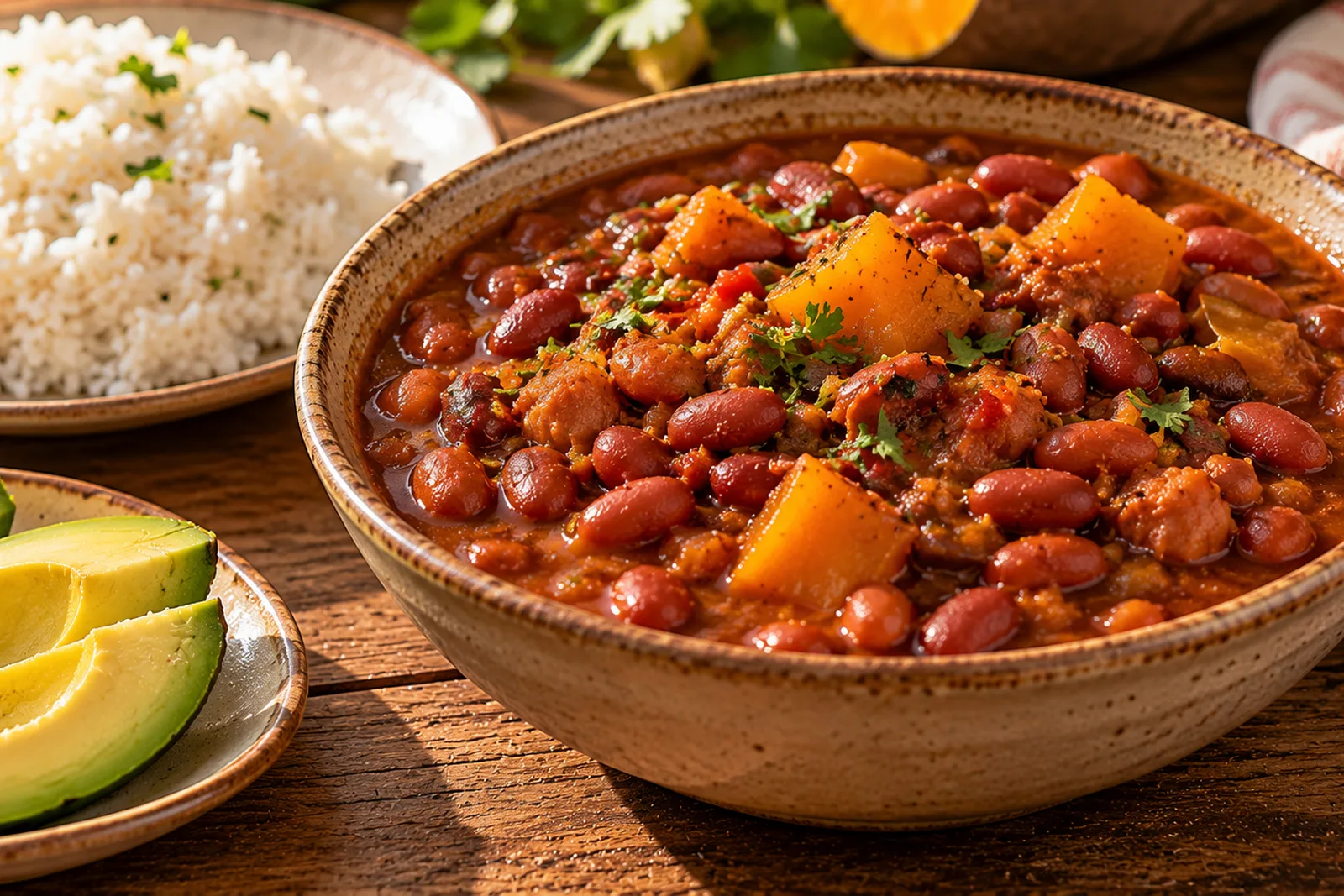

Two cans of pink beans, half a cup of green sofrito and a packet of annatto sazón are the whole shopping list for habichuelas guisadas, the stewed beans Puerto Ricans spoon over white rice most days of the week. Squash simmered with them falls apart and turns the liquid into a thick, russet sauce, so there is no flour and no blender. Below: the recipe for 6 in 45 minutes, what to buy if your store has no pink beans or calabaza, how to cook them from dried beans or in a pressure cooker, and how thick they should be.
What habichuelas guisadas are
How do you make Puerto Rican habichuelas guisadas? Cook ½ cup of sofrito in oil, with diced ham if you like, then add a packet of annatto sazón and ½ cup (120 ml) of tomato sauce. Stir in 2 cans of pink beans with their liquid, 1½ cups (360 ml) of water and 9 oz (250 g) of cubed squash, and simmer 20 to 25 minutes over medium-low heat until the squash breaks down and the sauce thickens. Salt at the end. 45 minutes for 6 servings.
Habichuelas is the Puerto Rican word for beans, and guisadas means stewed. They are the everyday side of a Puerto Rican lunch plate: a ladle of beans over white rice, with chicken, steak or a fried egg next to it. The beans stay whole and creamy inside; the sauce is savory and herby from the sofrito, a little sweet from the squash, and not spicy at all.
It is not chili and not refried beans. Mexican frijoles de la olla are simmered in a plain broth with onion and epazote; Venezuelan black beans get a touch of raw cane sugar; Colombian red beans are soupier, with green plantain. In Cuban congri the beans cook inside the rice, while here they are served on top.
The Dominican version is close: auyama squash, peppers, onion, celery leaves and thyme, with some of the beans mashed so it comes out creamier (details below). Don’t confuse either with habichuelas con dulce, a Dominican Lenten dessert of sweet creamed red beans with milk, coconut and sweet potato.
Time and difficulty. 45 minutes with canned beans: 10 to prep and 35 on the stove, mostly hands-off. From dried, add an overnight soak and 1 to 1½ hours of simmering, or about 30 minutes in a pressure cooker. Easy; the only judgment call is the thickness.
Ingredients and US and UK swaps
This makes 6 servings over rice, or 4 as a main with plenty of rice.
Pink beans, and what to buy instead
- Pink beans are the Puerto Rican default: small, thin-skinned and creamy inside without splitting. In the US, look in the Hispanic aisle, canned and dried.
- Small red beans behave almost the same.
- Red kidney beans are firmer, with thicker skins, so the stew is darker and less creamy. In the UK they are the easiest swap; canned pinto or borlotti beans also work.
Don’t drain the cans. The thick liquid is starchy and helps the sauce come together. It is also salty, which is why this recipe doesn’t salt until the end. Low-sodium cans are a good choice here.
Sofrito and sazón
- Sofrito or recaito is Puerto Rico’s green seasoning base: culantro, sweet ají peppers, onion, green pepper and garlic, blended. The homemade version, which makes 1½ cups and freezes in ice cube trays, is in the Puerto Rican arroz con gandules recipe, along with a homemade sazón blend. In jars, buy green recaito; red jarred sofrito is tomato-based and tastes different.
- Sazón comes in 5 g packets in the Hispanic aisle. Pick coriander and annatto: annatto (achiote) is what turns the sauce russet. No packets? Use 1½ tsp of the homemade blend, or make annatto oil by warming the 2 tbsp of oil with 2 tsp of annatto seeds over low heat for about 5 minutes and straining it.
- No culantro or ají dulce? Double the cilantro and use a cubanelle or (UK) a sweet pointed pepper. The stew is still good, just less perfumed.
Calabaza, and squash swaps
Calabaza is a Caribbean pumpkin with dense, orange, floury flesh. It thickens and gently sweetens the stew.
- Kabocha is the closest match: dry, sweet and quick to break down. Many US supermarkets carry it; in the UK, look in larger supermarkets or Asian grocers.
- Butternut squash is wetter and sweeter, so it thickens a little less. Give the stew 5 extra minutes uncovered.
- Potatoes, same weight in ¾-inch (2 cm) cubes, thicken with starch but add no sweetness.
Ham and olives, both optional
Diced cooking ham gives a smoky, salty backbone; smoked bacon or UK lardons work too, but skip any extra salt. Stuffed olives add a briny note; 1 tablespoon of alcaparrado (olives and capers) does the same. Leave both out and the stew is vegan, as long as your sazón contains no chicken bouillon.
Equipment. A heavy saucepan of about 3 quarts (3 liters) with a lid, and a wooden spoon for mashing.
Step by step
Build the base
Ham goes in for 4 minutes over medium heat, until it renders some fat and the edges crisp. The sofrito needs 3 to 4 minutes in that fat: it’s ready when the raw onion smell is gone and it looks almost dry. Sazón and oregano need only 30 seconds; burnt, they turn bitter. The tomato sauce cooks 2 minutes to lose its canned taste.
The simmer
Once everything boils, drop to medium-low with the lid ajar for 20 to 25 minutes. You want a lazy bubble, not a rolling boil, which splits the beans and scorches the bottom. Stir from the bottom every 5 or 6 minutes, because the bean starch likes to stick. The squash is done when it collapses against the side of the pot.
How thick should habichuelas guisadas be?
Thicker than soup, looser than a purée. The sauce coats the back of a spoon and a finger drawn through it leaves a line that holds for a moment before closing. Spooned over rice, it settles between the grains instead of pooling on the plate.
- To thicken. Mash 4 or 5 pieces of squash and a spoonful of beans against the pot and stir. Still thin? Simmer uncovered 5 minutes more.
- To loosen. Hot water from the reserve, 2 tablespoons at a time.
- Allow for resting. They thicken a lot as they cool, so if you are serving them later or tomorrow, leave them a little loose.
Cooking them from dried beans
8 oz (225 g, 1¼ cups) of dried beans gives roughly the same as two cans, with more bean flavor and a richer cooking liquid.
| Method | Before | Cooking | Done when |
|---|---|---|---|
| Canned (the recipe) | Nothing, use the liquid | 20 to 25 min in the stew | Squash falls apart, sauce coats a spoon |
| Dried, stovetop | Soak 8 to 12 h | 1 to 1½ h in 6 cups (1.5 liters) of water | A bean squashes between your fingers with no hard center |
| Dried, pressure cooker or Instant Pot | Soak 8 to 12 h | 8 to 15 min at high pressure, natural release | Same; if still firm, simmer a few minutes with the lid off |
| Dried, pressure cooker, unsoaked | Nothing | 25 to 30 min at high pressure, natural release | Same |
- Soak the beans overnight in three times their volume of water. Drain and discard the water.
- Cook them in fresh water covering them by about 2 inches (5 cm), at a hard boil for the first 10 minutes, then at a gentle simmer. Never put dried red or kidney beans straight into a slow cooker: its heat doesn’t break down a natural compound in the raw beans that can make you ill.
- Keep the liquid. Use 2½ cups (600 ml) of it in place of the canning liquid and water, and carry on from step 3 of the recipe. It is unsalted, so you will need more salt at the end.
Cooked dried beans keep up to 3 days in the fridge in their liquid, so you can do them over the weekend.
Troubleshooting
- Watery. The squash was cut too big, the cans were drained, or the lid was on tight over very low heat. Mash squash and beans, then simmer uncovered 5 to 10 minutes.
- Thick as paste. Boiled too hard or too long. Loosen with hot water and stir gently.
- Too salty. The canning liquid, ham, sazón and olives added up. Add ½ cup (120 ml) of water and a few more cubes of squash or potato and simmer 10 minutes: they soak up some of the salt and stretch the pot.
- Scorched bottom. The heat was too high or nobody stirred from the bottom. Don’t scrape: pour the top into a clean pot.
- Dried beans still hard. Old beans, or tomato added before they were tender. Cook them completely soft before they go into the stew; once in the tomato sauce they won’t soften further.
- Pale. Not enough annatto. A teaspoon of annatto oil stirred in at the end brings the color back.
Allergens and heat. No gluten or dairy, unless your sazón, jarred sofrito or ham contains them: check the labels. Not spicy: ají dulce is a sweet pepper. Kids usually like it; if they don’t like olives, add a few whole ones so they’re easy to pick out.
Dominican style and other variations
- Dominican habichuelas guisadas. Skip the jarred recaito. Cook ½ onion, ½ green or cubanelle pepper and 2 garlic cloves, chopped, in the oil with ½ tsp oregano, the leaves from a celery stalk and 2 thyme sprigs, then add tomato sauce, squash and beans. Once boiling, lightly mash some of the beans with a potato masher and simmer until creamy; finish with cilantro. It comes out thicker, without the culantro aroma, and is part of la bandera, the Dominican lunch plate of white rice, beans, meat and salad.
- Meatless or vegan. No ham, vegetable broth instead of water for depth, and a sazón without chicken bouillon. About 190 kcal per serving.
- Squash and potato. Half and half, 4½ oz (125 g) each. More body, less sweetness.
- For 12. Double everything in a 5- to 6-quart (5 to 6 liter) pot. The timing barely changes, but stir more often, because a full pot catches on the bottom sooner. I start with 2½ cups (600 ml) of water rather than 3, since a big pot evaporates less, and add more if needed.
What to serve with habichuelas guisadas
Spoon them over fluffy white rice, about 1 cup of cooked rice per person, with sliced avocado on the side. Add pan-fried steak, stewed chicken or a fried egg, and some crispy tostones. They also sit happily next to Puerto Rican mofongo. For a fried starter on the same table, crispy Puerto Rican bacalaitos (salt cod fritters) can be fried while the beans rest.
Fridge. In a covered container, refrigerated within 2 hours, they keep 3 to 4 days, and they taste better on day two.
Freezer. Freeze in portions in containers or flat bags. I use them within 3 months. Because the squash has already melted into the sauce, the texture holds up; potatoes, if you used them, turn a little grainy. Thaw overnight in the fridge.
Reheating. In a saucepan over medium-low heat with 2 to 3 tablespoons of water per cup, stirring, until bubbling and 165°F (74°C). In the microwave, covered, in 1-minute bursts, stirring in between. They always thicken in the fridge, so loosen them back to the spoon-coating stage.
Habichuelas guisadas FAQ
Should I drain canned beans for habichuelas guisadas? Not for this recipe: the liquid helps thicken the sauce. If you drain and rinse them, you lose some salt but also body, so add ½ cup (120 ml) more water and mash more squash.
Can I make them without squash? Yes. Use the same weight of diced potato, or nothing, and mash 2 or 3 tablespoons of beans to thicken. You lose the slight sweetness.
Is this the same as Puerto Rican rice and beans? “Rice and beans” in Puerto Rico usually means exactly this: white rice with habichuelas guisadas spooned over it. Dishes like congri, where the beans cook inside the rice, are a different thing.
How much jarred sofrito should I use? The same ½ cup. Jarred versions often contain salt and vinegar, so taste before salting; if it tastes sharp, 5 more minutes of simmering mellows it.
Nutrition
Per serving (1/6 of the recipe, with ham and olives, without rice), calculated ingredient by ingredient from the recipe amounts:
- Calories: 220 kcal
- Protein: 12 g
- Carbohydrates: 28 g
- Fat: 7 g, of which 2 g saturated
- Fiber: 7 g
- Sugars: 5 g
- Sodium: 1010 mg
The beans bring about 120 kcal per serving and nearly all the fiber; the oil about 40 and the ham about 30. Sodium comes from the canned beans, ham, sazón, olives and tomato sauce; low-sodium cans bring it down to about 810 mg. A cup of cooked white rice adds about 200 kcal.
I grew up in Venezuela with black beans that have a touch of cane sugar, so the first pot of habichuelas I made surprised me: salty, smelling of culantro, and thick with nothing but squash. Now I make them on Sundays with sofrito from the freezer, and the leftovers are Monday’s and Tuesday’s lunch with fresh rice and half an avocado. Dylan asks for his without olives. Josnaisis.