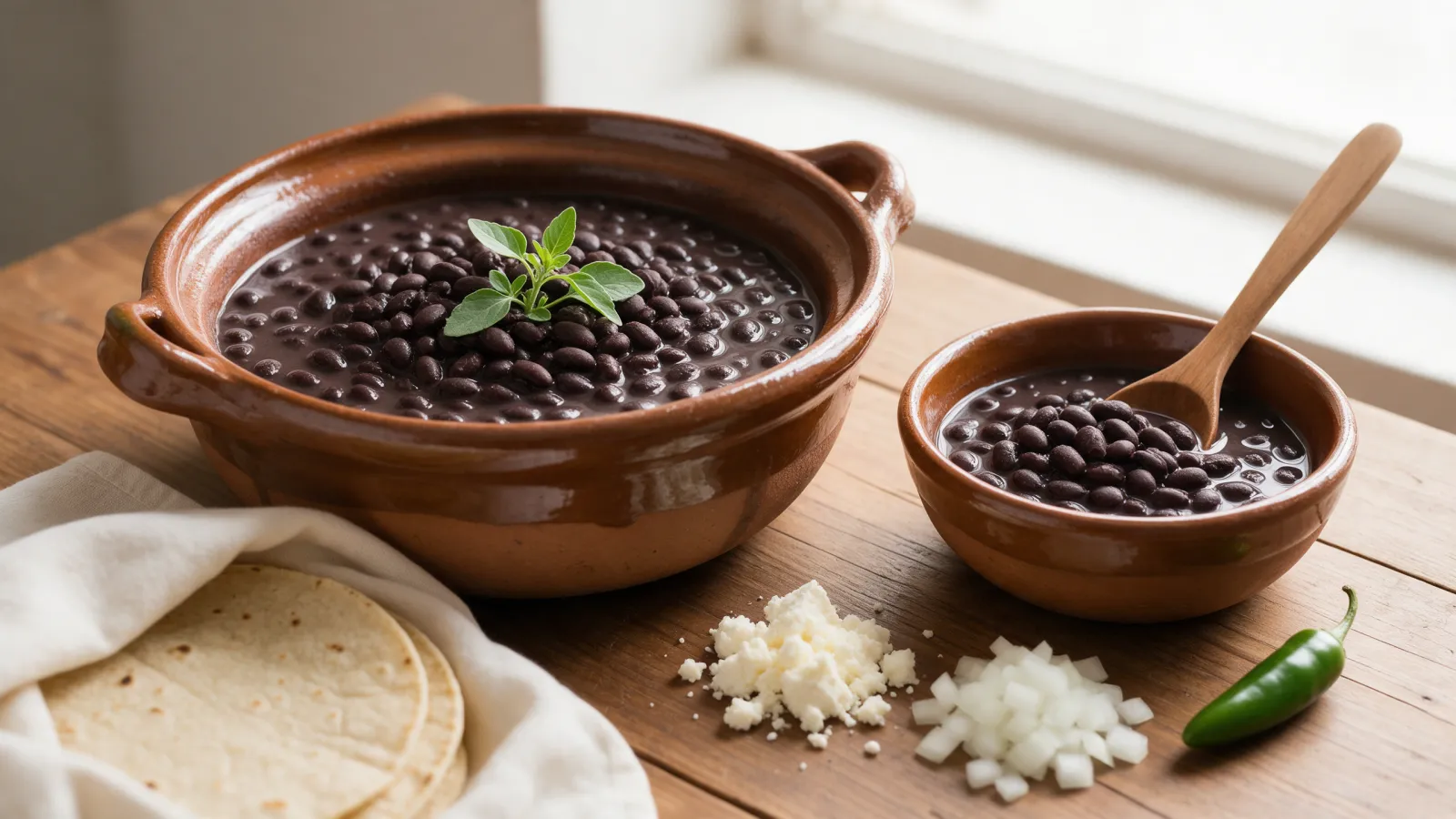

A pound of dried black beans costs about $1.63 at the average US price, and it turns into eight bowls of beans in a broth with real body. That pot is frijoles de la olla (free-HOH-less deh lah OY-yah), “beans from the pot”: dried beans simmered slowly with onion, garlic, a Mexican herb called epazote and salt, and served in their own cooking liquid. In Mexico it’s the everyday base for refried beans, bean sauces and half the side dishes on the table. What follows covers the timing on four kinds of pot, the salt question with the evidence behind it, and what to do when beans refuse to soften.
What are frijoles de la olla, and are they worth making from dried beans?
How do you make frijoles de la olla? Soak 1.1 lb (500 g) of dried black beans overnight, drain, and cover with 10½ cups (2.5 L) of fresh water with half an onion and 2 garlic cloves. Boil hard for 10 minutes, then simmer with the lid ajar for 60 to 90 minutes. Once the beans start to soften, add 2 teaspoons of salt and 2 sprigs of epazote and simmer 20 minutes more. 120 minutes for 8 servings.
They’re worth it if you eat beans more than once a week. One pot gives about 2.5 lb (1.1 kg) of cooked beans plus broth, the equivalent of roughly four 15-oz cans, for about $2.12 in ingredients. Home-cooked beans in their broth also taste of onion and herb in a way canned beans don’t.
Who they’re for. Anyone who batch-cooks on a Sunday, anyone cooking Mexican food that calls for beans on the side, and vegans: the base pot has no animal fat.
Who might skip them. If you need beans tonight in 20 minutes and own no pressure cooker, open a can. And if you cook for one with no freezer space, eight bowls is a lot.
Real time. 2 hours on the stove and about 15 minutes of actual work, after an overnight soak. In an Instant Pot, about an hour from start to finish without soaking.
Honest difficulty, easy. The only thing that can sink the pot is stale beans, and no technique fixes that.
The name points to the pot, traditionally clay, that the beans are still cooked in across much of Mexico, and the usual beans are flor de mayo or bayo, according to El Diario NY. Pot beans are the starting point for Mexican refried beans, mashed and fried in lard, and for frijoles charros, which add bacon, chorizo and tomato.
What you need, and what to swap in a US or UK kitchen
The exact quantities are in the recipe card: 1.1 lb (500 g) of dried beans, 10½ cups (2.5 L) of water, half an onion, 2 garlic cloves, 2 sprigs of epazote and 2 teaspoons of salt. Here’s what each one does and what to use instead.
Beans. Black beans give a dark, earthy broth and are the beans of Veracruz, Oaxaca and southern Mexico. Pinto beans, sold in every US supermarket, give a lighter, creamier pot and are the closest swap for the bayo beans of central Mexico. In the UK, dried black beans are often labeled black turtle beans. Nutritionally they’re near twins: cooked without salt, 132 kcal per 100 g for black and 143 for pinto (USDA).
Epazote. A pungent herb, somewhere between anise and resin, that goes into the bean pot almost everywhere in Mexico. Use 2 fresh sprigs per pound. Rick Bayless prefers it fresh because dried epazote is mostly stems; Pati Jinich uses about a third as much dried as fresh, which is where the 1 teaspoon comes from. In the US, look in Latin grocery stores, fresh or dried; in the UK, dried, online. El Universal suggests cilantro or parsley instead and the Mexican Food Journal suggests Mexican oregano. Neither tastes like epazote. If you can’t find it, leave it out.
Lard, or not. The base recipe has no fat, which is why it’s filed as vegan. Bayless calls lard an essential flavor in Mexican beans; if you agree, 2 tablespoons (25 g) with the onion add about 28 calories per bowl and a rounder broth. Oil keeps it vegan but adds little flavor, so I leave it out.
Water. Hard water slows softening. Colorado State University Extension says to avoid hard water for cooking pulses, and Michigan State explains why: the minerals bind to the skins and toughen them. If your kettle scales up, cook with filtered or bottled water.
Salt. Use 2 teaspoons (12 g) of fine salt. Kosher salt brands vary a lot by volume, so weigh it.
Canned beans instead. A 15-oz (425 g) can holds 1¾ cups of drained beans, according to University of Nebraska-Lincoln Extension, so the equivalent of this pot is about 4 cans. Canned black beans with their liquid carry 384 mg of sodium per 100 g (USDA), so taste before salting.
Equipment. A heavy 6-quart (6-liter) pot with a lid. Sunset’s recipe calls for a 6- to 8-quart pot per pound of beans. For speed, a stovetop pressure cooker or an Instant Pot; for hands-off, a slow cooker of at least 4 quarts.
How to plan it, soaking, salting and timing
2 hours on cooking day, 15 minutes of work, plus an overnight soak if you choose one.
Do you need to soak the beans?
No, but it changes the schedule. Here’s what the sources say:
- Soak. Nebraska Extension recommends 10 cups of water per pound for 8 hours in the fridge, or a hot soak, boiling 2 to 3 minutes and leaving the beans in the water for up to 4 hours, which it calls its preferred method because it gives the most consistently tender beans. Soaking shortens cooking, and draining off the soak water removes some of the compounds behind gas.
- Don’t soak. Bayless, Pati Jinich and El Universal cook their beans straight from dry, and Rancho Gordo, which sells recent-harvest heirloom beans, says its beans don’t need it. Lupe Romero Vidal’s recipe in Sunset adds at least 30 minutes when you skip the soak.
My rule: I soak overnight whenever I remember, because supermarket beans are rarely from the latest harvest and soaked beans cook more evenly. If I forget, I do a 1-hour hot soak. Unsoaked only goes in a pressure cooker. Pati Jinich’s warning is worth keeping: past half a day in the water, beans start to ferment.
When should you salt beans?
“Never salt beans until they’re soft or they’ll stay hard” is old advice, and it still appears in El Universal, in Pati Jinich’s recipe and in a Michigan State newsletter. The tests say otherwise. Colorado State Extension calls it a myth: salt actually shortens cooking time and helps keep beans from bursting. Cook’s Illustrated explains the chemistry for a salted soak, where sodium replaces some of the calcium and magnesium in the skins and lets more water in, and Serious Eats reached the same conclusion in repeated tests.
So why don’t I salt at the start? Because the broth reduces for two hours and it’s easy to overshoot. I salt when the beans start to give, as Rancho Gordo and the Sunset recipe do, and simmer 20 minutes more so it reaches the center. 2 teaspoons (12 g) per 1.1 lb (500 g) matches Sunset (about 2 teaspoons per pound) and Maricruz Avalos (1 tablespoon per 1½ pounds).
Instant Pot, pressure cooker and slow cooker times
- Instant Pot or electric pressure cooker. Nebraska skips the soak here, since soaked beans split and foamed more in testing: black beans 20 to 30 minutes and pinto 15 to 20 at high pressure, then a 20-minute natural release, with about 6 cups of water per pound and the pot no more than half full. Still firm? 10 more minutes at pressure. Instant Pot’s own chart lists shorter times (20 minutes for unsoaked black beans, 10 for pinto); with supermarket beans I go with Nebraska’s.
- Stovetop pressure cooker. Soaked beans take about 25 minutes at pressure, according to Michigan State; unsoaked, 30 to 35 minutes once the valve starts rocking, according to El Universal. Let the pressure drop naturally, then salt and simmer uncovered 5 to 10 minutes with the epazote.
- Slow cooker. Soak, boil hard on the stove for 10 minutes, then cook 6 to 8 hours, as Michigan State directs. Don’t skip the boil. Raw beans contain phytohaemagglutinin, a lectin that Hong Kong’s Centre for Food Safety found still active after an hour at 185°F (85°C); it advises against cooking raw beans at low temperature without a vigorous boil at 212°F (100°C) first. Red kidney beans carry by far the most, but the boil costs 10 minutes.
How to tell they’re done
- The simmer → small bubbles rising slowly. A rolling boil bursts and peels the beans.
- The water → always ¾ to 1 inch (2 to 3 cm) over the beans. Exposed beans wrinkle and stay hard on top.
- Time to salt → bite a bean: the skin still resists, the middle is creamy. With soaked black beans that usually happens between 60 and 80 minutes of simmering.
- Done → 3 beans collapse between your fingers with no chalky center, and the broth looks cloudy and slightly thick, not clear.
- Thin broth at the end → mash a cup of beans against the side of the pot and simmer 5 minutes uncovered.
Make ahead and scale for 4 to 20
Pot beans are better the next day, once the broth sets and the flavor settles. Plan on 1 cup per person, about 5 oz (140 g) of cooked beans with broth, from 2.2 oz (62 g) of dried beans. Nebraska puts a pound of dried beans at about 6 cups cooked.
| People | Dried beans | Cooking water | Onion | Garlic | Epazote | Salt | Pot |
|---|---|---|---|---|---|---|---|
| 4 | 250 g (9 oz) | 1.5 L (6⅓ cups) | 60 g (2 oz) | 1 clove | 1 sprig | 1 tsp (6 g) | 4 qt |
| 8 | 500 g (1.1 lb) | 2.5 L (10½ cups) | 120 g (4 oz) | 2 cloves | 2 sprigs | 2 tsp (12 g) | 6 qt |
| 12 | 750 g (1.65 lb) | 3.5 L (15 cups) | 180 g (6 oz) | 3 cloves | 3 sprigs | 3 tsp (18 g) | 8 qt |
| 20 | 1.25 kg (2.75 lb) | 5.5 L (23 cups) | 300 g (10½ oz) | 5 cloves | 5 sprigs | 5 tsp (30 g) | 12 qt, or two pots |
Water doesn’t scale exactly with the beans, because a big pot loses proportionally less to evaporation: keep it 2 inches (5 cm) over the beans. Cooking time barely changes, but a 12-quart pot takes longer to come to a boil. A pressure cooker should never be more than half full.
Before you start, why beans stay hard and the gas question
The one thing that matters most is the beans themselves. Michigan State names three factors behind cooking time, the age of the beans, the altitude and the hardness of the water, and notes that old beans never cook to a soft, creamy texture even though they haven’t spoiled.
- Old beans → Michigan State says to use your supply within a year and avoid bags with chipped beans or powdery dust; Rancho Gordo gives its own beans about 2 years. If they’re still hard after 3 hours, no pot will save them. Buy from a store with high turnover.
- Hard water → a salted soak. Michigan State’s ratio is 3 tablespoons of salt in 4 quarts of water per pound of beans for 8 hours, then drain, rinse and cook in fresh water.
- Acid too early → tomatoes, vinegar or wine added before the beans are tender keep them from softening fully, according to both Michigan State and Nebraska.
- Baking soda → Michigan State allows no more than ⅛ teaspoon per pound; Nebraska advises against it because it destroys thiamin (vitamin B1) and can give an off flavor. I’d rather do the salted soak.
- Altitude → water boils at a lower temperature up high, so beans take longer. Colorado State’s rule is 5% more time for every 1,000 feet above 2,000 feet.
Do beans cause gas, and does epazote help?
Less than people fear. Arizona State University researchers Winham and Hutchins pooled three feeding studies in Nutrition Journal. Adults ate half a cup of beans daily for two to three months, and fewer than half of the pinto-bean eaters noticed extra gas in week one. Even on bean-free control diets, 3 to 11% reported more gas. People vary a lot.
Soaking and discarding the soak water helps, according to Nebraska, especially the hot soak. Epazote’s reputation as an anti-gas herb is traditional; I found no human trial showing it works. A study in the Journal of Ethnobiology did find that beans cooked with epazote spoiled more slowly, which is a different benefit. I add it for flavor.
Heat level, 0 out of 5. The chile goes on the table.
Kid-friendly? Very. For little ones I mash a few beans with broth.
Allergens. None of the major ones: no gluten, dairy, eggs, nuts or soy. With lard it’s no longer vegan.
Which version to make
- Short on time → Instant Pot, unsoaked, about an hour door to door. Tonight in 20 minutes means canned: 4 cans for 8 bowls, heated with onion and garlic.
- No pressure cooker → the stovetop pot with an overnight soak, exactly as written.
- For a crowd → follow the scaling table; to hold on a buffet, keep the pot covered on low above 140°F (60°C), the USDA FSIS rule for hot food.
- More flavor → 2 tablespoons of lard at the start, or a dried chile in the pot. Bayless has a version with chile de árbol, and Sunset published one from Bacanora in Phoenix with charred habaneros and Mexican oregano.
- Lower sodium → 1 teaspoon of salt instead of 2 brings a bowl to about 295 mg.
- The next step → blend them with their broth and a chipotle for enfrijoladas, or mash and fry them for refritos.
- Cousins from other countries → Venezuela’s caraotas negras add a sweet pepper sofrito and a little panela, and Colombian red beans use cranberry beans with green plantain and pork.
What a pot of frijoles de la olla costs
Using the BLS average US price for dried beans in August 2026, $1.630 per pound, 1.1 lb (500 g) costs $1.80. Half a large white onion, at the $1.22 per pound in the USDA AMS retail report of October 9, 2026, adds $0.32. That’s about $2.12 for 8 bowls, or 27 cents each, before the garlic, epazote and salt.
In Mexico, at the wholesale prices the SNIIM recorded at the Central de Abasto in Mexico City in October 2026, the same pot costs about 13.70 pesos with black beans (18 pesos per kg) and 16.70 with pinto (24 pesos per kg).
What drives the cost. The beans, about 85% of the US total. Small supermarket bags can cost twice the average per pound, so the bulk bin pays off. I couldn’t find an official UK price for dried black beans that I could check, so I’m not giving one.
Real yield. 8 one-cup bowls, or 16 half-cup sides.
What to expect, serving, storing and reheating
Flavor and texture. Whole beans, tender to the center, in a cloudy, slightly thick broth that tastes of beans and onion with epazote’s faint anise. Black beans taste deeper; pinto, milder and creamier.
How they’re served. In a bowl with plenty of broth, with chopped onion, cilantro, serrano chile, crumbled queso fresco and warm tortillas on the table. As a side, next to Mexican red rice, or beside huevos rancheros at breakfast. With their broth they also sit well next to a saucy stew like pork in salsa verde.
Fridge. USDA FSIS limits for leftovers: no more than 2 hours at room temperature and 3 to 4 days at 40°F (4°C) or below. Nebraska gives the same 3 to 4 days and recommends shallow containers so the beans cool fast.
Freezer. Freeze them in their broth, which protects the beans. FSIS gives 3 to 4 months for best quality, and Nebraska says to freeze within 4 days of cooking. I freeze flat bags of 2 cups, onion and epazote removed.
Reheating. Over low heat with a splash of water, stirring, until they simmer and reach 165°F (74°C) in the center, per FSIS. Thaw frozen beans overnight in the fridge first. If the broth set too thick, add hot water 2 tablespoons at a time.
Frijoles de la olla FAQ
Do you have to soak beans before cooking? No. Skipping it costs at least half an hour of extra simmering on the stove, while an overnight soak gives faster, more even cooking. In an Instant Pot, don’t soak at all.
When should you add salt to beans? It can go in from the start without toughening them, according to Colorado State Extension. I add it when the beans begin to soften so I don’t oversalt as the broth reduces.
Why are my beans still hard after hours of cooking? Usually old beans, hard water, an acid such as tomato added too early, or high altitude. Beans more than a year old may never turn creamy.
How long do dried black beans take in an Instant Pot? 20 to 30 minutes at high pressure without soaking, plus a 20-minute natural release, according to Nebraska Extension.
Can you cook dried beans in a slow cooker? Yes, after soaking and a 10-minute hard boil on the stove. Then 6 to 8 hours.
How many cooked beans does a pound of dried beans make? About 6 cups cooked, according to Nebraska Extension, roughly the same as four 15-oz cans.
What can I use instead of epazote? Mexican oregano, cilantro or parsley. None tastes the same, and leaving it out is fine.
Does epazote prevent gas? That’s the traditional belief, but there’s no human trial behind it. Soaking and discarding the soak water does help.
Can you freeze frijoles de la olla? Yes. Freeze them covered in broth and use within 3 to 4 months for best quality. Thaw in the fridge and reheat until simmering.
What’s the difference between frijoles de la olla and refried beans? Pot beans are whole beans in their broth. Refried beans are those same beans mashed and fried, usually in lard.
Nutrition per serving
Per serving (1 cup, about 5 oz or 140 g of cooked beans with broth, one of 8), calculated ingredient by ingredient from USDA FoodData Central (SR Legacy) using raw black beans and this recipe’s quantities, without lard:
- Calories: 220 kcal
- Protein: 14 g
- Carbohydrates: 41 g
- Fat: 1 g, of which 0 g saturated
- Fiber: 10 g
- Sugars: 2 g
- Sodium: 585 mg
The 10 g of fiber is 36% of the FDA’s 28 g daily value. Unsalted cooked black beans have almost no sodium (1 mg per 3.5 oz), so nearly all of it comes from the salt you add. Adding 2 tablespoons of lard raises a bowl to about 249 kcal and 4 g of fat; swapping in pinto beans adds only about 4 kcal.
I grew up in Venezuela with black beans that always got a sweet pepper sofrito and a piece of panela at the end, so the first time I made Mexican pot beans with nothing but onion, garlic, epazote and salt, I was sure they’d taste flat. They didn’t. The broth carries the flavor, and nobody in my house lets me pour it out anymore. Now a Sunday pot covers the week, and the Wednesday refried beans go next to Colombian cheese arepas. Whole beans, their broth and a little patience. Josnaisis.