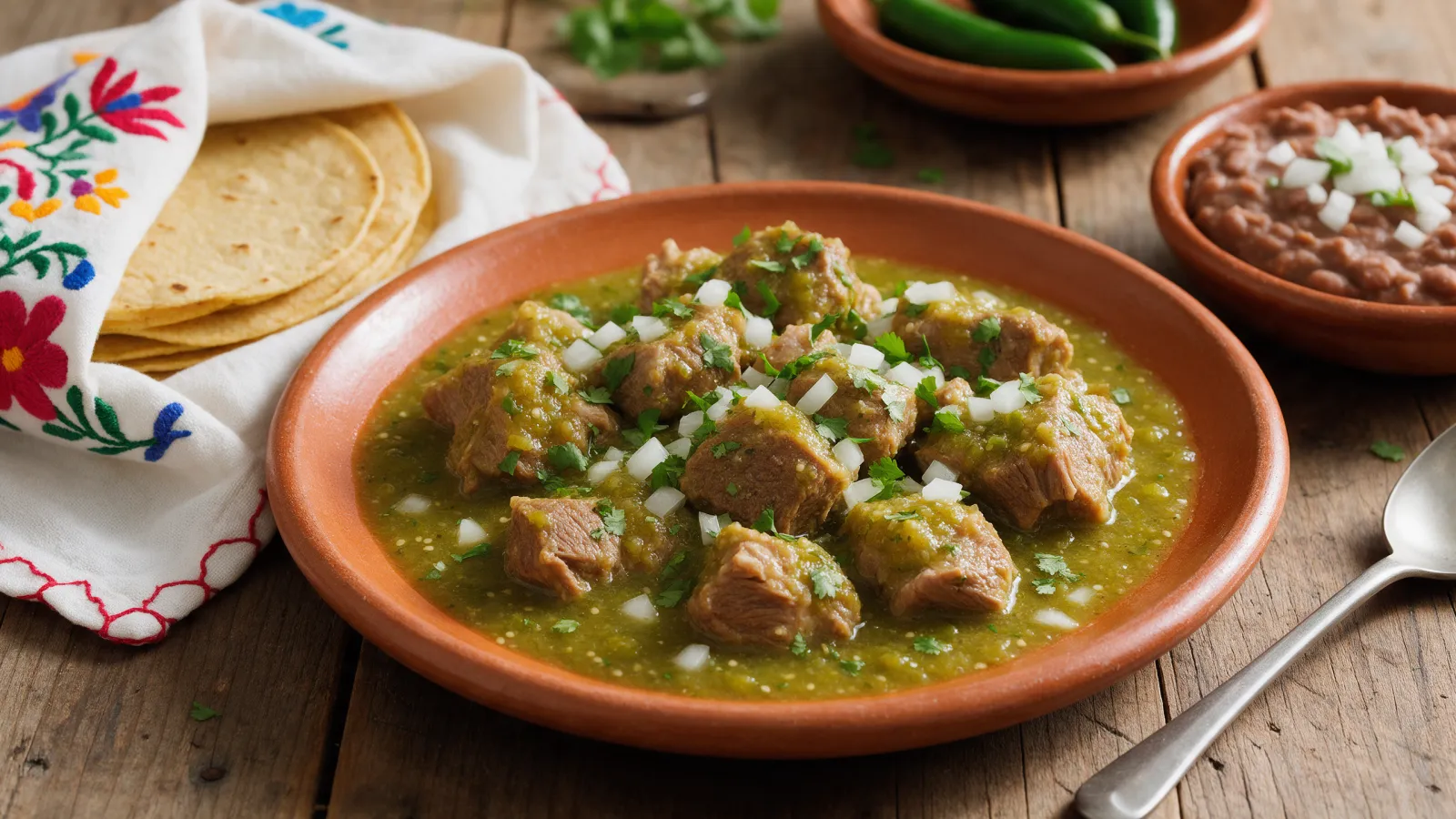

Carne de puerco en salsa verde (KAR-neh deh PWEHR-koh en SAHL-sah VEHR-deh) is a weekday stew from Mexican home kitchens: chunks of pork, browned and simmered until spoon-soft, in a tart sauce of tomatillos, serrano chile, onion, garlic and cilantro, often with potatoes or purslane in the pot. If you know pork chile verde from restaurants in California or New Mexico, you’re close. Those versions usually build their green on roasted long green chiles such as Hatch, Anaheim or poblano; this one takes its color and its tang from tomatillos, and the chile is there for heat.
What is pork in salsa verde, and is it worth two hours?
How do you make pork in salsa verde? Brown cubed pork shoulder in batches, then simmer it covered for 45 minutes in 3 cups (750 ml) of water with onion, garlic and a bay leaf. Meanwhile char tomatillos, serranos, onion and garlic and blend them with cilantro. Fry the sauce for 5 minutes, add it to the pork with cubed potatoes and simmer 30 minutes more, until the pork breaks under a spoon. Ready in 120 minutes for 6 servings.
Yes, if you want a pot that feeds six and tastes better on day two. The work is about an hour out of two, most of it at the start, and the ingredients come to roughly $14.30 at average US prices, or $2.38 a plate. Nothing here needs an oven or a specialty store in the US.
Where it fits. A Sunday cook that covers lunches through Wednesday, a big pot for a crowd next to rice and beans, or a taco filling: the leftovers shred straight into their sauce.
When to skip it. If you need dinner in half an hour, because stewing pork has no honest shortcut (a pressure cooker saves less than you’d think, more on that below). If someone at your table dislikes sour food, since tomatillos stay tangy however you balance them. And if you want something lean: the fat in pork shoulder is what keeps it juicy.
Honest difficulty, medium. Nothing is technically hard. What goes wrong is buying the wrong cut and taking the pot off the heat too early. Get those two right and it works the first time.
Related dishes on this site. A Mexican salsa verde is the sauce on its own, for the table or for cooking. Chicken in salsa verde uses almost the same sauce, but bone-in chicken is done in 30 minutes, so there the sauce simmers with the meat from the start; with pork it would spend an hour and a half on the heat.
The cut decides everything
Buy pork shoulder. In the US that’s the Boston butt (sometimes just “pork butt”), sold bone-in or boneless; in the UK it’s simply pork shoulder, often sold diced. Shoulder has marbling and connective tissue, and both are the point: the tissue melts into gelatin during a long simmer, and the fat keeps the meat moist when you reheat it. A chef quoted by Tasting Table, Marc Marrone of Arriba Abajo in Austin, names shoulder or the shoulder’s lean “cushion” as his pick for chile verde, and Mexican recipes I checked use shoulder, ribs or backbone (espinazo) between them.
Bone-in is more flavor, less meat. Country-style ribs, spareribs or neck bones give a deeper sauce, but you need about 1.8 kg (4 lb) to get the same amount of meat as 1.2 kg (2.65 lb) boneless shoulder, and they need 60 minutes in water instead of 45. A Mexican butcher in the US will know espinazo (backbone) by name. In the UK, ask a butcher for pork bones with meat on them, and watch the labels: British “spare rib” chops and joints are cut from the shoulder, which is good news here.
Skip the loin, and never use tenderloin. Loin is lean, done in 35 to 40 minutes and dry by 75. If loin is all you have, simmer the cubes in the finished sauce until they reach 145°F (63°C) and take the pot off the heat. Tenderloin (pork fillet in the UK) is even leaner; save it for the grill.
Safe at 145°F, tender only at a spoon
The USDA Food Safety and Inspection Service sets 145°F (63°C) plus a 3-minute rest as the safe minimum for whole cuts of fresh pork. A 1½-inch cube of shoulder gets there within minutes of simmering, and at that point it is chewy. Tenderness is a separate clock: ThermoWorks puts the start of collagen breakdown around 170°F (77°C), and Christina Blais’s braising guide at Ricardo Cuisine says a braise should sit just under the boil, 185 to 195°F (85 to 90°C), for long enough that the collagen softens. In this pot that’s about 75 minutes for boneless shoulder.
So use the thermometer for safety and the spoon for doneness. When a cube splits under the edge of a spoon with light pressure, it’s ready.
Tomatillos, chiles and potatoes, with US and UK swaps
Tomatillos are not green tomatoes. They’re Physalis philadelphica, firm and tart, each wrapped in a papery husk. US supermarkets sell them loose in the produce section, at about $0.99 a pound in the USDA’s weekly retail report for October 9, 2026; pick firm ones that fill their husks and are just turning yellowish, since very green ones taste more bitter. In the UK, whole tinned tomatillos are the realistic route: La Costeña’s 794 g (28 oz) tin was about £3.95 at Ocado in October 2026 and holds roughly 550 g of fruit. Tinned tomatillos are already cooked, so don’t char them; drain and blend, and start with 1½ tsp salt rather than 2, because the tin’s citric acid makes the sauce sharper.
Chiles. Serranos measure 10,000 to 23,000 Scoville heat units and jalapeños 2,500 to 5,000, according to the University of Arizona Cooperative Extension. Three serranos make a medium-hot stew; two jalapeños, a mild one.
| What the recipe uses | US option | UK option | What changes |
|---|---|---|---|
| Fresh tomatillos, 700 g (1.5 lb) | produce aisle | two 794 g (28 oz) tins, drained | tinned is softer and tarter, so use 1½ tsp salt |
| Homemade sauce | jarred salsa verde, about 700 ml (3 cups) | same, from Mexican food shops | thinner and saltier; halve the salt and fry it 5 minutes |
| Serranos | jalapeños | green finger chillies | jalapeño is milder |
| Pork shoulder (Boston butt) | country-style ribs | diced pork shoulder | ribs need 15 minutes more |
| Yukon Gold potatoes | red potatoes | Charlotte, Maris Peer | floury russets or Maris Pipers break up |
| Cilantro | cilantro | fresh coriander | same herb |
Equipment. A heavy 5-quart (5-liter) Dutch oven with a lid, a cast-iron skillet or the broiler, a second pan for frying the sauce, and a blender. An instant-read thermometer is useful but optional.
Your two-hour game plan, make-ahead and scaling
120 minutes on the clock, about 60 of them hands-on. Brown the pork first because it sets the pace; the whole sauce gets made inside the 45 minutes the pork simmers unattended.
Make-ahead. Cook the whole stew a day early. It tastes rounder on day two, and the fat sets on top in the fridge so you can lift it off with a spoon. Or blend the sauce the day before (it keeps in a jar in the fridge) and cube and salt the pork; that leaves about 90 minutes on the day.
Scaling for a crowd. Double everything except the water and salt. For 12, start with 1.25 liters (5 cups) of water and 3½ tsp salt and adjust at the end. Use an 8 to 10-quart pot, brown in 5 or 6 batches (about 30 minutes) and allow 15 extra minutes of simmering, because a full pot is slow to come back to a bubble. Plan on about 2½ hours.
| Servings | Boneless shoulder | Tomatillos | Serranos | Potatoes | Water | Salt |
|---|---|---|---|---|---|---|
| 3 | 600 g (1.3 lb) | 350 g (12 oz) | 1-2 | 300 g (10 oz) | 400 ml (1⅔ cups) | 1 tsp |
| 6 | 1.2 kg (2.65 lb) | 700 g (1.5 lb) | 3 | 600 g (1.3 lb) | 750 ml (3 cups) | 2 tsp |
| 12 | 2.4 kg (5.3 lb) | 1.4 kg (3 lb) | 5-6 | 1.2 kg (2.6 lb) | 1.25 l (5 cups) | 3½-4 tsp |
| 20 | 4 kg (8.8 lb) | 2.3 kg (5 lb) | 8-10 | 2 kg (4.4 lb) | 2 l (8½ cups) | 6 tsp, to taste |
Signs it’s on track. Each batch of pork releases from the pot on its own after 4 to 5 minutes with a brown crust. The simmer shows small, lazy bubbles; a rolling boil tightens the meat. Charred tomatillos are blotched black in places and collapse when pressed, and the garlic should be golden, not black. The fried sauce darkens a shade in 5 minutes and stops smelling raw. The potatoes are tender after 30 minutes.
Keeping the sauce from turning bitter or sour
Bitter comes from four places: the sticky resin on the tomatillo skins (rub it off under the tap), very unripe tomatillos (choose ones turning yellowish), garlic charred black (pull it at 5 minutes) and over-blending (30 seconds is enough; more whips in air and turns the sauce pale and foamy).
Sour is built in, so the goal is balance. Charring rather than boiling gives a sweeter, less acidic sauce, a fix Mexico’s Grupo Animal recommends for sour salsa verde. Frying the purée for 5 minutes in pork fat takes off the raw edge. Then the potato starch and the pork fat round it out over 30 minutes, which is why you taste at the end, not straight from the blender. Only if it’s still sharp after that, add ½ tsp sugar to the pot or a pinch of baking soda (under ⅛ tsp), never both; too much soda tastes soapy.
Pressure cooker, Instant Pot or slow cooker
With boneless shoulder, pressure saves only about 15 minutes overall, because the potatoes and sauce still need their own time afterward. It pays off with bone-in cuts.
| Method | Pork | Then | Total |
|---|---|---|---|
| Stovetop pot | 45 min covered in water (60 bone-in) | 30 min with sauce and potatoes | about 2 hours |
| Stovetop pressure cooker (15 psi) | 20 min at pressure (25 bone-in), 10 min natural release | 25 min uncovered with sauce and potatoes | about 1 hour 45 |
| Instant Pot | 25 min High Pressure with 1 cup (250 ml) water, 15 min natural release | 20 min on Sauté with sauce and 1 in (2.5 cm) potatoes | about 1 hour 50 |
| Slow cooker | 7 to 8 hours on LOW or 4 on HIGH, everything together, potatoes on the bottom | none | 8 to 9 hours |
Where the numbers come from: the Instant Pot time is Mamá Maggie’s Kitchen’s (25 minutes High Pressure, natural release), and her slow cooker range is 6 to 8 hours on low or 4 on high, in line with the 6 to 8 hours Ricardo Cuisine gives for collagen to soften at slow-cooker temperatures. For a stovetop cooker at 15 psi, I chose 20 minutes between the 15 a RecipeLion stew gives for 1-inch pork cubes and the 45 in Presto’s own recipe for 3-inch shoulder pieces. For the slow cooker, the USDA advises thawing the meat first and filling the crock between half and two-thirds full; brown the pork in a skillet first for flavor, and expect a darker sauce.
Versions worth knowing
- With purslane (verdolagas) → replace half the potatoes with 500 g (1 lb) of trimmed purslane, thick stems removed, for the last 8 minutes, covered. Rick Bayless gives it 5 to 7 minutes in his pork and purslane tacos. Purslane is a succulent with a slightly sour, salty taste and a mucilaginous texture that thickens the stew. In the US, look for it at Mexican grocers and farmers’ markets; in the UK it is worth asking at Turkish or Greek grocers, since it’s eaten in both cuisines (semizotu, glistrida). Baby spinach stirred in for the last 2 minutes is a stand-in, without the tang.
- With ribs or backbone → 1.8 kg (4 lb) bone-in, 60 minutes in water and 30 with the sauce. Deeper flavor, more bones on the plate.
- With nopales or zucchini → cooked nopales for the last 10 minutes, or zucchini half-moons in place of the potatoes.
- With jarred salsa verde → about 700 ml (3 cups), fried 5 minutes, salt halved. Thinner and saltier, but it works on a weeknight.
- Lighter → trim the visible fat, skip the potatoes (about 466 kcal a serving) and use 1½ tsp salt, which brings sodium to about 725 mg.
What it costs
At US average prices the pot comes to about $14.30, or $2.38 a serving. Pork is priced with the Bureau of Labor Statistics August 2026 average for “other pork” (roasts, steaks and ribs that aren’t chops or ham), $3.74 a pound; potatoes with the BLS average of $0.98 a pound; tomatillos, onion, garlic, cilantro and chiles with the USDA AMS weekly retail report of October 9, 2026 (serranos aren’t listed, so they’re priced as jalapeños).
Yield. Six bowls of about 500 g (1 lb) with pork, potatoes and sauce; with rice, beans and tortillas, eight light eaters. What drives the price is the pork, 69% of the total. Oil, salt and the bay leaf aren’t counted. I couldn’t find an official UK price for diced pork shoulder, so there’s no sterling total.
How to serve it, store it and reheat it
What it tastes like. An olive-green, smooth sauce with a charred edge, tangy but rounded, with the serrano heat arriving last. The pork shreds under a fork; the potatoes hold their shape outside and soak up sauce inside.
Serving. In wide bowls with plenty of sauce and warm corn tortillas. Alongside, Mexican red rice, or poblano and cilantro green rice for an all-green plate, and a bowl of frijoles de la olla with their broth, or refried beans for a full plate. Chopped onion, crema and crumbled queso fresco go on the table. Shredded leftovers make tacos, though they taste nothing like carnitas tacos: carnitas are cooked slowly in lard, this pork is simmered in sauce.
Fridge. Per USDA FSIS, no more than 2 hours at room temperature, then 3 to 4 days at 40°F (4°C) or below. Split it into shallow containers, under 3 in (7.5 cm) deep, so it cools fast.
Freezer. 2 to 3 months for best quality, the FoodSafety.gov guideline for soups and stews with meat. Freeze it without the potatoes (they turn grainy and weep) and without purslane. Pork and sauce freeze very well; simmer fresh potatoes in the sauce for 30 minutes when you reheat.
Reheating. Thaw in the fridge, not on the counter. Warm it covered over low heat with 60 ml (¼ cup) water per 2 servings, stirring, until it simmers gently and reaches 165°F (74°C), the FSIS target for leftovers. In the microwave, covered, in 1-minute bursts.
Pork in salsa verde FAQ
What’s the difference between pork chile verde and pork in salsa verde? They overlap. US chile verde is usually built on roasted long green chiles (Hatch, Anaheim, poblano) with tomatillos; the Mexican home version gets its green and tang from tomatillos, with serrano or jalapeño for heat.
What is the best cut of pork for salsa verde? Pork shoulder (Boston butt). Country-style ribs, spareribs and backbone also work and need 15 minutes longer. Loin dries out; tenderloin is wrong for a stew.
Why is my pork still tough? It was taken off the heat too early. Shoulder is safe at 145°F (63°C) within minutes but needs about 75 minutes at a gentle simmer to turn tender.
Do I have to brown the pork first? No, many Mexican cooks simply simmer it, but browning in batches adds a roasted flavor plain boiled pork lacks. It’s 15 minutes well spent.
Can I use jarred salsa verde? Yes, about 700 ml (3 cups). Fry it for 5 minutes and halve the salt, because it is saltier than homemade.
How long in the Instant Pot? 25 minutes at High Pressure plus 15 minutes natural release, then 20 minutes on Sauté with the sauce and potatoes.
Is it spicy? Medium with 3 serranos, about 2 out of 5. Use 2 jalapeños for mild, or blend the chiles into only part of the sauce.
Can you freeze pork in salsa verde? Yes. Take out the potatoes, then freeze it for up to 3 months and reheat to 165°F (74°C).
Nutrition per serving
Per serving (about 500 g / 1 lb, without tortillas, rice or crema), worked out ingredient by ingredient from USDA FoodData Central (SR Legacy) using this recipe’s quantities, with 1.2 kg (2.65 lb) raw Boston butt including its fat, water rather than stock, and the full 2 tsp salt:
- Calories: 535 kcal
- Protein: 38 g
- Carbohydrates: 26 g
- Fat: 31 g, of which 9 g saturated
- Fiber: 5 g
- Sugars: 7 g
- Sodium: 920 mg
Nearly all the fat is the shoulder’s own; skimming the layer that sets in the fridge lowers it, by an amount that depends on the piece. The salt you add accounts for about 84% of the sodium, so cutting it to 1½ tsp brings each serving to about 725 mg. Purslane barely moves the numbers, roughly 17 kcal a serving.
Pork at home in Venezuela meant a December pernil, and in Colombia, where the festive pork is a whole roasted lechona, I buy shoulder by the cut the butchers call brazo. Neither prepared me for this stew, and the first time I pulled it after 40 minutes because it was “cooked.” Now the pork gets its full hour in plain water while I blend the sauce from a tin of tomatillos, and I wait for the spoon test. Tender is a matter of time, not temperature. Josnaisis.