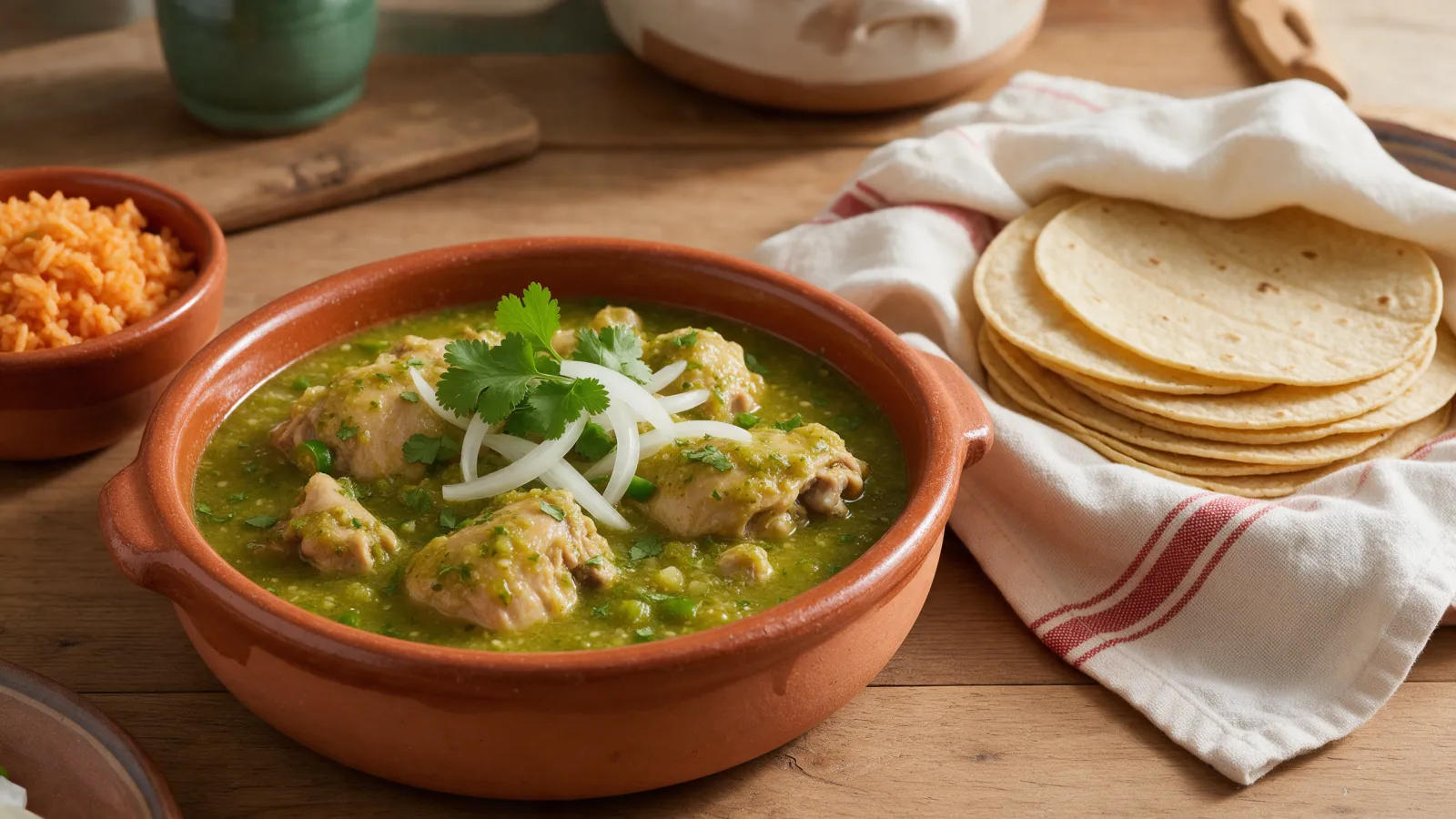

Pollo en salsa verde (POH-yoh en SAHL-sah VEHR-deh) is what a lot of Mexican families eat on an ordinary Tuesday: bone-in chicken pieces simmered in a sauce of tomatillos, green chile and cilantro, often with potatoes or zucchini cooked right in the pot, eaten with corn tortillas. It’s tangy rather than creamy and hot only as far as you want it to be. If you’ve seen “chicken chile verde” on a US menu, that’s a close cousin; the restaurant version often leans on roasted green chiles such as poblano or Anaheim, while this one gets its color and sourness from tomatillos.
What is chicken in salsa verde, and is it worth making?
How do you make chicken in salsa verde? Boil tomatillos and serrano chiles for 8 to 10 minutes until olive green, then blend them with onion, garlic, cilantro and salt. Brown bone-in chicken thighs and drumsticks, fry the sauce in the drippings for 5 minutes, add stock, and simmer the chicken covered for 30 minutes with cubed potatoes added after 5. Ready in 65 minutes for 6 servings.
It’s worth it if you cook for a family or like a pot that lasts three days. The whole thing runs 65 minutes, about 40 of them hands-on, uses one pan plus a pot for the tomatillos, and costs around $9.60 for 6 generous plates at average US prices. It reheats better than it tastes on day one.
Where it fits. A weeknight dinner you can start at 6 and serve at 7:05, a make-ahead lunch for the week, or a big pot for 12 with rice and beans on the side. Leftover meat, shredded into the sauce, makes excellent tacos.
When to skip it. If anyone at your table dislikes sour flavors, because tomatillos are tart even when balanced. If you need dinner in 20 minutes, unless you go with boneless cubes (see the versions below). And if you’re in the UK without access to tinned tomatillos, since unripe green tomatoes make a different stew.
Honest difficulty, easy. Two moments decide the dish: how long the tomatillos boil, and frying the sauce before the stock goes in. Get those right and it works the first time.
Related dishes on this site. A Mexican salsa verde is the sauce on its own, for the table or for cooking. Green chicken enchiladas and chilaquiles verdes put a similar sauce over tortillas, and pozole verde is a hominy soup thickened with pumpkin seeds. This one is a stew: whole pieces of chicken, on the bone, in the sauce.
What you need, and what to buy in the US or UK
The recipe card has exact amounts: 1.5 kg (3.3 lb) bone-in chicken, 700 g (1.5 lb) tomatillos, 3 serranos, 500 g (1.1 lb) potatoes and 375 ml (1½ cups) stock for 6. Three choices matter.
The chicken. Use bone-in, skinless thighs and drumsticks. Dark meat stays juicy through 30 minutes of simmering and a round of reheating, and the bones give the sauce body. I pull the skin off before browning, because skin that simmers in sauce goes rubbery and leaves a layer of fat on top. Breast works, but needs less time (more on that below).
The tomatillos. A tomatillo is not a green tomato. It’s Physalis philadelphica, a tart, firm fruit that grows inside a papery husk. In the US they sit loose in the produce aisle of most supermarkets; pick firm ones that fill their husks. In the UK they’re rare fresh, so tinned whole tomatillos are the realistic route: La Costeña’s 794 g (28 oz) tin was about £3.95 at Ocado in October 2026, and each holds roughly 550 g of drained fruit. Tinned tomatillos are already cooked, so skip the boiling step and blend them straight.
The chiles. Serranos run 10,000 to 23,000 Scoville heat units and jalapeños 2,500 to 5,000, according to the University of Arizona Cooperative Extension. Three serranos give a medium heat; two jalapeños give a mild one. In the UK, green finger chillies are a fair stand-in for serranos.
| What the recipe uses | US option | UK option | What changes |
|---|---|---|---|
| Fresh tomatillos, 700 g (1.5 lb) | produce aisle | two 794 g (28 oz) tins, drained | tinned is softer and more sour (citric acid), so cut the salt to 1½ tsp |
| Homemade sauce | jarred salsa verde, 700 ml (3 cups) | same, from Mexican food shops | thinner and saltier, so halve the salt and fry it 5 minutes |
| Serranos | 2 jalapeños | green finger chillies | jalapeño is milder |
| Yukon Gold potatoes | red potatoes | Charlotte, Maris Peer | floury russets or Maris Pipers fall apart sooner |
| Cilantro | cilantro | fresh coriander | same herb, different name |
Equipment. A wide 5-liter (5-quart) pan with a lid, a saucepan, a blender and, ideally, an instant-read thermometer. No thermometer? Pierce a thigh next to the bone: the juice should run clear with no pink. No blender? An immersion blender in a tall jug works fine.
Stovetop, slow cooker or Instant Pot
The stovetop method in the recipe card gives the deepest flavor and the thickest sauce, because the sauce fries and then reduces. The other two trade some of that for convenience.
Slow cooker. Brown the chicken in a skillet if you have 10 minutes (it adds flavor, not safety). Put the potatoes in 4 cm (1½ in) chunks on the bottom, the chicken on top, then the fried sauce with 250 ml (1 cup) of stock. Cook 6 hours on LOW or 3 on HIGH. USDA FSIS advice for slow cookers: thaw the chicken first, and fill the crock between half and two thirds. Finish with 10 minutes uncovered on HIGH to thicken.
Instant Pot or pressure cooker. Brown on Sauté, fry the sauce, then deglaze with 125 ml (½ cup) stock, scraping hard so you don’t trigger the burn warning. Add the chicken and potatoes in 4 cm (1½ in) chunks. 15 minutes at high pressure, 10 minutes natural release, about 50 minutes in all. The sauce comes out thin; reduce it 5 minutes on Sauté.
How to plan it, make it ahead and scale it for a crowd
The order that saves time. Brown the chicken while the tomatillos boil. Blend. Fry the sauce. Chicken back in, potatoes 5 minutes later. Chop the remaining cilantro while it simmers.
Make ahead. The blended sauce keeps in a jar in the fridge for 3 to 4 days; it sets almost like jelly when cold (tomatillos are rich in pectin) and loosens again as soon as it’s heated. Peeled, cubed potatoes keep covered in water in the fridge overnight. With both ready, dinner is 45 minutes. You can also cook the whole stew the day before; I think it’s better on day two, when the potatoes have soaked up the sauce.
Scaling. Multiply everything except the salt, which you add gradually and taste at the end. For 12, use an 8-liter (8-quart) pot or two pans, brown the chicken in 4 batches so it sears instead of steams (about 15 extra minutes), and allow 35 to 40 minutes of simmering, since a full pot takes longer to come back to a bubble. Total: about 90 minutes.
| Servings | Bone-in chicken | Tomatillos | Serranos | Potatoes | Stock | Salt |
|---|---|---|---|---|---|---|
| 3 | 750 g (1.65 lb) | 350 g (12 oz) | 1-2 | 250 g (9 oz) | 190 ml (¾ cup) | 1 tsp |
| 6 | 1.5 kg (3.3 lb) | 700 g (1.5 lb) | 3 | 500 g (1.1 lb) | 375 ml (1½ cups) | 2 tsp |
| 12 | 3 kg (6.6 lb) | 1.4 kg (3 lb) | 5-6 | 1 kg (2.2 lb) | 750 ml (3 cups) | 3½-4 tsp |
| 20 | 5 kg (11 lb) | 2.3 kg (5 lb) | 8-10 | 1.7 kg (3.7 lb) | 1.25 l (5 cups) | 6 tsp, to taste |
Signs it’s going right.
- Tomatillos turn from bright to olive green in 8 to 10 minutes and give when pressed with a spoon, still whole.
- Chicken releases from the pan by itself after 5 to 6 minutes per side. If it sticks, it isn’t ready to turn.
- Fried sauce darkens a shade in 5 minutes, stops smelling raw, and a spoon dragged through it leaves a trail.
- The simmer is a lazy bubble. A hard boil breaks the potatoes and scorches the bottom.
Why it can taste sour, and other things to know first
Balancing the acidity. Tomatillos are naturally tart, and the stew tastes sourer if they split while boiling, if there are too many of them, or if the sauce goes into the pot raw. In order of what helps most:
- Fry the sauce for 5 minutes in the chicken drippings before adding stock.
- Let the stock and potatoes work. 375 ml (1½ cups) of stock dilutes the sauce, and the starch from 500 g (1.1 lb) of potatoes rounds it out over 25 minutes. Taste at the end, not the beginning.
- A pinch of sugar, ½ tsp for the whole pot, only if it’s still sharp after simmering. More than 1 tsp and the stew tastes sweet.
- Baking soda, under ⅛ tsp, as an alternative to sugar, never both. Any more and it tastes soapy.
A charred sauce is also less sour than a boiled one: char the tomatillos and chiles in a dry skillet for 12 to 15 minutes, turning, until blistered and soft.
Safe and tender temperatures. USDA FSIS puts the safe minimum for all poultry at 165°F (74°C), measured next to the bone without touching it. Thighs and drumsticks keep improving past that point: I like them around 180°F (82°C), when the meat pulls away from the bone with a spoon.
Common mistakes.
- Thin, watery sauce → the tomatillos split, or you blended them with the cooking water. Simmer uncovered for the last 10 minutes.
- Bitter edge → the sticky residue on the skins wasn’t rinsed off. Rub them clean under running water.
- Dry chicken → breast cooked for 30 minutes. Bone-in breast needs 25, cubes need 12.
- Pale, foamy sauce → over-blended. 30 seconds is enough.
- Mushy potatoes → cubes smaller than 2 cm (¾ in), or a hard boil.
Heat level. About 2 out of 5 with 3 serranos, 1 out of 5 with 2 jalapeños. For kids, use 1 serrano with seeds and ribs removed and put sliced chiles on the table for the adults; a spoonful of sour cream on top softens both the heat and the tang.
Allergens. No gluten, dairy, eggs, nuts or fish in the stew itself. Check the label if you use stock cubes or powder, since some contain wheat or milk. Mexican crema or queso fresco at the table adds dairy.
Which version should you make?
- Short on time → 1 kg (2.2 lb) boneless thighs or breast in 3 cm (1¼ in) cubes, browned 5 minutes, then 12 minutes in the sauce (15 for thighs). Cook small potato cubes separately. About 35 minutes in all.
- No tomatillos nearby → tinned whole tomatillos, drained and blended without boiling, or 700 ml (3 cups) jarred salsa verde fried for 5 minutes. Halve the salt either way.
- For a party → the 12-serving batch, made the day before and reheated covered over low heat. Set it out with rice, beans and warm tortillas.
- With zucchini → swap the potatoes for 500 g (1.1 lb) zucchini (courgette in the UK) in 1 cm (½ in) half-moons, added for the last 10 minutes only.
- Lighter → skip the potatoes for about 300 kcal a plate, and use 1½ tsp salt to bring the sodium down to about 770 mg.
- Vegetarian → 600 g (1.3 lb) quartered cremini mushrooms plus the potatoes, with vegetable stock; brown the mushrooms 6 minutes and simmer them 15.
In central Mexico, cooks also add cooked nopales (cactus paddles) or verdolagas (purslane) for the last 10 minutes. Shredded chicken simmered 10 minutes in the sauce is the version for tacos and tortas.
What it costs to make
At US averages, the pot for 6 comes to about $9.60, or $1.60 a serving. Chicken legs are priced at the BLS average for August 2026 ($1.67/lb bone-in), potatoes at the same survey ($0.98/lb), and the produce at the USDA AMS advertised averages for 9 October 2026 (tomatillos $0.99/lb, cilantro $0.97 a bunch). Oil, salt and stock aren’t counted.
Yield. 6 plates of about 470 g (1 lb) each, with one thigh or drumstick, potatoes and plenty of sauce. With rice and tortillas, it stretches to 8 light eaters.
What drives the price up. Breast meat. The same pot with boneless breast at the BLS average of $4.17/lb runs past $13. In the UK, the tinned tomatillos are the expensive part.
Serving, storing and reheating
What to expect. An olive-green sauce, thick and smooth, tangy but rounded, with the chile heat arriving last and fresh cilantro on top. The meat comes off the bone with a spoon; the potatoes hold their shape outside and are soft and sauce-soaked inside.
How it’s served. In a shallow bowl with lots of sauce and warm corn tortillas for scooping. On the side, Mexican red rice and refried beans. For a vegetable, calabacitas if your stew doesn’t already have zucchini, and a bowl of caldo de pollo makes a light starter on a cold night.
Fridge. USDA FSIS guidance for leftovers: refrigerate within 2 hours, and eat within 3 to 4 days at 40°F (4°C) or below. Use shallow containers, under 3 in (7.5 cm) deep, so it cools quickly.
Freezer. 2 to 6 months for best quality (FSIS). Freeze it without the potatoes, which turn grainy and watery when thawed; simmer fresh potato cubes in the reheated sauce for 20 minutes instead. Thaw in the fridge, not on the counter.
Reheating. Covered, over low heat, with 60 ml (¼ cup) water or stock per 2 servings, stirring, until it simmers and reaches 165°F (74°C) in the center. In the microwave, covered, in 1-minute bursts.
Chicken in salsa verde FAQ
Is chicken in salsa verde the same as chicken chile verde? They’re close relatives. Pollo en salsa verde is built on a tomatillo sauce with fresh serranos or jalapeños; many US chile verde recipes add roasted green chiles such as poblano or Anaheim, and the classic restaurant version is made with pork.
Why is my salsa verde chicken sour? Usually because the sauce went in raw or the tomatillos split. Fry the blended sauce 5 minutes before adding stock, let it simmer with the potatoes, and only then add ½ tsp sugar if it still needs it.
Can I use canned tomatillos or jarred salsa verde? Yes. Drain two 794 g (28 oz) tins of whole tomatillos and blend without boiling, or use 700 ml (3 cups) of jarred salsa verde. Cut the salt by half and fry the sauce 5 minutes either way.
Which cut of chicken is best? Bone-in, skinless thighs and drumsticks: 30 minutes in the sauce, juicy when reheated, and far cheaper than breast.
How do I know the chicken is done? 165°F (74°C) next to the bone on an instant-read thermometer, per USDA FSIS. Without one, the juices should run clear.
Can I make it in a slow cooker? Yes: 3 hours on HIGH or 6 on LOW, with thawed chicken and the potatoes on the bottom. Uncover for the last 10 minutes to thicken.
Can I freeze it? Yes, for up to 6 months at best quality (FSIS gives 2 to 6), but freeze it without the potatoes and cook fresh ones when you reheat.
Is it spicy? Medium with 3 serranos, mild with 2 jalapeños. For children, use 1 seeded serrano and serve extra chile on the side.
Nutrition per serving
Per serving (about 470 g / 1 lb, without tortillas, rice or toppings), calculated ingredient by ingredient from USDA FoodData Central (SR Legacy) using this recipe’s quantities, counting 1.05 kg (2.3 lb) of meat in 1.5 kg (3.3 lb) of bone-in legs (I allow 30 % for bone), water instead of stock, and the full 2 tsp of salt:
- Calories: 358 kcal
- Protein: 37 g
- Carbohydrates: 23 g
- Fat: 13 g, including 2 g saturated
- Fiber: 5 g
- Sugars: 7 g (from tomatillos and onion, before any added sugar)
- Sodium: 960 mg
Without potatoes it drops to about 300 kcal and 10 g of carbohydrate. Corn tortillas add about 52 kcal per 24 g tortilla. If you use store-bought stock, add the sodium from its label.
Tomatillos weren’t part of my cooking growing up in Venezuela, and in Colombia I mostly buy them in tins, so my first few pots tasted sharp and I kept reaching for the sugar. The fix turned out to be earlier in the recipe: five minutes of frying the sauce. Now the sugar rarely comes out, and I only buy thighs and drumsticks for this. Sour is a seasoning here, not a flaw. Josnaisis.