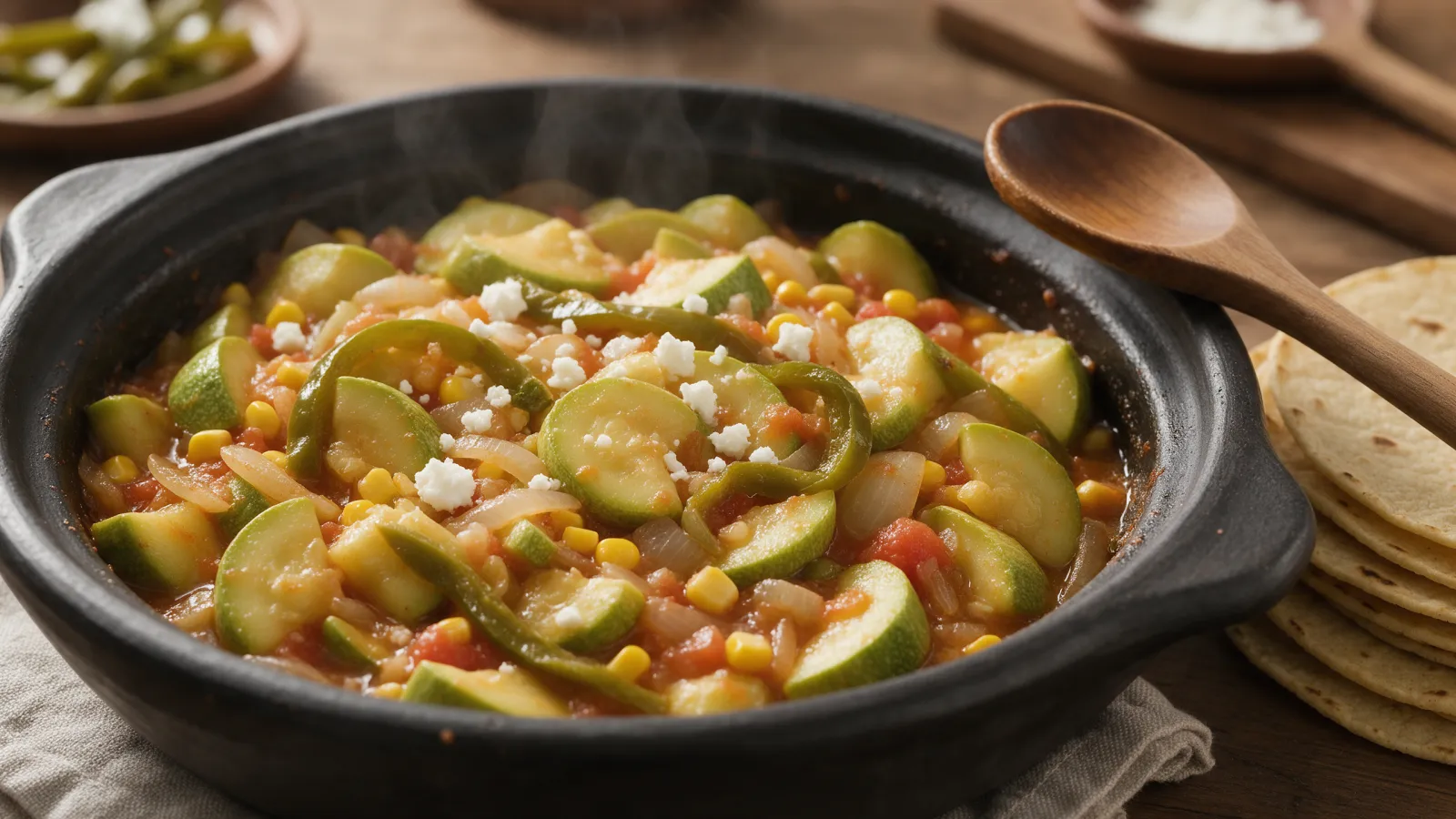

Calabacitas (kah-lah-bah-SEE-tahs) means “little squash” in Spanish, and in Mexico it’s also the name of the everyday side dish made with them: cubes of tender summer squash sautéed with corn, tomato, onion and fresh green chile. If you’ve ever made a zucchini side that ended up swimming in pale liquid, this is the fix. Zucchini is about 95 % water, so the whole recipe is built around keeping that water inside the squash until it reaches the plate.
Is calabacitas worth making, and how long does it take?
How do you make calabacitas? Soften 80 g (3 oz) of onion and 2 sliced serranos in oil for 2 minutes, add garlic and 200 g (7 oz) of diced tomato, and cook 3 minutes until saucy. Turn up the heat, add 600 g (1⅓ lb) of squash in ⅝ in (1.5 cm) cubes and 1 cup of corn, and cook uncovered 6 to 8 minutes. Salt at the end and finish with cilantro. 25 minutes for 4 servings.
Yes, especially if you have a zucchini glut or need a vegetable for taco night that isn’t a salad. It’s one pan, costs about a dollar a serving, and it’s vegan and gluten-free as written.
Why it beats plain sautéed zucchini. Sweet corn against soft squash, tomato cooked down just long enough to coat everything, and the clean heat of a fresh serrano. The cilantro at the end keeps it tasting freshly made.
When it fits. A side for 4 next to tacos, enchiladas or grilled meat; a filling for quesadillas or tortillas; a meatless main for 2 with rice, beans and cheese; or a big platter for 20.
When to make something else. If you want a high-protein main, the base version has just 4 g of protein a serving; go for the cheese or pork version below. If nobody at your table eats chile, leave it out and put hot sauce on the side.
Time and difficulty. 25 minutes: 10 of chopping, 15 at the stove, nearly all hands-on. Easy. The only thing that goes wrong is water, and that’s down to the pan, the lid and the salt.
What to buy for calabacitas in a US or UK supermarket
Everything for 4 sides is on the recipe card: 600 g (1⅓ lb) of squash, 1 cup of corn kernels and 200 g (7 oz) of tomatoes, plus onion, chile, garlic and oil. Add cheese and tortillas and the same batch feeds two or three as a main. Nothing here needs a specialty store, though one squash is worth looking for.
Mexican grey squash vs zucchini
In Mexico the classic choice is calabacita criolla, sold in the US as Mexican grey squash (sometimes “Lebanese” or “grey zucchini”): pale green with light speckles, thinner skin and very tender flesh. The other common one in Mexican markets is calabacita italiana, which is simply zucchini, or courgette in the UK. Both are the same species, Cucurbita pepo, and they swap 1 for 1 by weight.
Grey squash softens in about 6 minutes and breaks up if you stir it too much. Zucchini needs about 8 minutes to reach the same point, holds its cube better and tastes a little milder. Grey squash appeared in only a handful of the supermarket ads USDA surveyed in early October 2026, but at $0.69 a pound, against $1.91 for zucchini. If you see it, it’s both more traditional and cheaper. Pick firm zucchini around 8 in (20 cm) long; the giant ones have tough seeds and more water.
How to cut it
⅝ inch (1.5 cm) cubes, skin on. Smaller cubes fall apart before the corn is tender; thin slices leak water from every cut surface and end up stewing. The skin holds the cube together and gives the dish its green color. Don’t peel.
Corn, fresh, frozen or canned
- Fresh ears: one large ear gives about 150 g (1 cup) of kernels. Stand it in a wide bowl and slice down the sides so the kernels don’t scatter. They go in with the squash.
- Frozen kernels: 1 cup straight from the freezer, no thawing. Add 1 minute to the pan time.
- Canned: drained and rinsed, added for the last 2 minutes since it’s already cooked. It’s sweeter and salted, so taste before you salt.
Mexican market corn (elote) is usually white corn, less sweet than American yellow sweet corn. With supermarket sweet corn the dish turns out a bit sweeter. It’s still good.
Chiles, tomatoes and cheese
| If the recipe says | In the US | In the UK | What changes |
|---|---|---|---|
| Serrano chile | serrano, or 1 jalapeño | 1 green finger chilli, or 1 jalapeño | jalapeño is milder and fleshier |
| Jitomate saladette | Roma tomatoes | plum or vine tomatoes | salad tomatoes are juicier: seed them |
| Queso fresco | queso fresco in most stores | feta, rinsed, or a mild crumbly cheese | feta is saltier: cut the added salt in half |
| Melting cheese | Oaxaca or Monterey Jack | mozzarella or mild cheddar | cheddar is sharper and oilier |
| Elote | sweet corn, fresh or frozen | sweet corn, fresh or frozen | slightly sweeter |
Equipment
A 12 in (30 cm) skillet or a wide, shallow pan. A 10 in (24 to 26 cm) skillet holds only about 400 g (14 oz) of squash in one layer; any more and it piles up, the steam can’t escape and the squash boils instead of sautéing. With a smaller pan, cook in two batches or use a wok.
Step-by-step plan, with what each stage should look like
25 minutes, in this order: onion and chile, garlic, tomatoes, squash and corn, then salt. Have everything chopped before the heat goes on; nothing in the pan waits for you.
| Stage | Time | What you should see |
|---|---|---|
| Onion and chile | 2 min, medium-high | onion translucent and glossy, no brown edges |
| Garlic | 30 sec | smells strong, still pale |
| Tomatoes | 3 min | collapsed and saucy; a spoon leaves a trail that closes slowly |
| Squash and corn | 6 to 8 min, lid off | edges translucent, green skin brighter, fork meets slight resistance, no puddle |
| Salt and cilantro | last minute, off the heat | glossy, everything lightly coated in tomato |
Why the salt goes in last
Salt pulls water out of vegetables by osmosis, and summer squash is close to 95 % water by USDA’s numbers. Salt it at the start and it begins to weep before it can sear; five minutes later you have soup. Salt it in the last minute and the water stays in the squash.
Scaling for a crowd
| Servings (side) | Squash | Corn | Tomatoes | Onion | Serranos | Oil | Salt |
|---|---|---|---|---|---|---|---|
| 2 | 300 g (⅔ lb) | ½ cup | 100 g (3½ oz) | 40 g (1½ oz) | 1 | 1 tbsp | ¼ tsp |
| 4 | 600 g (1⅓ lb) | 1 cup | 200 g (7 oz) | 80 g (3 oz) | 2 | 1½ tbsp | ½ tsp |
| 8 | 1.2 kg (2⅔ lb) | 2 cups | 400 g (14 oz) | 160 g (5½ oz) | 3 to 4 | 3 tbsp | 1 tsp |
| 12 | 1.8 kg (4 lb) | 3 cups | 600 g (1⅓ lb) | 240 g (8½ oz) | 5 | ¼ cup | 1½ tsp |
| 20 | 3 kg (6⅔ lb) | 5 cups | 1 kg (2¼ lb) | 400 g (14 oz) | 8 | 7 tbsp | 2½ tsp |
I count 150 g (5 oz) of raw squash per person for a side, double for a main.
Make-ahead plan for 12 to 20
- Up to 4 days ahead, cook the onion, chile, garlic and tomato base in a big pot until thick, about 10 minutes for 20 people. Cool it and refrigerate within 2 hours.
- The night before, cube the squash and keep it in a container lined with paper towel. Cut any earlier and it starts to weep.
- On the day, stovetop: sauté the squash and corn in batches of about 700 g (1½ lb) in a 12 in skillet, 6 to 8 minutes each, and tip each batch into the pot of hot tomato base. Salt everything together at the end.
- On the day, oven: toss the squash and corn with the oil, spread them in a single layer on two large sheet pans and roast at 425°F (220°C) for about 20 minutes, stirring halfway. Fold into the hot base and salt. It comes out a little more browned and less juicy than the skillet version, and it’s the easiest way I know to feed 20.
Mistakes, spice level and allergens
- Watery → salted early, lid on the whole time, or a crowded pan. Lid off, medium-high heat, one layer, salt last.
- Mushy → cubes cut too small, or more than 10 minutes in the pan. Stick to ⅝ in (1.5 cm) and pull it while a fork still meets resistance.
- Raw tomato taste → the tomatoes went in and out in a minute. Give them the full 3 minutes.
- Bitter → browned garlic. 30 seconds, then the tomatoes go straight in.
- Tough corn → old ears with dull, dented kernels. Choose shiny kernels that squirt milk when you press one with a fingernail, or use frozen.
- Too hot → serrano seeds and ribs. Scrape them out, or serve the sliced chile on the side.
- Flat → underseasoned or pale tomatoes. Taste at the end; a squeeze of lime wakes it up.
Spice level. About 2 out of 5 with two seeded serranos, 3 with the seeds, 0 without chile. For kids, cook the base without chile, set their portion aside, then add the chile to the rest.
Allergens. The base recipe contains none of the nine major US food allergens and none of the UK’s 14: it’s vegan and gluten-free. With cheese or cream it contains milk; served in flour tortillas, wheat.
Which version to make, with cheese, pork, chicken or lighter
- Short on time → frozen corn and ½ in (1 cm) cubes: 6 minutes in the pan, dinner in 20.
- With queso fresco → 100 g (3½ oz) crumbled over the top to serve. Each serving goes from 125 to about 200 kcal and from 4 to 8 g of protein, which makes it a light main with tortillas.
- Cheesy calabacitas → 150 g (5 oz) of shredded Oaxaca cheese or Monterey Jack scattered over the squash, lid on for 2 minutes over low heat until melted. This is the one time I cover the pan.
- Calabacitas con puerco → a traditional Mexican stew where pork is browned, then simmered with tomato, corn, chile and spices such as bay leaf and cumin until tender, and the squash goes in last. Brown 500 g (1 lb) of cubed pork shoulder or ribs in its own fat for 10 minutes, add the tomato base and 1 cup (250 ml) of water, cover and simmer about 35 minutes, then uncover, add the squash and corn and cook 8 minutes more. With Mexican refried beans and Mexican red rice, it’s a whole meal in about an hour.
- With chicken → 300 g (10 oz) of cubed chicken breast browned for 5 minutes before the onion, or leftover shredded chicken stirred in at the end just to heat through.
- Creamy → ½ cup (120 ml) of Mexican crema or heavy cream at the end, 2 minutes over low heat. Milder and richer, and no longer vegan.
- Lighter → 2 teaspoons of oil instead of 1½ tablespoons in a nonstick skillet, which brings a serving down to about 97 kcal.
- With poblano → one roasted, peeled poblano cut into strips instead of the serranos. More flavor, almost no heat.
What calabacitas cost for 4
USDA’s Agricultural Marketing Service tracks the prices US grocery chains advertise each week. Using the averages for ads ending October 3 to 15, 2026, a batch for 4 costs about $4.07, or $1.02 a serving, before oil and salt.
Yield. About 1.08 kg (2⅓ lb) of raw ingredients cooks down to roughly 800 g (1¾ lb) in my kitchen: four 200 g (7 oz) sides, or two generous plates with tortillas.
What drives the price. The squash, at 62 % of the bill with zucchini. Grey squash at the advertised $0.69 a pound brings the batch down to about $2.46. Queso fresco, which the report doesn’t price, is the biggest add-on if you use it.
How to serve, store and reheat calabacitas
What to expect. Whole, juicy cubes of squash with translucent edges, sweet corn kernels that pop, and a light tomato coating with no puddle underneath. Gentle heat from the chile, fresh smell from the cilantro.
What to serve it with. Next to Mexican carne asada, bistec a la mexicana, Mexican steak with tomatoes, grilled chicken or pork, with rice, beans and warm corn tortillas. A spoonful beside huevos a la mexicana makes a full Mexican breakfast in the same red, white and green. If you have corn left over, esquites are the street-food way to eat it from a cup. Squash is also one of the vegetables in Mexican caldo de pollo, where it goes in for the last 10 minutes.
Fridge. 3 to 4 days in a covered container at 40°F (4°C) or below, the USDA FSIS window for cooked leftovers, as long as it goes in within 2 hours of cooking, or 1 hour above 90°F (32°C). It releases some liquid overnight; that’s normal.
Freezer. FSIS gives leftovers 3 to 4 months in the freezer for best quality, but I don’t freeze cooked calabacitas: thawed squash turns soft and watery. The tomato base freezes well on its own.
Reheating. In an uncovered skillet over medium heat for 3 to 4 minutes, stirring, until the extra liquid cooks off and the center reaches 165°F (74°C), the FSIS reheating temperature. In the microwave, cover, use half power in 1-minute bursts, and drain any liquid before serving.
Calabacitas FAQ
What is calabacitas? A Mexican side dish of summer squash sautéed with tomato, onion and green chile, usually with corn and often finished with queso fresco. The word means “little squash”.
Can I use zucchini for calabacitas? Yes. Zucchini is one of the two squashes used in Mexico (calabacita italiana). It needs about 2 minutes longer than Mexican grey squash and holds its shape a little better.
How do I keep calabacitas from getting watery? Use a wide skillet with the squash in one layer, keep the heat medium-high, leave the lid off, and add the salt in the last minute. Cook the tomatoes down for 3 minutes before the squash goes in.
Do you peel the squash? No. The skin holds each cube together and gives the dish its color.
What cheese goes on calabacitas? Crumbled queso fresco or cotija on top, or Oaxaca cheese or Monterey Jack melted in. In the UK, feta works as a crumbling cheese; cut the added salt in half.
Is calabacitas vegan and gluten-free? The base recipe is both: just vegetables, oil and salt. Cheese or cream adds dairy.
How many calories are in calabacitas? A side serving has about 125 kcal and 4 g each of protein and fiber; crumbled queso fresco takes it to about 200 kcal.
What do you serve calabacitas with? Rice, beans and corn tortillas, next to grilled meat, chicken or pork, or on their own with cheese as a vegetarian main. They also make a good taco filling.
Nutrition per serving
Per side serving (1 of 4, without cheese), calculated ingredient by ingredient from USDA FoodData Central (SR Legacy) values per 100 g, using this recipe’s amounts: 600 g (1⅓ lb) squash, 150 g (5 oz) corn, 200 g (7 oz) tomatoes, 80 g (3 oz) onion, 12 g chile, 6 g garlic, 21 g oil, 5 g cilantro and 3 g salt.
- Calories: 125 kcal
- Protein: 4 g
- Carbohydrates: 17 g
- Fat: 6 g, including 1 g saturated
- Fiber: 4 g
- Sugars: 8 g
- Sodium: 300 mg
Cutting the oil makes the biggest difference: it supplies 38 % of the calories, more than the corn (26 %) or the squash itself (19 %). With 100 g (3½ oz) of queso fresco for 4, each serving rises to about 200 kcal, 8 g of protein, 12 g of fat and 490 mg of sodium.
Zucchini is one of the cheapest things at the market where I shop in Colombia, and for years I boiled it and wondered why my son wouldn’t touch it. Taking the lid off and holding the salt until the end turned it into something he now eats without asking what it is. I make this once a week, with fresh corn when I can find tender ears. Josnaisis.