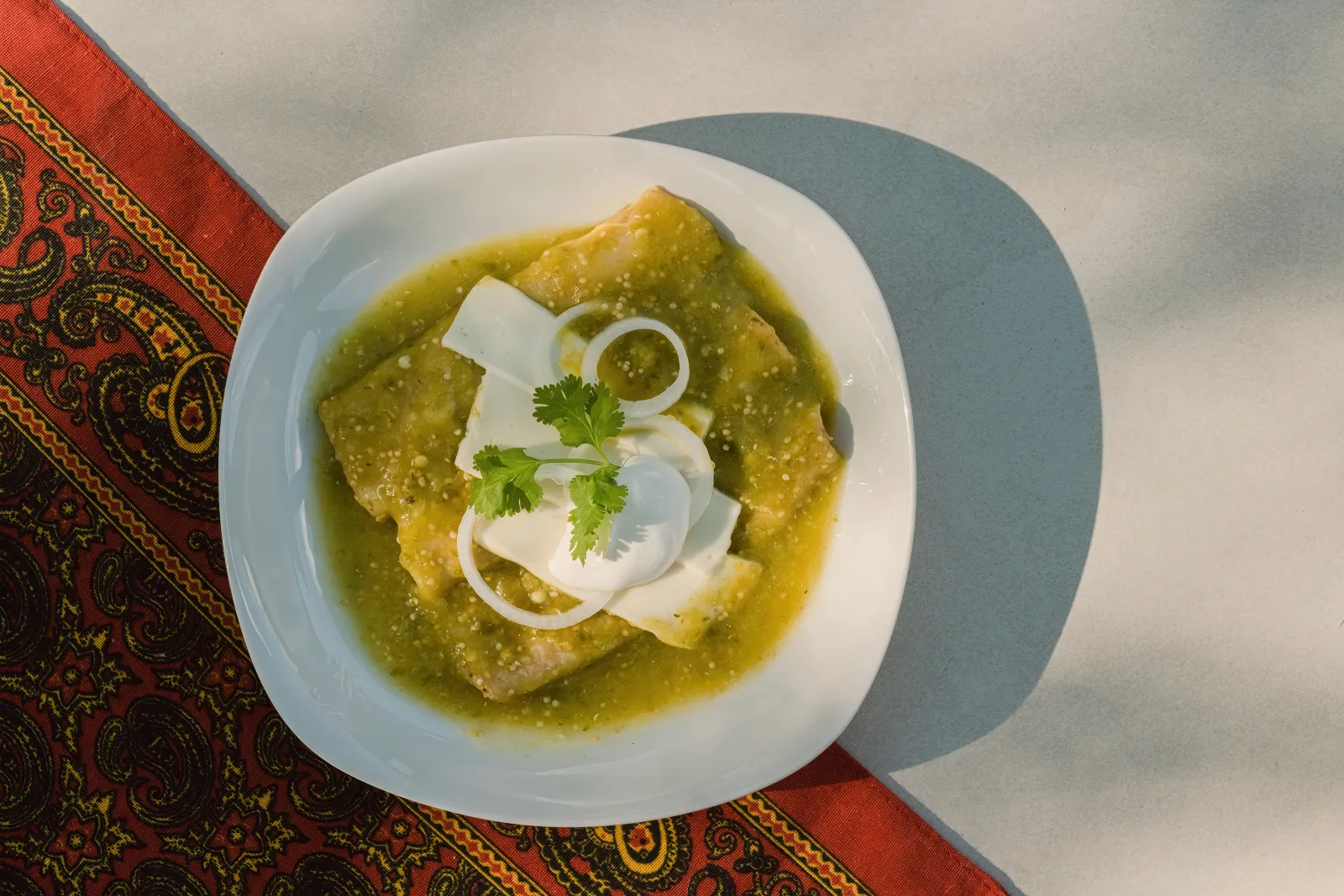

If your enchiladas have ever come out of the oven as a soft, sauce-logged slab, the fix happens long before the oven: a corn tortilla dipped in hot oil for 10 to 15 seconds a side becomes pliable enough to roll and gets a thin seal that keeps the sauce on the outside. Enchiladas verdes (en-chee-LAH-dahs VEHR-dehs) are Mexico’s green enchiladas: corn tortillas rolled around shredded chicken and covered in a tangy salsa made from tomatillos and serrano chiles, finished with crema, crumbled fresh cheese and raw onion. In Mexican home kitchens they’re often sauced and eaten straight away, with no oven and no blanket of melted cheese, which is the main thing that separates them from the Tex-Mex casserole most American readers know.
What are green chicken enchiladas, and are they worth making?
How do you make green chicken enchiladas? Poach chicken breast for 20 to 25 minutes and shred it. Simmer tomatillos, serrano chiles and garlic for 10 minutes, blend with onion, cilantro and broth, then fry the salsa for 6 to 8 minutes. Soften corn tortillas in hot oil for 10 to 15 seconds a side, fill, roll, cover with hot salsa and top with crema, queso fresco and onion. 55 minutes for 4 servings.
They’re worth it even on a weeknight. 55 minutes on the clock, about 45 of them hands-on, and both the salsa and the chicken keep in the fridge, so a second batch takes 25 minutes. The payoff is contrast: sharp, green salsa with heat at the finish, a soft tortilla that still holds its shape, cool crema and salty cheese.
Where they fit. A family dinner for 4, a casual lunch with friends, or a party for 12 if you bake them. They’re also the best use I know for leftover poached or rotisserie chicken.
Where they don’t. A buffet where food sits for an hour: sauced-to-order enchiladas are at their best in the first few minutes. For that, bake them, or go full Tex-Mex.
Difficulty, easy. The only step that takes practice is the oil dip, and you’ll have it down by the second of the 12 tortillas.
Mexican-style, baked or Tex-Mex, which should you make?
All three are rolled corn tortillas with a filling and a sauce. What changes is the oven, the cheese and how long the dish can wait.
- Sauced to order (this recipe) → no oven. Roll, sauce, top and eat. Firm tortillas, bright salsa. Best for 2 to 6 people.
- Baked → the same enchiladas in a 9×13-inch (23×33 cm) dish, covered with salsa, 10 to 15 minutes at 375°F (190°C). The tortillas soften a little; in exchange you can roll them up to 2 hours ahead and keep the salsa separate until baking. My choice for 12.
- Red enchiladas → the same tortilla technique with a sauce of dried guajillo and ancho chiles instead of tomatillos, toastier and milder; see red enchiladas with homemade guajillo sauce.
- Tex-Mex → the Texas version: a baked casserole, often with canned sauce or a chili gravy thickened with flour, lots of melted yellow cheese and sometimes flour tortillas. Good, heavier, and a different dish.
- Enchiladas suizas → “Swiss” enchiladas: the green salsa is blended with cream and the top is covered in melted cheese. The name is linked to the Sanborns restaurants in Mexico City; the exact origin is disputed. To try them, blend 120 ml (½ cup) crema into the fried salsa and broil with Monterey Jack for 5 minutes.
What to buy, with US and UK swaps
The exact amounts are in the recipe card: 600 g (1⅓ lb) of chicken breast, 700 g (1½ lb) of tomatillos, 2 serranos and 12 corn tortillas for 4 plates of 3.
Tomatillos look like small green tomatoes inside a papery husk, which you peel off before rinsing away the sticky residue underneath. They’re tart, not sweet, and there’s nothing else that tastes like them; unripe red tomatoes are a different fruit. About 20 medium make 700 g (1½ lb), at 34 g each according to the USDA.
Serrano chiles are slimmer and hotter than jalapeños. North Dakota State University Extension puts them at 5,000 to 15,000 Scoville heat units, against 2,500 to 5,000 for a jalapeño.
Corn tortillas, 6 inches (15 cm), made from nixtamalized corn. Flour tortillas go soft in salsa and aren’t used for this dish in Mexico.
Where to shop. In the US, tomatillos and serranos are in the produce section of most large supermarkets, next to the jalapeños, and crema and queso fresco are in the Latin dairy case. In the UK, fresh tomatillos are rare; canned tomatillos from Mexican online grocers work well. They’re already cooked, so drain them and skip the boiling step.
Equipment. A blender, a medium saucepan, an 8-inch (20 cm) skillet for the oil, tongs and paper towels. A stick blender in a tall jug makes the salsa just as smooth. No tongs? A fork and a spatula, and mind the spatter.
How to soften corn tortillas so they don’t break or go soggy
This is the step that decides the result. Hot oil does two things at once: it makes the tortilla flexible enough to roll, and it forms a barrier on the surface that slows the salsa down, as chef Jorge Guzmán explained to Food Republic. He gives a range of anywhere from ten seconds to 45 seconds. Pati Jinich, host of the PBS series Pati’s Mexican Table, uses 15 seconds per side in half an inch of oil over medium heat. I stay at ten to fifteen seconds: soft, barely greasy, and still intact when the plate reaches the table.
- Heat the oil properly. 1 cm (½ in) in an 8-inch (20 cm) skillet, medium heat, about 3 minutes. Test with the edge of a tortilla: it should bubble the instant it touches. No bubbles, wait; smoke, take the pan off the heat for a minute.
- Dip, flip, lift. Ten to fifteen seconds per side, no browning. If it crackles when you bend it, it stayed in too long.
- Stack and roll warm. Drain them on paper towels in a stack; the heat keeps them pliable. Roll loosely, seam side down.
Prefer less oil? Brush both sides lightly and warm them in a hot dry skillet, or spray them and warm them in a 350°F (175°C) oven for 2 to 4 minutes, the method America’s Test Kitchen uses. They roll fine, but without the seal they soften faster under the salsa, so this works better for the baked version.
Why the salsa gets fried
A blended raw salsa is watery and tastes of raw tomatillo. Fried for six to eight minutes in a tablespoon of oil, it loses some water, darkens, and its flavor settles. That thicker salsa is the one that doesn’t soak through. Pour it hot: cold salsa cools the whole plate. For a bigger batch to keep in the fridge, there’s a full Mexican salsa verde recipe.
Game plan for 4, and how to scale it for 12
The chicken poaches on its own for 25 minutes, and the whole salsa fits inside that time. The tortillas come last, once everything else is ready, because they go straight from the oil to the plate.
Make ahead. Fry the salsa and shred the chicken up to 3 or 4 days before, stored separately in the fridge. On the day, bring the salsa to a boil, soften the tortillas and assemble: about 25 minutes. Don’t soften the tortillas ahead; once cold they stiffen again.
Scaling. At 3 enchiladas per person:
| People | Tortillas | Chicken breast | Tomatillos | Serranos | Crema | Queso fresco | Baking dishes, 9×13 in |
|---|---|---|---|---|---|---|---|
| 4 | 12 | 600 g (1⅓ lb) | 700 g (1½ lb) | 2 | 120 ml (½ cup) | 100 g (3½ oz) | 1 |
| 6 | 18 | 900 g (2 lb) | 1.05 kg (2⅓ lb) | 3 | 180 ml (¾ cup) | 150 g (5 oz) | 2 |
| 12 | 36 | 1.8 kg (4 lb) | 2.1 kg (4⅔ lb) | 6 | 360 ml (1½ cups) | 300 g (10½ oz) | 3 |
A 9×13-inch (23×33 cm) dish holds 12 enchiladas in a single layer. For 12 people, bake them: soften all 36 tortillas in batches, topping the oil back up to half an inch as it drops.
How to tell it’s going right.
| Stage | What you should see |
|---|---|
| Chicken, 20-25 min | 165°F (74°C) in the thickest part, white and juicy |
| Tomatillos, ~10 min | bright green to olive green, still whole |
| Fried salsa, 6-8 min | darker green, no raw smell, coats the spoon |
| Oil, ~3 min | a tortilla edge bubbles on contact |
| Tortilla, 10-15 s a side | soft, no golden spots, bends without cracking |
Mistakes, spice level and allergens
- Tortillas crack when rolled → they went in cold, skipped the oil, or stayed in past 30 seconds and crisped. 10 to 15 seconds a side in bubbling oil.
- Soggy enchiladas → raw, cold or too much salsa, or they sat too long. Fry it, pour it hot, and sauce just before serving.
- Bitter or watery salsa → the tomatillos burst while boiling. Pull them at about 10 minutes, as soon as the color changes.
- Too sour → very underripe tomatillos. A pinch of sugar, ¼ teaspoon, balances it.
- Dry chicken → it boiled hard or went past 25 minutes. Low heat, lid on, and toss it with salsa.
- Greasy tortillas → the oil wasn’t hot enough, so they absorbed it instead of sealing.
Spice level, 2 out of 5 with 2 serranos. Most of the heat is in the seeds and veins; remove them, or use jalapeños, for a milder pan. Crema and cheese soften it on the plate. For kids, set aside their share of salsa before adding the chiles.
Allergens. Dairy in the crema and cheese; leave them off and it’s dairy-free. Corn tortillas are naturally gluten-free, but check the label for someone with celiac disease, since some brands blend in wheat flour. No egg, nuts or fish.
What it costs
At the US city average prices the Bureau of Labor Statistics published for August 2026, boneless chicken breast was $4.17 a pound, so the 1⅓ lb (600 g) here comes to $5.52, about $1.38 a plate. BLS doesn’t track tomatillos, corn tortillas, crema or queso fresco, so I won’t put a made-up total on them. For a sense of scale: in Mexico City’s Central de Abasto wholesale market, the Ministry of Economy’s SNIIM listed tomatillos at 16 pesos a kilo on October 9, 2026, which makes the whole salsa about 15 pesos.
Yield. 12 enchiladas, 4 plates of 3. As part of a bigger spread, 2 each is plenty and it serves 6.
What drives the price. The chicken. Outside the US and Mexico, imported canned tomatillos and crema add up; poaching a whole chicken gives you more meat for the money than breasts, and better broth for the salsa.
Serving, storing and reheating
Taste and texture. A sharp, herbal salsa with the serrano’s heat arriving last, soft tortillas that hold their shape, juicy chicken, and cold crema and salty cheese cutting through the acidity.
What to serve with them. Mexican rice made with fresh tomatoes or homemade refried beans on the side and a bowl of authentic Mexican guacamole on the table. Leftover tortillas and salsa make chilaquiles verdes the next morning. The same tomatillo and serrano salsa fills green chicken tamales, and for a bigger Mexican dinner, enchiladas sit well next to tacos al pastor or before a pot of pozole rojo.
Fridge. The USDA Food Safety and Inspection Service’s numbers for leftovers: 2 hours at most out of the fridge, 3 to 4 days in the fridge at 40°F (4°C) or below. Salsa and chicken keep better apart than assembled enchiladas, which soften from day one.
Freezer. Fried salsa and shredded chicken freeze well in separate containers, with 3 to 4 months of best quality for frozen leftovers per FSIS. Assembled enchiladas can be frozen, but the tortillas come out soft; if you must, freeze the baked version, without crema or cheese.
Reheating. Salsa and chicken in a saucepan over medium heat until the salsa boils and the chicken reaches 165°F (74°C), then soften fresh tortillas and assemble. Assembled enchiladas, covered with foil, 15 to 20 minutes at 350°F (175°C). The microwave softens them further; fine for a single plate, in 1-minute bursts.
Frequently asked questions
How do I keep corn tortillas from breaking in enchiladas? Dip them in hot oil for ten to fifteen seconds per side and roll them while warm, not too tight. Cold, dry corn tortillas crack.
Why are my enchiladas soggy? The salsa was raw, cold or too abundant, or the tortillas skipped the oil. Fry the salsa, pour it hot and serve right away.
Are enchiladas verdes baked? They don’t have to be. Sauced and served immediately is common in Mexico; baking for 10 to 15 minutes at 375°F (190°C) is handy for a crowd.
What’s the difference between enchiladas verdes and enchiladas suizas? Suizas have cream blended into the green salsa and melted cheese on top. Verdes keep the salsa plain, with cold crema and crumbled cheese added after.
Can I use rotisserie chicken? Yes. About 465 g (1 lb) of skinless meat for 12 enchiladas, and you skip 25 minutes.
Can I use canned tomatillos or jarred salsa verde? Canned tomatillos, drained, work well and skip the boiling. A jarred salsa verde works too; fry it for 5 minutes to thicken it.
Can I make green enchiladas ahead or freeze them? Make the salsa and chicken up to 3 to 4 days ahead, or freeze them separately for 3 to 4 months. Assembled enchiladas freeze, but the tortillas soften.
Are green enchiladas spicy? Medium, with 2 serranos. Swap in jalapeños or seed the chiles for a mild version.
Nutrition
Per serving of 3 enchiladas with crema, queso fresco and onion, calculated ingredient by ingredient from the USDA FoodData Central database (SR Legacy) with the quantities above. The oil absorbed by the tortillas, about 60 g (4 tbsp) in total, is my own estimate:
- Calories: 706 kcal
- Protein: 45 g
- Carbohydrates: 47 g
- Fat: 38 g, of which 10 g saturated
- Fiber: 8 g
- Sugars: 10 g
- Sodium: 883 mg
Without crema and cheese, a plate is 572 kcal: the crema adds about 59 kcal and the queso fresco about 75. Of the 883 mg of sodium, 581 mg comes from the salt in the salsa, and the absorbed oil adds roughly 135 kcal per plate.
Corn tortillas weren’t everyday food in the Venezuelan kitchen I grew up in, and my first enchiladas split down the middle because I warmed the tortillas in a dry pan. A few seconds in hot oil and they rolled on their own. Now the salsa gets made the night before, and dinner takes the time it takes to dip twelve tortillas. Josnaisis.