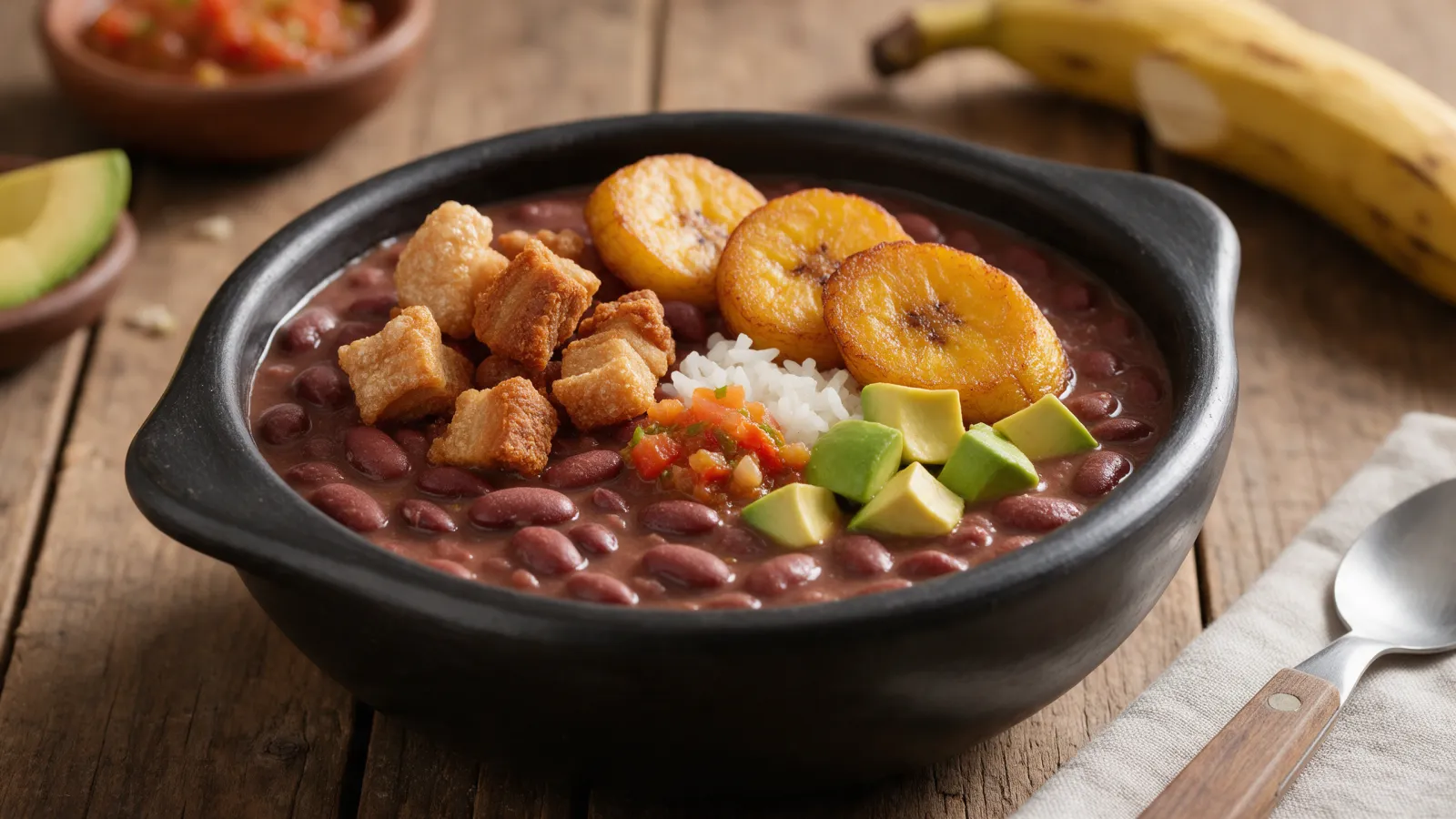

The pork on top of a Colombian bean casserole has a few minutes before the steam from the beans softens its skin, and the whole dish is built around that. Thick red beans go in first, boiling, then rice as a dry island, then chorizo, sweet fried plantain, avocado and a spoon of tomato sauce, with the crisp pork belly placed last where the broth can’t reach it. In Colombia it’s called cazuela de frijoles (kah-SWEH-lah deh free-HOH-lehs), and US Colombian restaurants often list it as “bean casserole”. This page covers the beans, the US and UK supermarket swaps, how to heat a clay dish without cracking it, and what it costs.
What is cazuela de frijoles, and is it worth making at home?
How do you make Colombian bean casserole? Reheat cooked Colombian red beans until boiling and thicken them by mashing 1 cup of beans back into the pot. Ladle them into clay dishes warmed for 20 minutes at 300°F (150°C) from a cold oven, then top with rice, chorizo, fried ripe plantain, avocado, hogao and, last, crisp pork belly. Ready in 85 minutes for 6 servings.
It’s the components of a bandeja paisa, the big platter from the Antioquia region around Medellín, served on top of the beans in one hot clay bowl instead of spread across a tray. A restaurant in central Medellín reviewed by Colombia Reports served it with shredded beef and potato sticks on top; a Bogotá review on Flavors of Bogota called it a bandeja paisa “all put together in a soup”.
It’s worth it if you already have beans, or will make them the day before. From there it’s about 55 minutes of real work spread over 85, and the result is a full meal that stays hot to the last spoonful because the clay holds heat. It’s a weekend lunch for 4 to 8, not a light one: each dish comes to about 1,275 kcal.
How it differs from bandeja paisa and Colombian red beans
| Dish | What it is | Served |
|---|---|---|
| Cazuela de frijoles | thick beans with everything on top | in a hot clay bowl |
| Bandeja paisa | 10 to 12 separate components, with ground beef, blood sausage and arepa | on a large platter |
| Colombian red beans | the beans and their broth | in a soup plate, sides next to it |
| Calentado | yesterday’s beans and rice fried together | in a skillet, for breakfast |
Ingredients, and what to buy in a US or UK supermarket
For 6: 1.8 kg (4 lb) cooked beans, 360 g (12.7 oz) pork belly, 3 chorizo links, 2 ripe plantains, 2 avocados, 1½ cups rice and a quick tomato hogao. Eggs and potato sticks are optional extras that many restaurants add.
The beans. The base is a pot of Colombian red beans simmered with pork belly and thickened with green plantain; the full recipe is in Colombian red beans with plantain. Colombians use cargamanto, a large cream bean streaked with red. Cranberry beans (sold as Roman beans in the US) or borlotti (UK) are the closest match. Canned red kidney beans work for a weeknight version: 3 cans of 15 oz (400 g), drained, simmered 30 minutes with the hogao and a grated green plantain.
The pork belly. It has to be fresh and skin-on, because the skin is what puffs into chicharron. In the US, look in Latin, Korean or Chinese butcher counters; in the UK, pork belly slices with the rind on are in most supermarkets. Bacon or smoked belly won’t puff. The method is the one in the Colombian chicharron recipe, scaled down.
The chorizo. Fresh and raw, in a casing. Colombian chorizo is poached, then browned; Mexican-style fresh chorizo links are the easiest US stand-in. In the UK, buy “cooking chorizo”, not the cured slicing kind, which turns hard and oily in the pan.
The plantains. Ripe means yellow skin with black patches, soft when pressed but still holding its shape. Fully black and mushy plantains fall apart in the pan. Most US supermarkets stock them; in the UK, large supermarkets and Caribbean or African grocers do.
Do you need a clay dish?
No, but it changes the experience. Individual glazed earthenware dishes, or one 28-30 cm (11-12 in) dish for the table, keep the beans bubbling well after they reach the table. La Chamba black clay from Colombia’s Tolima region is sold by US kitchen retailers. Oven-safe stoneware bowls or a cast iron skillet work at the same oven setting.
If you buy traditional pottery, the FDA’s advice applies: avoid pieces that look crude or irregular, antiques, worn or chipped pieces, and brightly glazed orange, red or yellow ware, because lead has been used to intensify those colors. Washing or boiling doesn’t remove lead. Anything stamped “Not for food use” stays decorative.
The make-ahead plan, minute by minute
Start the pork belly first. It simmers unattended for 45 minutes, and that window is where the rice, hogao and chorizo happen. Once the beans exist, the whole thing is 85 minutes.
The day before. Cook the beans; they thicken overnight as the starch sets, which is exactly what this dish needs, and keep 3 to 4 days in the fridge at 40°F (4°C) or below, per USDA FSIS. Make the hogao, which keeps 3 days covered. Score and salt the pork belly and leave it uncovered on a rack in the fridge, so the skin dries and puffs better. Poach the chorizo and refrigerate it, so it only needs browning.
On the day. Pork on the stove, then rice, hogao, chorizo, clay dishes into the cold oven, beans, final fry of the pork, plantains. Eggs in the last 3 minutes.
How to tell each part is right.
- Pork, simmering → after roughly three-quarters of an hour the bubbling turns into a dry crackle: it’s now frying in its own fat.
- Pork, done → the skin blisters and puffs. Smooth, hard skin needs more time skin side down.
- Beans → boiling in the center of the pot, not only at the edges, and a spoonful holds its shape on a plate.
- Plantains → dark golden edges and a center that gives under a fork after 2 to 3 minutes per side.
How to thicken the beans without flour
Mash 1 cup of beans per 1.8 kg (4 lb) into a paste with a fork or potato masher, stir it back in and simmer 5 to 8 minutes uncovered, scraping the bottom. The starch from the broken beans, plus the green plantain already in the pot, thickens the broth without flour’s raw taste or gluey look. The Antioquia recipe published by colombia.com blends part of the beans with carrot and a chorizo instead; I mash, because I like seeing pieces of bean.
Still thin after 8 minutes? Mash a second cup. Too thick? Add 60 ml (¼ cup) hot water.
Layering order, so the chicharron stays crisp
The skin of the pork belly absorbs moisture. Sitting in boiling broth, it goes leathery within minutes. So the build runs from what can take the broth to what can’t:
- Beans, 300 g (10.5 oz) per dish, boiling, filling two-thirds of it.
- Rice to one side, on top of the beans. It soaks up broth and becomes the dry platform.
- Chorizo slices, which don’t mind the broth.
- Plantain on the rice; in the beans it turns to mush.
- Avocado at the rim, cool and away from the hottest part.
- Hogao, a spoonful in the center or on the side.
- Pork belly, last, resting on the rice or plantain. A fried egg goes on the rice just before it.
Don’t cover the dish, and cut the pork just before plating: steam and the juice from freshly cut meat both soften the skin.
Heating a clay pot in the oven without cracking it
Clay cracks from sudden temperature changes, not from heat itself. Put the dishes in a cold oven, set it to 300°F (150°C) and give them 20 minutes, so they warm up with the oven. Lift them out with dry gloves onto wood, a trivet or a folded dry towel, never onto cold stone, a wet surface or under the tap, and never pour anything cold into a hot dish.
I use 300°F (150°C) because it’s enough to hold heat and stays below the 350-390°F (180-200°C) that manufacturers and cooks use to season new clay. Kitchprep’s guide to ceramic cookware puts unglazed earthenware at roughly 250-350°F (120-175°C) and, like Digitalfire, recommends starting clay in a cold oven. If your dish came with the maker’s instructions, follow those first.
Mistakes, spice level, kids and allergens
- Rice floating, everything mixed → thin beans. Mash more and simmer longer before plating.
- Soft pork skin → it sank into the broth, the dish was covered, or it was cut too early.
- Cracked dish → into a hot oven, onto a cold counter or cold liquid added. Cold oven, wooden board.
- Beans cooling fast → lukewarm beans or an underheated dish. Boil the beans and give the clay its full 20 minutes.
- Split chorizo → pricked or boiled hard. Steaming water, not boiling.
Spice level. Zero heat. The Colombian ají, a fresh salsa of chile, scallion, cilantro and vinegar, goes on the table.
Kids. Plantain and chorizo are usually the hit. Use a bowl that won’t burn them: a dish out of a 300°F (150°C) oven stays hot for a long time.
Allergens. No gluten, dairy, nuts or fish in the recipe itself. Eggs if you add them. Check the labels of store-bought chorizo and potato sticks if you cook for someone with coeliac disease.
Which version should you make?
- Weeknight, under an hour → canned beans thickened with hogao and grated green plantain, and the pork belly cut into 3 cm (1¼ in) cubes and deep-fried straight in oil at 356°F (180°C) for 12 to 15 minutes. In my kitchen that’s about 50 minutes; the skin comes out harder and less puffed.
- No oven → fill the bowls with boiling water for 5 minutes, empty and dry them before plating. They won’t hold heat like clay, but the beans won’t hit a cold bowl.
- For a party → one large 28-30 cm (11-12 in) dish in the middle, everything on top, and the pork belly on a separate plate for people to add themselves, so it stays crisp while guests arrive.
- Vegetarian → beans cooked without pork and with 3 extra tbsp oil in the hogao, no pork belly or chorizo, a fried egg on each. About 850 kcal per dish with the egg.
- Lighter → half the pork belly, no chorizo, double avocado: about 195 kcal less. It’s still a big plate.
Quantities for 4 to 20
Based on 300 g (10.5 oz) cooked beans per person, about 50 g (1.75 oz) dried.
| People | Cooked beans (dried) | Pork belly | Chorizo links | Plantains, unpeeled | Raw rice | Avocados |
|---|---|---|---|---|---|---|
| 4 | 1.2 kg / 2.6 lb (200 g / 7 oz) | 240 g / 8.5 oz | 2 | 400 g / 14 oz | 1 cup / 200 g | 1½ |
| 6 | 1.8 kg / 4 lb (300 g / 10.6 oz) | 360 g / 12.7 oz | 3 | 600 g / 1.3 lb | 1½ cups / 300 g | 2 |
| 8 | 2.4 kg / 5.3 lb (400 g / 14 oz) | 480 g / 1.1 lb | 4 | 800 g / 1.8 lb | 2 cups / 400 g | 3 |
| 12 | 3.6 kg / 8 lb (600 g / 1.3 lb) | 720 g / 1.6 lb | 6 | 1.2 kg / 2.6 lb | 3 cups / 600 g | 4 |
| 20 | 6 kg / 13.2 lb (1 kg / 2.2 lb) | 1.2 kg / 2.6 lb | 10 | 2 kg / 4.4 lb | 5 cups / 1 kg | 7 |
For 12 to 20, plating is the bottleneck, not cooking. Make the beans two days ahead, fry the pork belly in two pots, and plate in rounds of 6 while the beans stay on the lowest heat.
What it costs in the US
Using the Bureau of Labor Statistics US city average prices for August 2026, the ingredients that have a price series come to $8.11 for 6 dishes, about $1.35 each.
Pork is about half of that, priced with the BLS “all other pork” series because there’s no pork belly series; skin-on belly from a specialist butcher usually costs more. Chorizo, plantains, avocado, carrot and scallions have no BLS series, so a realistic grocery bill is higher than the chart. In Colombia, by comparison, the same priced ingredients cost about 24,400 pesos at Medellín’s wholesale market, per the government’s SIPSA price bulletin.
Serving, leftovers and storage
How it eats. Creamy beans with a pork-and-cumin broth that seeps into the rice as you go, crackling pork on top, sweet plantain, cool avocado to cut the fat. Serve with a Colombian cheese arepa or a plain arepa on the side, limes for the pork and ají. It’s eaten with a spoon from the edge inward.
Rice. Colombian white rice is cooked with a little oil and scallion until fluffy and separate; the method is in Colombian white rice.
Leftovers. Don’t store the assembled dish: the pork and plantain go soggy. Keep each part separately. Per USDA FSIS, no more than 2 hours at room temperature, then 3 to 4 days in the fridge at 40°F (4°C) or below. Beans freeze well for 2 to 3 months in flat bags with their broth; rice and cooked chorizo freeze too. Fried plantain, avocado and fried pork belly don’t.
Reheating. Beans over low heat with 30 ml (2 tbsp) water per cup until boiling, or to 165°F (74°C) in the center. Pork belly in an air fryer at 400°F (200°C) for 4 to 5 minutes, or a 425°F (220°C) oven for 8 to 10 minutes skin up; the microwave makes it chewy. And let the clay dish cool on its own before washing it.
Frequently asked questions
What is in a Colombian bean casserole? Thick red beans as the base, topped with white rice, crisp pork belly (chicharron), chorizo, fried ripe plantain, avocado and hogao, a tomato and scallion sauce. Fried egg and potato sticks are common extras.
Is cazuela de frijoles the same as bandeja paisa? Nearly the same ingredients, served differently: the cazuela piles everything on the beans in a hot clay bowl; the bandeja lays each part out separately on a platter, with ground beef, blood sausage and an arepa.
Can I use canned beans? Yes. Three 15-oz (400 g) cans, drained, simmered 30 minutes with hogao and a grated green plantain. The beans are softer than home-cooked cranberry beans.
Can a clay pot go in the oven? If it’s sold as oven-safe, yes. Start it in a cold oven, heat to 300°F (150°C) for 20 minutes, and set it on wood or a trivet when it comes out.
Can I make it ahead? Make the beans, hogao and chorizo the day before. Fry the pork belly and plantain, and slice the avocado, right before serving.
How many calories are in a bean casserole? With 76 g of fat, one dish of this recipe comes to about 1,275 kcal. The vegetarian version with an egg is about 850 kcal.
What can I use instead of pork belly? For crunch without pork, fried green plantain chips or potato sticks on top. The flavor changes, but the contrast with the soft beans stays.
Nutrition
Per dish, without egg or potato sticks, calculated ingredient by ingredient from USDA FoodData Central (SR Legacy) using the amounts in this recipe. Cranberry beans stand in for cargamanto, and the pork belly and fried plantain are counted at raw weight, so the fat is an upper limit: some of the pork fat stays in the pot.
- Calories: 1,275 kcal
- Fat: 76 g (saturated 23 g)
- Carbohydrates: 119 g
- Fiber: 21 g
- Protein: 32 g
- Sodium: 1,659 mg
The pork belly accounts for about 310 kcal and the beans for about 380. Each fried egg adds 6 g protein and 90 kcal. The sodium is 72% of the 2,300 mg Daily Value the FDA uses on US labels, and the fiber 75% of 28 g.
I grew up in Venezuela eating black beans with fried plantain on the side, and the first cazuela I ate in Medellín looked like someone had taken that idea as far as it would go. Making it at home, I found the dish is decided in the last minute: beans boiling, pork cut right then, nothing covering the top. Josnaisis.