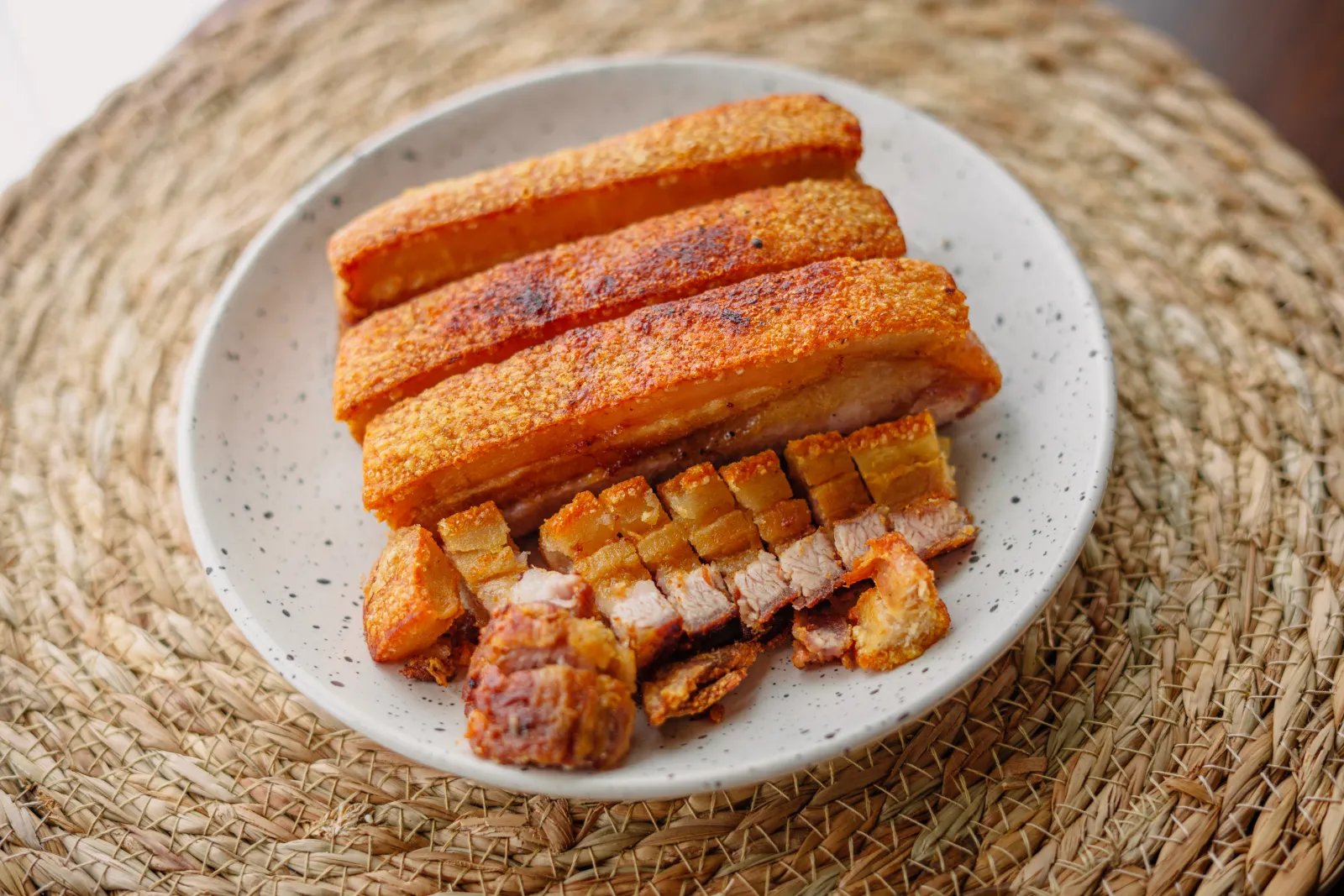

Colombian chicharrón (chee-cha-RRON) takes 2.2 lb (1 kg) of skin-on pork belly, 3 cups of water and no added oil, and the water is the part that surprises people. The pieces simmer in a shallow bath of salted water for about 45 minutes, and when the water is gone they keep cooking in the fat they released, until the skin bubbles up like crackling and the meat underneath stays juicy. It is the pork on a bandeja paisa, Colombia’s best-known platter, and it is nothing like the bagged pork rinds sold as chicharrones in US stores: there is a real strip of meat attached.
How do you make Colombian chicharrón crispy?
How do you make Colombian chicharrón? Score and salt skin-on pork belly, then cook it in a pot with water halfway up the pieces, 20 minutes covered and 20-25 uncovered, until the water evaporates. Fry the pork in its own rendered fat, turning, for 18 minutes, then finish skin side down at about 355°F (180°C) until the skin puffs. Ready in 85 minutes for 6 servings.
The short version of the science: water caps the heat at 212°F (100°C). During that phase the tough collagen in the skin softens and soaks up moisture, and the fat melts out of the belly. Once the water has boiled off, nothing stops the fat from getting hotter, and when it reaches frying temperature the moisture trapped in the softened skin turns to steam and blows it up into blisters. Skip the water and the skin shrinks and goes hard; skip the hot finish and it stays soft and chewy.
The water stage also takes care of safety. The USDA FSIS puts whole cuts of pork at 145°F (63°C) with a 3-minute rest; after 40 minutes at a boil, the pork is far beyond that before it ever starts to fry.
What pork belly to buy in the US and UK
You need 1 kg (2.2 lb) of fresh pork belly with the skin on, ideally a slab with at least 2 cm (¾ in) of lean meat. That last detail is what separates Colombian chicharrón from a crunchy strip of fat.
- In the US, skin-on belly is easiest to find at Asian supermarkets and Latin carnicerías; most mainstream stores sell it skinless, so ask at the meat counter.
- In the UK, butchers and many supermarket counters sell pork belly with the rind on, either as a joint or as thick slices. Ask for a piece rather than thin slices, which dry out before the rind puffs.
- Skip bacon and streaky bacon. They are cured and often smoked, so the salt dominates and they scorch before they soften.
Baking soda, optional. An alkaline surface browns faster and blisters more, which is why some cooks rub the belly with a pinch of bicarbonate of soda. Keep it to ¼ tsp per 1 kg (2.2 lb): more leaves a soapy, metallic taste. I only use it when the pork comes home wet; an overnight rest uncovered in the fridge does the same job.
Equipment. A heavy pot or Dutch oven about 26-28 cm (10-11 in) wide with a lid, long tongs, a wire rack and a splatter screen. A cheap clip-on thermometer helps but isn’t essential: if the skin doesn’t start blistering within 2 minutes of going skin side down, the fat is too cool.
Timing, and how to tell each stage is right
The clock says 85 minutes; your hands are busy for about 40 of them, at the start and at the end.
Make ahead. Cut, score and salt the pork the day before and leave it uncovered on a rack in the fridge. Raw pork keeps 3-5 days refrigerated, according to the USDA FSIS, so you can shop midweek for a weekend lunch.
What each stage should look and sound like.
- Covered simmer, 20 minutes — a steady, gentle boil; the water turns cloudy and fat droplets gather on top.
- Uncovered, 20-25 minutes — the level drops, a layer of fat floats on what water remains, and a fork goes into the skin without resistance.
- The switch — big lazy bubbles turn into a fast, dry crackle. Screen on now.
- Frying, 18 minutes — the meat goes from gray to deep gold on every side, in at least 1 cm (½ in) of liquid fat.
- Skin down, 4-6 minutes — small blisters appear within a minute or two and merge; the skin looks domed and sounds hollow when tapped with the tongs.
Hot fat safety, and the mistakes that ruin it
The risky moment is the switch from water to fat. Pockets of water trapped under the pork pop violently in hot fat. Keep the splatter screen on from the first crackle, wear long sleeves, use long tongs and turn each piece away from you. If the fat ever catches fire, the NFPA (the US National Fire Protection Association) advises sliding a lid over the pot and turning off the burner, then leaving it covered until it cools. Never throw water on a grease fire.
Why chicharrón goes wrong.
- Leathery skin → not enough time in the water. If a fork won’t go into the skin, add ½ cup (120 ml) of water and simmer 10 minutes more before frying.
- Skin that won’t puff → fat too cool, or wet skin. Pat dry at the start and give it the full medium-high finish.
- Dry meat → pieces too small or fried too long. Stick to 5 × 10 cm (2 × 4 in) and 25 minutes in the fat at most.
- Too salty → all the salt stays in the pot as the water boils off. 2 tsp per 1 kg (2.2 lb) is the ceiling.
- Scorched bottom → a thin pan or high heat during the water stage. Heavy pot, medium heat.
Spice level: none. Colombians add heat at the table with ají picante, a fresh chile, scallion and cilantro sauce.
Kids and allergens. Children usually love the crackling; cut it into 2 cm (¾ in) bites and keep them away from the stove for the last 25 minutes. Chicharrón contains no gluten, dairy, egg or nuts. The things to watch are saturated fat and salt.
Oven, air fryer or stovetop, which should you choose?
- Short on time → do the water stage in a pressure cooker, 15 minutes at pressure with 1 cup (240 ml) of water, then release, cook off what’s left and fry as usual. It saves about 20 minutes.
- No heavy pot, or no appetite for spatter → oven. Simmer the pieces in water for 30 minutes, dry them on a rack for 10, then roast skin side up at 425°F (220°C) for 40-45 minutes. The skin comes out as flat crackling, closer to a British pork roast than to a bubbled Colombian one.
- Air fryer → simmer 30 minutes, dry 5, then 400°F (200°C) for 20-25 minutes skin side up, 4 pieces at a time. Crisp, but less puffed than in the fat.
- For a party → the oven, since one tray holds 12 pieces and you don’t need to stand over it.
- Lighter → a smaller piece, about 70 g (2½ oz) cooked per person, with beans and salad. There is no light chicharrón, only a smaller serving.
- Vegetarian → there isn’t an honest swap. Twice-fried patacones give the plate the same crunch.
Scaling up. For 12, use 2 kg (4.4 lb) in two pots, with 1.5 liters (6 cups) of water in total; timings barely change. For 20, use about 3.5 kg (7.7 lb): do the water stage in batches in the morning, refrigerate the drained pieces, and fry 6 at a time in the saved lard just before serving.
What it costs to make
The BLS doesn’t publish a price series for pork belly. The closest one, “all other pork” at a US city average of $3.74 per lb in August 2026, puts 2.2 lb at about $8.22, roughly $1.37 a serving, before limes. Treat that as a floor: skin-on belly at an Asian or Latin market usually costs more than that average, and sliced bacon, which won’t work anyway, averaged $6.61 per lb the same month.
In Colombia, the government’s SIPSA market report for the week of September 12-18, 2026 had pork belly at 25,625 pesos per kg in Medellín and 17,875 in Bogotá. I don’t have an official UK price to quote; prices vary widely between butchers.
Yield. 6 servings of about 100 g (3½ oz) cooked, or snacks for 10-12. The strained lard is a bonus: keep it in a jar in the fridge for frying eggs or plantains.
How to serve and store Colombian chicharrón
How it eats. Shattering skin, a soft layer of fat and a juicy band of pork, all salt and pork flavor. Lime cuts through the richness, which is why it is always on the plate.
How Colombians serve it. In Antioquia it comes with Colombian red beans, white rice, fried sweet plantain and a thin arepa, or as one of the twelve parts of a bandeja paisa. In Bogotá it shows up in smaller pieces on a fritanga platter with blood sausage and small yellow potatoes. The easiest pairing at home is a warm cheese arepa and lime. If you love crisp pork skin for a crowd, Colombian lechona is the whole-pig version from the oven.
Fridge. No more than 2 hours at room temperature, then 3-4 days covered in the fridge (USDA FSIS). It loses its crunch from day one.
Freezer. Safe for 2-6 months, but frozen fried skin goes soft. Better: freeze the pieces after the water stage, unfried, and fry from thawed.
Reheating. Air fryer at 400°F (200°C) for 4-5 minutes, or oven at 425°F (220°C) for 8-10 minutes skin side up, until the center reaches 165°F (74°C). The microwave turns the skin rubbery.
Frequently asked questions
What is Colombian chicharrón? Skin-on pork belly simmered in salted water and then fried in its own fat until the skin puffs. Unlike Mexican chicharrón or US pork rinds, it keeps a thick layer of meat.
Why do you boil pork belly before frying? The water softens the collagen in the skin and renders the fat that the pork later fries in. Without it, the skin shrinks and turns leathery.
How do I get the skin to puff? Dry skin to start, a full water stage (a fork should slide into the skin), and a skin-down finish in fat at about 355°F (180°C) for 4-6 minutes.
Can I use skinless pork belly? It will fry, but with no skin there is nothing to puff. You get fried pork belly, not chicharrón.
Can I make chicharrón in an air fryer? Yes, after a 30-minute simmer: 400°F (200°C) for 20-25 minutes skin side up. It crisps well but puffs less than in the fat.
What internal temperature is safe for pork belly? 145°F (63°C) with a 3-minute rest, per USDA FSIS. The water stage gets it well past that.
How long does chicharrón keep? 3-4 days in the fridge (FSIS). Re-crisp in the air fryer at 400°F (200°C) for 4-5 minutes.
Nutrition per serving
Per serving (167 g / 6 oz raw belly, about 100 g / 3½ oz cooked), calculated from USDA FoodData Central (SR Legacy, Pork, fresh, belly, raw) plus the 2 tsp of salt, without lime or sides:
- Calories: 863 kcal
- Protein: 16 g
- Carbohydrates: 0 g
- Fat: 88 g, of which 32 g saturated
- Fiber: 0 g
- Sugar: 0 g
- Sodium: 828 mg
Read these numbers as a ceiling. They are based on raw belly, and some of that fat stays behind in the pot as lard; how much depends on the piece, so I don’t subtract it. A meaty slab, leaner than the USDA average, also comes in lower. Almost all the sodium is the salt (775 of the 828 mg).
Where I grew up in Venezuela, chicharrón meant the crunchy skin sold in bags, no meat at all, so the Colombian version took me by surprise. I didn’t trust the water method at first; it looked like I was just boiling pork. Then I heard the pot change from bubbling to crackling, and I understood the water had been doing the hard part all along. Josnaisis.