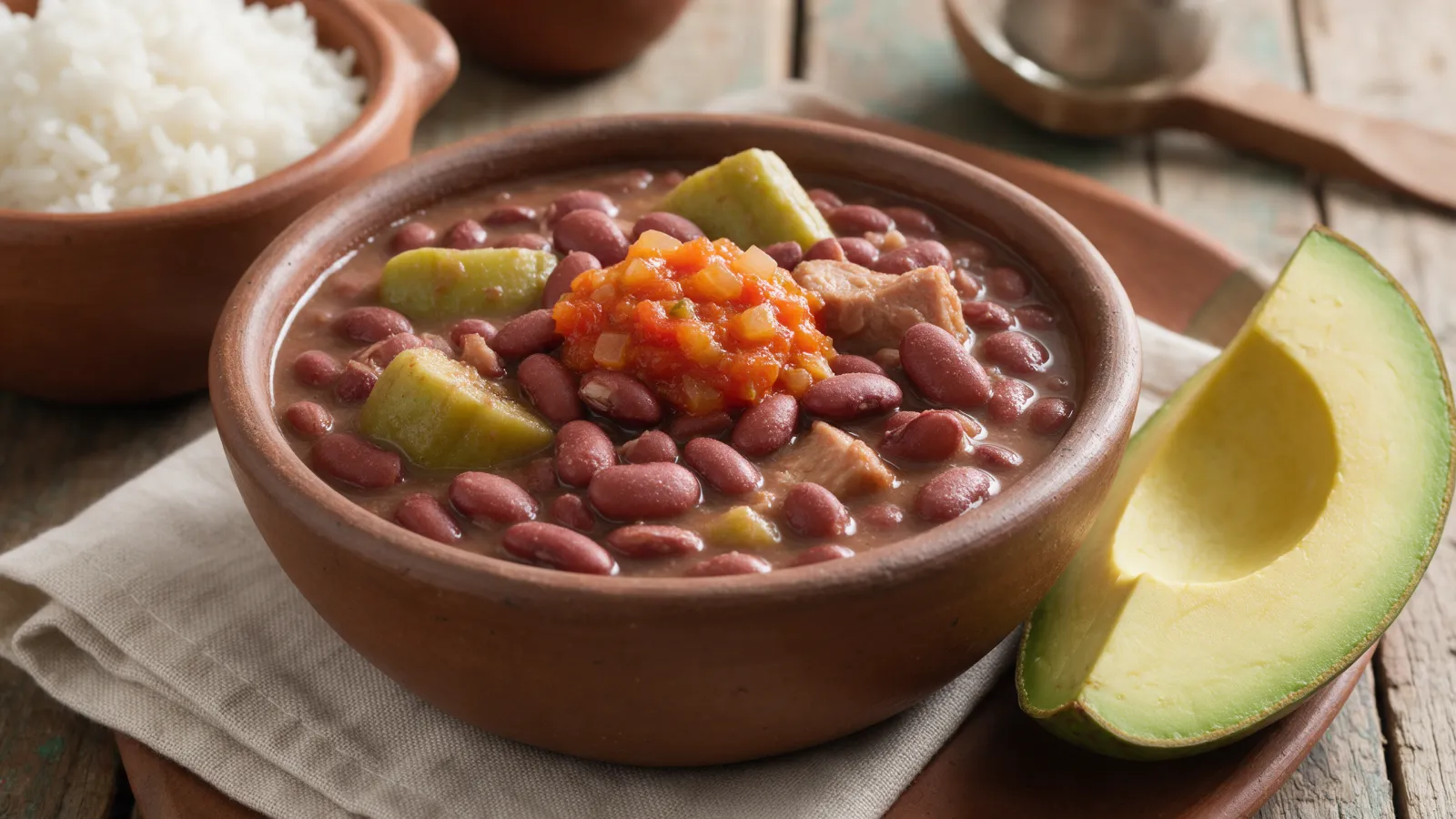

In Medellín, a bowl of beans comes in a thick, brick-red, pork-scented broth, and the thickener is green plantain, not flour. In Antioquia, the region around Medellín, they’re called frisoles antioqueños and they’re the everyday lunch, the base of the famous bandeja paisa platter, and the pot that gets made on Sunday to last the week. Here’s what to buy if you can’t find Colombian beans, how long they take on the stove, in a pressure cooker and in an Instant Pot, and how to keep the broth thick without turning it into paste.
What are Colombian red beans, and are they worth the soak?
How do you make Colombian red beans? Soak cranberry or cargamanto beans overnight, then pressure-cook them with pork belly for 40 minutes (25 in an Instant Pot). Add chunks and gratings of green plantain, carrot and hogao, a tomato and scallion sofrito with cumin, and simmer uncovered for 25 minutes until the broth thickens. 105 minutes for 8 servings.
They’re a pot of large, mottled beans in their own thick broth, eaten from a deep bowl next to white rice. The bean in Colombia is cargamanto, a big cream-and-red speckled variety; the pork is either fresh belly or a pig’s foot (garra); and the flavor base is hogao, Colombia’s tomato and scallion sofrito.
Why make them. One pound of dried beans gives you 8 bowls of about 13 oz (375 g), with leftovers that keep 3 to 4 days in the fridge and freeze well. The hands-on time is about 35 minutes.
Why you might not. You need to soak the beans the night before. If you don’t eat pork, the recipe works without it (see the versions below), but the broth is plainer. And if you want something spicy, this isn’t it: Colombian beans are mild, with hot sauce on the side.
Honest difficulty, easy. Nothing here is technical. The one thing that can’t be fixed at the stove is an old bag of beans, which never softens properly.
Which beans to buy in the US or UK
Cargamanto beans are sold dried in some Latin grocery stores, but you don’t need them. The closest match is the cranberry bean (sold as Roman beans by Goya in the US) or the Italian borlotti in the UK: same size, same mottled skin, same creamy inside.
What changes with each swap is mostly the broth. By the USDA FoodData Central numbers, dried cranberry beans have 24.7 g of fiber per 100 g, against 15.2 g for red kidney beans, and kidney beans have a thicker skin that releases less starch. With kidneys the broth comes out clearer; add all the grated plantain and mash a ladle of beans at the end. Pinto beans are smaller and floury, so they break down sooner and thicken faster. Canned beans work for a weeknight version, below.
Buy beans from a bag with a recent date. Beans more than a year old take far longer to soften, and some never get there.
Green plantain, the thickener
A green plantain looks like a big, hard, green banana and is sold in most US supermarkets and in UK greengrocers and larger supermarkets. It must be fully green and firm: once it starts to yellow, it sweetens the broth and thickens less. Raw green plantain carries 36.7 g of carbohydrate per 100 g by the USDA’s numbers, almost all of it starch.
It goes in twice. Rough, thumb-sized pieces of about ¾ in (2 cm), broken rather than cut, so the ragged surface sheds starch. Finely grated, for the last 10 minutes, so it melts into the broth. No plantain? I’ve used one grated russet potato; it thickens about the same and tastes of less.
Pork belly or a pig’s foot
Fresh, unsmoked pork belly is the easy option at any butcher counter. A pig’s foot gives more collagen and a stickier broth; it’s leaner too, with 212 kcal and 12.6 g of fat per 100 g raw against 518 kcal and 53 g for belly, by the USDA’s figures. I give a pig’s foot 20 minutes at pressure on its own before the beans go in, because it takes longer to soften. Skip smoked ham hocks and smoked bacon: they turn the pot into a different dish.
The schedule, and how long beans take in each pot
About 1¾ hours start to finish in a stovetop pressure cooker, roughly a third of it hands-on, plus the overnight soak. The hogao and the plantain prep both fit inside the 40 minutes at pressure.
| Method | Bean cooking | Total | What you get |
|---|---|---|---|
| Stovetop pressure cooker | 40 min + 10 natural release | 1 h 45 | whole, creamy beans; broth thickened by plantain |
| Instant Pot | 25 min high + 15 natural release | 1 h 50 | creamy beans; broth a bit thinner, nothing evaporates |
| Dutch oven or stockpot | about 2½ h at a gentle simmer | about 3 h | the thickest broth, since it reduces |
| Canned beans | none | 40 min | soft, broken beans; good for a weeknight |
Published Colombian recipes give 30 to 45 minutes at pressure for soaked cargamanto, depending on how hard the beans are; I set 40 and taste. The Instant Pot figures are what work in mine. For the canned version, drain about 2.6 lb (1.2 kg) of canned cranberry, pinto or kidney beans (three 15-oz cans), add the hogao, the grated plantain and 3 cups (750 ml) of water, and simmer 30 minutes.
Make ahead. The soak and the hogao (3 days in the fridge, covered) are obvious. The whole pot is better on day two: thicker, rounder. Don’t peel the plantain ahead; it blackens within the hour.
How to tell it’s going right.
| Stage | What you should see |
|---|---|
| After soaking | beans nearly doubled, skins smooth, not wrinkled |
| After pressure | a bean crushes between tongue and palate; a chalky center needs 5 to 10 more minutes |
| Hogao, 12 min | no tomato pieces left, red oil at the edge of the pan |
| Plantain, 20 min | chunks pierce easily; broth turns from clear to opaque |
| Done | broth coats the back of a spoon and clings to rice |
Mistakes, spice level, kids and allergens
- Beans won’t soften → old beans, short soak or very hard water. More pressure barely helps an old bean; buy a fresh bag and soak 12 hours.
- Watery broth → not enough plantain, or the lid stayed on. Add grated plantain, mash a ladle of beans and simmer uncovered until the broth coats a spoon, usually under 10 minutes.
- Thick as paste → too much grated plantain or too long. Stir in 1 cup (250 ml) of hot water.
- Scorched bottom → grated plantain settles. Scrape every 5 minutes over medium heat.
- Foam spitting from the valve → the cooker was more than half full; pressure cooker manuals cap beans at half. Take it off the heat, let the pressure drop, clean the valve and cook in two batches.
Heat level, none. Nothing in the pot is hot. Colombian tables put ají, a vinegary chile sauce, on the side.
Kids. Usually a hit: mild, slightly sweet from the plantain and carrot, creamy beans. Cut the pork small or leave it out of their bowl.
Allergens. No gluten, dairy, egg, nuts or fish. Check the label on ground cumin if you cook for someone with celiac disease.
Versions for weeknights, crowds and vegetarians
- Weeknight → canned beans with hogao and grated plantain, 40 minutes.
- No pressure cooker → a heavy pot, about 3 hours total, topping up with hot water and stirring every 20 minutes.
- Forgot to soak → in my cooker, about 70 minutes at pressure; the beans split more and cook less evenly.
- For 12 → 750 g (1.65 lb) beans, 375 g (13 oz) pork belly, 1½ plantains, 3 liters (3 quarts) of water in a 10-quart cooker or two batches in a 6-quart. Same timings.
- For 20 → 1.25 kg (2.75 lb) beans in a 16 to 20-quart stockpot on the stove, about 3 hours, made the day before.
- Lighter → pig’s foot instead of belly, or lift the belly out before serving. Leave the pork out and a bowl comes in around 311 kcal with 4 g of fat.
- Vegetarian or vegan → no pork, 3 extra tablespoons of oil in the hogao and ½ teaspoon of annatto (achiote) for color. The plantain still carries the broth; the flavor is flatter.
How they compare to beans you know. Mexican refried beans are mashed and fried into a paste; Venezuelan black beans use black beans and a sofrito, no plantain. Colombian red beans are a spoon dish with a thick broth, closest in spirit to a Louisiana red beans and rice, minus the smoked sausage.
What one pot costs
At the US city average prices the Bureau of Labor Statistics published for August 2026, dried beans were $1.630 per pound, so the 1.1 lb here cost $1.79. Tomatoes were $1.977 per pound: $1.30 for 0.66 lb. The BLS doesn’t track fresh pork belly, but it does track sliced bacon, at $6.605 per pound, so if you used 0.55 lb (250 g) of unsmoked bacon instead, that’s $3.63.
What drives the price. The pork, which costs about twice the beans. Plantain, carrot and scallions add little and aren’t tracked by the BLS. The same split shows up in Colombia: at Medellín’s wholesale market in September 2026, the pork belly and the beans for this pot each made up 42 % of the cost.
Yield. 8 bowls of about 13 oz (375 g). As a side for a bandeja paisa, with half a portion each, it serves 12.
How to serve and store them
Taste and texture. Creamy beans that hold their skins, a red, thick broth tasting of pork, cumin and tomato, tender bits of plantain and carrot. The grated plantain disappears.
How they’re served in Medellín. In a deep bowl, with Colombian white rice beside it or spooned in, sliced avocado, a thin unsalted arepa and ají on the side. Add fried ripe plantain, ground beef, crispy pork belly and a fried egg, and you’re most of the way to a bandeja paisa. Twice-fried green plantain patacones are another good side, and a cup of Colombian mazamorra, cracked corn in milk, is the Antioquian way to finish.
Fridge. Per the USDA Food Safety and Inspection Service: no more than 2 hours at room temperature, then 3 to 4 days at 40°F (4°C) or below. Cool them in containers no deeper than 3 inches (7.5 cm).
Freezer. 2 to 3 months for best quality, FSIS’s figure for stews with meat. I freeze them flat in bags, two bowls per bag, with plenty of broth. The plantain holds up; the carrot softens a little.
Reheating. They thicken overnight. Add ¼ cup (60 ml) of water per cup of beans and heat over low, stirring, until bubbling or 165°F (74°C) in the center. From frozen, thaw overnight in the fridge or warm straight from the bag in a covered pot with a splash of water. Leftovers fried with rice, egg and hogao become Colombian calentado, the breakfast built from yesterday’s lunch.
Frequently asked questions
What beans are used in Colombian red beans? Cargamanto, a large mottled red-and-cream bean. In the US use cranberry beans (Goya sells them as Roman beans); in the UK, borlotti. Red kidney and pinto beans also work, with a clearer broth.
How long do Colombian beans take in an Instant Pot? Soaked, 25 minutes on high pressure with a 15-minute natural release, then the plantain, carrot and hogao on sauté, uncovered, for 25 minutes.
Do I have to soak the beans? Soaking gives even cooking and whole beans. Unsoaked, plan on about 70 minutes at pressure in a stovetop cooker, and expect more split beans.
How do Colombians thicken bean broth? With green plantain: chunks for body, grated for the last 10 minutes, plus a ladle of mashed beans if needed. No flour or cornstarch.
Can I use bacon or ham hock? Unsmoked bacon is a fair stand-in for fresh pork belly. Smoked bacon or ham hock change the flavor enough that it stops tasting Colombian.
Can you freeze Colombian beans? Yes. Freeze in portions with plenty of broth and use them within 3 months. Reheat over low heat with a little water.
Are Colombian red beans spicy? No. Any heat comes from ají on the side.
Nutrition
Per bowl, about 13 oz (375 g) without rice or sides, calculated ingredient by ingredient from USDA FoodData Central (SR Legacy) for the pork belly version, using cranberry beans for the bean and including the 2 teaspoons of salt:
- Calories: 473 kcal
- Protein: 19 g
- Carbohydrates: 54 g
- Fat: 21 g, of which 7 g saturated
- Fiber: 17 g
- Sodium: 610 mg
Most of the fat is the pork belly; without it a bowl drops to about 311 kcal and 4 g of fat. That fiber alone is well over half the 28 g Daily Value on US labels. A cup of cooked white rice alongside adds about 205 kcal.
I grew up in Venezuela with black beans, and the first time I ate these in Medellín I couldn’t work out where the thickness came from until I watched someone grate a green plantain into the pot. Now a one-pound pot goes on almost every Sunday, half of it eaten by midweek and the other half frozen flat for the busy days. Josnaisis.