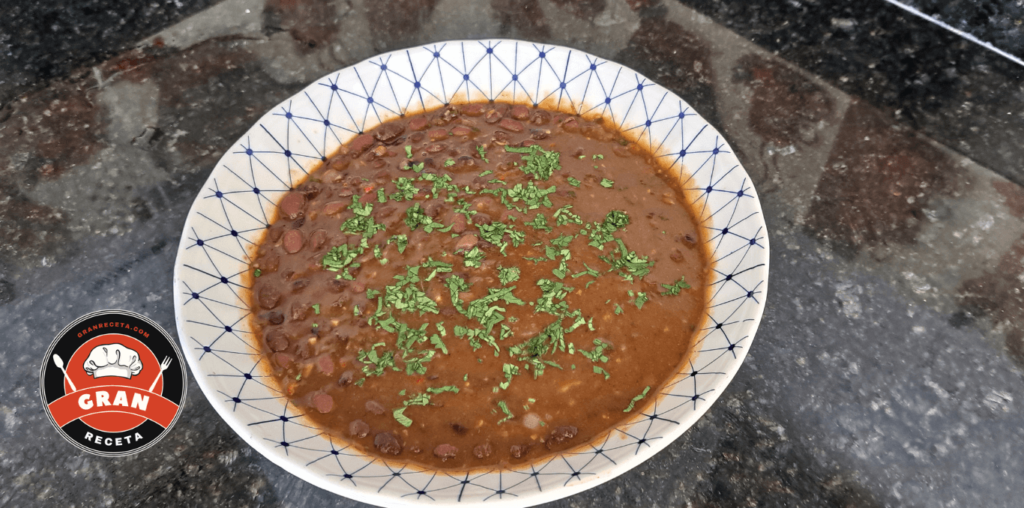
The rule everyone repeats about beans has it backwards, and it costs about 1 hour of pointless simmering. Salt does not toughen them; acid does, which is why tomato belongs at the end of this pot and salt can go in with the water. That single correction is worth an hour of frustration, and it matters most in a dish like this one, where the beans have to end up soft enough to crush. These are Venezuelan caraotas negras, finished with 1½ oz of panela, and the faint sweetness is exactly what tells them apart from every other black bean in the Americas. Six servings, 9 g of fiber each.
How do you make Venezuelan black beans? Soak the beans 8 hours, cook them 90 minutes in fresh water until they crush between your fingers, and add a sofrito of onion, bell pepper and sweet peppers. Crush a cup of beans to thicken, then stir in grated panela off the heat. 590 minutes in total for 6 servings.
What actually keeps beans hard
Salt is the usual suspect and it is innocent. Salted water does not stop a bean absorbing water, and cooking beans unsalted only means seasoning them later, when they no longer take it in and the pot ends up salty outside and bland inside.
Acid is the real culprit. Tomato, vinegar or lime strengthen the pectin in the skin, and beans started in a tomato base can still be firm after 2 hours. Hard water is the second cause, because calcium firms the skin, and old beans are the third: once a bean has dried out on a shelf for a couple of years, it never fully rehydrates.
How much soaking saves
Eight hours of soaking cuts cooking time by roughly a third: two and a half hours on the stovetop become 90 minutes, and an hour at pressure becomes 35 minutes. Evenness is the other benefit, since unsoaked pots always have some beans collapsing while others stay firm.
If you forgot, the hot soak works: cover the beans with boiling water and leave them 1 hour covered. It is not quite the overnight version, but it recovers most of the time.
The sweetness, and why it belongs
Venezuelan black beans are faintly sweet and Cuban ones are not, and that is the clearest line between two otherwise similar pots. It is 1½ oz of panela for 1 lb of dried beans, stirred in off the heat, which works out to about 6 g of sugar per serving.
The point is contrast rather than dessert. Against cumin, garlic and sweet pepper, that background sweetness reads as depth, and it is the thing Venezuelans notice immediately when a plate of beans does not have it. Panela is sold in Latin markets as panela or piloncillo; dark brown sugar is a fair substitute.
Shopping notes for a US kitchen
Ají dulce, the small aromatic pepper that carries no heat, is the one ingredient worth hunting for, and it turns up frozen in Latin markets. The bags of mini sweet peppers sold in most supermarkets are the closest easy substitute: use 4 of them, seeds removed.
Dried beans are otherwise the whole shopping list. Canned black beans can stand in when time is short, two 15 oz cans drained, added to the sofrito with a cup of water and simmered 15 minutes, though the broth never gets the body that comes from cooking your own.
Thickening without flour
Venezuelan beans are served soupy but with body. The way to get there is to crush about a cup of the cooked beans against the side of the pot and stir them back in: the released starch thickens everything without changing the flavor.
Ten uncovered minutes at the end finish the job by evaporation, reducing roughly 1 cup of liquid. That is better than any added thickener, because flour flattens both the sweet peppers and the panela.
What these beans give you
One serving carries about 9 g of fiber, close to a third of an adult’s daily recommendation. According to the USDA, cooked black beans provide 8.86 g of protein and 8.7 g of fiber per 100 g at 132 calories, numbers very close to red kidney beans, lentils and chickpeas.
Served with white rice, the combination also covers the amino acids the legume lacks on its own, which is the nutritional reason half a continent eats rice and beans without ever having worked it out on paper.
Who this recipe is for
- If you forgot to soak → cover the beans with boiling water and wait 1 hour before cooking
- If you cannot find ají dulce → 4 mini sweet peppers, or ½ tsp sweet paprika plus an extra half bell pepper
- If you have no panela → dark brown sugar or 2 tsp of molasses play the same part
- If you use an Instant Pot → 35 minutes at pressure with soaked beans, adding the sofrito afterwards
- If they are for pabellón → reduce 5 minutes longer so they sit thicker on the plate
Make ahead, storage and reheating
Beans are the definition of a make-ahead dish: they keep 4 days in the fridge and genuinely improve, since the broth thickens and the seasoning settles. One pound of dried beans gives 6 generous servings, which covers half a week of lunches.
They freeze 3 months in their broth without the beans breaking down, which almost nothing else does this well. Reheat over low heat with a splash of water, and expect to add a pinch of salt, since cold dulls it.
What goes wrong
Tomato added early. Acid firms the skin and the beans can still be hard 2 hours in.
Cooking unsalted and salting at the end. The bean no longer absorbs, so the pot tastes salty outside and flat inside.
Too much baking soda. Half a teaspoon softens; more leaves a soapy taste and breaks the beans apart.
A hard rolling boil. Skins split and separate; keep it at a medium simmer with the lid ajar.
Too much panela. 1½ oz per pound of beans; double that and it becomes dessert.
Variations
With smoked pork chop. 7 oz in the pot, giving a smoky broth and about 80 calories more per serving.
With coconut milk. ¾ cup at the end, in the style of Venezuela’s eastern coast.
Without the sweetness. The Colombian Caribbean version runs savory, with more cumin and no panela.
Refried. Next day, leftovers mashed and fried in a little oil, which is how they turn up at breakfast.
What to serve them with
These are one of the four parts of Venezuelan pabellón criollo, alongside white rice, shredded beef and fried sweet plantain, at about 5 oz a person. They are also a meal on their own with Colombian white rice and grated cheese, which is the Venezuelan weekday lunch, or beside Venezuelan ham bread at Christmas.
With a Colombian cheese arepa they make a light dinner, and leftovers go inside an arepa the next morning. For the Colombian take on the same legume, Colombian lentils with chorizo are the weekday pot and the beans in a Colombian bandeja paisa are cooked with pork and no sweetening at all.
Frequently asked questions
Does salt toughen beans? No. Acid from tomato or vinegar does, and it goes in at the end. Salt can go in from the start.
How long should they soak? Eight hours in cold water. If you forgot, 1 hour in boiling water recovers most of the time.
Why are my beans still hard after hours? Tomato added early, hard water, or old beans that no longer rehydrate.
How much panela goes in? 1½ oz per 1 lb of dried beans, off the heat. It should register at the end of the bite, not dominate.
Can they be frozen? Yes, 3 months in their broth. They thaw without the beans falling apart.
Nutrition
Per serving, a sixth of the pot, calculated with the USDA database for the beans, sofrito and panela:
- Calories: 250 kcal
- Protein: 13 g
- Carbohydrates: 40 g
- Fat: 4 g, of which 1 g saturated
- Fiber: 9 g
- Sodium: 380 mg
- Sugars: 6 g, from the panela
This has one of the best fiber-to-calorie ratios on the site: per the USDA they carry more fiber per calorie than almost anything else in a normal shopping basket. The fat is almost entirely the oil in the sofrito, and the sugar is the panela divided across 6 servings.
In my house caraotas were a Monday thing, and the panela was not up for debate: my mother said beans without it were just beans, not caraotas. The first time I served them in Colombia there was a silence at the table until someone said they tasted like dessert. Now I make two pots when guests come from both countries. Josnaisis.