
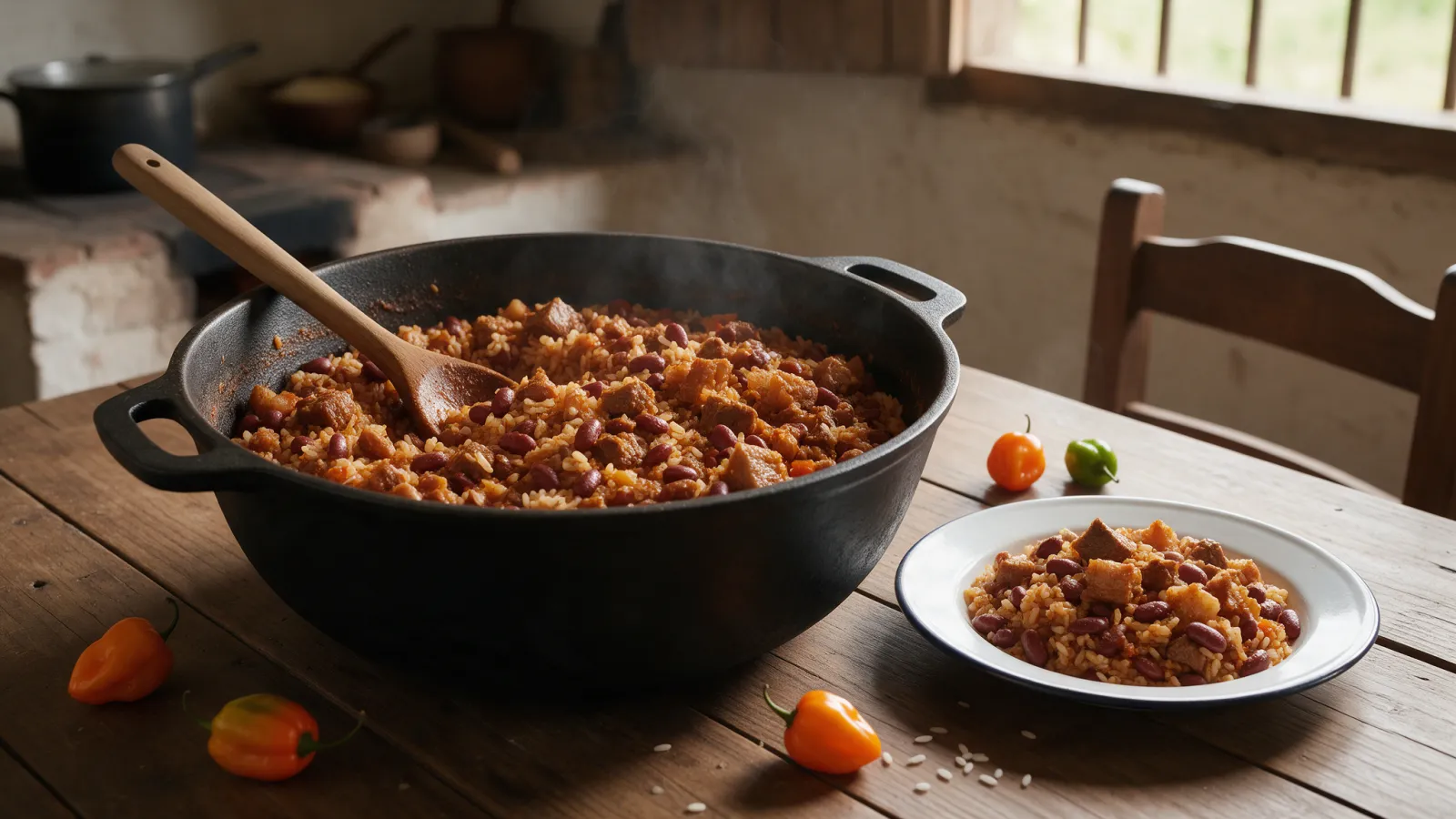

Two cups of rice, 3½ cups of the beans’ own cooking liquid and 10.5 oz (300 g) of dried red beans: that ratio decides whether palo a pique (PAH-loh ah PEE-keh) comes out loose and glossy or turns into a soggy mass. The dish is Venezuelan rice and beans with the meat cooked into the pot, from the Llanos, the country’s cattle plains, and the Guayana region in the southeast. Beef, a little pork belly, a sofrito of onion, sweet ají dulce peppers and annatto oil, and the rice simmered in the bean liquid so every grain turns red-gold. Below is the 140-minute plan for 6, the reason red kidney beans get a 10-minute hard boil, a safe way to keep and reheat the rice, and amounts for up to 20.
How do you make Venezuelan palo a pique?
How do you make palo a pique? Soak red kidney beans overnight, boil them hard for 10 minutes and simmer 80 more. Meanwhile brown pork belly and beef cubes in annatto oil, cook a sofrito of onion, peppers and tomato, and braise the beef covered. Toast the rice in the pot, add the beans and 3½ cups of their liquid, boil uncovered 8 minutes, then cover on low for 20. 140 minutes for 6 servings.
What palo a pique is, and why no two pots are alike
At its core, palo a pique is rice, beans and meat from a single pot, and Venezuelan cooks disagree on almost everything else. It’s worth knowing before you shop.
- The beans. The bean varies, with at least 4 kinds in use, but it is usually a reddish one. Venezuelan cooks use red, bayo (a tan bean) or pinto; some use white beans, and you’ll even see black-eyed peas. What you won’t see in a Venezuelan pot is black beans.
- The meat. Fresh beef or salted dried beef, with pork chop, smoked pork or pork belly. Leftovers from a barbecue often go in.
- The rice. Some cooks simmer raw rice in the pot, which is what I do. Others fold in cooked rice, often from the day before. In Barinas some cooks skip the rice in the pot altogether and serve beans stewed with pork.
How it differs from pabellón, moros and gallo pinto
Venezuela’s best-known rice-and-beans plate, pabellón criollo, keeps everything separate: black beans, shredded beef, white rice and fried plantain side by side. Cuban moros y cristianos is closer in technique, because the raw rice cooks in the black beans’ liquid, but the basic version has no meat in the pot; congrí, from eastern Cuba, uses red beans. Gallo pinto, from Costa Rica and Nicaragua, mixes cooked beans into rice that is already cooked. Palo a pique is the one of the four that cooks the beef with the rice.
Is it worth making, and who is it for?
Yes, if you want a one-pot meal for 6 that needs nothing on the side. It suits a weekend lunch or a crowd of 12 to 20, since it’s served straight from the pot.
It is not a 30-minute dinner unless you already have cooked beans and leftover rice. From dried beans it takes 140 minutes, about 60 of them hands-on, plus a soak the night before that takes 2 minutes of work. The only part that can fail is the rice: too much liquid, or stirring after the lid goes on, and it goes soft.
Shopping at a US or UK store
| What the recipe calls for | What to buy | What changes |
|---|---|---|
| Caraota roja (Venezuelan red bean) | Red kidney beans or small red beans, sold everywhere in the US and UK; pinto works too | Kidney beans hold their shape best; pinto comes out paler |
| Tocino (fresh pork belly) | Pork belly from the butcher counter, or slab bacon | Bacon adds smoke and salt; cut the salt to 1 tsp |
| Ají dulce | Mini sweet peppers, sold in 1 lb bags in US supermarkets | You get the sweetness, not the floral aroma. Never habanero: it looks similar and is very hot |
| Onoto | Annatto (achiote) seeds, or 1 tsp ground achiote | Without it, ½ tsp sweet paprika gives color but a different taste |
| Papelón | Piloncillo in Mexican aisles, panela, or dark brown sugar | Only ¾ oz (20 g) goes in, so any of them works |
| Carne de res para guisar | Beef stew meat or chuck, in UK stores “braising steak” | In my kitchen, lean cuts like round come out dry after the 34-minute braise |
If you only find canned beans, use two 15-oz (425 g) cans, drained and rinsed, and beef or chicken stock instead of bean liquid. Canned kidney beans are already cooked and don’t need the hard boil. The dish comes out paler and a bit thinner in flavor, and you skip the soak.
Leftover shredded beef works too: add it with the sofrito only to heat through and skip the braise. With salted dried beef, desalt it first the way I do for Venezuelan pisillo.
The cooking-day plan
Everything for the beef, from the annatto oil to the covered braise, fits inside the beans’ 80-minute simmer, so the stove is doing most of the work.
Make-ahead. Soak the beans the night before, always. For a short serving day, cook the beans the day before and refrigerate them in their liquid, and braise the beef with its sofrito too. On the day, only the rice is left: about 45 minutes from cold pot to table.
How to tell each stage is right.
- Beans — at 90 minutes a bean squashes flat between your fingers with no chalky center. Kidney beans are slow: soaked ones take 1½ to 2 hours on the stove, so don’t panic if yours need longer.
- Annatto oil — deep red within 3 to 5 minutes. If the seeds darken and smell scorched, start again; burnt annatto is bitter.
- Beef — after 34 minutes it gives to a fork and there’s about ½ inch (1 cm) of juice left. More than that, reduce it uncovered.
- Uncovered boil — after 8 minutes the liquid sinks below the rice and small craters open on the surface. Cover now.
- Done — after the rest, the grains are separate and tender, with a thin toasted crust on the bottom that isn’t black.
Why 3½ cups of liquid and not 4
For plain white rice I use a 1 to 2 ratio by volume. Here I drop it to 1 to 1¾, two cups of rice to 3½ cups of bean liquid, because the beef braise already leaves about ½ inch (1 cm) of juice and the tomato releases water as it cooks. With 4 cups mine comes out wet. Home versions range from 1 to 1, with very juicy meat, to 2.4 to 1, which gives an almost soupy rice. The cooked beans don’t absorb any more liquid, so they don’t count; the bean liquid itself is what colors the rice, which is why I don’t swap it for water.
Why red kidney beans need a 10-minute hard boil
Raw red kidney beans carry more phytohaemagglutinin, a lectin, than almost any other bean. A boil at 212°F (100°C) for at least 10 minutes destroys it; as few as four undercooked beans can cause nausea, vomiting and diarrhea, and a slow cooker leaves beans at around 167°F (75°C), which isn’t hot enough. It’s the same rule I follow for frijoles de la olla. A pressure cooker runs above 212°F, so it takes care of the problem on its own.
Four ways to make it
The pressure cooker route: soaked beans cook in about 25 minutes at pressure while the beef braises on the stove; then the rice goes in the wide pot as usual. The leftover-rice route: braise the beef with the sofrito, add 4 cups of cooked beans with a splash of their liquid and 6 cups of cold cooked rice, and heat covered for 5 to 10 minutes, stirring. That rice must have gone into the fridge within 2 hours of cooking.
Scaling for 4, 6, 12 or 20
| Serves | Dried beans | Rice | Beef + pork belly | Bean liquid for the rice | Pot |
|---|---|---|---|---|---|
| 4 | 7 oz (200 g) | 1⅓ cups (250 g) | 9.5 oz (270 g) + 2.5 oz (70 g) | 2⅓ cups (560 ml) | 4 quarts (4 L) |
| 6 | 10.5 oz (300 g) | 2 cups (370 g) | 14 oz (400 g) + 3.5 oz (100 g) | 3½ cups (840 ml) | 5-6 quarts, wide |
| 12 | 1.3 lb (600 g) | 4 cups (740 g) | 1.75 lb (800 g) + 7 oz (200 g) | 7 cups (1.7 L) | 10 quarts, wide, or two 6-quart pots |
| 20 | 2.2 lb (1 kg) | 6⅔ cups (1.23 kg) | 3 lb (1.35 kg) + 11.5 oz (330 g) | 11⅔ cups (2.8 L) | two 8 to 10 quart pots |
A bigger batch doesn’t change the 20 minutes under the lid. What stretches is the uncovered boil: wait for the craters, which in my pot takes about 4 extra minutes for a double batch. Past 4 cups of rice I use two pots, since one deep layer cooks raw on top and sticks underneath. The beans for 20 can share one big pot, with 1 quart (1 liter) of water for every 5.3 oz (150 g) of dried beans.
What goes wrong
- Mushy rice → too much liquid, or stirring after covering. Measure 3½ cups and leave the lid alone.
- Raw rice on top → covered too early, or the pot is too narrow and the rice layer too deep. Wait for the craters; split big batches.
- Scorched bottom → heat too high under the lid. Use the lowest flame, a heavy pot or a heat diffuser.
- Hard beans → old beans or very hard water. Keep simmering in 10-minute rounds before the rice goes in, because they won’t soften further once they’re in the rice pot.
- Too salty → smoked bacon plus the full salt. With bacon, 1 tsp.
- Brown, not red → the annatto oil burned. It should be red, never brown.
It doesn’t contain gluten, dairy, egg, nuts or fish; check the labels on bacon, dried beef and stock cubes. Ají dulce isn’t hot, so the heat level is zero unless you bring hot sauce to the table.
What it costs
With US city-average prices, the pot comes to $16.05, about $2.68 a serving, and the beef is 47% of it. The beef, beans, bacon, rice and tomato prices are US averages for August 2026; the bell pepper, mini sweet peppers, onion, garlic, green onions and cilantro are supermarket prices from October 9, 2026. Bacon stands in for the price of fresh pork belly. Oil, annatto, cumin, piloncillo and salt aren’t included. Trading 3.5 oz (100 g) of beef for the same weight of extra beans keeps it filling and saves about $1.50.
Serving, storing and reheating the rice safely
Serve it in deep bowls straight from the pot. Venezuelan recipes put fried plantain, avocado or arepas alongside; I like a spoonful of guasacaca, the Venezuelan avocado sauce, for the acidity the pot lacks. If you know the Colombian side of the plains, this is the everyday pot to the festive llanero beef roast.
Fridge. Cool it in shallow containers and refrigerate within 2 hours. Cooked leftovers keep 3 to 4 days at 40°F (4°C) or below, but with rice I play it safer and eat it within 24 hours. Cooked rice is the classic home of Bacillus cereus, whose spores survive cooking and, if the rice sits warm for hours, make a toxin that reheating doesn’t destroy.
Freezer. Flat in freezer bags, 2 to 3 months for best quality. Thaw in the fridge. The beans hold up well; the rice softens a little.
Reheating. Add 2 to 3 tbsp of water per serving, cover, and heat over low heat or in the microwave until it reaches 165°F (74°C) in the center. Dry and over high heat, the bottom scorches before the middle is hot.
Frequently asked questions
What beans are used in palo a pique? Usually red, bayo or pinto beans; some versions use white beans. Red kidney beans are the easiest match outside Venezuela.
Is palo a pique the same as pabellón criollo? No. Pabellón serves black beans, shredded beef, white rice and plantain separately. Palo a pique cooks rice, red beans and beef together.
What’s the rice to liquid ratio when cooking rice with beans? For this pot, 2 cups of rice to 3½ cups of bean cooking liquid, with 10.5 oz (300 g) of dried beans, for 6 servings.
Can I use canned kidney beans? Yes, two 15-oz cans, drained and rinsed, with stock instead of bean liquid. They’re already cooked, so no hard boil is needed.
Do I have to soak the beans? It helps: 8 to 12 hours. Soaked, kidney beans need 1½ to 2 hours on the stove. Always start with a 10-minute hard boil.
Can I make it in a slow cooker? Not from raw kidney beans. A slow cooker doesn’t reach the 212°F (100°C) needed for 10 minutes. Cook the beans on the stove or in a pressure cooker first.
How long does it keep? With rice in the pot, I stick to one day. Cooked leftovers in general keep 3 to 4 days.
Nutrition per serving
Per serving (one sixth of the pot), calculated ingredient by ingredient from this recipe’s amounts, using raw red kidney beans, long-grain rice, beef chuck for stew and fresh pork belly:
- Calories: 652 kcal
- Protein: 33 g
- Carbohydrates: 91 g
- Fat: 18 g, of which 5 g saturated
- Fiber: 10 g
- Sugars: 8 g
- Sodium: 657 mg
The pork belly is 13% of the calories and half the fat; leaving it out and using 1 extra tbsp of oil for the annatto takes off about 66 kcal and 7 g of fat per serving. Almost all the sodium comes from the added salt, and the 10 g of fiber mostly from the beans.
When I first made palo a pique in Colombia, I measured the liquid the way I would for plain rice and got something closer to a soupy stew. The beef had already brought its juice to the pot. Now it’s 3½ cups, the lid stays shut, and the crisp layer at the bottom goes to whoever gets to the pot first. Josnaisis.