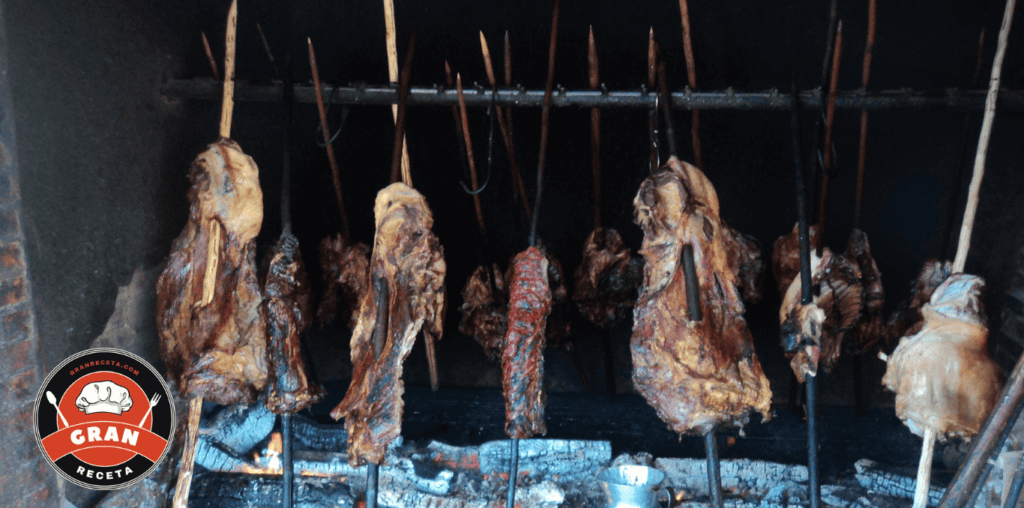
In the Colombian llanos the meat never sits over the fire. Stakes go into the ground at a slant around a bed of coals, and across four hours the beef takes its heat from the side, which is the whole method: slow, even, and with no flame close enough to char it. This is ternera a la llanera, the barbecue of Colombia’s eastern plains, made from a nursing calf under a year old and seasoned with salt alone. Twenty servings at 415 calories and 54 g of protein each.
How is ternera a la llanera cooked? Salt the cuts and chill them 12 hours. Burn hardwood down to flameless coals, drive stakes through the meat and plant them at an angle beside the fire. Roast 4 hours, turning every 40 minutes and never piercing the meat, then rest 15 minutes. 960 minutes in total for 20 servings.
What mamona means
Mamona is the llanero word for a calf still nursing, somewhere between nine and eleven months, and that age is the reason the dish works with salt alone. The fat in an animal that young is soft and spread through the muscle, so it renders slowly across the 4 hours and bastes the meat from the inside.
The word is also what you will hear at the roadside stands along the highway between Bogotá and Villavicencio, where the stakes are visible from the road, leaning around a fire, from mid-morning onwards.
The four llanero cuts
The llanos divide a calf into four named pieces, none of which appears on a butcher’s chart. La osa is the neck with jaw, tongue and dewlap; los tembladores are the chest and brisket meat; la raya is the hindquarters, rump and tail; la garza is the udder.
Each goes on its own stake and behaves differently. La osa is the most gelatinous, thanks to fat and collagen; la raya is the leanest, which is why it is cut with the skin still attached, working as a heat shield. Outside Colombia, where no one sells a calf broken down this way, short ribs and chuck are the closest match.
Llanero fire next to asado and smokers
If you have seen an Argentine asado al asador, you have essentially seen this: a carcass on an iron cross, leaning toward a bed of coals, cooked by radiant heat from the side for hours with salt as the only seasoning. The llanero version swaps the iron cross for wooden stakes driven into the earth, and that is most of the difference.
A Texas offset smoker is a different proposition. It runs at a measured 225 to 275 °F for 8 to 14 hours and treats smoke as the point. Here the smoke is light, the cook is 4 hours, and the flavor comes from the fat of a young animal rather than from the wood.
The fire, which is where it goes wrong
Almost nobody ruins this with seasoning; they ruin it with flame. The wood has to burn all the way down to coals under a layer of ash, which takes about 1 hour before the first stake goes in.
After that the job is keeping that bed steady by feeding it small pieces, not logs, because every fresh log raises flame. The distance of the stakes from the coals is the temperature dial: closer is faster with a risk of scorching, further away is a cook that never finishes.
The home version
The domestic equivalent of steady sideways heat is 300-320 °F for 3 to 4 hours, in an oven or a covered grill. The meat goes on a rack with a tray of water underneath so the air does not dry out, and it gets turned every 40 minutes just as the stakes would be.
At 355 °F the surface browns before the inside is ready, and at 430 °F it burns within 40 minutes. Below 250 °F does not work either: it takes over 6 hours and the meat dries by evaporation, which is the opposite of the point.
Shopping for it outside Colombia
For 20 people you need about 18 lb of bone-in beef. The mix that works is 9 lb of short ribs, 4.5 lb of chuck and 4.5 lb of brisket, which reproduces some of the range of textures that la osa, los tembladores and la raya give in the llanos.
Short ribs are the single best choice if you only buy one thing. The bone and the fat cap protect the meat across a long cook, and in Colombia the equivalent cut is also the cheapest of the four: per the DANE’s SIPSA bulletin for mid-September 2026, beef ribs sold in Barranquilla at roughly half the price of rump.
Who this recipe is for
- If you have no firewood → hardwood lump charcoal, same rule: ash-covered coals and never flame
- If you are cooking for 6 rather than 20 → 5.5 lb of short ribs in a covered grill at 300 °F for 3 hours
- If you have no covered grill → oven at 300 °F with a water tray; you lose the smoke, not the texture
- If you want to speed it up → you cannot; under 3 hours the collagen has not given and the meat is tough
- If there are leftovers → they keep 4 days refrigerated and get eaten cold and thinly sliced the next day
The clock, hour by hour
Sixteen hours counting the night before, of which 4 are fire. The 12 before that are salt working in the cold, and the hour in between is building the coal bed, which cannot be shortened.
During the roast the rule is not to touch the meat except to turn it. No piercing, no cutting, no checking the inside: every hole is an escape route for juice that is then missing on the plate.
What goes wrong
Cooking over flame. It chars the surface and leaves the center raw; the stake goes beside the fire, not over it.
Piercing the meat. Every hole releases juice that does not come back.
An uneven fire. If the coals drop, cooking stalls and the meat dries without finishing.
Carving immediately. Fifteen minutes of rest lets the juice redistribute.
Salting on the day. Salt needs the full 12 hours to penetrate; applied at the last minute it seasons only the crust.
Variations
With a marinade. Garlic, scallion, beer and thyme the night before, which is how many households outside the llanos do it.
Covered grill. Three hours at 300 °F with hardwood smoke, the closest urban adaptation.
Short ribs only. 9 lb of them instead of the mix; cheaper and the most forgiving over a long fire.
Oven. Three and a half hours at 300 °F with a water tray, no smoke but the same texture.
What to serve with it
In the llanos this comes with boiled cassava, small potatoes, roasted plantain and a fresh chili sauce, at about 6.5 oz of meat a person. Colombian patacones with hogao are the usual side once the table gets bigger.
If the fire is already going, a salt-crusted tenderloin cooks in 14 minutes on the same coals and beef skewers cover the first hours of waiting. For a Sunday that feeds the same twenty people without a fire pit, Colombian lechona does it from an oven, and cold Colombian rice pudding is what closes a four-hour roast.
Frequently asked questions
What is mamona? The llanero name for a still-nursing calf under a year old, the animal this roast is made from, chosen for its soft fat.
Why only salt? Because the fat of a young animal bastes the meat across the 4 hours. With a marinade, the dish tastes of the marinade.
Can it be done at home? Yes, in an oven or covered grill at 300-320 °F for 3 to 4 hours, with a water tray underneath.
How much meat per person? About 14 oz bone-in, which gives roughly 6.5 oz of meat on the plate.
How long does it really take? Four hours of fire, plus a 12-hour salting the night before and about an hour to build the coals.
Nutrition
Per serving of about 6.5 oz of roasted meat, one twentieth of the total, calculated with the USDA database for veal:
- Calories: 415 kcal
- Protein: 54 g
- Carbohydrates: 0 g
- Fat: 21 g, of which 8 g saturated
- Fiber: 0 g
- Sodium: 520 mg
This is the second highest-protein serving on the site: according to the USDA, cooked veal carries 30.1 g of protein and 11.39 g of fat per 100 g. The sodium figure is approximate, since it depends on how much of the salt crust stays on the cut.
The first time I watched a mamona in Villavicencio, what struck me was that nobody touched the meat for four hours. I came from a kitchen where everything gets checked, poked and tasted, and there the only job was turning the stakes and feeding the fire small pieces of wood. The man in charge told me the roast cooks itself if you let it, and he was right. Josnaisis.