

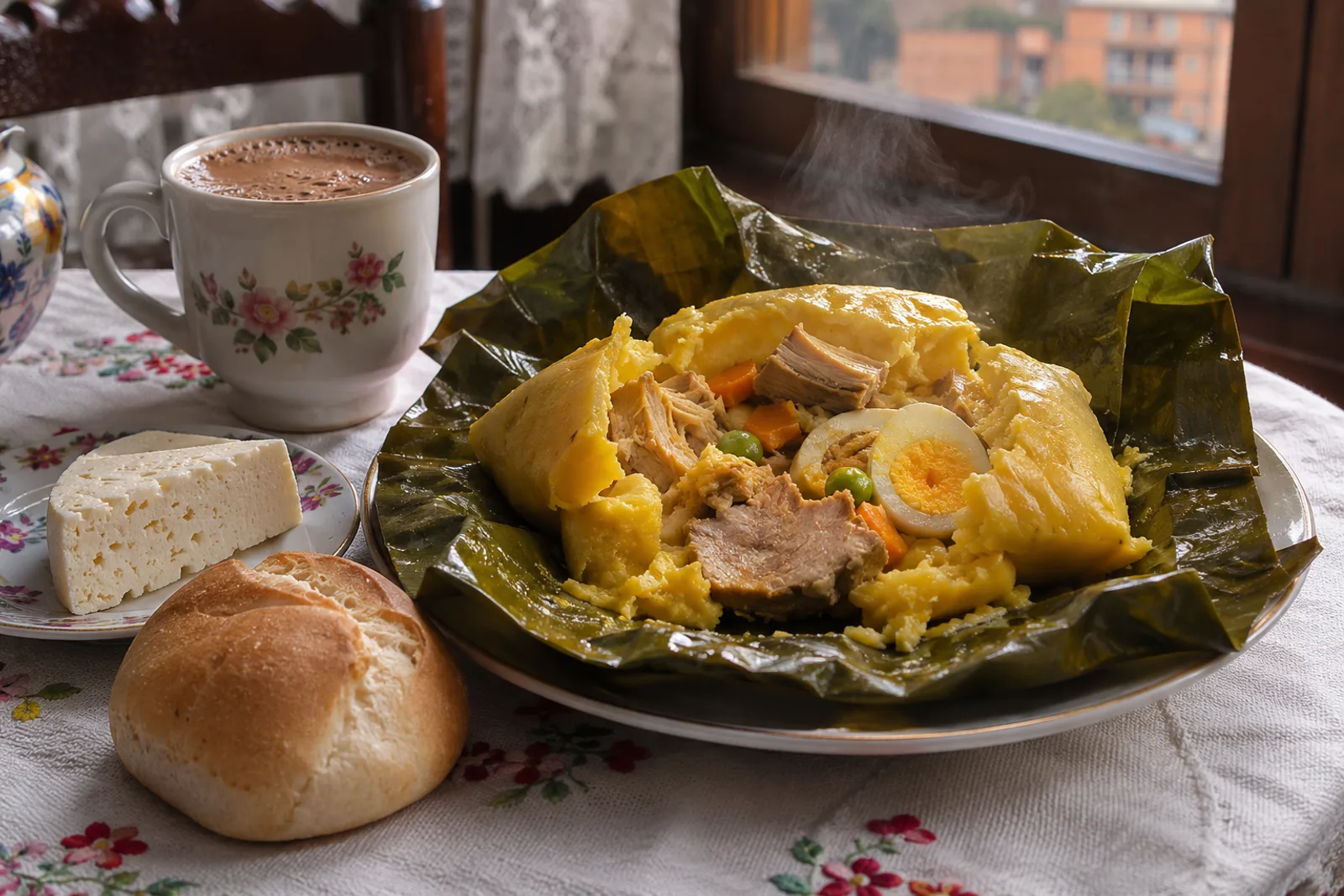

Bogotá-style tamales, called tamal santafereño or tamal bogotano in Colombia, are large banana-leaf parcels of soft yellow corn masa filled with a bone-in piece of chicken, pork ribs, pork belly, potato, carrot, peas and chickpeas, tied crosswise and simmered for about 2 hours. In Bogotá they are a weekend breakfast, served with Colombian hot chocolate with cheese and bread. Below is the recipe for 12, with US and UK shopping swaps, how to wrap and tie them so no water gets in, and the signs that tell you they are cooked through.
What a Bogotá tamal is, and how long it takes
How do you make Bogotá-style tamales? Marinate chicken, pork ribs and pork belly overnight. Next day, mix 600 g (1 lb 5 oz) precooked cornmeal with warm water, lard, hogao and peas into a soft masa, spread it on two crossed banana leaves, add the meats, potato, carrot and chickpeas, tie the parcel crosswise and simmer it covered for 2 hours. 250 minutes for 12 servings.
If your idea of a tamale is the small Mexican kind in a corn husk, this is a different animal. Each one weighs close to 500 g (about 1 lb), is opened on the plate and eaten with a knife and fork. The masa is soft and moist, seasoned with cumin and a tomato-onion base called hogao, and the chickpeas give it a bite that other Colombian tamales lack. It is not spicy.
Time. 250 minutes on cooking day: about 105 hands-on (leaves, masa and assembling twelve) and 145 for the hogao, the pot and resting, two hours of which is a covered pot. Add 10 minutes the night before to blend the marinade. Difficulty, medium. Nothing is technically hard, but it rewards planning and a firm tie.
Who it is for. A weekend breakfast for a crowd, or a freezer stash that lasts for months. If you want tamales on the table in an hour, this is not the recipe.
How it differs from other Colombian tamales
| Bogotá (santafereño) | Tolima-style | Valle del Cauca | Pipián, Popayán | |
|---|---|---|---|---|
| Masa | Precooked cornmeal, mixed raw with hogao, lard and peas | Hulled corn soaked 3 days and ground, with rice and dried peas | Ground hulled corn cooked into a thick porridge first | Precooked cornmeal with lard and annatto |
| Filling | Chicken, ribs, pork belly, chickpeas, potato, carrot; sometimes sausage | Chicken, ribs, pork belly, boiled egg, potato, carrot | Chicken, pork, ribs, potato, carrot, peas | Potato and peanut stew with pork |
| Shape | Rectangular parcel tied crosswise | Round bundle | Rectangle with two turns of twine | Small, snack-sized |
| Cooking | 2 hours simmered | 150 minutes | 120 minutes | 45 minutes steamed |
The giveaway is the chickpeas, and the absence of rice and egg. Some Bogotá families leave the chickpeas out and use only peas; it is still a santafereño. For an everyday all-pork version, see the Colombian pork tamales; for chicken only, the Colombian chicken tamales.
Ingredients for 12 Bogotá tamales, and US and UK swaps
Each tamal gets about 200 g (1 cup) of masa and one piece of each meat:
The cornmeal
You need precooked yellow cornmeal, sold as masarepa or harina precocida, the same flour used for arepas. In the US it sits in the Latin aisle of most large supermarkets; in the UK, look in Latin American shops or online. White precooked cornmeal works the same, just paler.
Do not swap in masa harina (the Mexican flour for tortillas): it is nixtamalized, tastes of tortilla and gives a denser masa. Regular cornmeal and polenta are not precooked and turn gritty.
Lard makes the masa tender and savory. Vegetable oil gives the same softness with a little less flavor.
The meat, by its supermarket name
- Chicken. Bone-in, skin-on thighs or drumsticks. They stay juicy through 2 hours of simmering; breast dries out.
- Pork spareribs, cut into bite-size pieces with the bone. Ask the butcher to saw them.
- Fresh pork belly, uncured. In Colombia this is called tocino. Do not use bacon or smoked streaky bacon: the smoke takes over the whole masa.
- Longaniza, optional. Colombian longaniza is a mild fresh pork sausage; fresh chorizo or kielbasa stand in. Any of them adds salt, so cut the masa salt by ½ tsp.
- Potatoes. Yukon Gold in the US or a waxy salad potato in the UK hold their slices; floury russets or Maris Pipers tend to fall apart.
Banana leaves, and where to buy them frozen
You need 24 rectangles of 40 to 50 cm (16 to 20 in), two per tamal, plus scraps for the bottom of the pot.
- US. Sold frozen in 1 lb (454 g) packs in the freezer section of Latin and Asian grocers, and in some large supermarkets. Buy three packs for this recipe: some leaves always tear.
- UK. Frozen in Asian and Latin American supermarkets, and from online specialist grocers.
- Thawing. Overnight in the fridge, then wipe and soften them over a flame like fresh ones.
Without banana leaves, foil keeps the water out, but the tamal loses the leaf’s aroma and the masa comes out paler. Corn husks are too small for a tamal this size.
Equipment. Your biggest lidded pot (all 12 need to lie flat with water over them), a large mixing bowl, a blender for the marinade and kitchen twine or thick cotton string. An instant-read thermometer helps with the final check.
Making Bogotá tamales, step by step
The night before, and the cooking-day order
Blending the marinade takes 10 minutes and is what seasons the meat all the way through. On the day, the order looks like this:
A soft, spreadable masa
The masa is not cooked beforehand. It is mixed with warm water, marinade, lard and half the hogao, and it sets inside the tamal. That is why it has to be softer than arepa dough, like a thick mash that spreads with a spoon and does not crack when you squeeze a bit between your fingers. If it splits, add water 60 ml (¼ cup) at a time and knead again. Ten minutes of rest evens it out.
Wrapping and tying
- Brush two leaf rectangles with a little oil and lay one across the other.
- Spread about 200 g (1 cup) of masa in the center, in a square about 12 cm (5 in) wide.
- Put the meats together in the middle, the potato, carrot and chickpeas around them, and a spoonful of hogao on top.
- Fold the sides of the bottom leaf over the filling, then the sides of the top leaf, as if you were wrapping a gift.
- Tie it crosswise: two turns of twine lengthwise and two across, finished with a firm knot.
If the filling shifts when you lift the tamal by its string, or you can see a gap, add a third leaf on the outside and tie again. A loose parcel lets water in and the masa comes out washed out.
Cooking, and how to tell they are done
Start the 2 hours once the water comes back to a boil with the tamales in. At high altitude, Bogotá included, water boils below 212°F (100°C) and the tamales may need a little longer: go by the checks below, not just the clock. Keep it at a gentle simmer, lid on, with water almost covering them; every 30 minutes check the level and top up with water that is already boiling so the pot never stops simmering.
Lift one out at 2 hours and let it sit 10 minutes before opening: straight out of the pot, the masa always looks soft. It is ready when:
- The masa is firm and comes away cleanly from the leaf.
- The center is not pasty or raw, and the color is an even yellow.
- The chicken pulls off the bone with a fork.
- With a thermometer, the thickest part of the chicken, away from the bone, and the center of the filling both read above 165°F (74°C), the safe temperature for chicken. Hot masa alone doesn’t prove it.
If the masa sticks or the middle is still raw, put it back and test another after 20 minutes.
What goes wrong with Colombian tamales
- Stiff masa, like arepa dough. The tamal comes out dry and crumbly. Keep it soft; it still absorbs meat juices in the pot.
- Loose tie. Water gets in, the masa washes out and the tamal tastes of boiled leaf. Two turns each way, and a third leaf if needed.
- Leaves not softened. They split when folded and water gets in through the crack. Pass them over the flame until glossy.
- The pot runs low. Two hours is long; if it boils dry, the bottom scorches and the lower tamales stay raw. Check every 30 minutes.
- Opening one hot. Two minutes out of the pot the masa looks raw and sticks to the leaf. Wait the full 10 minutes before you judge.
- Breast instead of thigh. Two hours of simmering leaves it dry and stringy.
Allergens and heat. Gluten-free as long as the cornmeal, annatto and sausage are (check labels). No dairy, egg or nuts. Not spicy at all, so most kids like it; for them, skip the pork belly and use small pieces.
Scaling up for 24 or 36 tamales
Multiply everything as is; what changes is the number of pots. The simmering time stays the same because it depends on the size of each tamal, not how many there are:
For a big batch, an assembly line works best: one person softens the leaves, one adds masa and filling, one ties. Nobody waits around and the masa does not dry out in the bowl.
Cost. The pork, especially the ribs and pork belly, is what drives the bill; chicken and cornmeal are the cheap part. To spend less, swap the ribs for more chicken and skip the sausage.
Lighter, pork-free and chickpea-free versions
- Lighter. Without the pork belly and with the same chicken pieces skinned, each tamal drops to about 610 kcal. The masa is a little less juicy; add 60 ml (¼ cup) more water.
- Chicken only, pork-free. Replace the ribs and pork belly with 12 more small chicken pieces (about 1.2 kg / 2.6 lb more). To leave out pork entirely, use vegetable oil instead of lard in the masa and skip the sausage.
- No chickpeas. Double the peas. Some Bogotá households make it this way, and it tastes milder.
- With sausage. The most festive version and the saltiest; cut the masa salt by ½ tsp.
Serving, storing and reheating
Serving. Open it on the plate and eat it off its own leaf. In Bogotá it comes with hot chocolate, a slice of fresh cheese and bread or an arepa; one tamal is a generous breakfast. For the rest of a Bogotá breakfast table, changua, the milk and egg soup, is the other classic. More dishes from the region are in Colombian highland food from Bogotá and Boyacá.
Fridge. In their leaves, in shallow sealed containers, spread out rather than stacked in the pot, refrigerate them promptly without waiting for the whole batch to cool, always within 2 hours of cooking. They keep 3 to 4 days.
Freezer. 3 to 4 months in sealed bags, still wrapped and tied: the leaf is the best packaging. Freeze them cooked and cooled.
Reheating. Still wrapped, in boiling water: about 15 minutes from the fridge and about 30 from frozen, no thawing needed. In the microwave, unwrapped on a plate and covered, at medium power in 2-minute bursts, turning the masa over in between. Either way, the center should reach 165°F (74°C).
Frequently asked questions
Is it the same as a Mexican tamale? No. Mexican tamales are usually smaller, steamed in corn husks, with a masa made from nixtamalized corn and lard beaten until fluffy. The Bogotá tamal is boiled in banana leaves, uses precooked cornmeal and carries bone-in meat and vegetables inside.
Do I cook the meat before assembling? No. It goes in raw, after marinating overnight, and cooks inside during the 2 hours in the pot. That is why the thickest part of the chicken and the center of the filling have to pass 165°F (74°C).
Can I make them in a pressure cooker or Instant Pot? It can work in small batches that fit under the max-fill line with water, but I have not timed it for a tamal this size. If you try it, open one and run the same doneness checks before taking the rest out.
Can I freeze them uncooked? Better not. Raw potato does not freeze well and raw masa weeps as it thaws. Cook them first, then freeze.
Nutrition per tamal
Per tamal (1 of 12, without sausage), worked out ingredient by ingredient from the quantities above:
- Calories: 899 kcal
- Protein: 34 g
- Carbohydrates: 66 g
- Fat: 55 g, including 17 g saturated
- Fiber: 8 g
- Sugars: 7 g
- Sodium: 1131 mg
The pork belly adds about 194 kcal per tamal, and the chicken skin a good part of the chicken’s 175; the lard, about 45. Sausage raises the fat and sodium. The cup of hot chocolate is extra.
I always tie mine crosswise with two turns each way, even if it uses more string, because one loose tamal in the pot is one tamal lost. And I stick with thighs, which come out juicy after two hours. Having grown up in Venezuela with hallacas, what struck me about this one is how different it is: less sweet, more like a hearty one-pot meal, and made to be eaten at breakfast next to a cup of chocolate. Josnaisis.