

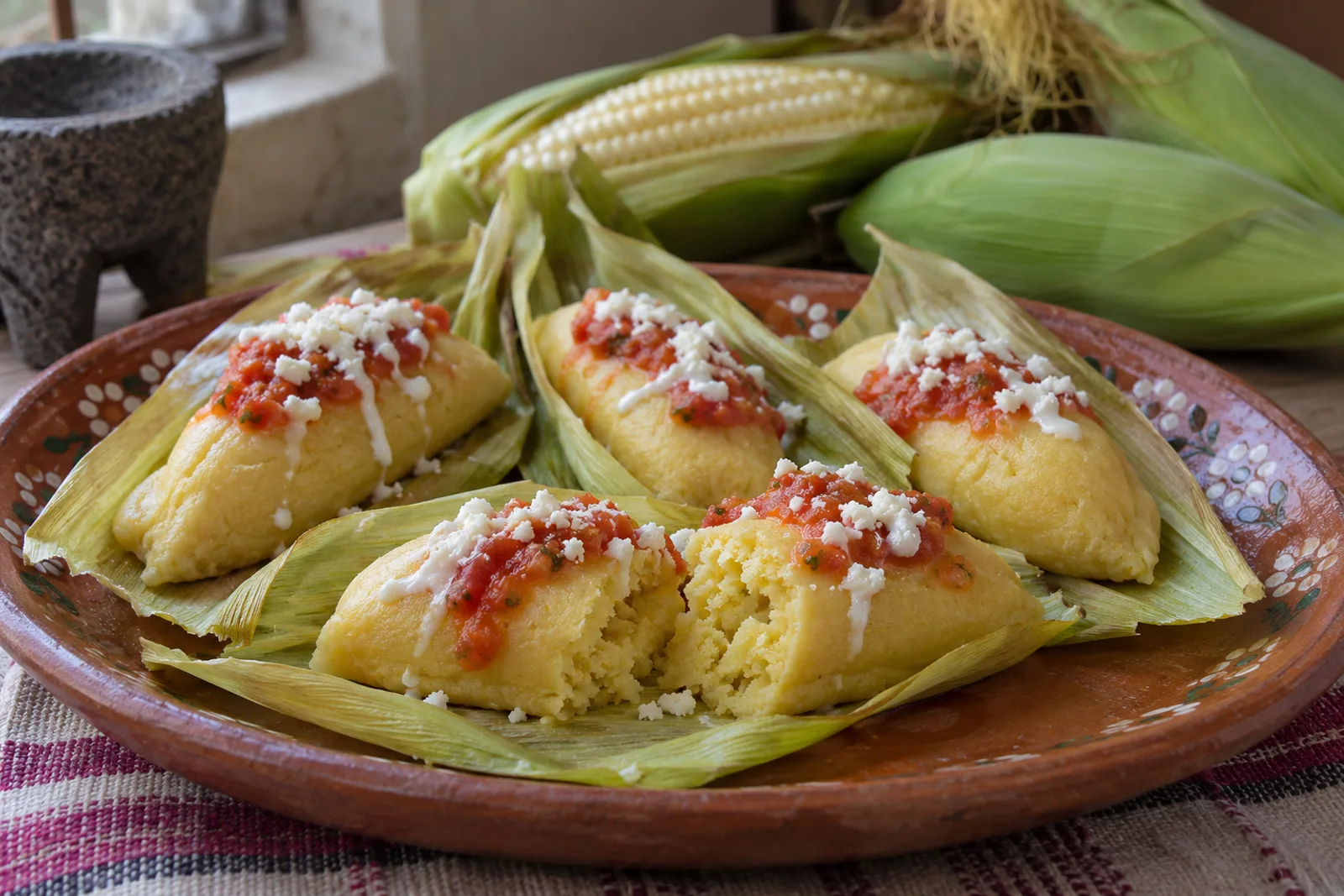

Uchepos (oo-CHEH-pohs) are the fresh corn tamales of Michoacán, in western Mexico: raw kernels ground with butter and salt, spread on the green husk of the same ears, folded with the top left open and steamed standing up. This version has no masa dough, no filling and no baking powder. They come out soft, creamy and corn-sweet, and get topped with crema, crumbled cheese and a cooked tomato salsa. The catch outside Mexico is the corn. American and British sweet corn is juicier and less starchy than Mexican field corn, so the batter often comes out too loose to set unless you correct it before wrapping. This recipe makes 18 and shows you how.
What uchepos are, and how long they take
How do you make uchepos? Blend 2.2 lb (1 kg) of raw fresh corn kernels with 4 tbsp (60 g) of butter and 1 tsp of salt into a thick paste, spread about ¼ cup on each fresh husk, fold it closed at the bottom and open at the top, and steam the 18 uchepos upright for 55 minutes, until the batter peels cleanly away from the husk. 130 minutes for 6 servings.
Total time 2 hours 10 minutes: an hour of hands-on work (husking, cutting, blending and wrapping) and 70 minutes of steaming and resting, during which you make the salsa. If the batter needs fixing (draining and adding masa harina), allow up to 30 minutes more. Medium difficulty: nothing is technical, but your first few folds will look clumsy.
Think of them as a corn pudding you can hold. They’re eaten for breakfast or supper in Michoacán, especially in the hot southern lowlands. Their highland cousin, the corunda, is a different tamal made from nixtamalized corn dough.
Other Latin American kitchens wrap fresh corn too. Chilean humitas with basil and onion are tied and boiled in water, and Colombian envueltos with fresh cheese hide a stick of cheese inside. In Venezuela the same kind of batter is cooked flat on a griddle as cachapas. If you want a baked corn cake with eggs and condensed milk, that’s Mexican pan de elote.
Ingredients and supermarket swaps
The recipe makes 18 uchepos of about 2 oz (60 g) each, three per person for breakfast with salsa and crema. One large ear gives about 5 oz (140 g) of kernels, a little over two uchepos’ worth.
Which corn works, and how to fix sweet corn
In Michoacán cooks use young white field corn, picked at the milky stage, with enough starch to thicken the batter on its own. Press a thumbnail into a kernel near the middle of the ear: it should release a milky white juice. Watery juice means very young corn and a loose batter; a dry, hard, dull kernel means the corn is past its best for uchepos and will give you a floury, dry batter.
What you’ll find in US and UK supermarkets is sweet corn, yellow or bicolor. It has more sugar and less starch and releases more liquid when blended. It works, with two changes:
- Leave out the sugar. Sweet corn is sweet enough. The sugar in the list is only for white corn that isn’t.
- Firm up the batter before wrapping. If the spoon test spreads, drain the batter in a fine sieve for 10 minutes, then add masa harina, the flour for corn tortillas, 1 tbsp at a time up to 5, letting each one hydrate for 5 minutes. Fine polenta or fine cornmeal does the same job if you can’t get masa harina.
If a Latin grocery near you sells Mexican-style white corn (elote, not white sweet corn, which is just as sweet), buy it: it’s closer to the Michoacán kind. Color alone doesn’t tell you, so do the thumbnail test before you buy. In the UK, corn with its husks is mostly a summer find at greengrocers and farm shops. The pre-cooked vacuum-packed cobs don’t work for this recipe: they’re already cooked and won’t give you the uchepo texture.
Fresh husks, or dried
Uchepos are wrapped in the green husk of the ear itself. The best are the middle layers: outer husks tend to be tough and dirty, and the innermost ones are thin and tear. Overlap two or three if they’re narrow.
No fresh husks? Dried corn husks for tamales are sold in Latin aisles in the US and online in the UK. Soak them in hot water for 30 minutes, until they bend without cracking. They hold the batter just as well; what you lose is the green corn smell a fresh husk gives.
Everything else
- Butter, 4 tbsp (60 g). Adds richness and keeps them moist. Melt it and let it cool slightly so it blends in evenly. Some cooks use only corn and salt; those uchepos are firmer and less juicy.
- Salt, 1 tsp. It’s what lets them stand up to salsa and cheese. Drop it to a pinch for the sweet version below.
- Milk and masa harina. Optional fixes: milk helps a weak blender with dry corn, masa harina rescues watery corn.
- Toppings. Mexican crema is thick and slightly tangy; in the UK, crème fraîche is the closest swap. Queso fresco and cotija are in Latin aisles in the US; in the UK a mild feta, crumbled, is the nearest to cotija.
Equipment. A steamer or tamale pot of 8 to 10 quarts (8 to 10 liters), a blender or food processor, a long knife and a clean dish towel. No steamer? A large pot with a metal colander set on top, above the water line, does the same job.
How to make uchepos, step by step
Work in this order: husks, kernels, blending, spoon test, then get the steamer on the heat before you start wrapping so the water is hot when the last one goes in.
Cutting and blending the corn
Stand each ear upright inside a wide bowl and run the knife down close to the cob; the kernels land in the bowl instead of across the kitchen. Pulse and scrape for 1 to 2 minutes. You want a thick paste with some texture left, not a smooth purée. Go easy with the milk: every spoonful is water you may have to take out again.
How to fold the husk
- Lay a husk with the narrow tip pointing toward you and the wide, cupped side up. If it’s narrow, overlap two or three along the edges.
- Spread ¼ cup (about 60 g / 2 oz) of batter in the middle in a rough 2½ in (6 cm) rectangle, leaving ½ to ¾ in (1 to 2 cm) clear on each side.
- Bring the two long sides together over the batter and roll them over to one side, wrapping the husk around it.
- Fold the empty tip up against the seam. The uchepo is now closed at the bottom and open at the top.
No tying needed. They stand upright, leaning on each other, and their own weight keeps the folded tip in place.
Steaming
Stand them in the steamer open end up, close enough not to topple but not squeezed, because the batter swells a little. Fill gaps with crumpled spare husks. Top with a layer of husks and a clean dish towel, which catches drips from the lid so they don’t fall into the open tops. Steam 55 minutes from when the steam starts, over medium heat. At 30 minutes, check the water and add hot water down the side if it’s low.
How to tell they’re done
Pull one from the middle at 45 minutes and open it. It’s ready when the batter peels cleanly off the husk, looks opaque and feels firm and spongy when pressed. If it clings to the husk or the center is glossy and sticky, keep steaming to 55 minutes.
Fresh out of the pot they’re very soft and look underdone even when they aren’t. Turn off the heat, uncover and give them 15 minutes: they firm up as they cool and unwrap cleanly.
The tomato salsa
While they steam, simmer 1 lb 2 oz (500 g) of tomatoes with the onion, garlic and serrano for 10 minutes, blend, and fry the purée in a tablespoon of very hot oil for 5 to 8 minutes, until it turns from bright to deep red and thickens. Salt at the end. Without the serrano it isn’t hot at all and kids eat it happily. For a tangier, hotter topping, a Mexican salsa verde made with tomatillos works too.
Runny, dry or leaking uchepos, and how to fix them
- Batter runs out of the top in the steamer. It was too loose, usually from uncorrected sweet corn or too much milk. Always do the spoon test, and drain and thicken if it spreads.
- Sticky and raw in the center. Taken off too soon, the steamer ran dry or they were packed too tight. Test one from the middle, not the edge.
- Dry and floury. Over-mature corn or too much masa harina. With older corn, add milk 2 tbsp at a time until the batter mounds but still looks moist.
- Water inside. You skipped the towel under the lid.
- Bland. The salt goes in the batter. To check it without tasting raw batter, cook a teaspoonful in a small covered pan for 2 to 3 minutes.
- Husks tear when folding. Dry or outer husks. Soak in hot water, or use two.
Who they suit. Uchepos aren’t spicy; any heat comes from the salsa. Kids tend to love them. They contain dairy (butter, crema, cheese) and are gluten-free as long as your masa harina is.
Sweet, savory or with poblano, and scaling up
The basic batter is lightly sweet from the corn and seasoned with salt, and the toppings decide which way it goes.
- Savory, as written. Tomato salsa, crema and cheese. This is the everyday way in Michoacán.
- Sweet. Cut the salt to a pinch and blend the kernels with ½ cup (155 g) sweetened condensed milk and 1 tsp ground cinnamon. Condensed milk adds liquid, so expect to need the masa harina. Eat them plain, with a glass of milk or a mug of warm Mexican atole.
- With poblano and cheese. Lay a strip of roasted, peeled poblano and a 10 g (⅓ oz) stick of queso fresco on the batter in each one and fold as usual. For 18 you’ll need about 2 poblanos and 6 oz (180 g) of cheese.
For 36, double everything and use two steamers or one large tamale pot, and test one from the middle, because a full pot cooks slower in the center. For 9, halve it; the steaming time barely changes, so start checking at 45 minutes.
Ears with their husks are the expensive part in season and even more out of season, when frozen kernels and dried husks are the cheaper route.
Serving, make ahead and storing
Serving. Hot, out of the husk, which isn’t eaten. Top each one with 1½ tbsp salsa, 2 tsp crema and some cheese. With Mexican refried beans on the side, they make a full meal.
Make ahead. The easiest plan is to steam them the day before, cool them in their husks and refrigerate. Next day, 10 to 15 minutes in the steamer and they’re as good as fresh.
Fridge. In their husks, in a covered container within 2 hours of cooking, for 3 to 4 days.
Freezer. Cooked, cooled and still in their husks, in an airtight bag, for 3 months at best quality. I don’t freeze them raw: the batter weeps as it thaws.
Reheating. In their husks, straight from cold, steam 10 to 15 minutes from the fridge and about 25 minutes from frozen, until the center is piping hot, 165°F (74°C). In the microwave, wrapped in a damp paper towel, 1 minute per uchepo; they’ll be softer. In a dry skillet, still in the husk, 3 to 4 minutes per side: the husk chars and the batter picks up a smoky edge.
Frequently asked questions
What’s the difference between uchepos and tamales? Regular Mexican tamales are made from masa, dough of dried corn cooked with lime, usually beaten with lard and filled with meat, salsa or something sweet, and wrapped in dried husks. Uchepos use only raw fresh corn, wrapped in green husks, with nothing inside.
Are uchepos the same as corundas? No, though both come from Michoacán. Corundas are made from nixtamalized corn dough with lard, wrapped in the long leaf of the corn plant and usually savory.
Can I use frozen corn? Yes: 2.2 lb (1 kg) of kernels, thawed in a colander to drain. It behaves like fresh sweet corn, so you’ll almost certainly need to drain the batter and add masa harina, and you’ll need dried husks. Canned corn doesn’t work: it’s cooked and waterlogged.
Do uchepos need baking powder? This version doesn’t need it. Some cooks, in Michoacán too, add it, and those come out fluffier and less creamy. If your batter passes the spoon test, you don’t need it.
Nutrition
Per serving (3 uchepos, 1 of 6), worked out ingredient by ingredient from the quantities above, without sugar, masa harina, salsa, crema or cheese:
- Calories: 215 kcal
- Protein: 6 g
- Carbohydrates: 31 g
- Fat: 10 g, of which 6 g saturated
- Fiber: 3 g
- Sugars: 10 g
- Sodium: 414 mg
The corn brings about 145 kcal per serving and the butter about 70. The 5 tbsp masa harina, if you use it, adds about 20 kcal per serving and 2 tbsp sugar about 15. The crema and cheese on top add about 120 kcal.
With uchepos I trust the spoon more than the clock. If the batter holds in a mound, everything else takes care of itself, and with sweet corn I’d rather spend ten minutes draining and thickening before wrapping than open the steamer to find half of them leaking. Mine are always savory, with the tomato salsa fried until it’s dark and plenty of cheese. Josnaisis.