
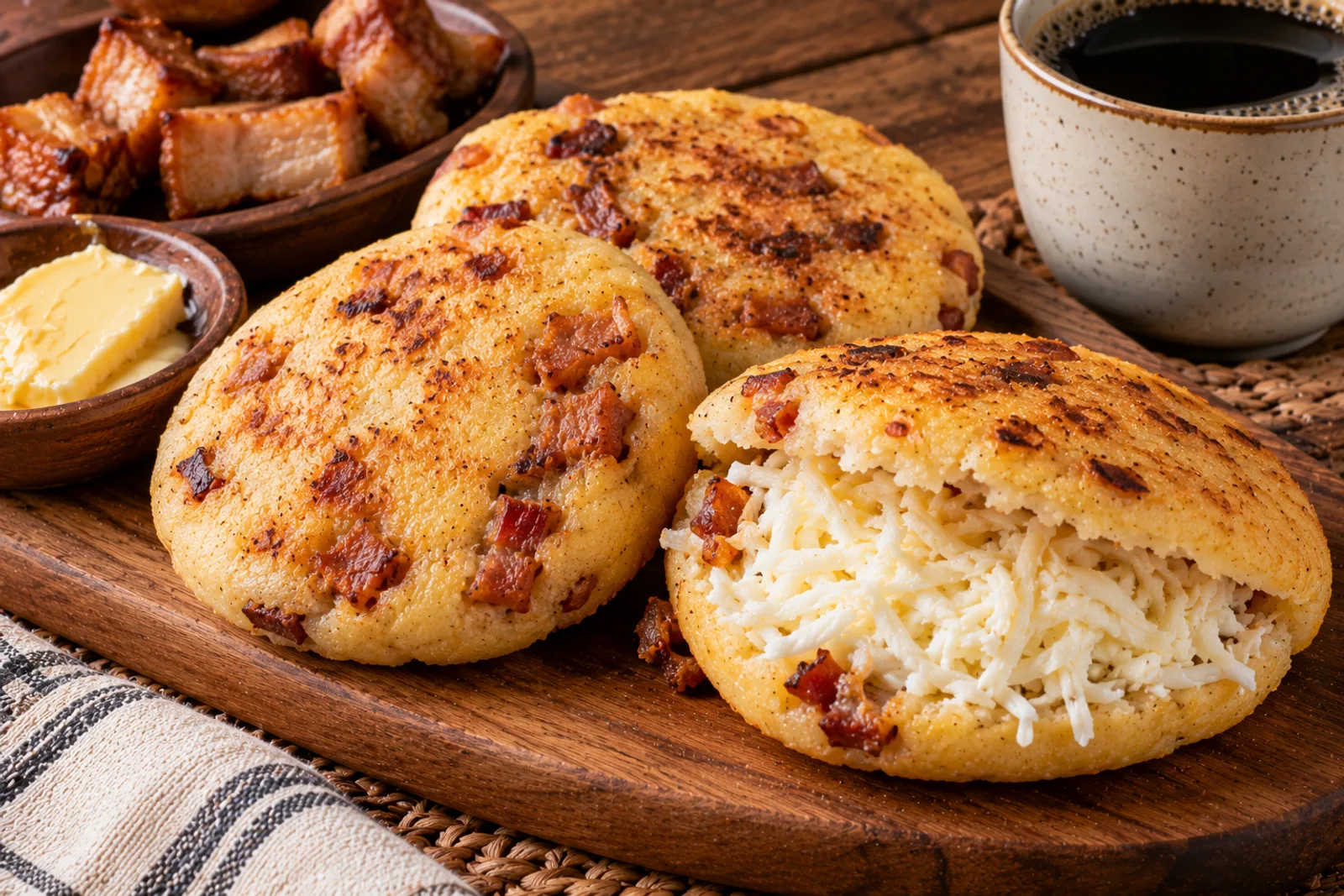

In Venezuela, an arepa (ah-REH-pah) is the everyday corn cake you split and stuff, and the chicharrón (chee-chah-RRON) version has crisp fried pork skin chopped right into the dough. Every bite has small, soft, salty bits of pork, and the fat they release on the griddle turns the crust a deeper gold than a plain arepa. It’s eaten all over the country and is especially popular in the east. The method is my Venezuelan griddle-and-oven arepas with two changes: almost no salt, and the pork chopped small.
What chicharron arepas are, and how long they take
How do you make Venezuelan chicharron arepas? Chop 7 oz (200 g) of pork crackling smaller than ¼ inch (5 mm) and knead it into 500 g (3½ cups) of pre-cooked corn flour and 650 ml (2¾ cups) of warm water, with ½ tsp of salt or none if you use bagged pork rinds. Rest the dough 10 minutes, shape 10 discs ⅝ inch (1.5 cm) thick, sear 5 minutes a side and bake 15 minutes at 350°F (180°C). 70 minutes for 10 servings.
The crackling is inside the dough, not a filling. That means the arepa already tastes of something with nothing but butter, and a little fresh white cheese turns it into a full breakfast. The clock says 70 minutes, about 45 of them hands-on, because a 10-inch pan holds four at a time and you’ll cook three batches. It’s easy, as long as you watch the salt and the size of the pork bits.
The flour matters as much here as in any arepa. It has to be pre-cooked corn flour: P.A.N., Goya Masarepa or Juana, in the Latin aisle of most US supermarkets and online in the UK. Masa harina for tortillas and plain cornmeal won’t hold together.
Which pork crackling to buy in the US or UK
Any pork crackling that is already fried and crisp works. They differ in salt and fat, and the salt in the dough follows from that.
- Venezuelan chicharrón de cochino. Fried pork skin with its layer of fat and sometimes a little meat. The chicharrón volao is just the thin, puffed skin. Use the crisp parts and set aside any hard meat.
- Homemade pork belly crackling. Skin-on pork belly fried in its own fat, like Colombian chicharrón, pork belly boiled then fried in its own fat. It carries more meat and more fat. Made a day ahead, it keeps 3 to 4 days in a sealed container in the fridge.
- Plain bagged pork rinds (US). In the chip aisle, or labelled chicharrones in the Latin aisle. Cracklins, the meatier Southern kind with fat attached, work too. Rinds are the saltiest and driest option, so the dough gets no salt. Avoid barbecue or hot flavors.
- Pork scratchings (UK). Much harder than rinds. Chop them very fine, and leave the salt out.
- Bacon. Last resort. Crisp, crumbled bacon works, but the arepa tastes smoky and stops being a chicharrón arepa.
Don’t confuse them with wheat “chicharrones”. The pinwheel-shaped chicharrones de harina (duros) sold in Mexican shops are fried wheat flour, not pork. They contain gluten and turn to cardboard in the dough.
How much crackling per cup of flour
I use about 2 oz (57 g) of crackling per cup of flour, which is 7 oz (200 g) for a 500 g half-bag of P.A.N. At that ratio you taste pork in every bite and a 4-inch (10 cm) disc still flattens without splitting. Weigh it if you can: a cup of puffy rinds weighs far less than a cup of meaty crackling.
At 1¼ oz (35 g) per cup the pork shows up only now and then. At 3½ oz (100 g) per cup, which some cooks use for tiny arepitas, there’s more pork than corn in places, and I only make two-tablespoon party bites at that ratio, because a full-size disc breaks apart along the pieces.
The salt rule
Bagged pork rinds are so salty that 7 oz (200 g) carry nearly as much salt as the 2 teaspoons in a plain arepa recipe. So I always taste a piece first. If it is very salty, no salt in the dough. If it tastes of fried pork and not much else, ½ tsp.
The water stays the same as for plain arepas: 2¾ cups (650 ml) at about 104°F (40°C) for 500 g of flour, with 3 or 4 tablespoons held back. Dry rinds soak up some moisture as the dough rests, which is why it rests 10 minutes instead of 5 before you check it. The pork fat already softens the dough, so it gets no oil.
Equipment, and the timing plan
A griddle (in Venezuela, the round iron budare) or a heavy 10-inch (26 cm) skillet, a large knife or food processor, and the oven. A cast-iron or thick nonstick pan works fine in place of a griddle.
The pork gets chopped while the water warms, and the 10-minute rest is exactly how long the pan and oven need to heat. Each batch goes from the griddle straight into the oven, so the oven works while you sear the next one.
Make-ahead. Chop the crackling the night before and keep it sealed, in the fridge if it’s homemade. I don’t hold the dough overnight: it dries out and the pork turns soggy. You can sear the arepas the day before, refrigerate them, and bake them in the morning, 20 minutes at 350°F (180°C).
How to tell each stage is right.
- Crackling → bits the size of a lentil or smaller. Nothing as big as a fingernail.
- Dough → after 10 minutes, a flattened ball doesn’t crack at the edge and the pork doesn’t fall out when you touch it.
- Discs → 4 inches (10 cm) across, ⅝ inch (1.5 cm) thick, smooth edge, no pork poking out.
- Griddle → they sizzle more than plain arepas because of the pork fat. At 5 minutes they release on their own with toasted spots.
- Oven → at 15 minutes they are slightly puffed and sound hollow when knocked. A dull thud means 3 or 4 more minutes.
Why chicharron arepas crack, stick or taste too salty
- Too salty → salt added with bagged rinds. Taste the pork first, and with rinds, add none.
- The disc splits when you flatten it → pieces too big, or too much pork. Chop finer and stay at 2 oz (57 g) per cup for 4-inch arepas.
- Black, bitter spots on the crust → pork poking out and scorching on the griddle. Tuck it in when you shape.
- Sticks to the pan → the griddle wasn’t hot, or you flipped too soon. It releases on its own once the crust has formed.
- Hard dough after a while → it didn’t rest 10 minutes or needs water. Add it a tablespoon at a time and knead again.
- Raw in the middle → it left the oven before it sounded hollow.
No oven, frying, air fryer or a crowd
- Skillet only → medium-low heat, 8 to 10 minutes a side, with a lid for the last 5. The crust comes out thicker.
- Fried → thinner discs, ⅜ inch (1 cm), in oil at 350°F (175°C), 3 to 4 minutes a side, then drained on paper towels. They come out very crisp. If you want an arepa that puffs into a pocket for stuffing, that’s the plain Venezuelan fried arepa.
- Air fryer → brush with oil, 400°F (200°C) for 16 minutes, flipping at 8.
- Party bites → two tablespoons of dough, about 2 inches (5 cm) across, 4 to 5 minutes a side on the griddle. This is the size where you can push the pork up to 3½ oz (100 g) per cup.
- With sweet peppers → two red ají dulce peppers per cup of flour, finely chopped and sautéed, kneaded in with the pork; a Venezuelan variation with a gentle sweetness. Half a small red bell pepper is the closest supermarket swap, though it has none of the ají’s aroma.
For 20 people I count 1½ arepas per adult, so 30 arepas: 1.5 kg (3.3 lb) of flour, 600 g (1 lb 5 oz) of crackling, 1.95 liters (8¼ cups) of warm water and at most 1½ tsp of salt. One griddle means 8 batches, so I sear them the day before and bake them in the morning. A 2.2 lb (1 kg) bag of P.A.N. makes 20.
Serving, storing and reheating
Serving. Hot, wrapped in a napkin. Plain, with butter. Split, the classic is about 1 oz (30 g) of grated firm white cheese per arepa; in the US, queso fresco or Cotija are the easy swaps, and in the UK, a crumbly feta, which is saltier. Since the pork already brings salt and fat, fresh fillings suit them best: avocado, Venezuelan guasacaca avocado sauce, or Venezuelan black beans with cheese. Shredded beef makes them too heavy for me.
Fridge. No more than 2 hours at room temperature; in a sealed bag in the fridge, 3 to 4 days.
Freezer. Raw discs, separated with parchment, frozen flat on a tray and then bagged: one month. Seared and baked: also a month. They stay safe longer, but dry out.
Reheating. From the fridge, 10 to 12 minutes at 350°F (180°C); from frozen, 20 minutes, no thawing. In a skillet, sprinkle them with a few drops of water and cover for 2 to 3 minutes a side, so the steam softens the crumb again. The microwave makes the crust rubbery.
Allergens. Corn, pork, water and salt: no gluten, eggs or dairy, as long as the crackling isn’t the wheat kind and isn’t seasoned with something that contains them. The cheese brings dairy. No heat at all.
If you like the idea of pork in the dough, Colombia has its own take, the Santander arepa with cassava and pork cracklings, made from hulled corn rather than flour, thin and cooked on a clay griddle. And for a Venezuelan breakfast bread with no corn, there are the soft Andean wheat arepas.
Chicharron arepa questions
Do you grind or chop the crackling? Either. Knife-chopped under ¼ inch (5 mm), you notice the bits; coarsely pulsed in a processor, it spreads more evenly and releases a little more fat. Ground to powder, you lose the texture.
Can I stuff chicharron arepas? Yes, a ⅝-inch (1.5 cm) arepa splits along the side like any other. White cheese, avocado or black beans suit them best.
Can I use pork scratchings or cracklins? Yes. Scratchings are very hard, so chop them very fine; cracklins have more fat and meat, closer to Venezuelan chicharrón. With either, taste for salt before adding any.
Why are my chicharron arepas falling apart? The pieces are too big or there’s too much pork for the size of the disc. Chop under ¼ inch (5 mm), use about 2 oz (57 g) per cup of flour and rest the dough 10 minutes.
Nutrition per arepa
Per arepa of about 4¾ oz (135 g), unfilled, calculated with plain pork skin crackling and the ½ tsp of salt:
- Calories: 298 kcal
- Protein: 16 g
- Carbohydrates: 40 g
- Fat: 8 g, 2 g of it saturated
- Fiber: 2 g
- Sugars: 1 g
- Sodium: 483 mg
Nearly all the protein and fat come from the pork. Fattier or meatier crackling pushes the fat up.
With these arepas the salt shaker comes last. I taste a piece of the pork first, because every bag and every batch of crackling is salted differently, and decide from there. Everything else is my everyday arepa: the same warm water, the ball pressed between my palms to see whether it cracks, and the knuckle knock when they come out of the oven. Josnaisis.