
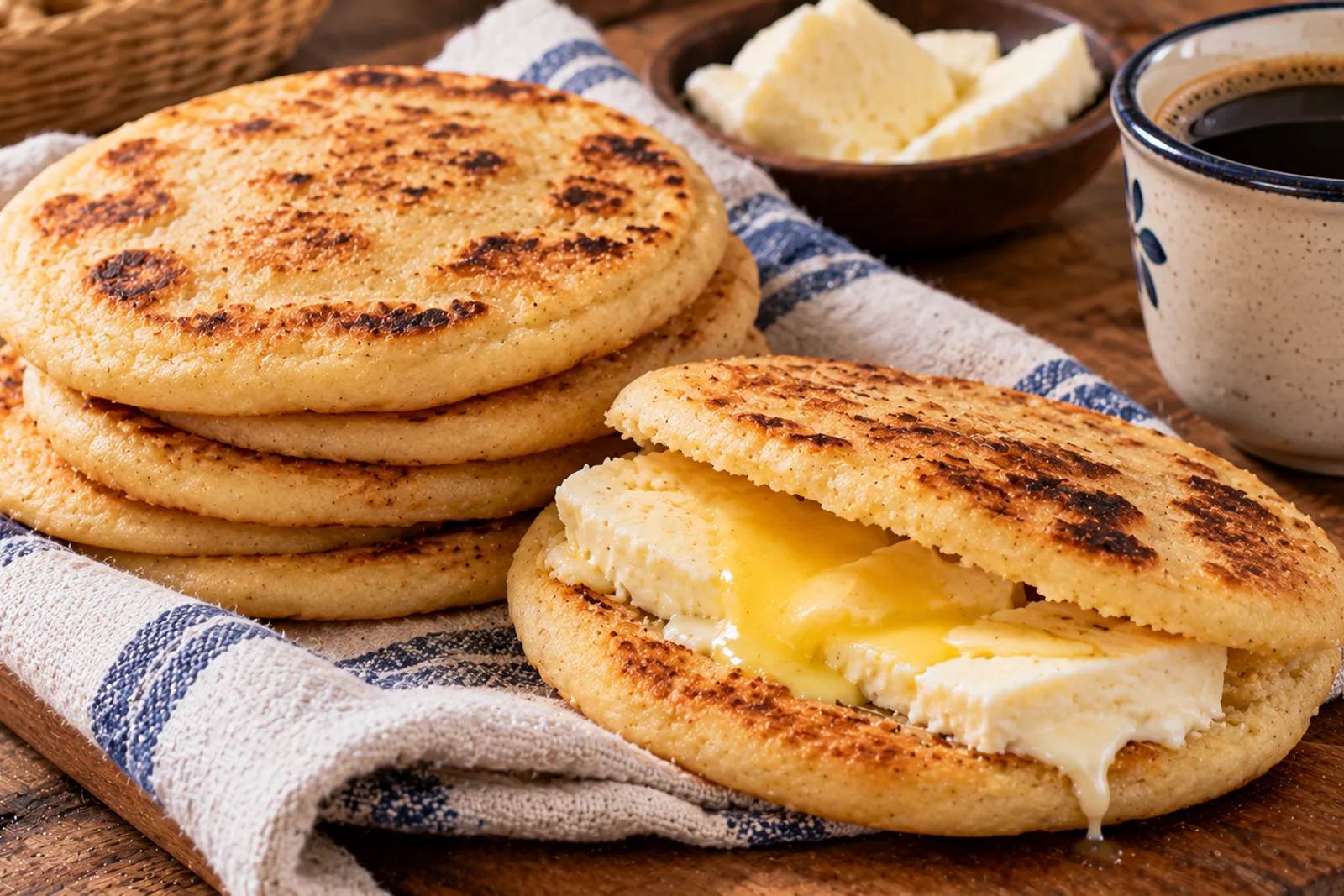

Arepas andinas (ah-REH-pahs ahn-DEE-nahs), or arepas de trigo, are the wheat-flour arepas of the Venezuelan Andes: round, soft griddle breads made with flour, milk, an egg, a little butter and sugar, and baking powder. Most people outside Venezuela know the corn arepa, the crusty white disc split open and stuffed in arepa shops. The Andean one, from the states of Mérida, Táchira and Trujillo, is a different dough. It rises on the griddle and eats more like a warm, plain bread roll, buttered and filled with smoked cheese at breakfast. If you can make pancakes, you can make these: the one thing to learn is the heat under the pan.
What Andean wheat arepas are, and how long they take
How do you make Venezuelan wheat arepas? Whisk 4 cups (500 g) of all-purpose flour with baking powder, salt and sugar, then knead in an egg, 1 cup plus 2 tbsp (270 ml) of warm milk and 2 tbsp (30 g) of butter until the dough is barely sticky. Rest it 30 minutes, roll 10 rounds of 4 in (10 cm) at ⅜ in (1 cm) thick, prick them with a fork and cook on a griddle over medium-low heat for about 5 minutes per side. 90 minutes for 10 servings.
Total time 90 minutes, but only about 20 of them hands-on. The rest is resting the dough and three batches on the griddle. Easy.
Here’s how they compare with the two flatbreads they get confused with: the Venezuelan corn arepa made with precooked cornmeal, and the Mexican homemade flour tortilla.
If you came for a cheese-filled corn arepa, Colombia’s cheese arepas are that recipe.
Ingredients and US or UK swaps
| Ingredient | Metric | US | Notes and swaps |
|---|---|---|---|
| All-purpose flour | 500 g | 4 cups | UK plain flour. Not bread flour, which makes them chewier |
| Baking powder | 6 g | 1½ tsp | Check it’s fresh (see troubleshooting) |
| Fine table salt | 6 g | 1 tsp | With kosher salt, use a little more by volume |
| Sugar | 25 g | 2 tbsp | Up to 50 g (¼ cup) for a sweeter snack version |
| Egg | 50 g | 1 large | 2 tbsp plain yogurt for egg-free |
| Whole milk, warm | 270 ml + up to 30 ml | 1 cup + 2 tbsp, + up to 2 tbsp | Or water plus 2 tbsp milk powder |
| Butter, soft | 30 g | 2 tbsp | Or 2 tbsp neutral oil |
Why the extra milk. Flours absorb different amounts of liquid, so start with 270 ml (1 cup plus 2 tbsp) and add the last 2 tbsp only if the dough cracks when you press it.
Self-rising flour (US self-rising, UK self-raising) already contains baking powder and salt. Leave out the baking powder and cut the salt to ½ tsp. They rise the same.
Baking soda instead of baking powder. Some Andean families call the leavening «bicarbonato» and add a pinch of baking soda alongside the powder. Soda needs an acid to work and fresh milk has very little, so on its own it tastes metallic and turns the crumb yellowish. Keep the baking powder and, if you like, add a pinch of soda on top.
Equipment. A large bowl, a rolling pin (or a smooth bottle) and a cast-iron griddle or a heavy 10 to 11 in (26 to 28 cm) skillet, which holds 3 at a time. A Venezuelan budare is a flat cast-iron griddle; any of these does the same job.
How to make wheat arepas, step by step
Mix, knead, rest
Whisk the dry ingredients, pour the egg and warm milk into a well, and stir until no dry flour is left. Add the butter and knead 8 to 10 minutes. The dough starts spongy and sticky and is ready when it’s smooth, soft and barely sticks to clean hands.
Cover it for 30 minutes. The gluten relaxes, so the rounds roll out without springing back. Skip the rest and they shrink back into small, thick discs.
Roll to ⅜ inch
Cut 10 pieces of about 3 oz (88 g), ball them up and roll each to 4 in (10 cm) across and ⅜ in (1 cm) thick. A rolling pin gives the most even rounds, and 5 or 6 fork pricks per round keep them level as they rise.
On the griddle
Give the griddle a good 5 minutes over medium-low, wipe it with an oiled paper towel and lay in as many rounds as fit without touching (3 in a 10 in skillet). Then leave them alone.
- First 2 to 3 minutes. They start to rise as the baking powder and steam lift the dough. Unpricked, the center would puff into a balloon.
- Around 5 minutes. The underside has golden freckles, not black ones, and releases on its own. Flip.
- Another 5 minutes. The second side browns the same way, and the pale, damp-looking edge turns firm when you squeeze it.
How to tell they’re done. The edge is firm, the center springs back when pressed and the arepa sounds hollow when you tap it. With an instant-read thermometer, the center reads 190°F (88°C). Golden outside but soft at the edge means the heat is too high: turn it down and give each side another 1 to 2 minutes.
As each batch comes off, wrap it in a clean towel. The trapped steam keeps them soft.
Troubleshooting
Allergens. Wheat (gluten), milk and egg. There is no heat at all, and kids usually like them plain.
Variations
- Egg-free. Swap the egg for 2 tbsp plain yogurt or 2 to 3 tbsp more milk. They brown a little less and are slightly denser.
- Half whole wheat. Replace 250 g (2 cups) of the flour with whole wheat and expect to use the extra 2 tbsp of milk. Denser, with a toasty wheat flavor.
- Sweeter, for an afternoon snack. Up to 50 g (¼ cup) sugar, or grated panela (unrefined cane sugar; light brown sugar is the nearest supermarket swap). More sugar browns faster, so drop the heat a notch.
- Thinner, ¼ in (5 mm). Roll 14 or 15 wider rounds for dunking in coffee. They cook faster, so flip when the underside is freckled instead of waiting the full 5 minutes.
- A double batch. Double everything, egg included, knead in two lots if your bowl is small, and run two skillets at once.
How they’re eaten in the Andes
Butter and smoked cheese. Split one open while it’s hot, spread it with about 20 g (1½ tbsp) of butter and tuck in 30 g (1 oz) of sliced cheese. In Mérida and Táchira that cheese is often queso ahumado, a pressed cow’s-milk cheese smoked over a wood fire, firm and woodsy. Outside Venezuela:
- US. Latin grocers sometimes carry a Venezuelan or Central American smoked cheese. Otherwise, smoked provolone or smoked mozzarella. Both melt more than the Andean cheese, but the smoke is there. Queso fresco covers the mild white cheese.
- UK. A firm smoked cheese from the deli counter, or smoked Cheddar. Halloumi or paneer stand in for the fresh white cheese.
With pisca. An Andean breakfast puts a wheat arepa next to a bowl of pisca andina, the milky potato and egg soup, for dunking. Add huevos pericos, scrambled eggs with tomato and scallion, and coffee or a glass of chicha andina for a full weekend spread.
Filled. Anything that goes in a corn arepa works: ham and cheese, shredded beef, scrambled eggs. They’re thinner than corn arepas, so go lighter on the filling.
Cost. The dough is pantry staples; the smoked cheese is what makes breakfast expensive, and a plain fresh cheese keeps it cheap.
Make ahead, storing and freezing
- Room temperature. Cooled completely, in a sealed bag, 1 to 2 days. They firm up a little and come back on the griddle. In a hot, humid kitchen, freeze them the same day instead.
- Not the fridge. Cold makes the crumb go stale faster than the counter does.
- Freezer. Cooled, separated with parchment and bagged, up to 3 months.
- Reheat. In a dry skillet over low heat, covered, 3 to 4 minutes per side; from frozen, a few minutes longer, until hot in the middle. Or split them and use the toaster. The microwave softens them but they toughen as they cool, so only use it if you’re eating them right away: 20 to 30 seconds wrapped in a damp paper towel.
- Making the dough the night before. I don’t. Baking powder loses some of its lift in a dough that sits, so cook the whole batch and freeze what you won’t eat.
FAQ about Venezuelan wheat arepas
Are they the same as English muffins? They’re cousins, both round breads cooked on a griddle, but English muffins are leavened with yeast and need a long rise. Wheat arepas use baking powder, so they’re ready in 90 minutes, and they’re slightly sweet from the sugar and milk.
Can I bake them instead? Yes, at 350°F (180°C) on a greased sheet, flipping them once the underside is golden and taking them out when they sound hollow. The tops stay paler and you lose the griddle freckles.
Are wheat arepas gluten-free? No. Corn arepas made with precooked cornmeal are naturally gluten-free; these are made with wheat flour.
Nutrition per arepa
Per arepa (1 of 10), unfilled, worked out ingredient by ingredient from the recipe amounts:
- Calories: 242 kcal
- Protein: 7 g
- Carbohydrates: 42 g
- Fat: 5 g, of which 2 g saturated
- Fiber: 1 g
- Sugars: 4 g
- Sodium: 335 mg
The flour accounts for about three quarters of the calories. A buttered arepa with a slice of smoked cheese (1½ tbsp butter, 1 oz cheese) comes to roughly 490 kcal.
With wheat arepas, what matters most is leaving the burner at medium-low and not touching it, even when it feels slow: turning it up only gives you a brown outside and a raw middle. I always make all ten, because the extras go straight into the freezer, and on a school morning one comes back to life in the skillet while the coffee brews. Josnaisis.