
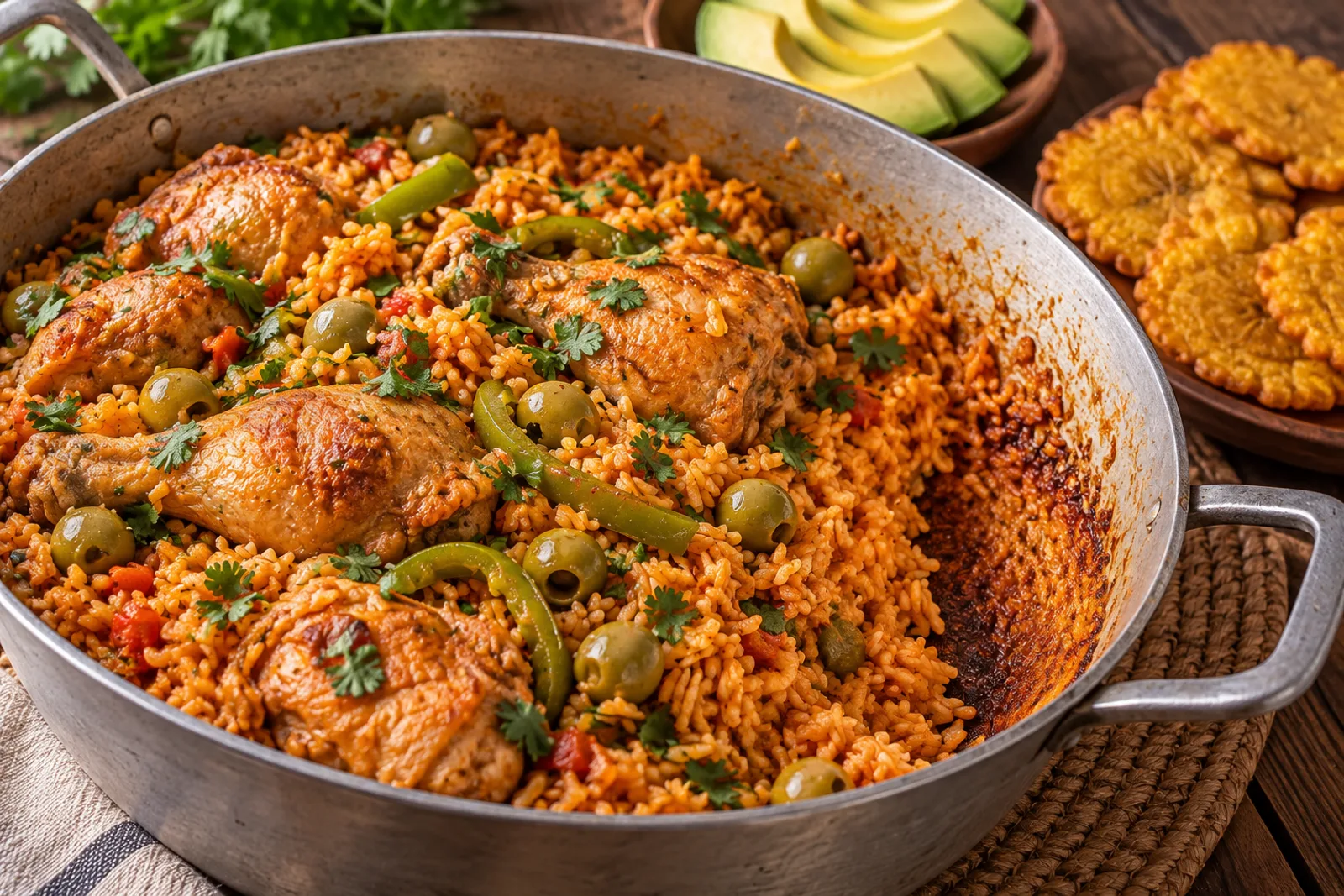

Locrio de pollo (loh-KREE-oh deh POH-yoh) is how the Dominican Republic does chicken and rice: bone-in pieces browned in sugar caramelized in the oil, braised with a sofrito of onion, cubanelle pepper and celery, then cooked in the same heavy pot with tomato paste and long-grain rice until the rice is dry and fluffy and a crust forms on the bottom. That crust is the concón, and plenty of Dominican cooks will tell you it’s the best part. The sugar doesn’t make the dish sweet. It’s there for color, a deep reddish-brown on the chicken and the rice. This recipe serves 6 and covers the water ratio for different rices, how to get the crust without burning it, and what to buy in a US or UK supermarket.
What locrio is, and how long it takes
How do you make Dominican locrio de pollo? Marinate 3⅓ lb (1.5 kg) of bone-in chicken with garlic, oregano and lime, brown it in caramelized sugar, braise it 13 minutes with sofrito and stir in tomato paste. Add 2½ cups (600 ml) of hot salted water and, once boiling, 2 cups (370 g) of rinsed long-grain rice. Cook uncovered until the liquid drops below the rice, cover on the lowest heat for 15 minutes, fold and finish for 5 to 8 minutes. 100 minutes for 6 servings.
In Dominican kitchens, locrio means any rice cooked in the pot together with a meat and colored with tomato or annatto. Chicken is the everyday one. Total time 100 minutes: 35 to marinate and chop, which overlap, and 65 at the stove, about 35 of them with the lid on. Medium difficulty, only because the caramel and the water level need your attention the first time.
If you know other Latin chicken and rice dishes, this one sits apart:
- Colombian arroz con pollo uses cooked, shredded breast with hogao and vegetables and stays moister.
- Moro de guandules uses the same pot method and gets the same crust, but with pigeon peas instead of meat, and it’s a side dish.
- Puerto Rican asopao is soupy and eaten with a spoon. Puerto Rico’s arroz con gandules has its own crust, called pegao.
Ingredients and US and UK swaps
| Ingredient | Amount | US | UK |
|---|---|---|---|
| Bone-in chicken thighs and drumsticks | 1.5 kg / 3⅓ lb | Any supermarket; remove the skin | Any supermarket |
| Long-grain white rice | 2 cups / 370 g | Plain long-grain | Long grain rice, not easy-cook |
| Cubanelle pepper | 1 (60 g / 2 oz) | Most produce sections | ½ green bell pepper |
| Dominican oregano | 1 tsp | Latin grocers | Mexican oregano online, or regular |
| Tomato paste | 2 tbsp / 32 g | Tomato paste | Tomato purée (tube or can) |
| Green olives and capers | 10 olives, 1 tbsp | Jarred | Jarred |
That’s about 250 g (9 oz) of bone-in chicken per person.
Notes on the seasoning
- Dominican oregano is a different plant from Mediterranean oregano, with a stronger aroma. Mexican oregano is the closest swap; with regular dried oregano, use a little more and taste the cooking liquid.
- Cubanelle is a long, pale green, mild pepper. A green bell pepper works, with a slightly more bitter edge.
- Sazón packets and bouillon. Many Dominican cooks add a packet of annatto sazón or half a chicken bouillon cube to the water. If you do, cut the salt for the water to ¼ tsp and taste before the rice goes in.
- Tomato sauce instead of paste. ¼ cup works; the rice comes out lighter, and you should take 2 tablespoons off the water.
- Thighs and drumsticks, not breast. The chicken spends over 50 minutes in the pot. Breast dries out; if you use it, cut it into 4 bone-in pieces, brown it with the rest, set it aside during the braise and put it back in with the rice.
Rice and water
The recipe is built on plain long-grain white rice, rinsed until the water runs almost clear. The 2½ cups (600 ml) of water join the 4 or so tablespoons of thick sauce left from the braise, a bit under 2¾ cups of liquid in all for 2 cups of rice.
Parboiled (converted or easy-cook) rice absorbs more and stays firmer: start with 3 cups (720 ml) and check when you fold. Medium-grain absorbs less and turns soft, so use about 2¼ cups (540 ml). Short-grain, arborio or paella rice releases starch and makes it gluey, and brown rice takes so long that the chicken falls apart before the grains are tender.
Equipment. A Dominican caldero (cast aluminum) or any heavy-bottomed pot or Dutch oven, 5 to 6 liters (5 to 6 quarts), with a tight lid. A smaller pot burns the bottom before the top is cooked. If the lid is loose, lay a sheet of foil under it. Nonstick works for the rice but gives you almost no crust.
How to make locrio de pollo
Marinate, then dry the chicken
Garlic, oregano, salt, pepper and lime, 30 minutes in the fridge, or overnight. Let the pieces drip well before browning: wet chicken cools the caramel and steams instead of coloring.
Caramelize the sugar
This is where the color comes from. Give the sugar 1 to 2 minutes in the hot oil, unstirred. It melts, foams, turns golden and then dark mahogany, and that’s the moment to add the chicken. A wisp of smoke is normal. If it goes black and smells acrid, it will make the whole pot bitter: wipe it out and start over, you’ve only lost 2 teaspoons of sugar.
Add the pieces one at a time, holding the lid as a shield, because it spatters. They need 6 to 8 minutes of turning to go reddish-brown all over. Without sugar the chicken still browns, just paler, and so does the rice.
Braise and build the liquid
Sofrito vegetables 3 minutes, then the marinade liquid and ½ cup (120 ml) of water, 13 minutes covered over medium-low. Then the tomato paste, olives and capers, 3 minutes uncovered, until what’s left in the pot is a thick sauce rather than broth. Getting it that far is what makes the water measurement work.
Once the hot water boils, taste it. It should be slightly saltier than you’d like the rice, because the grains absorb the salt.
Uncovered until the rice shows
With the rice in, leave the lid off for 8 to 10 minutes over medium heat. Every couple of minutes, stir gently and loosen the bottom. Keep the chicken nestled in the rice, not lying flat on the bottom. Cover when the liquid has dropped below the surface and you can see small steam holes. Cover too early and it’s soggy; wait until it’s bone dry and it scorches.
Covered, then done
Move the chicken to the top, cover, and turn the heat to the lowest setting that still makes steam: the lid should feel hot. Then leave it alone for 15 minutes without peeking. After that, drizzle the last tablespoon of oil, fold the rice from the edges toward the middle without scraping the bottom, and cover for 5 to 8 minutes more.
It’s done when grains from the top and bottom are tender but whole, with no chalky center, and the chicken reads 165°F (74°C) next to the bone. Without a thermometer, the juices run clear and the meat pulls away from the bone. Rice still hard in a dry pot? Sprinkle 2 or 3 tablespoons of hot water over it. Cover for 5 more minutes.
Concón, the crispy bottom
Concón is the layer of toasted rice stuck to the bottom of the pot. It forms on its own during the covered stages, the 15 minutes without lifting the lid plus the final 5 to 8, when four things line up:
- A heavy pot. Cast aluminum or cast iron.
- The right amount of water. Too much and it never toasts; too little and it burns before the rice is cooked.
- No scraping once the lid goes on. When you fold, move the rice over that layer.
- The lowest heat that still steams, plus the final tablespoon of oil, which is what makes it crunchy.
Locrio’s crust darkens faster than a plain rice crust, because the caramel and tomato paste on the bottom toast before the rice does. I go by smell: toasty is right; if it smells burnt, leave the bottom alone and serve only the rice above it.
When the rice is done, empty it into a dish right away, or the steam softens the crust. Wait 2 minutes with the pot uncovered, then lift the concón out in big pieces. For a thicker crust, give the pot 5 more minutes on the lowest heat before you empty it.
When it goes wrong
- Soggy or mushy. Too much water, unrinsed rice, or covered with liquid still on top. Uncover and leave 5 minutes on the lowest heat.
- Hard rice, burnt bottom. Heat too high while covered, or steam escaping. Turn it down, seal with foil and use the 2 or 3 tablespoons of water.
- Bitter rice. The sugar went too far. There’s no fix; next time add the chicken at mahogany, not black.
- Pale chicken. Wet pieces or caramel that was too light.
- Broken grains. Stirred during the covered stage. Fold once, that’s all.
- Bland. The liquid wasn’t tasted before the rice. Sprinkle a little salt dissolved in 2 tablespoons of hot water over the top and fold.
Allergens and heat. Contains celery. Gluten-free unless your sazón or bouillon contains gluten, so check the label. Not spicy at all.
Variations and cooking for a crowd
- With squash. Add 1 cup (150 g) of kabocha or butternut squash in ½ in (1 cm) dice with the sofrito. It partly melts and makes the rice a little juicier.
- With soy sauce. Some Dominican cooks add 1 tbsp to the marinade for color; take ¼ tsp of salt off the water.
- Other locrios. The same method works with Dominican salami, longaniza sausage, smoked pork chops, smoked herring or shrimp. Cured meats are already salty: brown them without the sugar and taste the liquid carefully.
I don’t scale the water straight up, because a big pot loses less liquid per cup of rice. For 12: 4 cups (740 g) of rice, 6½ lb (3 kg) of chicken and 4½ cups (1.08 liters) of water, with ½ cup of hot water held back for the end, in an 8 liter (8 quart) pot. For 18 to 20: two 5 to 6 liter pots, each with 3 cups of rice, 5 lb (2.25 kg) of chicken and 3½ cups (840 ml) of water, plus ½ cup in reserve. Double the sofrito and salt too, and taste each pot’s liquid.
Make ahead. Marinate the chicken and chop the vegetables the night before. Cook the rice on the day: reheated locrio loses its crust.
Serving, storing and reheating
Serving. In a Dominican home it comes with a green or tomato salad, sliced avocado and tostones, twice-fried green plantains. Some people add stewed beans on the side and some say locrio doesn’t need them. A plate is about 1½ cups with one or two pieces of chicken. For a bigger Sunday pot, Dominican sancocho is the other classic.
Fridge. Spread it in shallow containers and refrigerate within 2 hours: it keeps 3 to 4 days. Store the concón separately.
Freezer. Flat bags, by the portion, 2 to 3 months. Thaw overnight in the fridge.
Reheating. In a covered pan over low heat with 2 or 3 tablespoons of water per 2 cups, 6 to 8 minutes, folding once, until steaming and the chicken hits 165°F (74°C). In the microwave, covered, with 1 tablespoon of water per serving, in 1-minute bursts. Crisp the concón in a dry skillet, 1 to 2 minutes per side.
Locrio de pollo FAQ
Is locrio the same as moro? No. Both cook in the pot with sofrito and tomato paste, and both have concón, but moro has beans or peas and is a side; locrio has meat and is the whole meal. Rice with both beans and meat is called moro-locrio.
Can I use boneless chicken? Yes. Add boneless thighs or breast in 1¼ in (3 cm) cubes after the caramel and braise only 5 minutes instead of 13, or they’ll dry out. You lose some of the flavor the bones give.
Why do you brown the chicken in sugar? For color. The caramelized sugar turns the chicken reddish-brown and leaves a toasty layer on the bottom that darkens the rice; the locrio doesn’t taste sweet. The key is adding the chicken when the caramel is mahogany: if it goes black, the whole pot turns bitter. Without sugar the chicken still browns, just paler.
Can I make it in a rice cooker? Yes, but there’s no crust. Brown the chicken and braise it in a skillet, move everything to the rice cooker with the rinsed rice and use the water the manual gives for 2 cups of long-grain rice, counting the sauce from the braise. Rice cookers barely evaporate, so don’t pour in the full 2½ cups without checking.
Nutrition per serving
Per serving (one-sixth of the recipe, no sides), calculated ingredient by ingredient from the recipe amounts, bones excluded:
- Calories: 536 kcal
- Protein: 42 g
- Carbohydrates: 55 g
- Fat: 15 g, of which 3 g saturated
- Fiber: 2 g
- Sugars: 3 g
- Sodium: 1000 mg
The rice brings about 225 kcal per serving and the chicken about 220. Most of the sodium comes from the salt, olives and capers; sazón or bouillon pushes it higher.
My first few locrios had a bitter bottom because I waited for the caramel to look properly dark. Now the chicken goes in as soon as the sugar turns mahogany, and I pry out the concón before anyone else reaches the pot, so Dylan gets his piece. Josnaisis.