
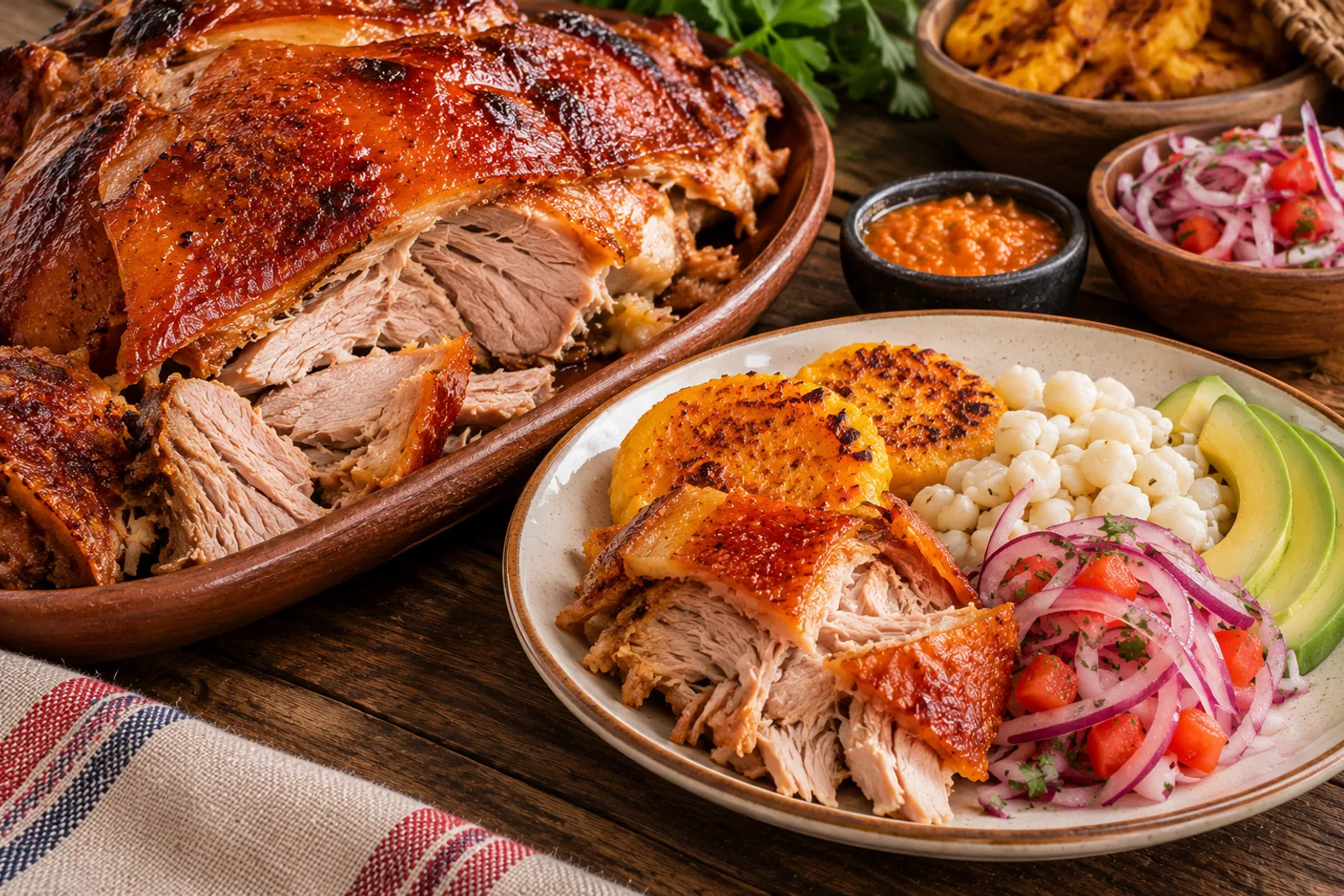

Hornado (or-NAH-doh) is Ecuador’s slow-roasted pork: meat rubbed with a garlic, cumin and annatto paste, marinated in chicha de jora (a tangy fermented corn drink) or beer, and roasted for hours until it falls into juicy chunks under a sheet of red-gold crackling. In the Andean highlands whole pigs are roasted in wood-fired ovens and sold by the plate in markets. At home, a 6½ lb (3 kg) skin-on pork shoulder does the job in a regular oven. Below: what to buy in a US or UK store, how long per pound, the temperature to pull it at, how to get the skin to crackle, and the sweet-sour agrio that goes on top.
What hornado is, and how long it takes
How do you make Ecuadorian hornado at home? Score the skin of a 6½ lb (3 kg) pork shoulder, rub the meat with a paste of garlic, cumin, annatto, salt and chicha or beer, and refrigerate it 12 to 24 hours with the skin dry and salted. Roast uncovered at 325°F (160°C) for about 4½ hours, until 190 to 195°F (88 to 90°C) inside, brush the skin with annatto lard and finish at 450°F (230°C) for 15 to 25 minutes. 1090 minutes (30 minutes of hands-on work, 12 hours of marinating, 30 minutes out of the fridge and about 5 hours of roasting and resting) for 6 servings.
Time. About 30 minutes of work the night before, then a roasting day that’s mostly waiting: roughly 5 hours of oven and rest. Medium difficulty, only because it needs planning and a meat thermometer.
In Ecuador it’s a lunch dish all year round, served on a plate with mote (big-kernel hominy), llapingachos (cheese-stuffed potato patties), avocado, fried sweet plantain and agrio, a loose sweet-and-sour salsa of tomato and onion in chicha or beer. In the Carchi style, from the far north, there’s no agrio: the pork comes with its own broth.
It isn’t the same as the other roast pork on this site. Cuban lechón asado is marinated in sour-orange mojo with oregano, Venezuelan pernil is a sweet-and-savory Christmas roast glazed with raw cane sugar, and Colombian lechona is the whole pig skin stuffed with pork and yellow peas. Hornado’s signature is the chicha, cumin and annatto, and the plate it’s served on.
What to buy, from the pork to the sides
Every quantity is in the recipe card. The pieces that matter:
| Ingredient | Metric | US | UK and swaps |
|---|---|---|---|
| Pork shoulder, bone-in, skin on | 3 kg | 6½ lb | Shoulder joint with the rind on, from a butcher |
| Chicha de jora | 500 ml + 240 ml | 2 cups + 1 cup | Pale lager |
| Ground annatto | 7 g + 2.5 g | 1 tbsp + 1 tsp | Sweet paprika for color |
| Lard | 26 g | 2 tbsp | Vegetable oil |
| Cooked mote | 600 g | 1⅓ lb | Canned white hominy |
| Panela | 12 g | 1 tbsp | Dark brown or dark muscovado sugar |
The pork, with the skin on
- Bone-in picnic shoulder, as written. It has fat running through the meat, forgives an extra half hour and pulls into chunks, which is how hornado is served. Latin supermarkets in the US often sell it with the skin on; regular supermarkets sometimes trim it, so ask the meat counter.
- Fresh ham (uncured pork leg), often sold as a half, shank end or butt end. It’s the cut most Ecuadorian home recipes use: leaner and neater to slice, but it dries out if you take it as far as the shoulder. Pull it at 176 to 185°F (80 to 85°C).
- Boneless Boston butt. Juicy and easy, but no skin means no crackling, which is half the point.
I plan on about 1 lb (500 g) of raw bone-in, skin-on pork per person. That sounds generous, but each pound gives only about 6¾ oz of cooked meat once the bone, skin and water are gone (420 g per kg), and there’s usually a little left for a sandwich.
Chicha, annatto and the swaps that work
Chicha de jora is a lightly sour, fermented corn drink. Bottled Peruvian chicha de jora is the easiest to find outside Ecuador, in Latin grocers in the US and online in the UK. A pale lager is the common stand-in, Ecuador included: a little more bitter, less fruity. To skip alcohol, use 300 ml (1¼ cups) orange juice plus 100 ml (scant ½ cup) stock for marinating and 100 ml orange juice in the paste. It comes out sweeter, without the fermented tang. Regular beer contains gluten, so for a gluten-free roast use the juice version or a gluten-free beer.
Ground annatto (achiote) gives the orange color and a mild, earthy flavor. US: the Hispanic aisle. UK: Latin shops and online. Sweet paprika matches the color but tastes of peppers; Yucatán achiote paste in a block has vinegar and spices, so it’s a different flavor.
Hominy for the mote
Mote is big white corn kernels, hulled and cooked. Canned white hominy is the closest swap and needs only draining and warming; its kernels are a little softer. Latin supermarkets in the US also carry frozen Ecuadorian mote. In the UK, look for canned hominy or Mexican pozole corn online or in Mexican shops. Dried mote needs an overnight soak and hours of simmering, so follow the package.
Equipment. A deep roasting pan about 14 × 10 in (35 × 25 cm) with ¾ in (2 cm) of room around the pork, a very sharp knife or a clean box cutter for the skin, a blender, and an instant-read thermometer, the one thing with no substitute. No blender? Pound the garlic with the salt and cumin in a mortar, then stir in the liquids.
The plan, from the night before to the table
- The night before, 30 minutes. Score, blend, rub, salt the skin and leave the pork uncovered in the fridge. Up to 24 hours the flavor keeps improving; after that, barely.
- Roasting day. For lunch around 2:15 p.m., the pork comes out of the fridge at 8:30 a.m. and goes in at 9. From noon, check every 30 minutes. If it’s done around 1:30, the skin goes until 1:50, then it rests 20 minutes. Make the agrio early so it gets its hour in the fridge.
Roasting hornado, step by step
Keeping the skin dry
The paste goes only on the meat and into the cuts on the skinless side. Score the skin through the skin and fat but not into the meat; if you cut the meat, juices bubble up through the slits and the skin stays wet. Pour the marinade around the pork, never over it. The next morning the skin should look dry and taut, like cardboard. That’s what makes the crackling.
Minutes per pound, and when to pull it
At 325°F (160°C), allow about 35 to 40 minutes per pound (80 to 90 minutes per kg): 4 to 4½ hours for 6½ lb. Ovens and cuts vary, so start checking at 3 hours, then every 30 minutes, in the thickest part and away from the bone. A fresh ham usually gets there sooner.
Keep ½ in (1 cm) of liquid in the pan the whole time; if it dries out, the garlic scorches and the juices turn bitter. The raw marinade goes into the pan at the start and simmers for hours under the meat, which is why the strained juices are safe to serve. Never serve the marinade raw.
Pork is safe at 145°F (63°C) with a 3-minute rest, but shoulder is still tough there: its connective tissue needs more time and heat to soften. That’s why it comes out at 190 to 195°F (88 to 90°C), when a fork pulls it into chunks, while fresh ham comes out at 176 to 185°F (80 to 85°C) for tender slices.
Crackling, and the rescue if it won’t puff
Dry, salted skin plus annatto lard and 15 to 25 minutes at 450°F (230°C) puffs into reddish blisters that sound hollow when tapped with a spoon. Pull it as soon as it’s there; a couple of minutes more and the edges blacken.
If smooth, leathery patches remain after 25 minutes, lift the whole skin off, lay it fat side down on a parchment-lined sheet and roast it alone at 450°F (230°C) for 10 to 15 minutes, checking every 5. The broiler works too: 3 to 5 minutes, about 4 in (10 cm) from the element, and don’t walk away, because it spits and burns fast. Keep the meat loosely tented with foil meanwhile.
Agrio and the pan juices
Agrio means sour, but it tastes sweet and sour: tomato and onion sitting in chicha or beer with lime, a little panela and cilantro. Give it at least 1 hour in the fridge so the onion softens; it’s fine the next day. Every family makes it sweeter or sharper, so taste and adjust the sugar and lime.
The pan juices, strained and skimmed, go hot over the pork and the hominy. They’re the most hornado-tasting thing on the plate.
What goes wrong, and allergens
- Leathery skin. It got wet from the marinade or basting, wasn’t dried overnight, or was covered while resting. Rescue: skin on its own at 450°F (230°C).
- Tough meat that’s cooked through. Pulled at 160 to 165°F (71 to 74°C). Safe, but not tender yet: back in until 190°F (88°C).
- Dry meat. A fresh ham taken to 195°F (90°C), or a dry pan. Pull ham at 176 to 185°F (80 to 85°C).
- Bitter juices. The pan bottom burned. Keep that ½ in (1 cm) of liquid topped up with hot water.
- Bland inside. Less than 12 hours of marinating, or no cuts on the skinless side.
Allergens and kids. No dairy, egg or nuts. Beer contains gluten; check the label on chicha. Not spicy: the chile in the agrio is optional. Kids usually love the pork with hominy and juices. The agrio is never cooked, so with chicha or beer it keeps its alcohol: make a small batch with orange juice for children.
Scaling up and other versions
- For 12. Two 6½ lb (3 kg) shoulders in two pans, swapping shelves halfway, or a 13 lb (6 kg) whole fresh ham. Double the paste and check each piece on its own.
- For 20. A 20 to 22 lb (9 to 10 kg) whole fresh ham, if your oven takes it, with 3.3 times the paste and 2 days of marinating. Expect 7 to 8 hours and start checking at 6.
- Short on time. A minimum of 6 hours in the fridge. The outside tastes of the paste, the center less so, and the skin still needs a few hours uncovered.
- Skinless. A 5½ lb (2.5 kg) boneless shoulder, same recipe without the lard or the 450°F blast; start checking at 3 hours.
- Carchi style. No agrio: use 500 ml (2 cups) water in the pan instead of 250 ml and serve the skimmed juices in a bowl on the side, like a broth.
Serving, leftovers and reheating
On the plate: chunks of pork, a piece of crackling, hominy with juices, agrio on top and, nearly always, Ecuadorian llapingachos, potato patties stuffed with melting cheese. Avocado, lettuce and fried ripe plantain finish it. Allow 3½ oz (100 g) of hominy and 2 llapingachos per person. For a sharper, drier relish alongside, the red onion and lime curtido on encebollado, Ecuador’s fish soup takes 15 minutes. Leftover pork, chopped and browned in a skillet, is also a good filling for a bolón de verde instead of the usual pork crackling.
Sandwich. Ecuadorian sánduche de hornado: a crusty roll, hot pork with its juices, chopped crackling and a little drained agrio.
Fridge. 3 to 4 days in shallow covered containers with some juices, refrigerated within 2 hours. Keep the crackling separate and uncovered or it softens overnight. Agrio, 2 days.
Freezer. 2 to 3 months, meat in chunks bagged with its juices. Thaw overnight in the fridge. Crackling doesn’t freeze well.
Reheating. Covered, with 3 or 4 tbsp of juices or water, in a 325°F (160°C) oven or a skillet over medium heat, to 165°F (74°C) in the center. Crackling re-crisps in about 10 minutes at 400°F (200°C), uncovered. The microwave is fine for the meat, not the skin.
Hornado FAQ
What’s the best cut for hornado? Bone-in, skin-on shoulder for a juicy, forgiving roast that pulls into chunks; fresh ham if you prefer slices. Either way, the skin has to be on for crackling.
Can I marinate it for 48 hours? For a 6½ lb shoulder there’s little gain past 24 hours. A whole 20 lb leg is different: give it 2 days.
Can I make it in a slow cooker? The meat will be tender, but the skin will be soft and pale, and there’s no crackling without dry oven heat. If you try it, crisp the skin separately at 450°F (230°C) as in the rescue above.
Should I cover it with foil? Covered, the meat steams and the skin goes soft. If one patch of skin darkens too early, cover only that spot loosely with a scrap of foil and remove it for the final blast.
Hornado nutrition
Per serving (6 oz / 170 g roast shoulder with its fat, no skin or bone, 3½ oz / 100 g hominy, plus a sixth of the agrio and the annatto lard), calculated ingredient by ingredient from the recipe quantities:
- Calories: 664 kcal
- Protein: 42 g
- Carbohydrates: 25 g
- Fat: 42 g, of which 15 g saturated
- Fiber: 4 g
- Sugars: 6 g
The pork accounts for about 496 kcal, the hominy 72 and the agrio around 45. Each llapingacho adds roughly 150 kcal, and the crackling a good deal more. I don’t give a sodium figure, since it depends on how much of the salt in the paste stays on the meat and how much ends up in the pan.
My own Christmas pork is the sweet Venezuelan kind, so what I like about hornado is that the meat has no sugar at all: the sweetness comes from the agrio, and everyone spoons on as much as they want. The one step I never skip is the night with the skin uncovered in the fridge, because that decides whether the crackling shatters or bends. Josnaisis.