
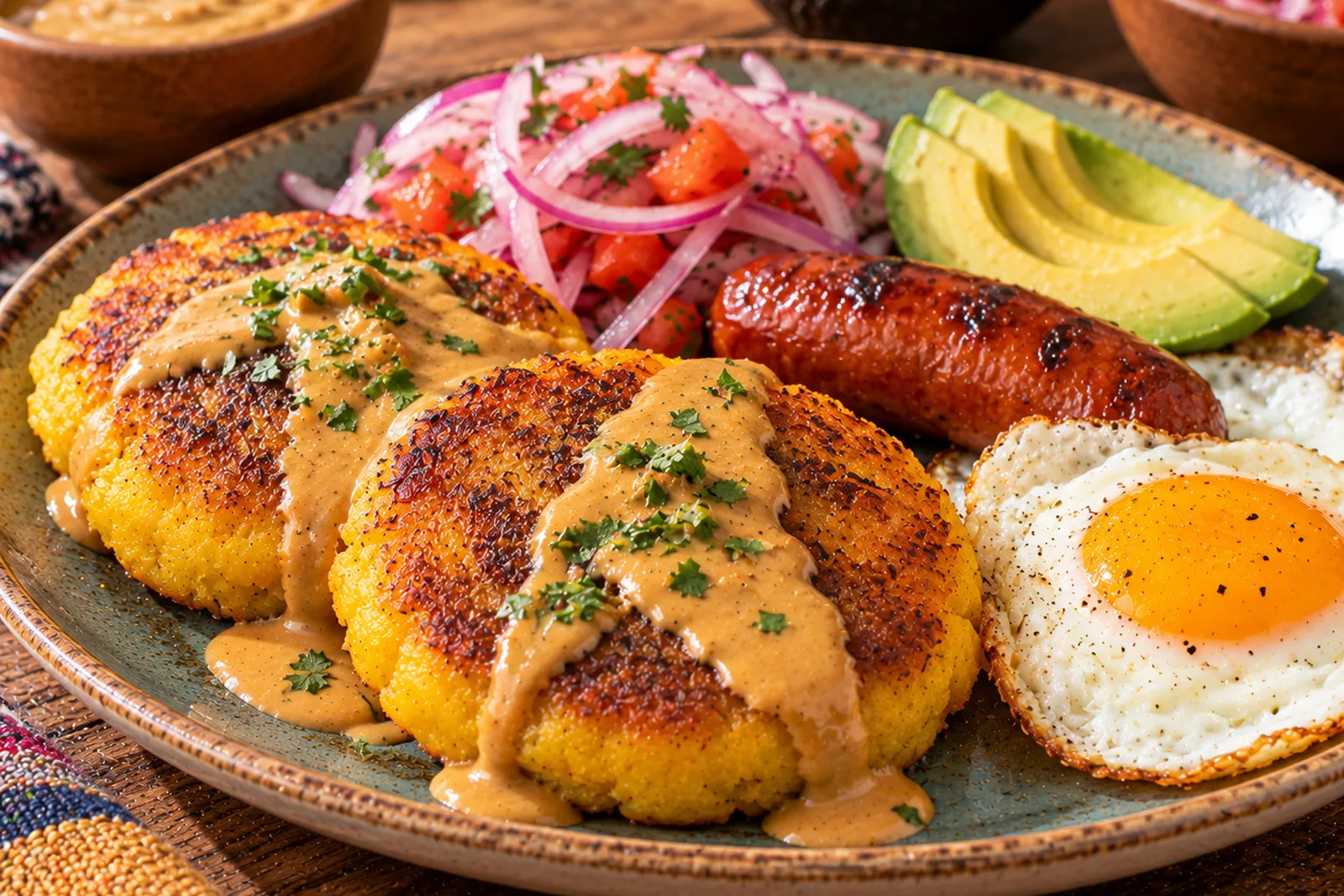

Llapingachos are thick potato patties from the Ecuadorian highlands: floury mashed potato stained orange with achiote-cooked onion, wrapped around a nugget of cheese and griddled with barely any oil until a crust forms. They come three to a plate with sausage, a fried egg, avocado, a tangy tomato and onion relish called curtido and, very often, a mild peanut sauce. The method below makes 12, and the part that matters most is how to buy, dry and chill the potato so the patties hold together.
What llapingachos are and what to expect
How do you make llapingachos? Boil 1 kg (2.2 lb) of peeled floury potatoes, dry them in the pot and mash them hot with onion cooked in oil with achiote and cumin. Cool the dough 30 minutes, shape 12 discs around 150 g (5 oz) of grated mozzarella, chill them 30 minutes and griddle over medium heat 4 to 5 minutes on the first side and 3 to 4 on the second, flipping once. 130 minutes for 4 servings.
Think of a potato cake with no egg, no flour and no breadcrumbs. The starch in a floury potato is the only thing holding it together, so the potato you buy and the cooling time decide how neat the patties turn out. When it works, the outside is golden and lightly crisp, the inside soft and savory with a hint of cumin, and the cheese melts into a small pool in the middle. There is no chili in them.
If you already know Mexican potato patties, those use egg and breadcrumbs in the dough and shallow-fry in more oil. Colombian papas rellenas are deep-fried, battered balls with a meat filling. Llapingachos are plainer and gentler, a griddle dish rather than a fried one.
Time and effort. 130 minutes on the clock, about 70 of them hands-on; the rest is boiling and chilling. Medium difficulty: shaping takes a light touch and the griddle takes patience.
Ingredients and US and UK swaps
The quantities make 12 patties about 7 cm (2¾ in) across, three per person. Allow roughly 300 g (10½ oz) unpeeled potato per person if you scale up.
The potato has to be floury
In Ecuador cooks use papa chola (or superchola), a floury variety that mashes into a firm dough. Outside Ecuador you want the same thing, high starch and low moisture:
- US. Russet (Idaho) potatoes, the baking kind. Yukon Gold has less starch, so the dough is softer and the patties need more care when you flip them.
- UK. Maris Piper or King Edward.
- Avoid waxy potatoes: red-skinned, fingerling, new or “salad” potatoes. They make a gluey dough that splits on the griddle.
A cheese that melts without weeping
Ecuadorian quesillo is a fresh cheese that melts. The supermarket stand-ins are low-moisture mozzarella sold as a block for grating (not fresh mozzarella balls, which leak whey and burst the patty) or Monterey Jack. Crumbled queso fresco, used in many Ecuadorian recipes, tastes more of fresh milk but softens without stretching; half and half is a good compromise.
Achiote, and what to use without it
Ground achiote, sold as annatto powder in the Latin aisle of US supermarkets and online in the UK, gives the orange color and a mild, earthy flavor. If you have manteca de color (lard tinted with achiote), use it instead of the oil and achiote in the onion base. Without achiote, ¾ teaspoon sweet paprika gives similar color, though it tastes of pepper rather than annatto. Skip Yucatecan achiote paste: it contains vinegar and spices and changes the dish.
Equipment. A potato masher or ricer, a tray that fits in your fridge, a wide thin spatula and a heavy griddle or 28 cm (11 in) skillet. Thin pans have hot spots that scorch one side of a patty before the rest browns.
Make-ahead plan
- The day before. Boil, mash and shape. Covered on the tray, the raw patties keep up to 24 hours in the fridge and actually get firmer. The peanut sauce can also be made ahead; it thickens when cold, so loosen it with a splash of milk as it warms.
- On the day. Make the curtido at least 15 minutes before serving; after several hours the onion goes limp. Cook the patties, sausages and eggs at the end, side by side.
How to make llapingachos step by step
Boil, then dry the potatoes
Peeled chunks soak up water as they boil, which is why they go back into the empty pot over low heat for a minute or two after draining; the boil itself takes a quarter of an hour, at most 20 minutes. They are ready when the steam stops and the edges look white and chalky. Skip this and the dough is wet and the patties split.
Make the dough
Give the onion base 5 minutes over medium heat, until it looks like this: onion soft and translucent, oil deep orange, nothing browned. Mash the potatoes while hot, when they turn smooth with no lumps, then work in the onion base until there are no pale streaks.
Once cool, the dough is right when a flattened ball doesn’t crack at the edge and doesn’t stick to your palms. Cracking means it’s dry: knead in 1 tablespoon of milk. Sticky means it’s wet: give it more time in the fridge rather than adding flour.
Shape so they don’t burst
An 80 g (2¾ oz) ball, a thumb-pressed well, 12 g of cheese, then pull the dough up from the sides until the cheese is completely covered. Flatten to about ¾ in (2 cm) and smooth the edge with a damp finger, because any crack is where the cheese escapes. Thinner patties break when flipped; thicker ones don’t get hot enough in the middle to melt the cheese. The 30 minutes in the fridge firm them up enough to survive the flip.
Griddle with little oil and one flip
Medium heat, not high: high heat burns the outside before the cheese melts. Use a thin film of oil wiped on with a paper towel. A pool of oil soaks in, softens the crust and the patty falls apart.
- First side untouched, 4 to 5 minutes. Flip when you can see browning creeping up the edge and the patty slides when nudged.
- Second side, 3 to 4 minutes. One flip only.
- Done when both sides have an even golden crust and the center feels soft when pressed, which means the cheese has melted.
The short peanut sauce
Onion and achiote softened in oil, then 6 tablespoons (100 g) natural peanut butter and ¾ cup (180 ml) milk, simmered gently for 5 to 8 minutes. It’s ready when it coats the back of a spoon and a line drawn with your finger holds. Use peanut butter with no added sugar; a sweetened one makes the sauce taste like dessert. The recipe gives about 5 tablespoons per plate.
For a more rustic sauce, blend 100 g (3½ oz) unsalted roasted peanuts with all the milk until as smooth as you can get it, then cook it the same way for a few minutes longer, stirring so it doesn’t catch.
How llapingachos are served
On each plate: 3 patties on lettuce leaves, a sausage, a fried egg, slices of avocado, a big spoonful of curtido and the peanut sauce over the top or in a bowl. The curtido is the same kind of lime-cured red onion that tops Ecuadorian encebollado, and its acidity cuts through the cheese and sausage fat.
- Sausage. The chorizo served with llapingachos in Ecuador is a fresh pork link. Use any fresh pork sausage or link chorizo, not loose Mexican chorizo, which crumbles. Cook it to 160°F (71°C) in the center.
- Egg. A runny yolk is traditional. For young children, pregnant guests or older adults, cook it until the yolk is set.
- Heat. Serve a hot sauce on the side for those who want it. A cilantro and onion sauce like Colombian ají picante works well.
- Vegetarian plate. Patties with avocado, curtido and peanut sauce, no sausage or egg.
Cost. The cheese and sausage are what make this plate pricey; the potatoes are cheap. Queso fresco instead of mozzarella and no sausage bring it down a lot.
Allergens and who it suits
A plate of 3 llapingachos contains milk (cheese, and milk in the sauce) and peanuts; egg only if you serve it alongside. There is no gluten in the recipe, but check the sausage label. Kids usually like them since nothing is spicy. If anyone has a peanut allergy, serve the patties with curtido and avocado only.
The potato is the same floury kind that thickens Colombian ajiaco, so if you’ve made that soup you already know what to look for at the store.
Storing, freezing and reheating
Fridge. Cooked patties go into a sealed container within 2 hours and last 3 to 4 days; raw shaped ones, covered, up to 24 hours. The peanut sauce, separately, also 3 to 4 days.
Freezer. Freeze them raw and shaped: on the tray without touching, then into a bag once hard. They keep good texture for about a month. Thaw overnight in the fridge on paper towels and cook like fresh. The peanut sauce doesn’t freeze well; the peanut fat separates.
Reheating. Until the center reaches 165°F (74°C): a dry skillet over medium-low heat does it in 3 to 4 minutes per side. The microwave heats them but softens the crust. Warm the sauce in a small pan over low heat with a splash of milk.
Llapingachos FAQ
Why do my potato patties fall apart? Almost always water: waxy potatoes, undried potatoes or dough shaped while warm. The second cause is moving or flipping them before a crust forms. Floury, dried potatoes, cold dough, 30 minutes of chilling and a single flip fix it.
Can I add egg or flour to hold them together? The Ecuadorian recipe doesn’t use either, and it doesn’t need them if the potato is floury and dry. Flour makes the patty pasty; drying and chilling longer works better.
Can I make them in an air fryer? They will brown, but without egg or flour these patties are fragile to flip and the crust comes out drier than on a griddle. For this dish I stick with the skillet.
Are there other kinds of llapingachos? Yes. In Ecuador they’re also made with mashed cooked yuca (cassava), which gives a stretchier texture, and with mote, a large-kernel hominy, which needs longer on the griddle.
Nutrition per serving
Per serving (three patties with a quarter of the peanut sauce and curtido, without sausage, egg or avocado), worked out ingredient by ingredient from the quantities above:
- Calories: 690 kcal
- Protein: 22 g
- Carbohydrates: 64 g
- Fat: 41 g, of which 11 g saturated
- Fiber: 6 g
- Sugars: 12 g
- Sodium: 1040 mg
A single patty is about 150 kcal; the peanut sauce adds about 210 kcal per plate. Sausage and egg add a good deal more, so on a full plate the sauce is the easiest thing to measure.
To me llapingachos are about planning more than technique: with the dough shaped the night before, the day itself is just the griddle, the eggs and the table. I always buy a floury potato and test it, and if a chunk starts falling apart in the water, it’s the right one. And on the griddle I make myself leave them alone until they release, because that’s where most of them break. Josnaisis.